Cached at:
09/19/26, 04:11 PM
# Florida Faces $1B Budget Shortfall as Orange County Moves to Halt AI Data Centers
Source: [https://centralflorida.substack.com/p/florida-1-billion-budget-shortfall-orange-county-ai-data-centers?open=false](https://centralflorida.substack.com/p/florida-1-billion-budget-shortfall-orange-county-ai-data-centers?open=false)
Florida’s financial outlook reads like a roller coaster with near\-term surpluses and a long\-term note: by 2029–30, revenue may lag spending by about $1 billion, shadowed by hurricanes, Medicaid costs, litigation, and economic uncertainty\. From Orange County’s potential pause on giant AI data centers to statewide AI education rules, the Sunshine State is testing a new balance between opportunity and oversight\. SNAP enrollment has plummeted while demand at food banks rises, and local budgets—Orlando’s $1\.9 billion spending plan and Seminole County’s revenue risks tied to Amendment 3—signal that tax\-and\-service tradeoffs are front and center\. Add a campus\-forward USF Uptown Landing project and a stadium redevelopment pause in Tampa, and you can feel the weather shift across policy, infrastructure, and community life\.
Let’s jump in\.
⏱ Estimated reading time: 13 minutes
💰**Florida’s Budget Shortfall:**Florida projects strong near\-term surpluses but a roughly $1 billion revenue shortfall by 2029–30, with hurricanes, Medicaid, litigation, and economic uncertainty posing risks\.
🤖**Orange County Data Centers:**Orange County is considering a temporary moratorium on large AI data centers while officials study impacts on water, power, noise, infrastructure, and neighborhoods\.
🥫**SNAP Enrollment:**Florida SNAP participation has fallen by about 647,000 people, including 247,000 children, amid new federal eligibility and work rules and rising food\-bank demand\.
🚔**City of****Orlando’s 2027 Budget:**Orlando is advancing a $1\.88 billion budget while officials warn Amendment 3 could reduce future revenue and constrain staffing and services\.
🚒**Seminole County & Amendment 3:**Officials estimate Amendment 3 could cut Seminole County property\-tax revenue by $119 million, affecting sheriff and fire\-rescue staffing and projects\.
🎓**Florida AI Education Rules:**Florida approved AI rules requiring parental choice and notification, human oversight, teacher training, and limits on student monitoring and AI companions\.
🏗️**USF Uptown Landing Development:**USF broke ground on a $495 million first phase of Uptown Landing, featuring housing, student beds, retail, a hotel, and research facilities\.
⚾**Rays Stadium Redevelopment Delay:**Tampa postponed redevelopment\-zone changes and a community benefits agreement tied to the Rays’ stadium project until November\.
**AND MORE…**
[](https://substackcdn.com/image/fetch/$s_!bgZ-!,f_auto,q_auto:good,fl_progressive:steep/https%3A%2F%2Fsubstack-post-media.s3.amazonaws.com%2Fpublic%2Fimages%2F469976ce-b09c-453d-b96f-235baf628d48_1536x1024.png)
Florida’s budget outlook remains positive in the near term, but a projected $1 billion general revenue deficit by 2030 is raising long\-term fiscal concerns\.
The state’s[latest Long\-Range Financial Outlook](https://edr.state.fl.us/Content/long-range-financial-outlook/3-Year-Plan_Fall-2026_2029-2030.pdf)projects general revenue surpluses of $7\.1 billion in fiscal 2027\-28 and $3\.4 billion the following year before expenditures overtake available revenue in 2029\-30\. Revenue adjustments, primarily from general revenue via trust fund transfers and tax/fee changes, are expected to reduce available funding by $440 million in 2027\-28, $855\.1 million the following year, and nearly $1\.3 billion by 2029\-30\. The state’s near\-term finances improved substantially compared to last year’s projections, where the 2025 Outlook had forecast deficits for FY2027\-28 and FY2028\-29\.
The report also identifies hurricanes, federal Medicaid funding, litigation against the state, and potential constitutional amendments as risks to Florida’s finances\. Economic uncertainty remains another concern, with inflation, reduced household savings, and increased consumer credit use potentially affecting future growth\.
The Florida Economic Estimating Conference projects the state’s GDP growth slowing to 2% this year before improving to 2\.7% in fiscal year 2027\. The state’s population is expected to surpass 24 million in 2027, which is predicted to boost economic growth\.
[](https://substackcdn.com/image/fetch/$s_!P46b!,f_auto,q_auto:good,fl_progressive:steep/https%3A%2F%2Fsubstack-post-media.s3.amazonaws.com%2Fpublic%2Fimages%2F04de3d87-dfd5-4ac4-814f-3fcdb6cdd2e4_1250x703.jpeg)Spectrum News 13
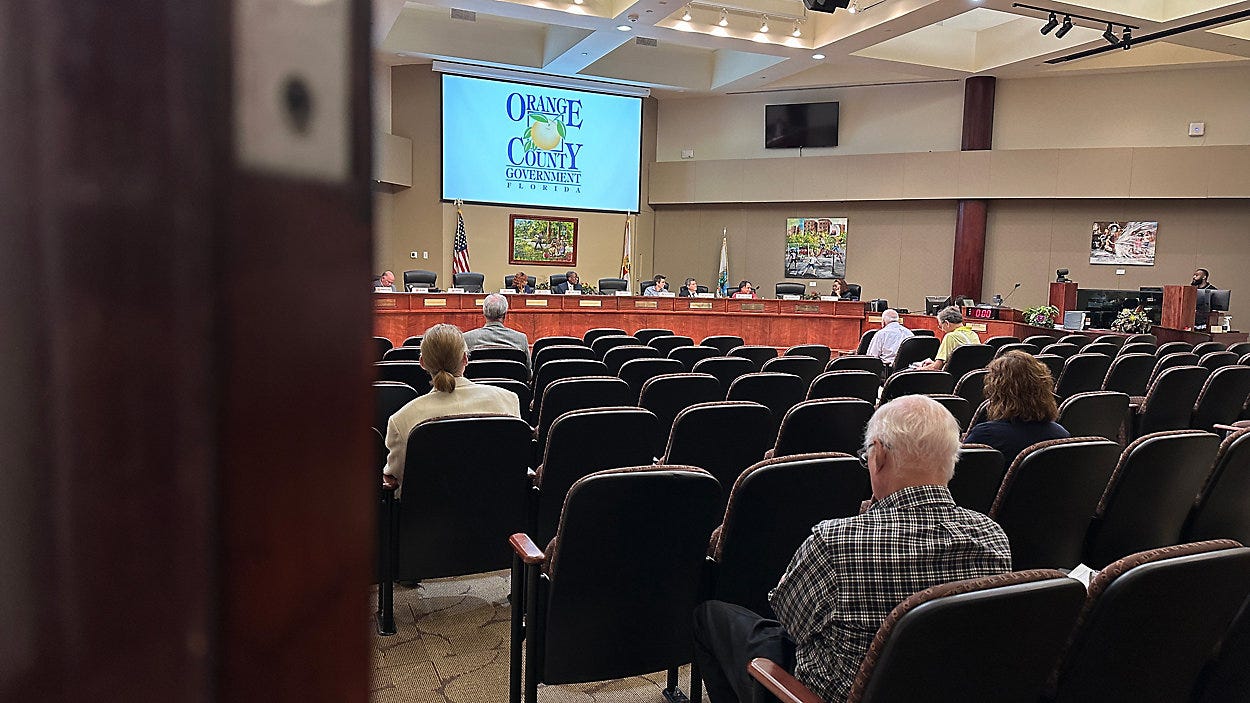
Orange County could become the latest of 16 Florida counties to temporarily halt development of large\-scale AI data centers as commissioners move toward studying a local moratorium\.
Commissioners supported further work on the proposal after District 5 Commissioner Kelly Martinez Semrad reported receiving more than 800 emails seeking restrictions before any projects were submitted\. Semrad called for a moratorium of at least one year to allow the county to revise data center approval policies and assess their potential environmental effects\. Supporters of the temporary ban cited concerns about water use, electricity demand, noise, light pollution, and potential effects on surrounding neighborhoods\. Hyperscale data centers, averaging about 250,000 square feet and exceeding 50 megawatts, can consume up to 5 million gallons of water per day, a major issue for a region facing a 96‑million‑gallon shortfall by 2045, according to the 2025 Central Florida Water Initiative \(CFWI\) Regional Water Supply Plan\. Noise levels of these facilities can also reach 100 decibels, comparable to a low\-flying helicopter\.
County staff will now examine zoning, infrastructure capacity, water resources, and other potential impacts before commissioners decide how long a moratorium should last\. Orange County commissioners could revisit the moratorium proposal in December as staff develops recommendations\. It would not apply to existing facilities or municipalities within the county\.
The debate comes after Florida enacted SB 484, which preserves local governments’ authority over comprehensive planning and land\-use regulations involving large electricity users such as data centers\. The law also establishes additional requirements involving utility costs and water permits\. Florida has about 110 data centers, but none at hyperscale capacity\.
[](https://substackcdn.com/image/fetch/$s_!7tXt!,f_auto,q_auto:good,fl_progressive:steep/https%3A%2F%2Fsubstack-post-media.s3.amazonaws.com%2Fpublic%2Fimages%2F29561ba7-664c-42c5-bf13-98ab50a8ff88_1200x675.jpeg)
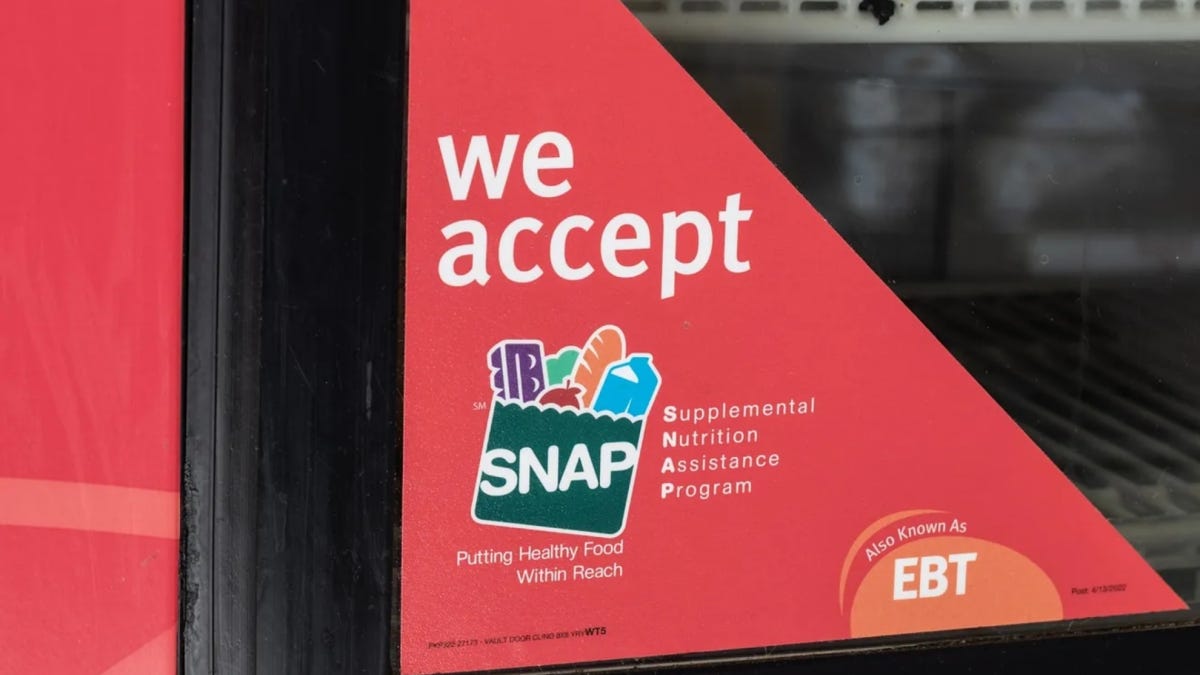
More than 247,000 Florida children have lost SNAP benefits over the past year as participation in the food assistance program has fallen sharply following changes enacted through the One Big Beautiful Bill Act, according to a[Tampa Bay Times analysis of state data](https://www.tampabay.com/news/health/2026/09/09/more-than-247000-florida-kids-have-lost-food-stamps/)\.
Florida’s Supplemental Nutrition Assistance Program \(SNAP\) participation fell by roughly 647,000 people, or 22%, bringing participation to its lowest level in nearly 17 years\. In Tampa Bay alone, more than 27,000 children have lost benefits\. The decline is due to new federal eligibility and work requirements taking effect under the One Big Beautiful Bill Act signed in July 2025\. The legislation expanded work requirements, changed eligibility rules, and shifted some SNAP costs to states\.
The reduction could extend beyond household food budgets\. Children in SNAP households are generally eligible for free school meals through direct certification, meaning fewer SNAP participants can affect the number of students identified for meal assistance\. The changes could also affect schools using the federal Community Eligibility Provision \(CEP\), which relies partly on the share of students directly certified through programs such as SNAP\.
In Orange County, Public Schools provides breakfast and lunch at no charge at participating CEP schools, limiting the immediate effect on many students\. However, changes in federal eligibility data could influence future reimbursement calculations\.
Meanwhile, food banks are reporting increased demand\. Second Harvest Food Bank of Central Florida said hunger in the region has worsened compared with last year and that its network is distributing hundreds of thousands of meals daily\. Florida charities also report that some applicants who have lost assistance are abandoning the process because of paperwork, interviews, and difficulties correcting application problems\. Additional changes are scheduled for 2027, when Florida could face greater financial responsibility for SNAP costs depending on the state’s payment\-error rate\.
[](https://substackcdn.com/image/fetch/$s_!pPCM!,f_auto,q_auto:good,fl_progressive:steep/https%3A%2F%2Fsubstack-post-media.s3.amazonaws.com%2Fpublic%2Fimages%2F45c79ba8-b22a-4152-aca3-c4b520d32ea3_1280x720.jpeg)FOX 35 Orlando
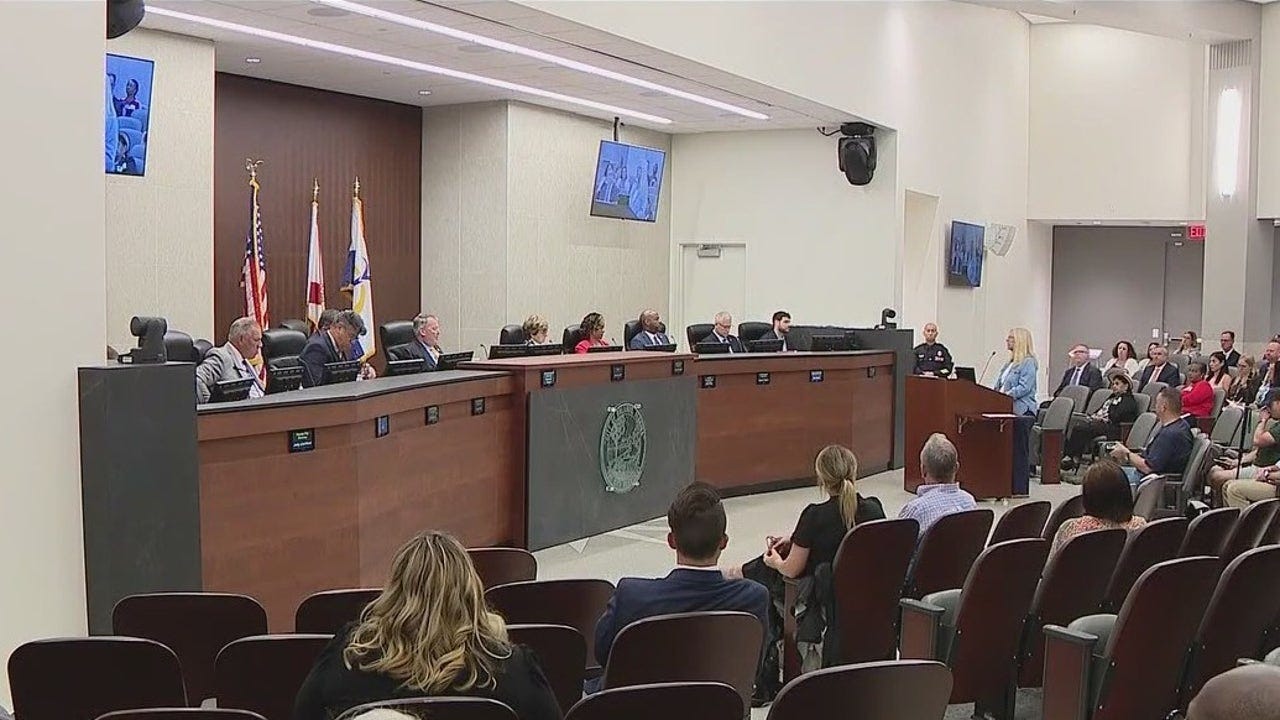
Orlando’s first reading of its 2026–27 budget opened with a stark warning: Amendment 3 could significantly weaken the city’s future revenue, Budget Division Manager Jason Wojkiewicz told commissioners\. While immediate cuts to police and fire are not expected, he said Orlando may struggle to grow staffing, leading to slower 911 response times, fewer patrols, and delays in road and park maintenance\.
Commissioners tentatively adopted an unchanged 6\.65 millage rate and a $1\.88 billion city budget for fiscal year 2027, with a second and final budget hearing scheduled for September 28\. The spending plan is about $81 million larger than the previous year and includes 44 police and fire positions, while freezing new jobs across all other city departments\. The budget allocates nearly $270 million to the Orlando Police Department and about $170 million to the Orlando Fire Department through the general fund, representing increases of 8\.6% and 7\.6%, respectively\.
The city is also creating a Budget Stabilization Fund to help cushion the impact of potential future revenue losses\. Under Amendment 3, the homestead exemption would increase to $150,000 in 2027 and $250,000 in 2028\. City estimates project that the changes could reduce revenue by roughly $30 million in the first year and $50 million the following year\. If homestead taxes were eliminated entirely, the impact could reach $80 million annually—about 10% of total general fund revenue\.
The city receives only about 35 cents of each dollar generated through Orlando property taxes\. The rest is distributed among other taxing entities, including Orange County, the school district, the library system, and the water management district, as well as the Downtown Development Board for properties within the downtown area\. Beyond police and fire staffing, officials warn that prolonged revenue reductions could result in fewer programs or reduced operating hours at parks and neighborhood centers, and less financial support for arts, cultural, and economic development groups\.
More than 60% of Orlando residents rent, meaning they would not benefit from the exemption but could face higher costs if millage rates or fees rise to make up for lost revenue\.
[](https://substackcdn.com/image/fetch/$s_!sULS!,f_auto,q_auto:good,fl_progressive:steep/https%3A%2F%2Fsubstack-post-media.s3.amazonaws.com%2Fpublic%2Fimages%2F0b41bc81-e7b9-48d7-83d4-5c29140c8987_655x468.jpeg)Joe Burbank/Orlando Sentinel
Seminole County’s sheriff and fire chief are among a growing number of local officials warning residents about the potential fiscal impact of Florida’s proposed Amendment 3, which could reduce property tax revenue by an estimated $119 million countywide if voters approve the measure in November\.
County officials said property taxes currently generate about $562 million for Seminole County, with roughly 72% supporting sheriff’s office and fire rescue services\. Sheriff Dennis Lemma said his agency could see a 20% reduction in funding, or about $41 million, potentially putting as many as 300 positions at risk\. Fire Chief Matt Kinley estimated a 23% decrease in his department, amounting to approximately $33 million\. He said the loss could delay or halt planned fire station projects and lead to staffing reductions through attrition\.
Officials warned that sustained revenue losses could slow the growth of public safety staffing, postpone equipment purchases and capital projects, and potentially increase emergency response times\. Property tax revenue collected for the school district would not be affected by the proposed amendment\.
Supporters of Amendment 3 say the measure would provide homeowners with significant and long\-awaited property tax relief\. Critics, however, argue that local governments should first look for savings in areas such as administrative overhead and travel spending rather than threatening core public safety operations\. County leaders maintain no final reductions will occur until voters decide the issue on November 3\.
Florida’s Board of Education has approved statewide rules governing artificial intelligence in public schools and colleges, putting parents at the center of decisions involving classroom AI\.
Under the new framework, school districts must notify parents when an AI instructional tool is approved and allow families to choose whether their children use it or receive a non\-AI alternative\. Schools must also ensure AI tools are viewpoint‑neutral, with prekindergarten through fifth grade subject to additional age\-appropriateness reviews\.
The rules require adult supervision of autonomous AI for students through 12th grade and prohibit AI from making decisions without human review\. Districts must also train teachers and administrators, publish approved AI tools, and prevent undisclosed student monitoring\.
AI designed to simulate friendship or emotional relationships with students is prohibited\. Florida College System institutions must establish their own AI policies and notify parents of minors using AI in their courses\. College students are generally prohibited from using AI on graded assignments without instructor approval\. State officials said the framework is intended to allow educational uses of AI while maintaining human oversight, privacy, and parental choice\.
[](https://substackcdn.com/image/fetch/$s_!P4lg!,f_auto,q_auto:good,fl_progressive:steep/https%3A%2F%2Fsubstack-post-media.s3.amazonaws.com%2Fpublic%2Fimages%2F526cbc6b-256d-4dca-bf00-b501c161972a_1000x466.jpeg)University of South Florida
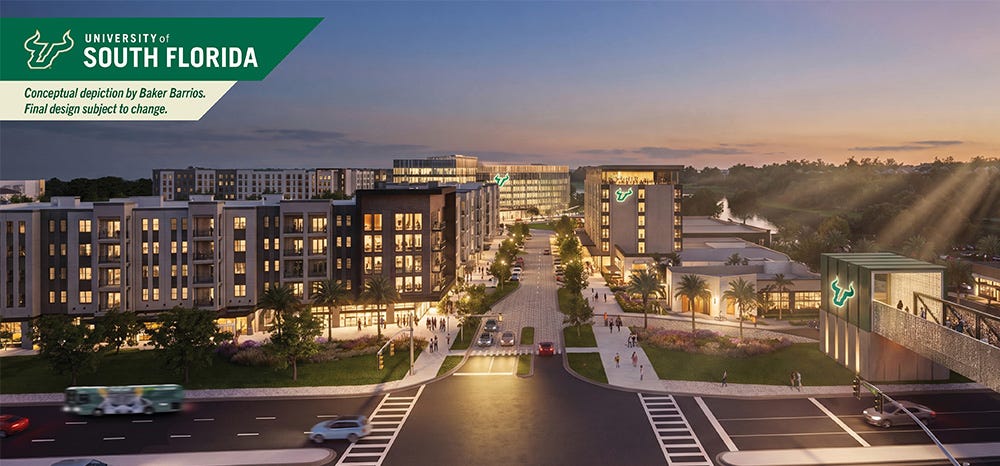
The University of South Florida has officially broken ground on its long\-planned Fletcher District redevelopment, now called Uptown Landing USF, a major mixed\-use development on the former Claw golf course near the Tampa campus\.
The first phase will transform 27 acres with 150 multifamily residences, 700 student beds, restaurants, retail space, a hotel and conference center, plus a new Translational Research Institute\. USF expects the initial phase to open by fall 2028, complementing the university’s new on\-campus stadium scheduled to open next year\.
The project is being developed through a public\-private partnership, and the first phase carries an estimated $495 million price tag, including $225 million for the university’s research facility— USF’s only direct project cost\. USF President Moez Limayem said the development is intended to strengthen connections among the university, surrounding community, and stadium\.
Environmental concerns remain, however, with advocates warning that the former golf course provided a buffer for an adjacent 600\-acre forest preserve\. In response, the university plans to establish a designated wildlife buffer zone to help mitigate potential impacts\.
Tampa officials have pushed back a key procedural step tied to the Tampa Bay Rays’ proposed stadium and surrounding redevelopment, but city leaders say the delay should not affect the project’s construction schedule\.
The City Council, sitting as the Community Redevelopment Agency \(CRA\), postponed consideration of changes involving redevelopment areas in Drew Park, downtown, West Tampa, and East Tampa until November 12\. The changes were included in the broader $2\.3 billion stadium agreement\. The delay came after the CRA’s attorney said he still needed information before preparing the required documents\. The council also moved discussion of a proposed Community Benefits Agreement to November, which outlines neighborhood and local area commitments the Rays must make beyond building the ballpark\.
The proposed changes include extending redevelopment zones, adjusting boundaries in Drew Park, and cutting future city contributions to the downtown redevelopment district by half\. City leaders characterized the postponement as procedural, saying it should not prevent the Rays from proceeding with stadium\-related work\. Early site construction could begin within weeks\.
[](https://substackcdn.com/image/fetch/$s_!Dcdz!,f_auto,q_auto:good,fl_progressive:steep/https%3A%2F%2Fsubstack-post-media.s3.amazonaws.com%2Fpublic%2Fimages%2F5f06c47b-9763-4205-ad3b-de0ac6d9a1c3_2560x1706.jpeg)Orange County Library System
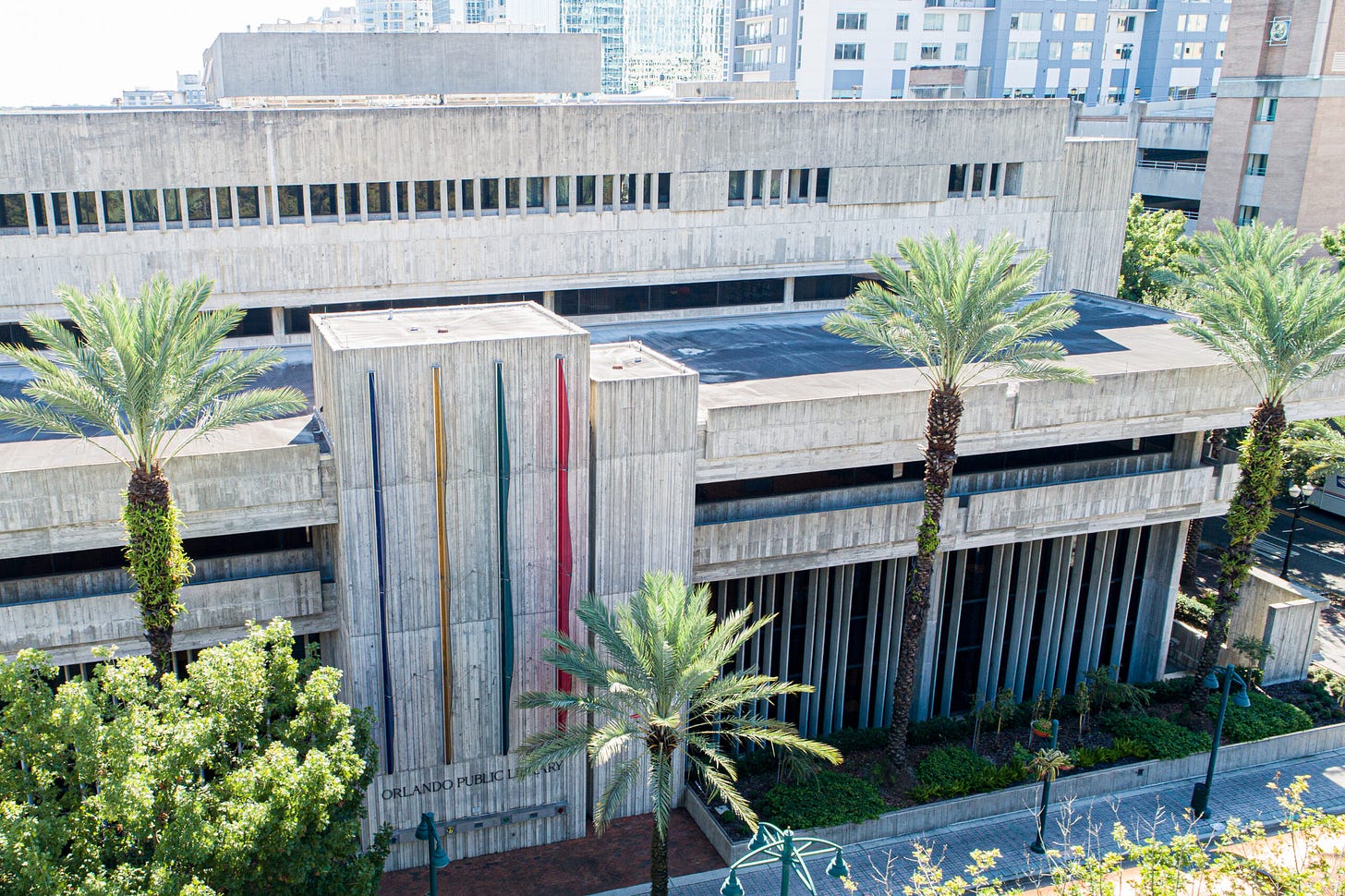
Orange County commissioners are considering a 14% increase in the public library system’s budget, raising it from $175 million to $200 million as they establish next year’s tentative millage rate\.
The library system operates 15 branches and is funded entirely through its own property tax millage, separate from funding for other county departments\. Officials say the proposed increase is being driven by rising operating and construction costs, as well as plans to open new library locations in Lake Nona and Horizon West and add a new bookmobile\. Construction expenses have increased significantly, including the cost of replacing aging air conditioning units, which has nearly tripled\.
The proposed capital budget would increase 43%, reaching $67\.8 million to fund branch renovations and new construction\. An additional $12\.2 million is designated for future technology upgrades\.
Orange County commissioners are scheduled to hold a second budget hearing on September 29, when they are expected to finalize the library system’s millage rate and spending plan\.
Orange County is launching its first Urban Forest Master Plan as Central Florida’s rapid growth reshapes communities across the region\. The 20\-year\-plus initiative will establish strategies for protecting existing trees and expanding the county’s tree canopy\. Orange County currently estimates tree coverage at about 35% and is targeting 48% by 2050\.
County planners say additional trees can provide shade, reduce heat, improve air quality, and help manage stormwater\. The plan will examine opportunities in urban, suburban, and rural communities, recognizing that each area has different needs\. Tree planting is already underway at Great Oaks Village as part of the county’s broader canopy efforts\. As development continues, the master plan will guide how Orange County preserves mature trees and expands green space\.
The master plan is expected to be completed in winter 2027, with residents invited to provide input throughout the process\.
AI, education, housing, and public safety are all contending with tighter wallets and bigger visions, from library expansions to tree canopy ambitions that push toward a greener, denser future\. The reformist tempo—AI rules for transparency, Amendment 3 property tax debates, and strategic investments like USF’s mixed\-use complex—will shape how responsive and resilient the state can be\. For residents and policymakers, the takeaway is clear: defend critical services while cultivating growth engines, mindful of pension\-like long\-term gaps, climate risks, and the everyday needs of SNAP participants, students, and neighbors in Central Florida and beyond\.
Enjoyed today’s breakdown? We keep Central Florida informed without the spin\. Consider forwarding this email to a friend, neighbor, colleague, or local business owner who needs to stay in the know\.
[Share](https://centralflorida.substack.com/p/florida-1-billion-budget-shortfall-orange-county-ai-data-centers?utm_source=substack&utm_medium=email&utm_content=share&action=share)
Help support local reporting by…
📤**Share**this newsletter with a friend, neighbor, or coworker who wants to stay informed about Central Florida\.
📩**Not subscribed yet?**Subscribe for free to receive local news, politics, business, and community updates delivered directly to your inbox\.
❤️**Like**this post to help more readers discover it\.
💬**Leave a comment**with your thoughts—we read every one\.
*See You in the Next Edition*
#### Discussion about this post
### Ready for more?