@GergelyOrosz: Actually, here's what you need to know about stacked diffs (aka stacked pull requests) as a concept, the deepdive writt…
Summary
Gergely Orosz shares the Pragmatic Engineer deepdive on stacked diffs, explaining the concept popularized by Meta and Google, and how GitHub's new public preview makes it more accessible.
View Cached Full Text
Cached at: 07/31/26, 04:47 AM
Actually, here’s what you need to know about stacked diffs (aka stacked pull requests) as a concept, the deepdive written 3 years ago in @Pragmatic_Eng Removed the paywall, now that GitHub has a public preview feature built. Finally!! https://newsletter.pragmaticengineer.com/p/stacked-diffs
Stacked Diffs (and why you should know about them)
Source: https://newsletter.pragmaticengineer.com/p/stacked-diffs 👋 Hi, this is Gergely with a formerly subscriber-only issue of the Pragmatic Engineer Newsletter. In every issue, I cover challenges at Big Tech and startups through the lens of engineering managers and senior engineers.
The paywall for this issue was removed nearly after 3 years of publishing - when GitHub shipped stacked diffsin public review.If you’d like to stay ahead of the industry, subscribe to the weekly newsletter:
One of my biggest personal “wow” moments during my time at Uber as a developer, was when I began using stacked diffs. Stacking refers to breaking down a pull request (PR) for a feature into several, smaller PRs which all depend on each other – hence the term “stacked”. It might sound counterintuitive, but this workflow is incredibly efficient by making it easier to review and modify PRs – or “diffs” as we called them at Uber.
The concept of stacking has existed for ages at Google, but Meta was the first company to really popularize this workflow outside the company, by open sourcing its internal developer tool called Phabricator, which supports stacked diffs. To this day, Meta engineers live and breathe stacked diffs.
For today’s issue, I reached out to five former Meta software engineers for their insights on stacking. All are now cofounders, or early employees at the developer tooling startupGraphite, which builds this stacking workflow for any company using GitHub.I am a smallinvestor in Graphite– after experiencing the major impact which stacking had on productivity at Uber, and being curious about why this tooling is not more widely available.
Today, we cover:
- Stacked diffs: the concept
- How Meta uses stacked diffs
- Google’s approach to stacking: chaining
- Stacking outside of Meta and Google
- Meta’s other neat developer tools -including ones we’ve previously not covered inInside Meta’s Engineering Culturea year back
- The impact of Meta’s developer tools on the industry
- Working at Meta versus working at a startup like Graphite
If you are looking for tools that support this workflow, here are some to look at:
- Graphite(engineers from this company contributed to this deepdive)
- Gerrit(refers to this as a patch-based approach)
- Sapling
- ReviewStack
Stacking is a tricky concept that’s much more easily understood by doing it. To help with this, we’ll explain and visualize the process separately.
Tomas Reimersworked for 2.5 years at Meta, before cofounding Graphite three years ago. Here’s how he explains stacking:
‘Stacking lets you make many small PRs easily, and without having to wait for review. Traditional git workflows equate every feature with its own PR. A PR has its own branch, and is made up of several commits. The traditional, non-stacking workflow is this:
- Finish a feature
- Submit a PR
- Await PR approval
- Merge back into main once approved
‘Once the PR is merged, you want to start work on the next feature. So you branch off of main again and begin building. Even at its most seamless, this process takes a long time! The biggest time waster is that PRs sit waiting for review for hours or days. We analyzed historical data for 15 million pull requests and PRs exist which waited several years to be merged!
**‘Stacking makes the unit of change an individual commit, rather than a pull request composed of several commits.**With stacking, you break up larger changes into many smaller ones. This change – a commit! – can be tested, reviewed, landed, and reverted individually.
‘These collections of smaller changes, or “stacks,” can be built continuously, one on top of the other, allowing engineers to stay unblocked and to keep moving. To give a practical example, it’s pretty common that once you build a feature, you want to build the next feature using the completed one. With stacking, you don’t have to wait for the first feature to be approved and merged; you just keep working!
‘Stacking as a methodology empowers developers to bypass the delays of main branch dependency and permits continuous parallel development.’
For stacking, a visual explanation is also helpful, and here’s my attempt at one. The traditional pull request flow works as follows:
 The classic PR flow. Checkout a branch, make changes, get a review, and merge back to main.
Productive engineers tend to make small-enough pull requests, which are atomic enough and easy to review. How does an engineer go about creating a series of small PRs? There are two choices:
The classic PR flow. Checkout a branch, make changes, get a review, and merge back to main.
Productive engineers tend to make small-enough pull requests, which are atomic enough and easy to review. How does an engineer go about creating a series of small PRs? There are two choices:
- Create a PR, then wait for this PR to be reviewed, and then create the next PR. This is time consuming!
- Create PR, then, while waiting for this PR to be reviewed, start a new branch with a second new PR, to keep working.
The most common approach for productive engineers is #2. Sure, it involves a little more context switching, but it beats waiting and doing nothing, right? So a typical flow when working on several pull requests is:
 A more typical workflow when working on several pull requests is to work on several PRs, parallel, while waiting for comments to come in. It’s more context switching, but better than waiting, doing nothing!
**But this “traditional” pull request flow doesn’t work well when PRs depend on one another.**So long as PRs are completely independent, the classic flow works well enough, and you just switch between different branches, locally.
A more typical workflow when working on several pull requests is to work on several PRs, parallel, while waiting for comments to come in. It’s more context switching, but better than waiting, doing nothing!
**But this “traditional” pull request flow doesn’t work well when PRs depend on one another.**So long as PRs are completely independent, the classic flow works well enough, and you just switch between different branches, locally.
But you are blocked if you want to make changes in PR_2 that depend on changes in PR_1 being in the main branch. Then there’s no choice but to await PR_1 approval and ping reviewers, asking them to speed up the review.
In practice, what devs usually do is add more commits to PR_1, which turns it into a giant code change. This isn’t ideal, but there’s no choice because there’s no good way to “split” a PR into several independent parts. This is where stacked diffs come in.
The idea behind stacked diffs is that you can keep working on your main branch, and worry about reviews later.You check out the main branch and start working on it, make a small change, and commit this as adiff– a very small pull request. You then continue working, creating a second diff, and a third, and so on.
You still need reviews to merge these diffs but these can wait until later. So now, your workflow changes to this:
 Workflow when working with stacked diffs. You move on to the next code change, after creating a diff
It might feel like a small change to keep working on your current branch without waiting on reviews. But this adds up to a massive productivity boost when working with small diffs and small pull requests. Let’s visualize the difference:
Workflow when working with stacked diffs. You move on to the next code change, after creating a diff
It might feel like a small change to keep working on your current branch without waiting on reviews. But this adds up to a massive productivity boost when working with small diffs and small pull requests. Let’s visualize the difference:
 The difference in workflow when using pull requests, versus working with stacked diffs
The real benefit of stacked diffs is that they protect your “coding streak” by ensuring it doesn’t break when completing one code change, and moving to the next:
The difference in workflow when using pull requests, versus working with stacked diffs
The real benefit of stacked diffs is that they protect your “coding streak” by ensuring it doesn’t break when completing one code change, and moving to the next:
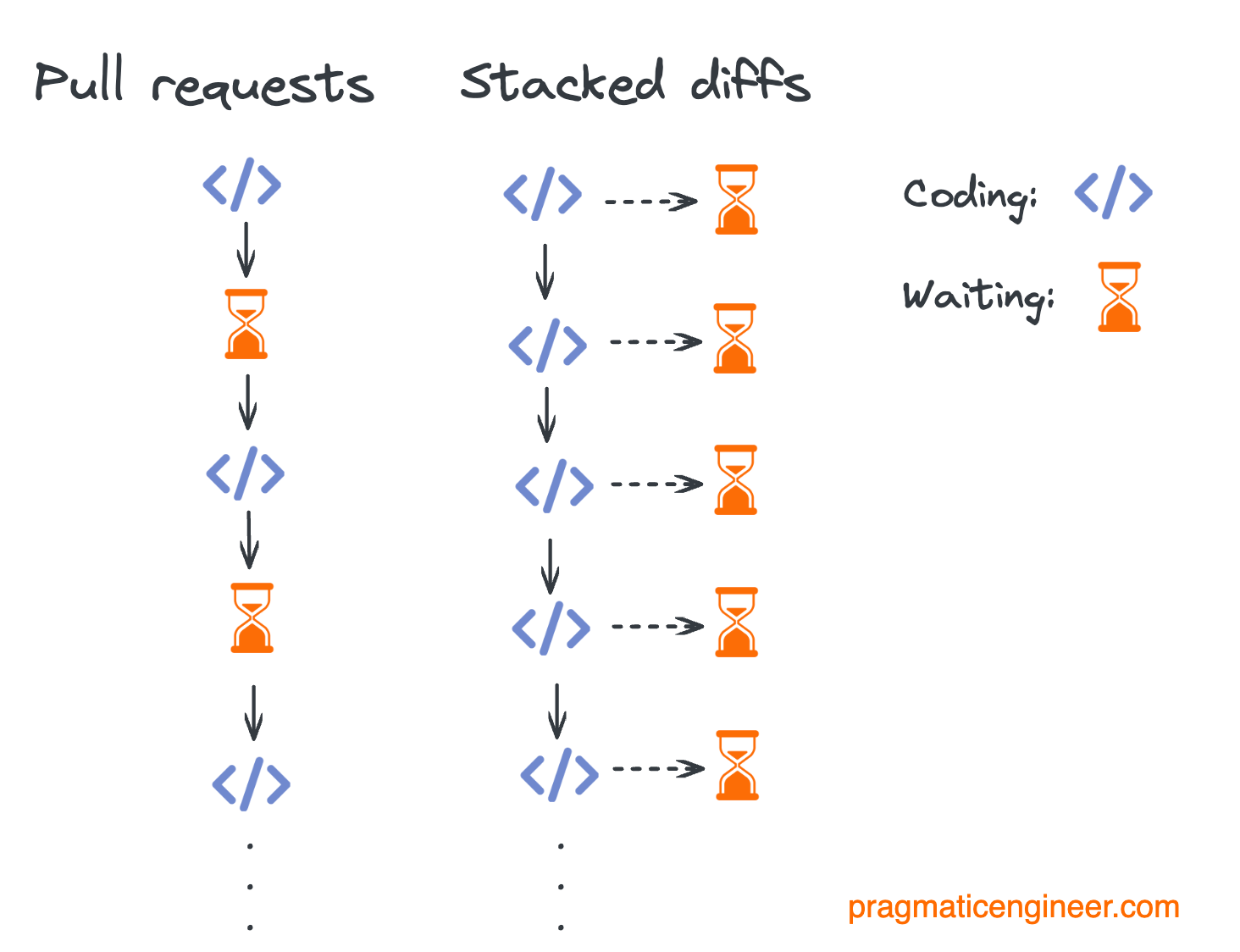 Working with stacked diffs keeps devs “in the flow” and focused on creating the next diff. Reviews can wait.
**With stacked diffs, every commit (diff) becomes a code review.**And this is the main idea behind stacked diffs. Everything else is a tooling matter.
Working with stacked diffs keeps devs “in the flow” and focused on creating the next diff. Reviews can wait.
**With stacked diffs, every commit (diff) becomes a code review.**And this is the main idea behind stacked diffs. Everything else is a tooling matter.
Most developers work on large and complex pieces of work, and because of this complexity, it is not reasonable to ask engineers to limit a pull request to, say, 200 changed lines at most. Sometimes one, complete piece of work can be as many as hundreds – or even thousands! – of lines long.
Diffs – which are basically commits – make it reasonable to ensure all commits are small in size. A large piece of work that changes 1,000 lines of code can be broken into three separate diffs as follows:
- Scaffolding (800 lines): the “boring” but verbose stuff. Perhaps this is auto-generated code.
- Core business logic (150 lines): key changes made to the code
- Edge cases (50 lines): handling of cases which aren’t part of the core code
Suddenly, it’s easier to review this code and spot issues with it. It also helps better organize your work as a dev!
In theory, stacked diffs seem like a pleasant workflow. However, things get a bit more complicated when a change is made on the main branch or in an earlier diff. Let’s take the latter case, when a reviewer requests significant changes to the first diff.
In this example, we have three stacked diffs which all depend on one another:
 Three code changes (diffs) that depend on one another
After we’ve finished the last code change (diff,) the code review for Diff 1 completes. The reviewer found a couple of issues and significant changes are needed to Diff1. So:
Three code changes (diffs) that depend on one another
After we’ve finished the last code change (diff,) the code review for Diff 1 completes. The reviewer found a couple of issues and significant changes are needed to Diff1. So:
 Diff 1 needs changes, after we’ve completed Diff 2 and 3. Now what?
Now what? Diff2 and Diff3 cannot be landed to the main branch while they don’t contain changes from the updated Diff 1. This is exactly why we useInteractive rebasing– basically, rewriting thelocalgit history. We execute the command*git rebase -i.*If the changes to Diff1 cause conflicts with Diff2, we manually select the changes we want the updated Diff2 to contain. And we do the same with Diff3:
Diff 1 needs changes, after we’ve completed Diff 2 and 3. Now what?
Now what? Diff2 and Diff3 cannot be landed to the main branch while they don’t contain changes from the updated Diff 1. This is exactly why we useInteractive rebasing– basically, rewriting thelocalgit history. We execute the command*git rebase -i.*If the changes to Diff1 cause conflicts with Diff2, we manually select the changes we want the updated Diff2 to contain. And we do the same with Diff3:
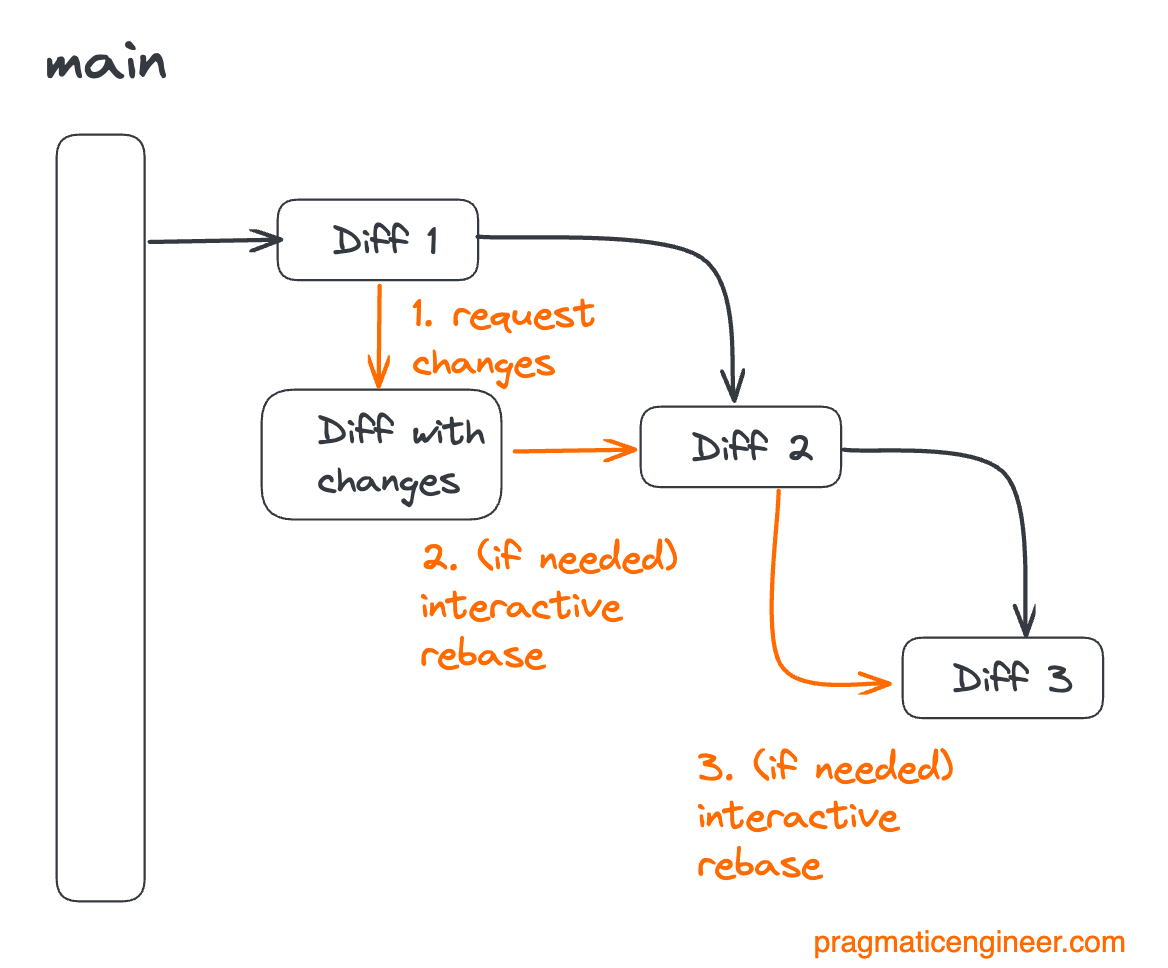 We rebase both Diff 2 and Diff 3, using interactive rebase. This can be simple, or involved, depending on the changes with Diff 1!
**Working with stacked diffs usually means more frequent rebasing of small diffs.**When I started to use stacked diffs with Phabricator, at Uber, rebasing became almost a daily habit. This was not just because it was common to get meaningful feedback for an earlier diff in the chain that required major code changes, but because the main branch changed frequently!
We rebase both Diff 2 and Diff 3, using interactive rebase. This can be simple, or involved, depending on the changes with Diff 1!
**Working with stacked diffs usually means more frequent rebasing of small diffs.**When I started to use stacked diffs with Phabricator, at Uber, rebasing became almost a daily habit. This was not just because it was common to get meaningful feedback for an earlier diff in the chain that required major code changes, but because the main branch changed frequently!
Rebasing is not unique to stacked diffs, though: it’s a pain point that happens any time lots of engineers are working in the same part of the codebase. Stacked diffs actually make rebasing a little easier because the conflicts you need to merge tend to be smaller, since the diffs themselves are smaller. The most risky rebase tends to be merging a branch with hundreds or thousands of lines of changed code and dozens of conflicts.
**Getting proficient at rebasing is a helpful skill for any software engineer.**Working with stacked diffs forces you to master this practice! My only addition is that when using the stacking workflow, dedicated tooling for stacking — such as withinPhabricator(now unmaintained as an open source project), orGraphite,Gerrit(refers to this as a patch-based approach),SaplingorReviewStackcan make rebasing a bit easer than the native git flow.
Nick Yanworked at Meta for 4 years, before joining Graphite as an engineer. When he started at Meta – then Facebook – in 2017, he was surprised that the topic of stacked diffs was covered during onboarding, early on:
“We covered stacked diffs on day one. Before starting at Facebook, I had used Git in previous internships and for school projects. Obviously Meta’s codebase was a little bit larger than my COMP11 class assignments! For engineers at Meta, stacking wastheway to write and ship code, hence this being one of the first engineering topics on Bootcamp. Stacking was so central to the culture that I had a manager who regularly told me they would not accept my code unless I split it up into smaller chunks. And splitting a larger change was straightforward. **By using stacking from day one, I didn’t have to learn the ‘hard parts’ of git.**I didn’t have to worry about dependency graphs, commit trees, or cherry-picking changes. Stacking felt like a much simpler data model for code that could get complicated very quickly, especially when you have a lot of engineers all working on their own features! I remember one of my managers literally said “I’m not accepting this unless you split this up”. Small, stacked PR’s were the cultural norm and I’ve been developing that way ever since.”
Aryaman Naikworked at Meta for nearly 5 years before joining Graphite. He shared that stacked diffs are “the way” to work at the company:
“I’m not exaggerating when I say that pretty much 100% of engineers used stacking all the time. It was a cultural norm and was the expected workflow you were supposed to follow. Stacking was so ubiquitous that when I left Meta, I was shocked to learn that stacking was a concept unique to Meta and a select few other companies. An engineer who used to work at Meta doesn’t know hownotto stack.”
Why is stacking considered a better way of working at Meta?Tomas Reimers– cofounder of Graphite – worked on mobile product infra for two and a half years at Meta. He said:
“At its core, stacking allows devs to keep developing quickly, doing this by helping avoid them getting blocked by waiting on code reviews. Stacked PRs, stacked changes, and stacked diffs are better than having several individual PRs because you have to wait less, thanks to the concept of “dependent changes.” Say you have a “child” feature that depends on work yet to be merged; with stacking, you don’t have to wait for the “parent” feature to land, you can continue to develop while it is in review. Also, you can scale this way of “dependent” working to stacks of 5, 10 or even 20 pull requests – I’ve done this! Once your work is ready, you can merge all these PRs as a single stack, making the merge process seamless.”
Jacob Goldworked on messaging infrastructure at Meta for 2 years, before joining Graphite as a founding engineer. He also saw the benefit of not having to wait around when stacking:
“Working in many small diffs helps ease the burden of rebasing against trunk, compared to using large, long-lived branches. It’s also nice because you can continue to add to your stack while waiting on specific stakeholders to review your changes — since there might be different reviewers on different parts of the stack who review at different times.”
While the name “stacked diffs” originated at Meta and its initially internal-only Phabricator product, the earliest example of stacking I’ve found is from Google.
**Google uses a concept identical to stacking, but calls it “chaining.”**The Big Tech giant calls its code changes CLs (changelist,) similar to what most tech teams call pull requests.
Google is also big on having small, easy-to-review CLs and chained CLs. Each CL being small-sized is how they do this. The company uses an internal, customized version ofMercurialfor source control, internally referred to as Piper. Within Piper, Google’s tooling allows for the creation of ‘chained CLs’ which is pretty much what stacked diffs are. In this tooling, one can navigate through each CL individually. But what about when a CL gets changed, and this change needs to propagate to the child CLs?
***‘hg evolve’***is the command used to “evolve” changes in the dependency tree; it’s the equivalent of git’s interactive rebasing. Take this example, where there are 3 CLs dependent on each other:
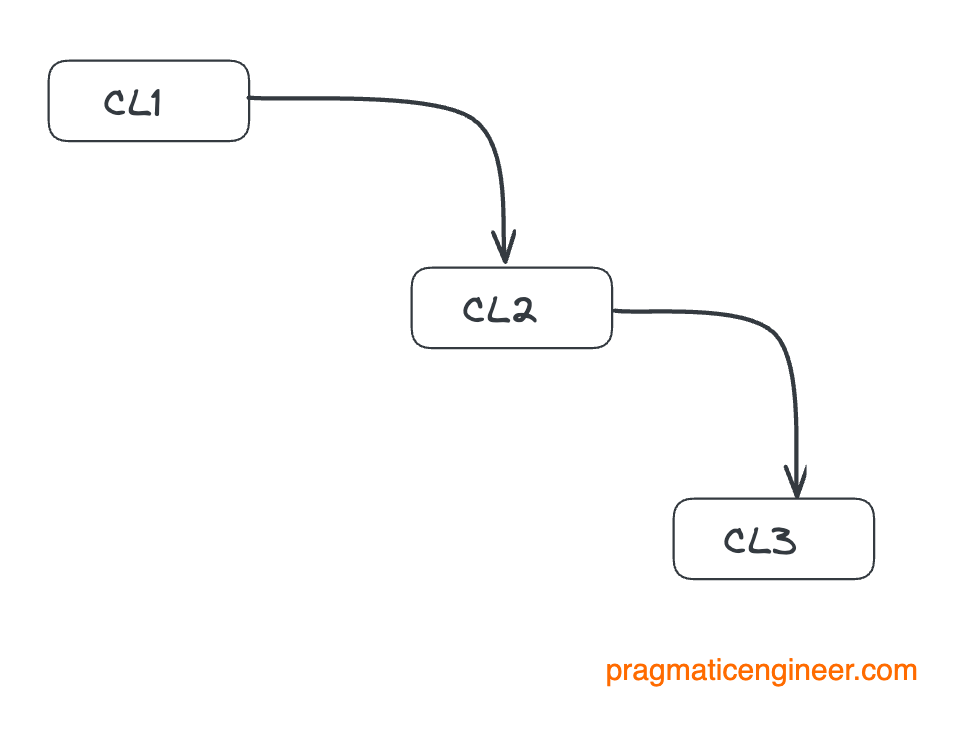 Three changelists (CLs) dependent on each other
Say you get a review that suggests making significant-enough changes to CL1. Once these changes are made, you need to update CL2 and CL3, so run ‘hg evolve’ and manually resolve conflicts in CL2 and CL3.
Three changelists (CLs) dependent on each other
Say you get a review that suggests making significant-enough changes to CL1. Once these changes are made, you need to update CL2 and CL3, so run ‘hg evolve’ and manually resolve conflicts in CL2 and CL3.
An important note with ‘hg evolve’ is that if you update CL1 but don’t run ‘hg evolve,’ then CL2 and CL3 become orphan CLs that cannot be merged!
**Google awards fun badges for perfect binary CLs trees.**In what is perfectly fitting for a company with a geeky culture, a developer is awarded a badge when they create a chained CL tree in the shape of a perfect binary tree. Pulling this off is not straightforward as each CL must have precisely two children, like this:
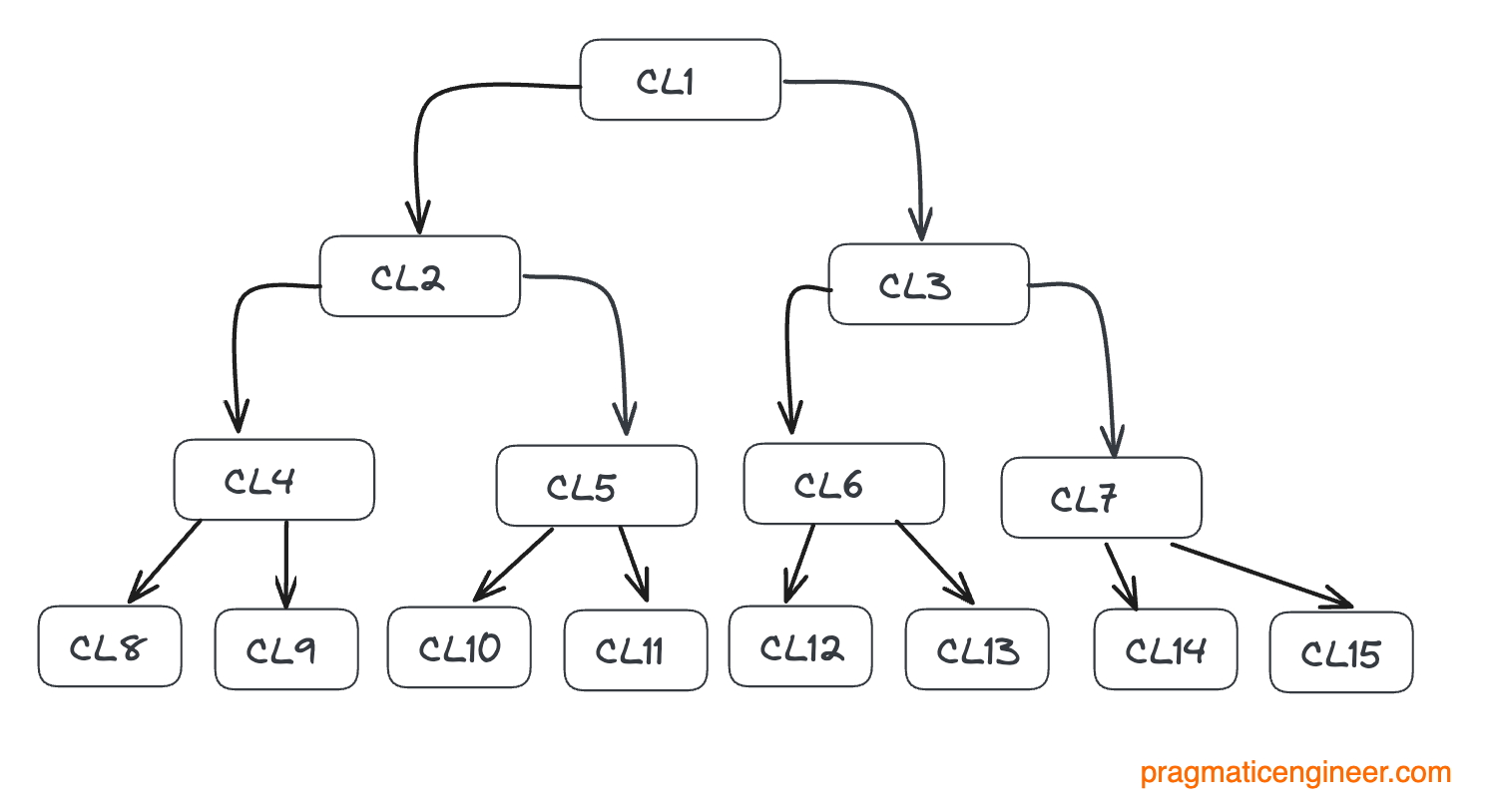 A perfect changelist tree with a height of 4. At Google, this CL earns a neat badge
Awarding badges for perfect binary tree CLs might be a bit over the top, but encouraging small CLs is on point, while aiming for small CLs is part of Google’s engineering culture.
A perfect changelist tree with a height of 4. At Google, this CL earns a neat badge
Awarding badges for perfect binary tree CLs might be a bit over the top, but encouraging small CLs is on point, while aiming for small CLs is part of Google’s engineering culture.
Google has not opened up its source control system, so chained CLs remain available only to the company.
Meta, on the other hand, open sourced its internal developer tool,Phabricator, in 2011. It was around 2016 that the Differential tool was open sourced, which had support for stacked diffs. From 2015 until 2021, a company called Phacility – founded by former Facebook engineer and Phabricator lead Evan Priestley – offered paid support for Phabricator. As of 2021, Phabricator is no longer maintained by Phacility.
Companies using Phabricatorare the majority of tech companies that introduced stacked diffs to their workflows after adopting Phabricator. In 2020, more than 200 companiesusedPhabricator. Companies using the tool back then included Asana, Biktm Disqus, Dropbox, Groupon, Pinterest, Quora, Usabilla and WePay.
However, with Phabricator’s support discontinued, the majority of these companies moved off of the tool, such as Khan Academy, which confirmed it had moved to GitHub in 2020. The only companies still using stacked diffs with Phabricator tooling are those which maintain their own Phabricator source, often because an internal infrastructure team owns it. Companies which I know do this:
- Uber: one of the earlier adopters of Phabircator and stacked diffs, with a dedicated developer platform team working on Phabricator.
- Twitter (now X): uses Phabricator. Some engineers stick to a regular branch-based GitHub-like workflow – which is also possible with this tool. However, many engineers use a Twitter-internal tool called “multidiff” for a stacked main branch workflow.
- Rubrik: also supporting its own Phabricator version.
**Companies usingGerrit**have also utilized the concept of stacking because it comes pretty much out of the box. Gerrit is a free, open source code review tool that integrates with Git. Companies where some teams use Gerrit and stacking, include:
- Adevinta: a classifieds company which bought eBay’s classifieds divisionin 2020. Some teamsuseGerrit, and some others utilizeMaiao, a Gerrit-like workflow for GitHub that Adevinta built and open sourced
- WikimediausesGerrit, together witha neat projectto facilitate creating and updating stacked merge requests on GitLab
- Amazon: some teams use it
- Arm: a couple of teams use this tool
- … and likely many more!
In the comments, Jeffrey Altman shared details on howOpenAFS(a distributed filesystem project) andAuriStor(a global namespace file system) has used a workflow akin to stacking, although not called this:
“These projects migrated to Git/Gerrit in July 2009. In the OpenAFS developer community we required: 1. One change per patch and one patch per change 2. Changes should be small enough to be reviewable while waiting for a bus 3. Every Change must pass continuous integration testing 4. A Change-Set (or Gerrit Topic) consists of a stack of dependent changes OpenAFS operates Gerrit in rebase mode. Merge commits are avoided (with the exception of security fixes which are developed outside of the public repository. The benefits of small reviewable changes are ease of review; ease of back-porting; and more precise identification of the point of failure when bisecting.”
**Companies that are customers ofGraphite,**given Graphite builds stacking on top of GitHub workflows. These include:
- Chronosphere: an observability company where wecovered their story, recently
- **The Browser Company:**they build the innovativeArc browser
- Vercel, DuckDuckGo, Ramp
Teams using Sapling or ReviewStack. Both Sapling and ReviewStack are tools open sourced by Meta.Saplingis a source control system that integrates with Git and provides convenient methods for stacking.ReviewStackis a user interface for GitHub pull requests, adding support for stacked changes.
Why is stacking not more popular? Given its productivity benefits and that Google and Meta both use it at the core of their workflows, it’s surprising this practice remains obscure. Having asked around and personally considered this question, here are the biggest reasons why stacking is not widespread:
- **Lack of tooling.**The primary reason is that a workflow and tooling are needed which support stacking. Google built this in-house, as did Meta with Phabricator, while Gerrit has support for it. However, unless you adopt Gerrit, or have an infra team the size of Google’s or Meta’s to build it from scratch, or a developer platform team like Uber and Twitter/X has to support a Phabricator fork, then you simply won’t have this kind of tooling
- “Gated” knowledge.“These tools are gated and so is knowledge of the practices themselves! There’s no readily-available way for smaller companies to leverage stacking, so there’s a good chance that they haven’t even heard of the practice,” – Jacob Gold, founding engineer at Graphite.
- It’s a relatively new concept.“It wasn’t really widespread at Facebook until 2016. We literally built Graphite because we were disappointed by the lack of tooling publicly available to support stacking. The fact we built an entire company on top of this concept shows how hard it is to build tooling for this workflow from the ground up.” – Nick Yan, software engineer at Graphite.
- It’s complicated.“The stacked diffs workflow is relatively complicated. I think a lot of engineers don’t have the patience, and/or the git skills, to make it worth the overhead.” –Shawn Burke, distinguished engineer at SoFi, and former principal engineer at Uber.
I asked all five former Meta engineers who contributed to this article – Tomas Reimers, Aryaman Naik, Jacob Gold, Brendan Ngo, and Nick Yan – which internal developer tools they liked using at Meta. These tools are mostly unavailable outside of the company:
- Unidash: create custom dashboards with any data. Heavily used for monitoring.
- Scuba: a tool to create analytics tables and query them via a graphical user interface (GUI.) This GUI was composable with Unidash. Scuba is used both for monitoring and analytics use cases.
- **On-demand:**spin up a machine with a clone of the monorepo and develop instantly. It is a kind of cloud development environment.We cover CDEs in the article,Cloud development environments.
- QE2is a tool used for feature flagging and feature gating. It is heavily used across the company. A third-party tool that offers similar functionality isStatsig.
- Workplaceis a “Facebook, but in a work context,” including profiles of all employees, status updates, groups, search, etc. Workplace is nowa standalone Meta productand available for companies to onboard to.
- Workchatis a chat and group chats product. Think of it as a “Messenger for work,” or a Slack alternative.
- Phabricatorhelps with the organizing and displaying of diffs, and the tool that had support for developer workflow actions, like creating a pull request (a diff), or merging it back to main (landing a diff). Phabricator is the tool which inspiredGraphite’s founders.
- ButterflyBotallows engineers to define various rulesets for adding reviewers to specific PRs. For example, you could create a rule that if a PR contains some keywords, or if it is changing specific parts of code, then you’d like a rule to fire. You can also do neat things like associate diffs with tasks. ButterflyBot also sends notifications across Workchat and email.
- Task Reaperis a clever tool, built to automaticallydeletetasks previously created by engineers or managers. You can define a ruleset, such as “delete tasks created by anyone on my team, which were not updated for 6 months or longer.”
- Buckis a super-fast, multi-language build system. It is open sourced and used outside of Meta. It’s now called Buck2.
Brendan described what using the tools above was like:
“What made these tools so magical at Facebook was how integrated they were. They all communicated seamlessly with one another and worked as one unit to power your workflow. In the real world, dev tools feel extremely fragmented. Companies generally use SaaS products in the tens – sometimes, even hundreds! It’s little wonder so many different tools working together doesn’t always feel very integrated.”
We cover Meta’s internal tools in the article,Inside Facebook’s engineering culture.
Graphite was born thanks to inspiration its cofounders took from Meta’s internal developer tools – specifically, the stacked diffs flow. I asked cofounder Tomas Reimers what impact he thinks Meta’s internal tools have on the industry. His take:
“Most developer productivity companies usually start by borrowing concepts used by internal tools at a large company. I can point to several tools that were inspired by Meta’s approaches, and founded by Meta/Facebook alumni: - Asana: work management. The company was cofounded in 2008 by former Facebook engineers Dustin Moskovitz and Justin Rosenstein. At Facebook, the pair built the task management tool, Tasks. - Threads: a Slack replacement, cofounded in 2017 by Meta alumni Rousseau Kazi and Jon McCord.Not to be confused Meta’s ownThreads social network product, launched in 2023. - Statsig: feature management and experimentation platform. Vijaye Raji founded the company in 2021 after 10 years at Facebook. - Expo: create universal native apps with React that run on Android, iOS, and the web. Cofounded in 2016 by Facebook alumni, Charlie Cheever and James Ide. - Kintaba: an incident management platform cofounded in 2020 by John Egan, Zac Morris and Cole Potrocky, who all previously worked at Facebook. - … and the list goes on! Entire companies have been created around these tools, and have raised billions of dollars of total funding. It’s pretty strong evidence that Meta’s dev tools have a large impact on the wider tech industry. So why are these tools not more widespread?”
Jacob Gold, founding engineering at Graphite, said it’s due to the cost of development and support, as well as the obvious pain point of fragmentation between tools,
“Tooling for stacking is complex (i.e. expensive) to develop and support. Facebook has hundreds to thousands of engineers constantly working on development and upkeep of internal workflows and processes; I mean, they maintain their own language, Hack! It takes a pretty big bet to dive into replicating these tools, which is one Graphite is undertaking right now. It comes down to how we believe in this tooling and workflow, and have the conviction that there’s enough engineers out there who would fall in love with this way of working as much as we did.“
My take is that fragmentation and the cost of developing this tooling are two important reasons why stacking is not widespread:
- **The pain point which stacking solves is obvious only on large teams.**For small teams, there’s not a huge difference between using pull requests or utilizing stacking. This is especially true when engineers rarely step on each other’s toes.
- **Stacking is not straightforward to adopt today.**The elephant in the room is that it’s hard to adopt a workflow if GitHub doesn’t natively support it. GitHub doesn’t support the concept of stacking, meaning that teams which want to use it need to use an additional tool that has this, such as Gerrit, Maiao, Graphite, or similar, or build their own.
It’s rare to get to talk to five software engineers who’ve all worked at Meta, and who now work together at the startup, Graphite. Obviously, I had a few questions about the experience, so far:
There’s a popular belief that Meta runs teams like they’re startups. How true is this, now you really do run your own startup?
Jacob Gold:
“Is that really a commonly-held belief? I’m not sure I agree. Maybe a few pockets of the company move as fast as startups, but being at a startup still feels completely different. At real early-stage startups you just learn so much faster than in a more established corporate setting. You also just have so much more immediate control over the implementation and direction of the product. And this is coming from someone who worked for some time at Meta!”
What skills did you develop at Meta which helped you hit the ground running at Graphite?
Nick Yan:
“**Iterating quickly.**This was the most important lesson I took from my time at Meta. Whether we were building a proof of concept, or trying to figure out how some new functionality would fit into our existing codebase, prototyping out quickly was super helpful. Iterating fast also helped during disagreements with teammates and leadership. ‘Code wins arguments’ is a cultural value at Meta which we used a lot. It’s a lot easier to argue against something theoretically than when you can see the code itself in front of your face, and that code speeds up rendering times by 10x!”
Aryaman Naik:
“**Get stuff quickly into the hands of real users.**This solves pretty much all your problems! Shipping a first version fast, and then shipping incremental fixes in a speedy fashion is much better than having something sit in ‘QA hell’ for years! By ‘QA hell,’ I am referring to the QA team saying a version isn’t ready to ship due to a very long list of issues, then the developer team fixing these issues, and then this cycle repeating several times, until the QA team finally gives a greenlight to ship to users. I’m not saying you want users to find ALL the bugs! And of course you want to release a reasonably polished product. But no matter what you do, you will never be able to test every edge case before launch. And that’s okay!”
What did you need to “unlearn” from your time at Meta?
Nick Yan:
“**Starting a codebase from scratch was an unexpectedly strange experience!**At Meta, you get used to working with this massive monorepo; whenever you start a new project, you have this massive internal codebase to take inspiration from. Meta is such a huge and mature product that they already solved a lot of challenges you’ll face, so you can expand on those approaches, and get inspired by how you did it. When we started Graphite, we had no existing codebase to lean on. At Graphite, we had to learn to open source solutions for inspiration, and to rely on ourselves to build from scratch because there was nothing comparable available. Especially in the early days, I missed being able to just ping for help from another team at Meta which had solved problems like the ones we faced!”
Brendan Ngo:
“We needed to ‘unlearn’ how stuff just works! At Facebook, everything is kind of just handed to you! What I mean by this is even when you start a new project, you have CI/CD pretty much taken care of; linting; feature flagging; release practices and every other common thing you can think of: you don’t need to worry about it! And if something doesn’t work, you can ask for help from infra teams and they’ll sort it for you. **At a startup, you are forced to be a lot more creative, and learn much quicker.**This is not a bad thing, but it was a different reality from what we were used to at Meta. At a startup like Graphite, when as an engineer you have a problem, it is YOUR problem. There is no dedicated team that owns a module you are using, or the service you want to modify because this small startup team owns everything! It’s up to you to solve your problem.”
Ever since leaving Uber, I’ve wondered why stacked diffs are rarely used across the industry. I had the benefit of first-hand experience of just how powerful this workflow is, and every single Meta engineer I talked with thought the same, as did many Google engineers.
Today, more companies are exploring moving to a stacked workflow, overwhelmingly driven by Google or Meta alumni advocating the usefulness of this approach. I recently got wind that Databricks is considering adding tooling support for this feature.
I hope today’s issue explains this workflow and its benefits,especiallyfor large engineering teams that merge to the main branch. It’s rare to come across a helpful engineering practice with such a low profile across the broader industry.
Special thanks to the five former Meta engineers now building Graphite, who contributed to this article. For further reading, I recommend these articles:
- Stacked diffs: a Twitter threadby Benjamin Schachter (2022)
- Stacked diffs discussion on Reddit(2022)
- Problems with pull requests and how to fix themby Gregory Szorc (2020)
- Stacked diffs versus pull requestsby Jackson Gabard (2018)
- Stacked diffs: Keeping Phabticator diffs smallby Kurtis Nusbaum (2016)
Discussion about this post
Ready for more?
Microsoft Developer (@msdev): Stacked pull requests are now in public preview on @github.
Here’s what you need to know🧵
Similar Articles
Stacked pull requests are now in public preview
GitHub has released stacked pull requests in public preview, allowing developers to break large changes into smaller, reviewable PRs that can be reviewed independently and merged together in one click.
@cognition: Devin now natively supports @Github Stacked PRs ▪︎ Break down large changes into smaller, reviewable diffs ▪︎ Address a…
Devin now natively supports GitHub Stacked PRs, enabling developers to break down large changes into smaller diffs, fix comments across stacks, and automatically rebase downstream changes.
Accepting a messy git history
A blog post discussing two git workflow philosophies—commit often vs rebase carefully—and why a messy history is acceptable given resilience in larger teams, referencing GitHub's new stacked PR feature.
spr: Stacked Pull Requests on GitHub
spr is a CLI tool that converts each commit on a Git branch into a separate pull request on GitHub, enabling stacked PRs without manual branch management.
Make Reviews Possible Again With This One Simple Trick
The article proposes using stacked branches (small, sequential pull requests) to make reviewing AI-generated code more manageable and effective, addressing the common problem of large, hard-to-review diffs.