Cached at:
07/05/26, 10:34 PM
# Zero-copy in Go: sendfile, splice, and the cost of io.Copy
Source: [https://segflow.github.io/post/zero-copy-sendfile-splice/](https://segflow.github.io/post/zero-copy-sendfile-splice/)
A small file\-serving service of mine slowed to a crawl one afternoon after a “harmless” middleware change\. CPU on the server box doubled, throughput roughly halved\. The diff was a single line: instead of handing a`\*os\.File`to`io\.Copy`, somebody had wrapped it in a tiny logging reader to count bytes\.
That one wrap quietly turned off`sendfile\(2\)`\.
This post is about that fast path: what Go does for you for free, how to see it actually fire, and the surprisingly easy ways to lose it\.
## The setup
- Linux 6\.6 / Ubuntu 24\.04 \(WSL2\), AMD Ryzen 5 9600X, 16 GiB RAM
- Go 1\.22\.12
- 512 MiB random\-bytes file, page cache warm
Every benchmark below serves the same`big\.bin`file over plain TCP to a Go client on the same machine\. Server pinned to CPU 0, client to CPU 1, so we can read`/usr/bin/time`server\-side and compare apples to apples\. Syscall counts come from a vanilla`strace \-c \-e trace=read,write,sendfile,splice`\.
## What`sendfile`actually does
A normal “send this file” looks like this:
```
disk -> page cache -> read() into user buffer -> write() into socket buffer -> NIC
^ copy 1 ^ copy 2
```
`sendfile\(2\)`collapses those two copies into one in\-kernel transfer:
```
disk -> page cache --(sendfile)--> socket buffer -> NIC
^ no userspace round trip
```
No`read`, no`write`, no 32 KiB buffer bouncing through your address space\. The kernel just splices page\-cache pages straight into the socket’s send queue\. For socket\-to\-socket forwarding the equivalent is`splice\(2\)`, which moves bytes through a kernel pipe without ever materialising them in user memory\.
You don’t call either of these directly in Go\. The standard library does it for you, when it can\.
## The fast path
The Go runtime gives`\*net\.TCPConn`a`ReadFrom`method\. When you write
`io\.Copy`checks whether the destination implements`io\.ReaderFrom`\. A`\*net\.TCPConn`does, so the call gets dispatched to its`ReadFrom`\. That method’s first job is to look at the source: is it a`\*os\.File`? Is it an`\*io\.LimitedReader`wrapping a`\*os\.File`? If yes, it calls into`internal/poll\.SendFile`, which loops over`sendfile\(2\)`until the file is drained\.
The whole detection chain lives in two files:`net/sendfile\_linux\.go`and`os/zero\_copy\_linux\.go`\. It is roughly:
```
// (simplified, in net/sendfile_linux.go)
lr, ok := r.(*io.LimitedReader)
if ok { remain, r = lr.N, lr.R }
f, ok := r.(*os.File)
if !ok { return 0, nil, false } // fall back
// ... sendfile loop ...
```
Two type assertions and a syscall loop\. That’s the whole thing\.
## Three handlers, one file
Here are the three reader shapes I want to compare\. All three serve the same 512 MiB file over plain TCP\. The only difference is what gets passed to`io\.Copy`\.
```
// raw: hand io.Copy a *os.File directly.
_, _ = io.Copy(conn, f)
// wrapped: hide *os.File behind a "just an io.Reader" struct.
type justReader struct{ r io.Reader }
func (j justReader) Read(p []byte) (int, error) { return j.r.Read(p) }
_, _ = io.Copy(conn, justReader{r: f})
// limit: wrap in *io.LimitedReader, the only wrapper the runtime sniffs.
_, _ = io.Copy(conn, io.LimitReader(f, fileSize))
```
A`justReader`does nothing\. It’s the minimal example of a piece of middleware that “just wants to count bytes” or “just wants to inject a tracing span” or any other innocent reason to slip an`io\.Reader`in front of the file\. As far as the type system is concerned, the value is now an`io\.Reader`, full stop\. The runtime’s type switch on`\*os\.File`fails and the optimization is gone\.
`io\.LimitReader`looks just as wrappy, but the runtime explicitly checks for`\*io\.LimitedReader`before giving up, unwraps it, and keeps going\. So it preserves the fast path\.
Three handlers, three different things happening under the hood\.
## Watching it with strace
Run each handler under`strace \-c \-e trace=read,write,sendfile,splice`, fire five 512 MiB transfers, and look at the summary\.
**`raw`\(`io\.Copy\(conn, f\)`\):**
```
% time seconds usecs/call calls errors syscall
------ ----------- ----------- --------- --------- ----------------
99.79 0.231981 78 2958 860 sendfile
0.15 0.000359 51 7 1 write
0.05 0.000126 18 7 read
------ ----------- ----------- --------- --------- ----------------
100.00 0.232466 78 2972 861 total
```
2,958`sendfile`calls, 7`read`s, 7`write`s\. The`read`s and`write`s are accept/setup chatter, not file data\. The 860 “errors” are`EAGAIN`returns where the socket buffer was full and the runtime poller bounced back, which is normal under sendfile\.
**`wrapped`\(`io\.Copy\(conn, justReader\{f\}\)`\):**
```
% time seconds usecs/call calls errors syscall
------ ----------- ----------- --------- --------- ----------------
56.67 3.202339 48 65546 3 write
43.33 2.448353 37 65547 read
------ ----------- ----------- --------- --------- ----------------
100.00 5.650692 43 131093 3 total
```
Zero`sendfile`\. ~131 thousand combined`read`and`write`syscalls, all of them 32 KiB chunks bouncing the data through a userspace buffer\. That 32 KiB number is the default in`io\.copyBuffer`\. The wall time spent in syscalls is roughly**24x**the fast path\.
A CPU profile of the wrapped handler under load makes the call chain obvious:
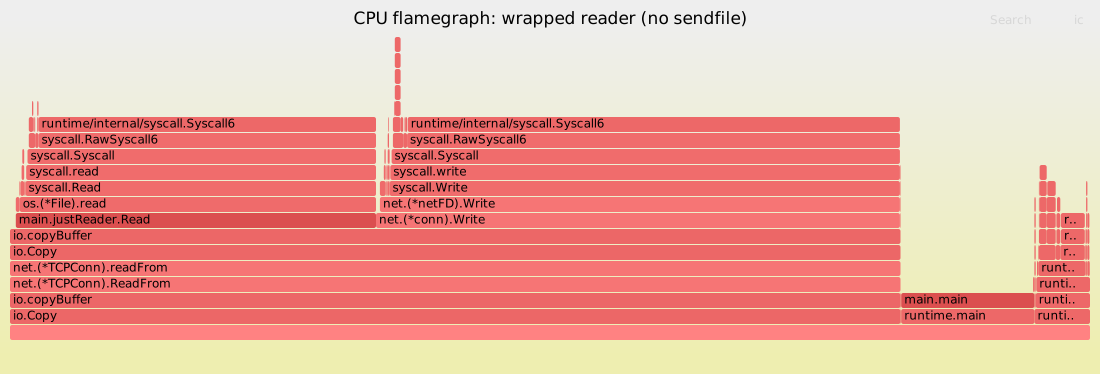
Of 1,670 CPU samples collected during the run,**1,362 \(~82%\) are inside syscalls**: 761 in`syscall\.Write`writing to the socket, 522 in`syscall\.Read`pulling the next 32 KiB out of the file\. The frame sequence at the top of every hot stack is`io\.Copy \-\> io\.copyBuffer \-\> \(\*TCPConn\)\.ReadFrom \-\> readFrom \-\> io\.Copy \-\> io\.copyBuffer \-\> \.\.\.`\. That nested`io\.copyBuffer`is the signature:`\*TCPConn\.readFrom`couldn’t find a`\*os\.File`to hand to`sendfile`, so it threw the work back to`io\.copyBuffer`, which is now doing the bounce by hand\. The flamegraph shows where every cycle of that bounce went\.
**`limit`\(`io\.Copy\(conn, io\.LimitReader\(f, n\)\)`\):**
```
% time seconds usecs/call calls errors syscall
------ ----------- ----------- --------- --------- ----------------
99.84 0.239191 82 2896 893 sendfile
0.14 0.000330 47 7 1 write
0.02 0.000047 6 7 read
```
Indistinguishable from`raw`\. 2,896`sendfile`s\. The LimitReader wrap is free, because the runtime knows about that one specific type\.
## What this costs
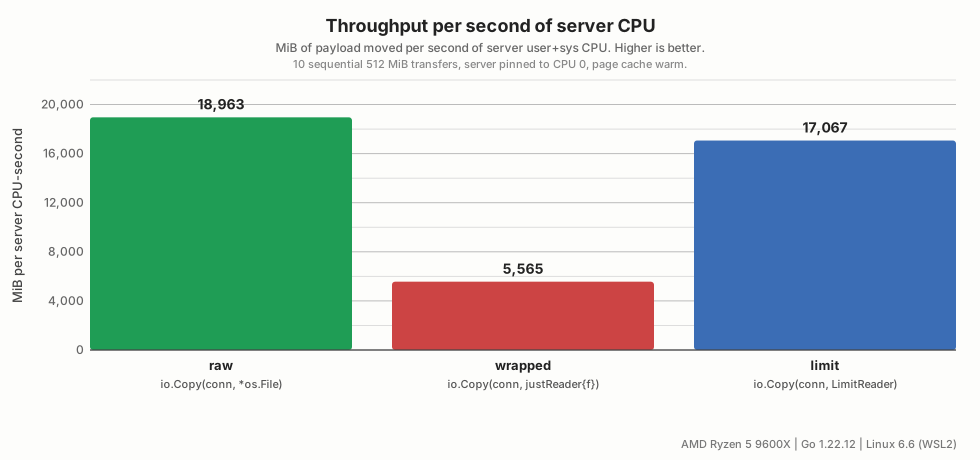
Loopback throughput is a misleading number: the receiver and the TCP buffers absorb a lot, so the wall clock looks similar across all three modes \(1\.5 \- 1\.7 GiB/s per request\)\. A more honest measure is the**server’s own CPU time**to ship the file:
modeserver user\+sys CPU \(10 x 512 MiB\)per\-GiB CPUraw0\.27 s~54 mswrapped0\.92 s~184 mslimit0\.30 s~60 msThe wrapped path costs roughly**3\.4x**the CPU per byte\. On localhost that gets absorbed; on a real network or under concurrent load it pegs a core and tanks tail latency\. 2,972 syscalls vs 131,093 syscalls to move the same 2\.5 GiB is the cost of saying “I just want an`io\.Reader`”\.
The same data viewed the other way around, as MiB of payload shipped per second of server CPU consumed, makes the gap stand out:
## `splice`for socket\-to\-socket
`sendfile`is file\-to\-socket\. The symmetric case is socket\-to\-socket, which is the bread and butter of proxies\. There the runtime uses`splice\(2\)`instead\. A 30\-line TCP proxy:
```
ln, _ := net.Listen("tcp", ":9100")
for {
c, _ := ln.Accept()
go func(client net.Conn) {
defer client.Close()
server, _ := net.Dial("tcp", upstream)
defer server.Close()
go io.Copy(server, client)
io.Copy(client, server)
}(c)
}
```
Two`io\.Copy`calls, both between`\*net\.TCPConn`s\. Strace one transfer through the proxy and watch:
```
% time seconds usecs/call calls errors syscall
------ ----------- ----------- --------- --------- ----------------
99.98 0.754999 70 10677 481 splice
0.01 0.000109 13 8 read
0.01 0.000065 65 1 write
```
10,677`splice`calls\. Zero`read`or`write`on the data path\. The proxy never touches the bytes\.`\(\*TCPConn\)\.readFrom`looks at the source, sees another`\*TCPConn`, and dispatches to`spliceFrom`\. The same fragility rule applies: wrap either side in your own`io\.Reader`or`io\.Writer`and you fall back to the 32 KiB bounce\.
## Rules of thumb
A few things I took away from the file server that started this whole thing:
**Don’t wrap if you can avoid it\.**Every layer of`io\.Reader`between the file and the connection is a chance to type\-assert your way out of the fast path\. The runtime only recognises`\*os\.File`,`\*io\.LimitedReader`, and a handful of`\*net\.TCPConn`\-shaped types\. Anything else is opaque\.
**If you must wrap, preserve the optional interfaces\.**A wrapper that implements`io\.WriterTo`\(when wrapping a source\) or`io\.ReaderFrom`\(when wrapping a destination\) and forwards through can keep`io\.Copy`dispatching all the way down\. It is slightly fiddly to get right, but the stdlib does it routinely\.
**`io\.LimitReader`is free, anything else isn’t\.**For ranged responses this is the wrap to reach for\. It’s exactly how`http\.ServeContent`keeps`sendfile`active for`Range`requests\.
**Trust`strace \-c`, not your intuition\.**Two sendfile counts and zero`write`s mean you’re on the fast path\. Hundreds of thousands of`read\+write`pairs mean you’re not\. There is no middle ground\.
**Don’t assume sendfile is always reachable\.**A surprise I’ll save for another post: even the textbook`io\.Copy\(w, f\)`against an`http\.ResponseWriter`can route around`sendfile`for reasons that have nothing to do with your code\. The principle is the same, but the trigger is hiding in the framework, not the handler\.
`sendfile`and`splice`are old, boring kernel APIs that you almost never have to reach for in Go\. The runtime mostly does it for you, for free\. The trick is knowing what to leave alone for that to keep being true\. When`strace`shows read/write spam where you expected zero\-copy, the cause is almost always an innocent wrapper somebody added for the best of reasons\.
And when even sendfile isn’t enough, when you want the file mapped into your address space so the kernel never has to copy it out at all, you go user\-space\. But that’s a different story\.