@dair_ai: Nice paper discussing context trimming for agents. This is a hot topic at the moment, so it might be worth your time. C…
Summary
This paper compares context trimming strategies for AI agents, finding that protocol-aware trimming with adaptive budget guardrails maintains high task success while reducing tokens, though it relies on gold annotations for implementation.
View Cached Full Text
Cached at: 09/16/26, 06:13 PM
Nice paper discussing context trimming for agents.
This is a hot topic at the moment, so it might be worth your time.
Context trimming for agents is usually judged by how many tokens it removes. This study also measures whether the task still succeeds.
The work compares five trimming strategies on multi-step tool workflows. Recency, relevance and summarization saved about 60% of tokens, but task success fell to between 66.6% and 77.3%.
Protocol-aware trimming keeps identifiers, constraints, tool schemas and unresolved commitments intact and compresses the rest. With adaptive budget guardrails it reached 96.0% task success and 1.0% cascading failure while still saving 56.0% of tokens.
The budget has a large effect.
Keeping 25% of the context or less raised the odds of failure 10.92 times compared with keeping 50% or more, and complex workflows needed more retained context.
There is one caveat. The protected state came from gold annotations, so a production system would still need to detect that state on its own.
Paper: https://academy.dair.ai/papers/protocol-preserving-context-trimming-for-agentic-workflows-benefits-failure-regi-2609.16461…
Protocol-Preserving Context Trimming for Agentic Workflows: Benefits, Failure Regimes, and Budget Guardrails
Source: https://academy.dair.ai/papers/protocol-preserving-context-trimming-for-agentic-workflows-benefits-failure-regi-2609.16461 Agents · Efficiency · SafetyChat with Paper
First page
The curator’s take
Harish Gaggar (Intuit Credit Karma) compares five context-trimming strategies for multi-step agent workflows and finds that preserving protocol-critical state matters more than the amount of text removed.
Ask this paper
Question about this paper Key points01
Strategies compared: Recency, relevance, summarization, protocol-aware trimming and adaptive budget guardrails, measured on task success, protocol adherence, valid tool calls, token savings, latency and cascading failures.
02
Conventional trimming: About 60% token savings, but task success of only 66.6-77.3% and protocol adherence of 85.5-88.6%.
03
Protocol-aware and adaptive: Protocol-aware trimming raises task success to 92.2%; adaptive guardrails reach 96.0% success, 96.3% adherence and 1.0% cascading failure while still saving 56.0% of tokens.
04
Caveat: The protocol-aware condition protects state marked in two independent gold annotations, so it shows the value of knowing which state is critical; the paper does not name the model used, and data is available on request.
05
Budget threshold: Keeping 25% of context or less raises failure odds 10.92-fold against budgets of 50% or more, and the critical threshold rises with workflow complexity.
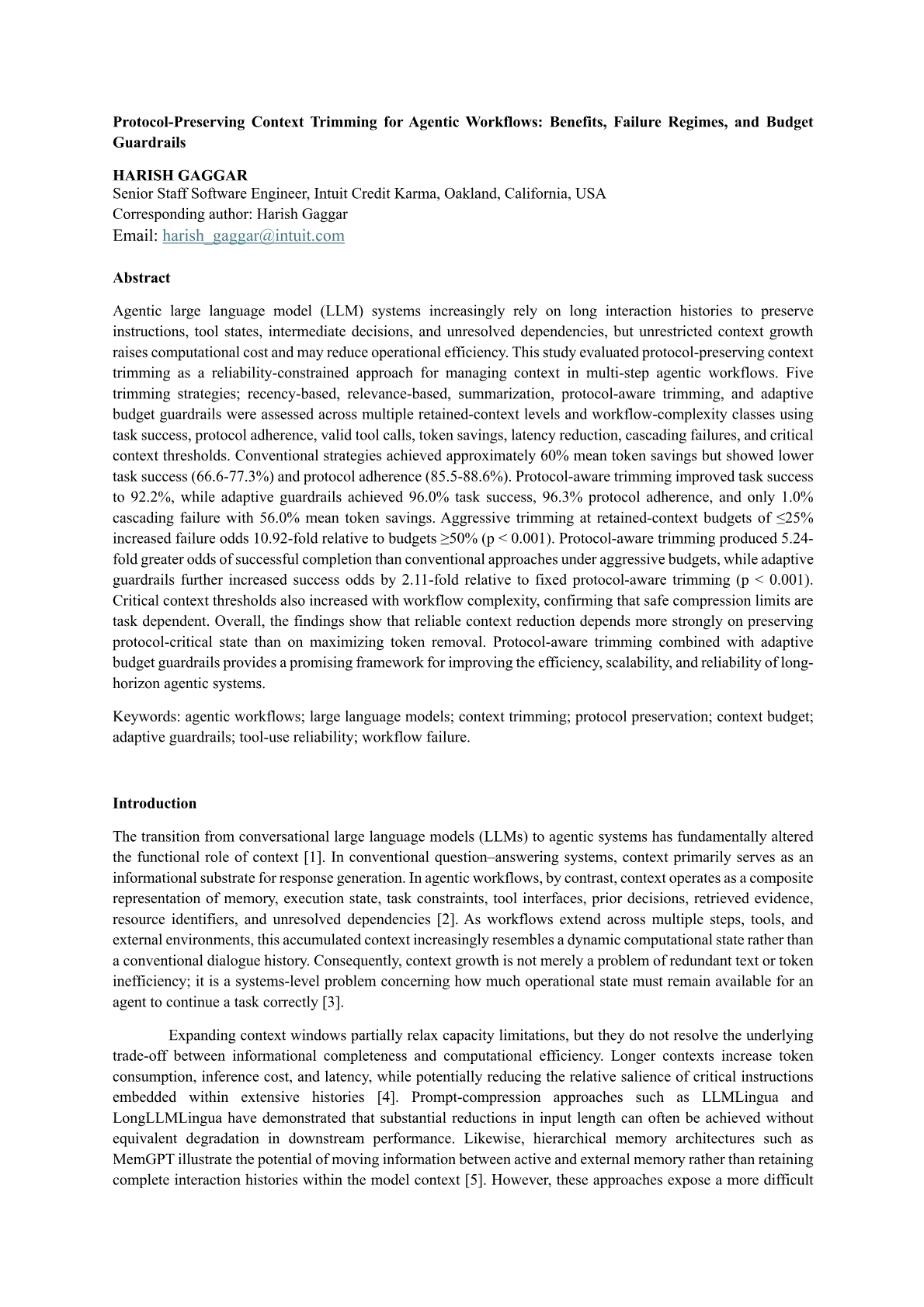
AbstractAgentic large language model (LLM) systems rely on long interaction histories to preserve instructions, tool states, intermediate decisions, and unresolved dependencies, but unrestricted context growth increases computational cost and can reduce efficiency. This study evaluates protocol-preserving context trimming as a reliability-constrained approach for multi-step agentic workflows. Five trimming strategies - recency-based, relevance-based, summarization, protocol-aware trimming, and adaptive budget guardrails - were compared across retained-context levels and workflow-complexity classes using task success, protocol adherence, valid tool calls, token savings, latency reduction, cascading failures, and critical context thresholds. Conventional strategies achieved about 60% mean token savings but lower task success (66.6-77.3%) and protocol adherence (85.5-88.6%). Protocol-aware trimming improved task success to 92.2%, while adaptive guardrails achieved 96.0% task success, 96.3% protocol adherence, and 1.0% cascading failure with 56.0% mean token savings. Retained-context budgets of 25% or less increased failure odds 10.92-fold relative to budgets of 50% or more (p < 0.001). Protocol-aware trimming produced 5.24-fold greater odds of successful completion than conventional methods under aggressive budgets, while adaptive guardrails further increased success odds 2.11-fold versus fixed protocol-aware trimming (p < 0.001). Critical context thresholds also increased with workflow complexity. These findings indicate that reliable context reduction depends more on preserving protocol-critical state than on maximizing token removal, and that adaptive guardrails can improve efficiency, scalability, and reliability in long-horizon agentic systems.
Similar Articles
@dair_ai: https://x.com/dair_ai/status/2066174390048358760
A curated thread covering three notable AI papers: MiniMax Sparse Attention for efficient long-context inference, Self-Harness for self-improving agent scaffolds, and Agents' Last Exam benchmark for measuring agent economic value.
@sairahul1: https://x.com/sairahul1/status/2067171101978071501
This thread presents a comprehensive guide to context engineering for AI agents, explaining why context management is critical for agent performance and how to optimize token usage to avoid degradation.
Token Optimization and Context Window Management in Multi-Agent AI Workflows
This paper explores techniques for token optimization and context window management in multi-agent AI workflows to improve efficiency and performance.
Less Context, Better Agents: Efficient Context Engineering for Long-Horizon Tool-Using LLM Agents
This paper evaluates context engineering configurations for LLM agents in enterprise tool-use workflows, showing that summarization with selective pruning achieves 91.6% accuracy while reducing token usage by over 60% compared to full-context baselines.
@dair_ai: A great read if you an AI dev. Current context compactors retain 17% of the standing rules users give them. Session Con…
A new paper introduces COMPINT, an evaluation suite showing that context compactors silently drop session constraints, retaining only 17% on average. A simple SC-aware extractor recovers over 90% retention without modifying the compactor or model.