Cached at:
05/19/26, 12:36 AM
# Introducing Casuarina Linux: A glibc-Based Chimera Linux Derivative
Source: [https://casuarina.org/news/introducing-casuarina-linux/](https://casuarina.org/news/introducing-casuarina-linux/)
by[Wesley Moore](https://www.wezm.net/)
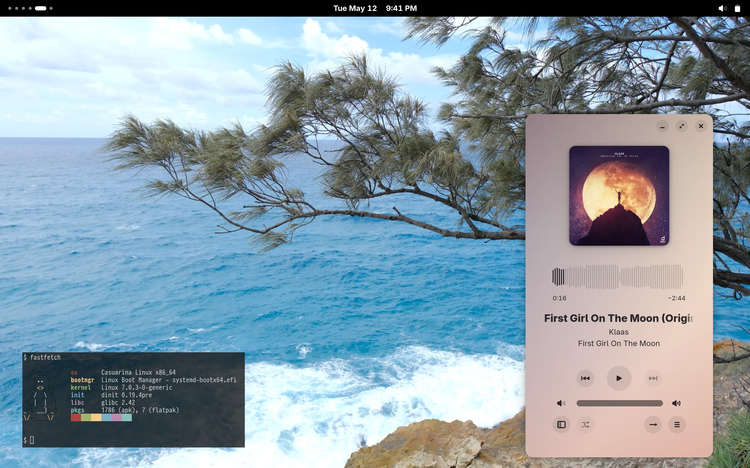
Casuarina Linux is an experimental, in\-development Linux distribution derived from[Chimera Linux](https://chimera-linux.org/)\. It uses glibc instead of musl as libc\. The motivation for this is to preserve much of the Chimera experience while remaining binary compatible with the wider GNU/Linux ecosystem\. The initial`x86\_64`ISO has been published, check out the[download page](https://casuarina.org/download/)to download it\.
[](https://casuarina.org/casuarina-gnome.webp)
Casuarina is comprised of[LLVM](https://www.llvm.org/)toolchain,[Dinit](https://davmac.org/projects/dinit/)init system,[GNU libc](https://www.gnu.org/software/libc/),[FreeBSD derived core utilites](https://github.com/chimera-linux/chimerautils), and[apk package manager](https://gitlab.alpinelinux.org/alpine/apk-tools)\. The resulting system is compact and efficient, but still full\-featured and well suited to desktop use\. It may appeal to people that want a Linux distribution that’s up\-to\-date, doesn’t compromise on functionality, compatible, and easy to understand and contribute to\.
The system was bootstrapped from source using the same multi\-stage process as Chimera\. The use of`glibc`complicates this because it currently requires`gcc`to build, so the bootstrap process requires building GNU`binutils`,`gcc`, and then`glibc`\. After that LLVM is built and all other packages are built with LLVM\. An implementation of`libgcc`is also provided by LLVM\.
Packages are built with[Chimera’s cbuild tool](https://chimera-linux.org/about/#buildable-from-source), which builds all packages in an isolated sandbox\. Package building is automated with[Buildbot](https://buildbot.net/)at[build\.casuarina\.org](https://build.casurina.org/)\. All development takes place on[Codeberg](https://codeberg.org/casuarina/)\. Currently only`x86\_64`is supported\. Eventually`aarch64`should be supported too, but probably not any architectures beyond that\. For other architectures it’s better to use Chimera as there isn’t an established ecosystem of binaries to try to be compatible with\.
The distro is still considered in\-development and experimental, but it is readily usable\. I’ve been daily driving it on my desktop and laptop for work and personal computing since mid\-April\.
If any of that sound interesting I hope you’ll try it out\. Be sure to read the other pages on this website too\. There’s also forums for discussion at[forums\.casuarina\.org](https://forums.casuarina.org/)\.
## Backstory
I’ve wanted a distro like this for a long time \(my earliest experiments are from 2019\)\. Chimera Linux was exactly what I was looking for and I used it as the primary OS on my laptop from June 2023\. However the reality of using a musl\-based distribution on the desktop posed challenging for me\. It meant I never quite made the switch on my desktop, which I also use for my day job\. Some of the Musl incompatibilities required compromises or workarounds\. Eventually I decided to see how hard it would be to swap in`glibc`for`musl`and Casuarina is the result\. See the[about page](https://casuarina.org/docs/about/)for more details\.
Casuarina development began in June 2025, but things really got going in February 2026 after a break in development\. During that time the system was bootstrapped, the package set built, and infrastructure set up\. I’ve been using it as my daily driver for a while, and am now opening it up to others, which I will admit is a bit daunting\.