Cached at:
09/28/26, 02:49 PM
# Agent (Muse) Compute Demand
Source: [https://robonomics.substack.com/p/agent-muse-compute-demand](https://robonomics.substack.com/p/agent-muse-compute-demand)
There are obviously a lot of moving assumptions: how long agents stay active, how aggressively CPUs and memory can be oversubscribed, how many model calls an agent generates, and how efficiently those models are served\.
Rough conclusion is:
- **~1–2 GW of average total power**to serve 100M DAU in the base case, of which only**~0\.1 GW comes from the CPU/VM layer**\. Depending on the \# of reasoning\-equivalent model calls one Muse DAU generates per day,**3\-4GW**is entirely plausible\.
- The sandbox layer =**sub $1B****of CPU content**and**~$2B of DRAM content, which is smaller than many expected\.**
Welcome all feedbacks/ pushbacks\.
Two very different pieces of infrastructure behind Muse\.
1\. Muse VM / sandbox infrastructure
**2 vCPUs, ~8 GB of RAM and ~100 GB of persistent logical storage per user**\.[Observed Muse VM configuration](https://www.starkinsider.com/2026/09/meta-muse-specs-what-it-runs-on.html)
2\. Muse Spark inference
Model inference goes out through Meta's external inference infrastructure\.[Meta’s description of Muse architecture](https://research.meta.ai/blog/security-and-safety-for-ai-agents-our-approach-with-muse)
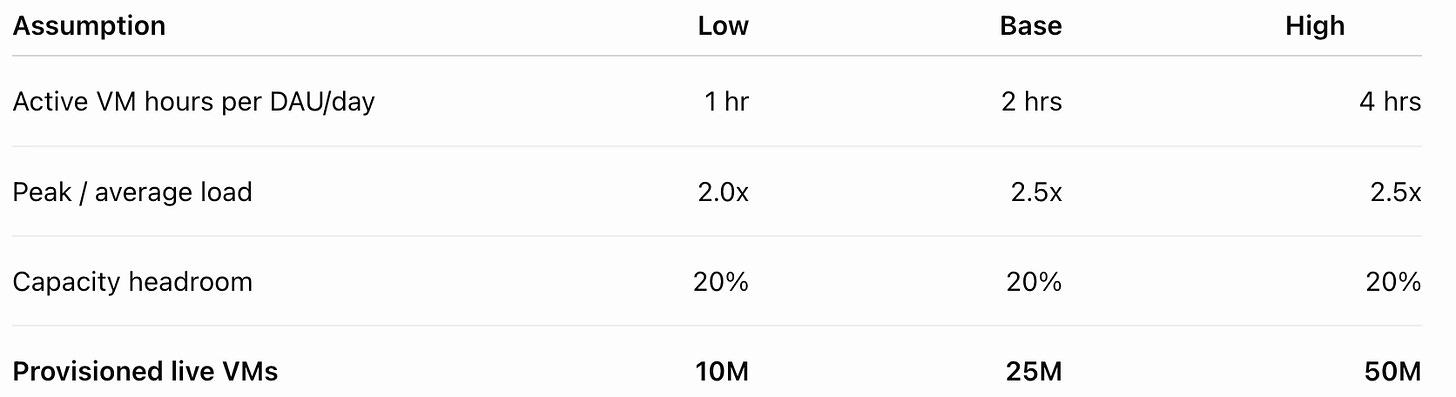
The first mistake is assuming that**100M DAU means 100M VMs are actively consuming compute at the same time**\.
Suppose the average Muse DAU has an agent actively working for two hours per day\.
100M users \* 2 hours / 24 hours = ~8M average simultaneous active VMs
Meta obviously cannot provision only for the daily average\. Usage will be concentrated during waking hours and bursty\.
Assume a 2\.5x peak\-to\-average ratio:
8M \* 2\.5 = ~20M peak active VMs
Then add roughly 20% capacity headroom:**~25M provisioned live VMs\.**So the base assumption is effectively that Meta needs enough infrastructure to support roughly**25% of DAU being live simultaneously**\.
[](https://substackcdn.com/image/fetch/$s_!Rk_q!,f_auto,q_auto:good,fl_progressive:steep/https%3A%2F%2Fsubstack-post-media.s3.amazonaws.com%2Fpublic%2Fimages%2F958cc7c7-8b76-4da9-80d1-7052b0deb327_1672x456.png)
The next important distinction is between**virtual CPU allocation**and**physical CPU demand**\. Agent sandboxes are particularly well suited to CPU oversubscription\. They spend a lot of time waiting\. During those periods, the VM may still be alive, but it is barely using CPU\.
DeepSeek’s recently published DSec infrastructure provides a useful benchmark\. Its production agent sandbox platform runs approximately**30,000 physical CPU cores and 250TB of DRAM across ~160 nodes**, with peak concurrency above**380,000 sandboxes**\.[DeepSeek DSec paper](https://arxiv.org/abs/2609.22978)\. DSec also demonstrates stable operation at around:**800 microVMs per node\.**With roughly 188 physical cores per node: 188 physical cores / 800 microVMs = ~0\.23 physical cores per live VM\.
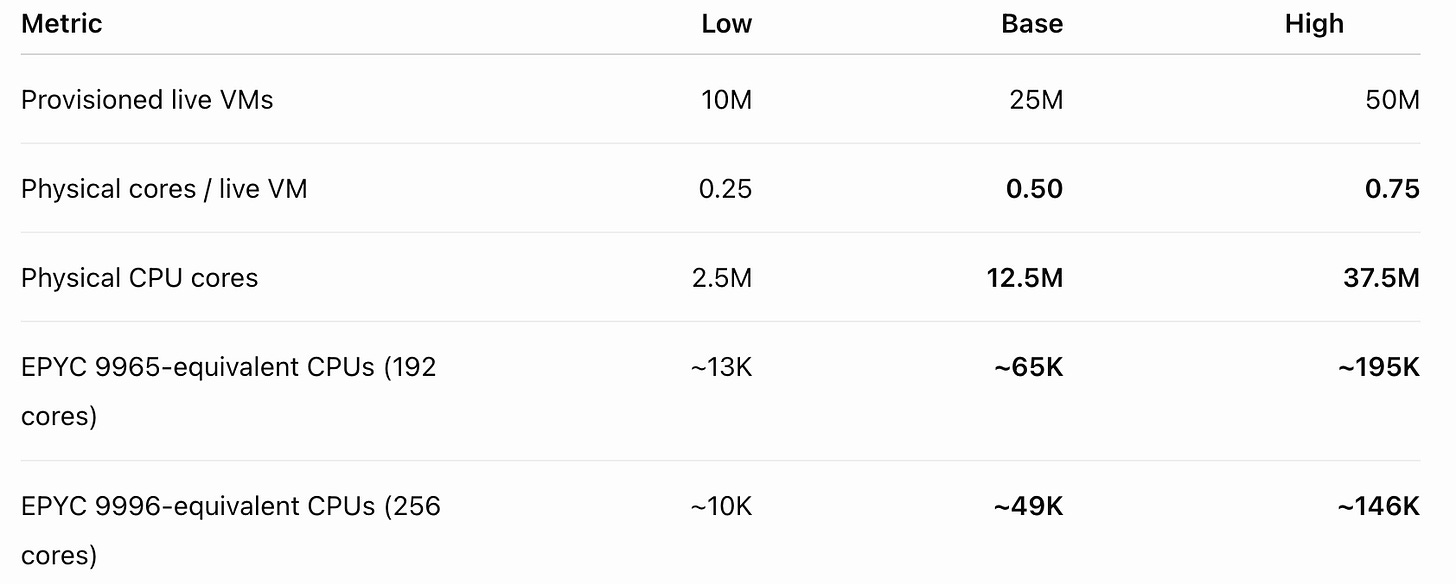
DeepSeek is obviously the King of efficiency\. The number for Muse might be at 0\.3\-0\.75 physical cores per live VM, or assume**0\.5 physical cores per live VM as the base case\.**That is equivalent to roughly**two simultaneously live Muse VMs per physical CPU core**\.
Using the base assumptions:**25M live VMs \* 0\.5 physical cores per VM = 12\.5M physical CPU cores\.**
On a 256\-core CPU: 12\.5M cores / 256 cores per CPU = ~50K CPUs; Or on a 192\-core CPU that would be 65K CPUs\.
**At the current public pricing, that is ~$800M\.**
[](https://substackcdn.com/image/fetch/$s_!h3Sq!,f_auto,q_auto:good,fl_progressive:steep/https%3A%2F%2Fsubstack-post-media.s3.amazonaws.com%2Fpublic%2Fimages%2F707b35ef-5681-4371-9c6e-fa61b918df5a_1684x676.png)
CPU can be aggressively oversubscribed because a VM that is waiting may consume almost no CPU\. Memory is harder to oversubscribe because a live VM still needs to retain its working state\.
Muse exposes roughly**8GB of RAM**to the user environment, but one observed instance was actually using only around**3GB**at the time of measurement\.
25M live VMs \* 3GB = 75PB of physical DRAM, call it ~75\-100PB of physical DRAM feels like a reasonable base range\.
**At the current public pricing, that is ~$2B\.**
**~0\.1 GW for the entire Muse sandbox / VM layer at 100M DAU\.**
Muse’s personal computer executes tools and stores state locally, but the actual model runs on separate inference infrastructure\.[Meta’s Muse architecture](https://research.meta.ai/blog/security-and-safety-for-ai-agents-our-approach-with-muse)
Microsoft’s 2026 study estimates that optimized frontier\-scale inference consumes a median of approximately:**0\.31Wh per normal query**
But a long reasoning query with roughly 15x the token count consumes approximately 13x as much energy, or around:**4Wh per long reasoning query**
The study specifically highlights reasoning and agentic workloads as significantly more energy intensive\.[Microsoft Research on AI inference energy](https://www.microsoft.com/en-us/research/publication/energy-use-of-ai-inference-efficiency-pathways-and-test-time-scaling/?utm_source=chatgpt.com)
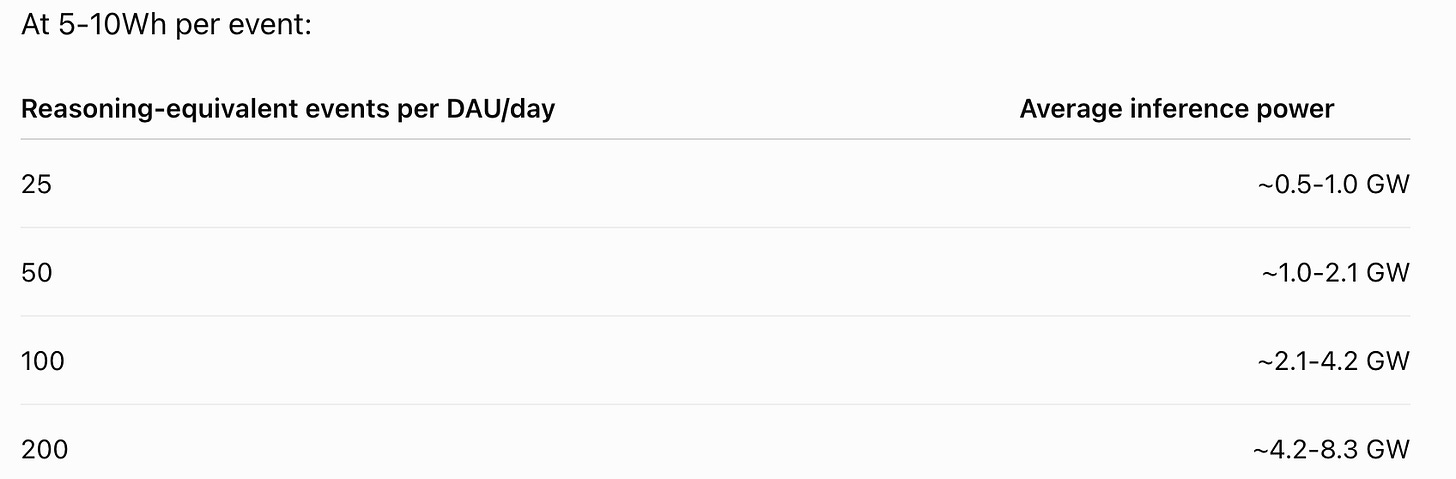
For a Muse\-like workload, let’s assume**5\-10Wh per heavy reasoning\-equivalent inference event**as a rough sensitivity range\.
Assume 50 reasoning\-equivalent events per DAU per day
Suppose each active Muse user generates the equivalent of 50 heavy inference events per day\.
At 5Wh each:
100M users \* 50 events/day \* 5Wh = 25GWh/day
25GWh/day / 24 hours = ~1\.0GW average power
So inference alone could require:**~1\-2GW of average power**
[](https://substackcdn.com/image/fetch/$s_!QYgl!,f_auto,q_auto:good,fl_progressive:steep/https%3A%2F%2Fsubstack-post-media.s3.amazonaws.com%2Fpublic%2Fimages%2F3883608c-7bda-4731-800d-bf10da4d2d75_1696x558.png)
So a**3\-4GW Muse**is entirely plausible\. Maybe that’s why Meta is rumored to be adding 7\-10GW of compute next year\.
The popular framing around Muse is that giving every user**2 vCPUs and 8GB of RAM**creates an enormous CPU requirement\. But the naive calculation materially exaggerates the CPU requirement because it treats logical VM allocation as dedicated physical infrastructure\.
The more interesting conclusion is:**Consumer agents may be a meaningful new demand driver for CPUs and conventional DRAM, but inference remains the real compute bottleneck\.**And as agents do more work, run longer trajectories and increasingly spawn other agents,**inference demand can scale much faster than the number of users itself\.**
#### Discussion about this post
### Ready for more?