Woxi is an open-source Wolfram Language interpreter implemented in Rust, offering a browser playground, CLI, Jupyter kernel, and notebook editor.
Woxi is an interpreter for the Wolfram Language written in Rust.<p>It comes with Woxi Studio, a Mathematica-like GUI built with iced, but you can also use Woxi through a CLI, Jupyter kernel, Python package, npm package, or WASM module.<p>Compared with wolframscript / Mathematica, the main differences are:<p>- Free and open source
- Very fast startup - Typically milliseconds rather than seconds for the Wolfram kernel, making Woxi practical for shell scripts, one-liners, and other short-lived processes
- Embeddable - It can run in a browser via WASM or be embedded into another application as a scripting language<p>A more detailed comparison with Mathematica is available here:
<a href="https://woxi.ad-si.com/docs/comparison/mathematica/" rel="nofollow">https://woxi.ad-si.com/docs/comparison/mathematica/</a>.<p>Conformance is ensured with ~26'000 unit tests and ~900 .wls script snapshot tests.<p>The current focus is on fixing remaining edge cases, improving performance, and growing the community.<p>If you use the Wolfram Language, I'd be particularly interested in feedback on compatibility and missing functionality.
Contributions and bug reports are also very welcome: <a href="https://github.com/ad-si/Woxi" rel="nofollow">https://github.com/ad-si/Woxi</a>
# Woxi — Wolfram Language interpreter in Rust
Source: [https://woxi.ad-si.com/](https://woxi.ad-si.com/)
Wolfram Language interpreter implemented in Rust\.
---
Examples:
Everything runs locally in your browser\. No data is sent anywhere\.
### Output
![Plot of Sin[x], a bar chart, and a number line plot](https://woxi.ad-si.com/default-row1.svg)

---
## Other ways to use Woxi
The playground above is one of several Woxi front\-ends — the same interpreter powers a full\-screen playground, a command\-line tool, a Jupyter kernel \(also runnable in the browser via JupyterLite\), and a native notebook editor\.
[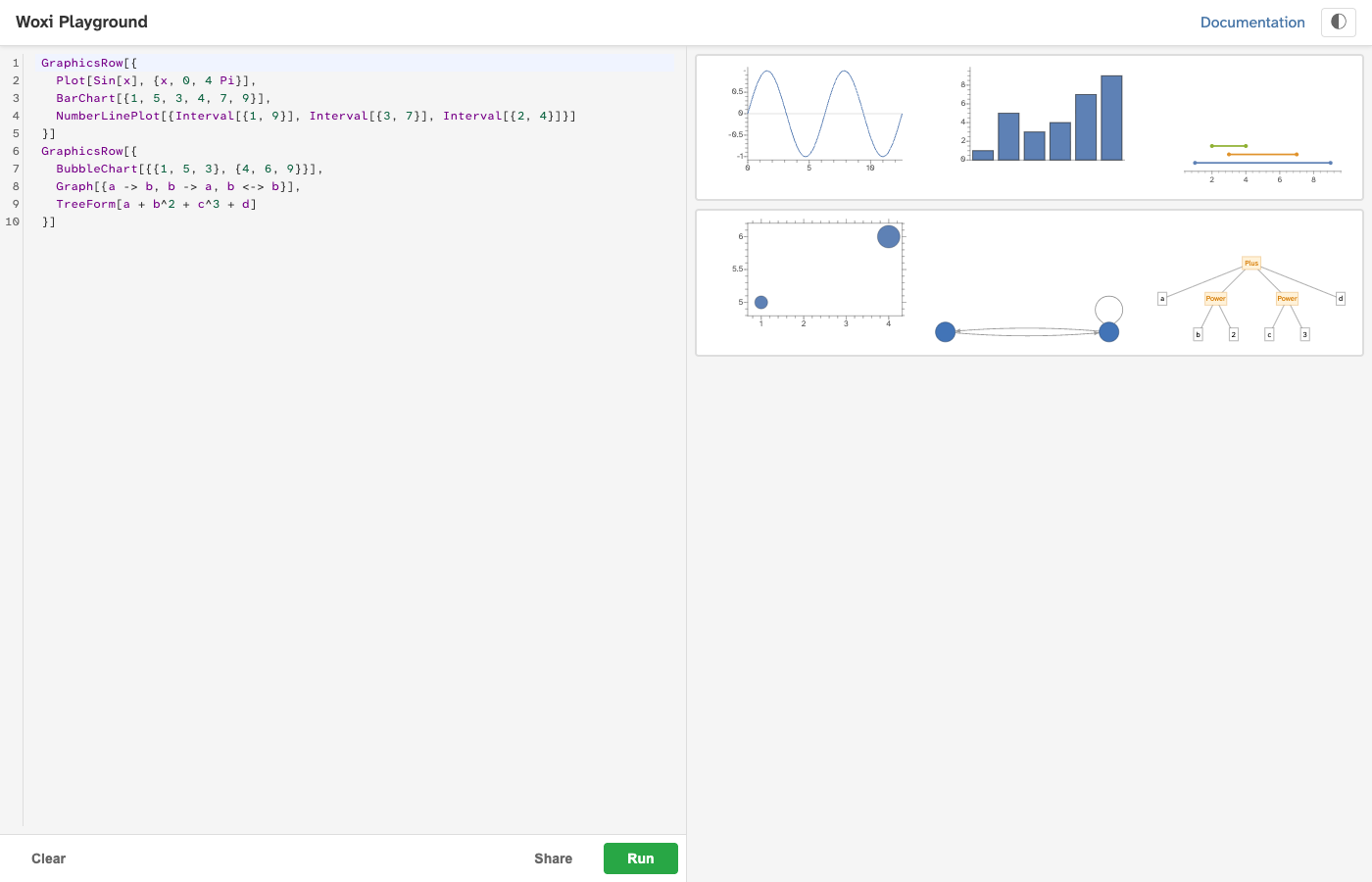 ### Extended playground Side\-by\-side editor and output pane with more room to explore\. Great for multi\-line expressions and experimenting with graphics\. Open the full playground →](https://woxi.ad-si.com/playground/)[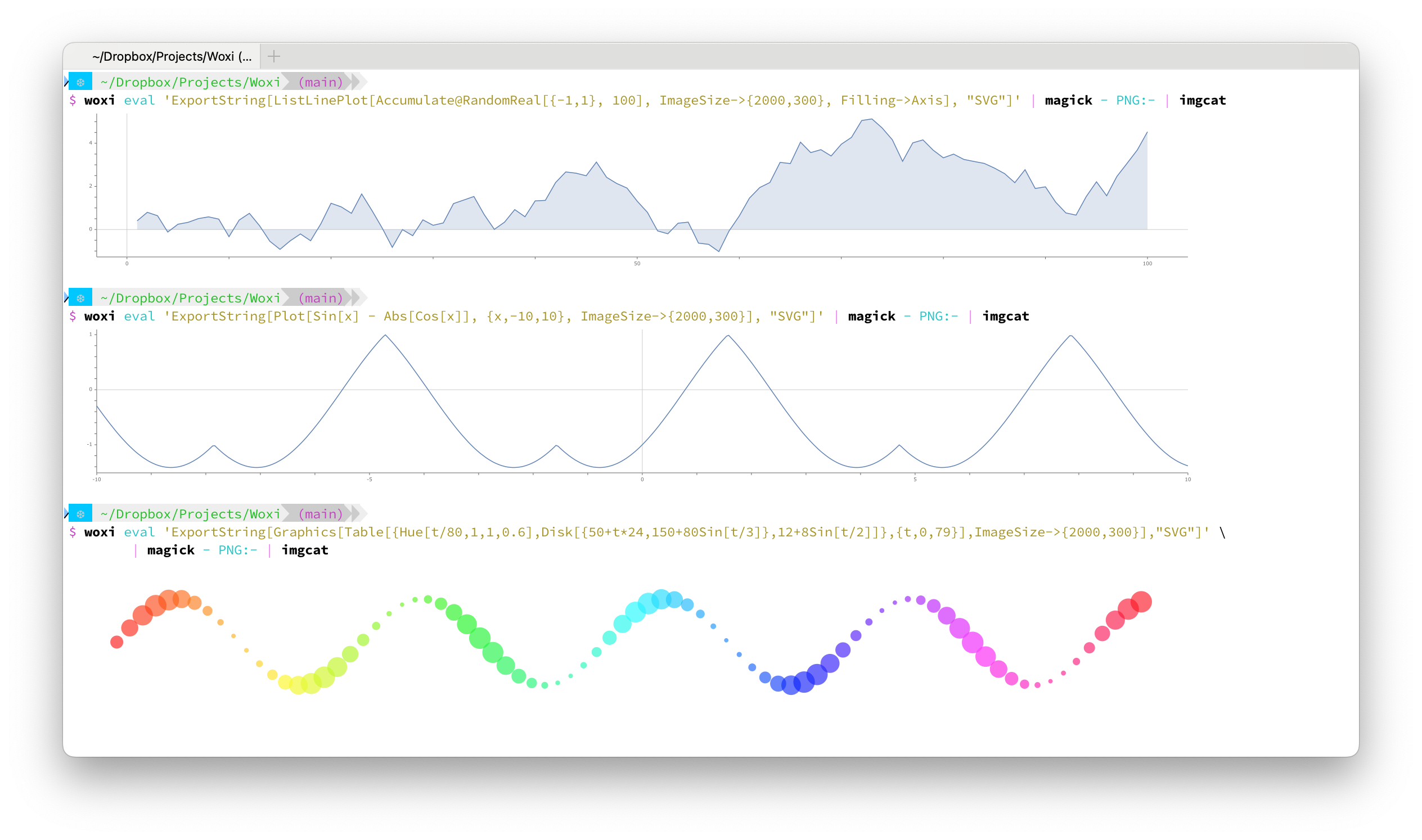 ### Command\-line tool Evaluate expressions with`woxi eval`, run`\.wls`scripts directly, or use Woxi as a shebang interpreter\. Faster to start than`wolframscript`\. See the scripting guide →](https://woxi.ad-si.com/docs/scripting/)[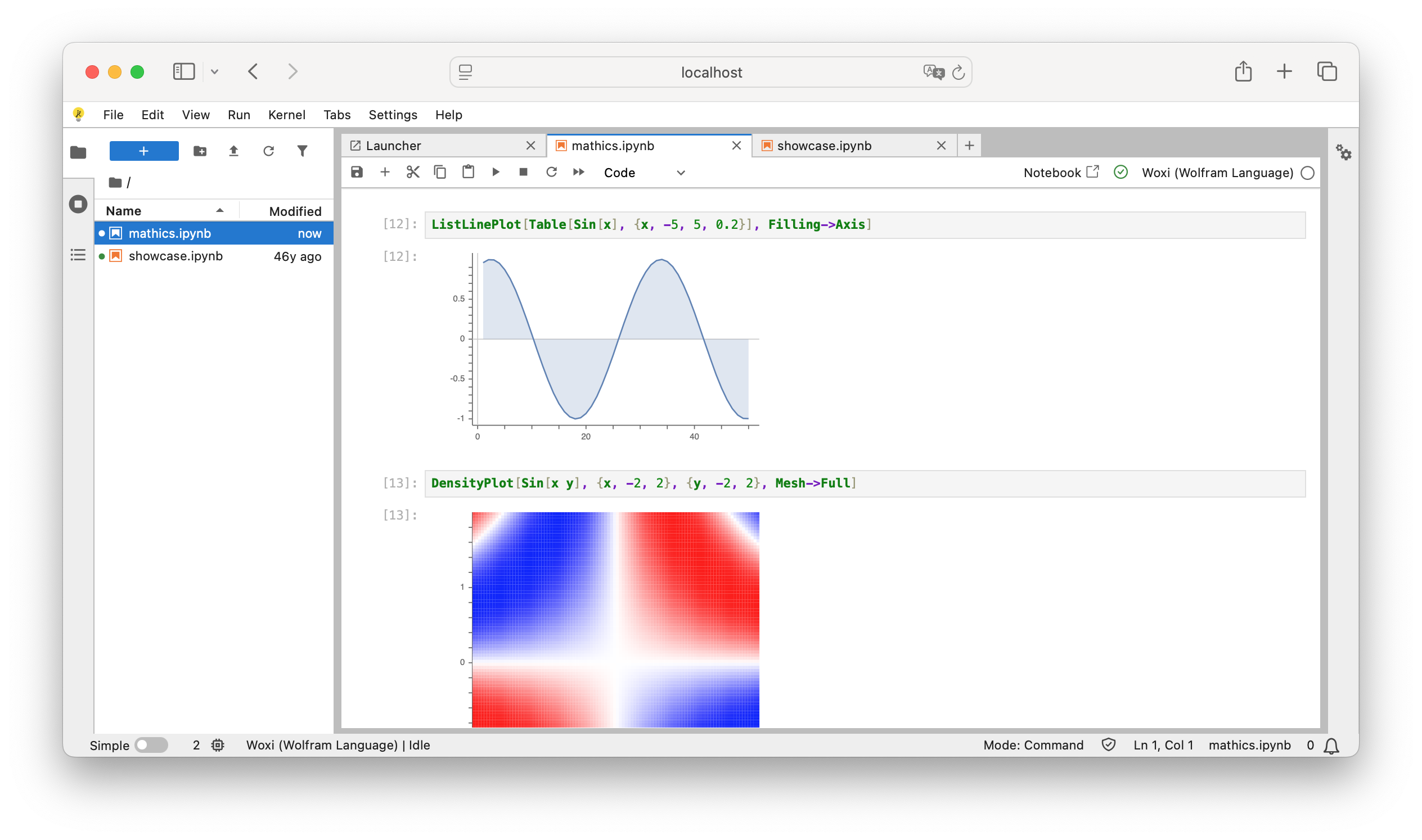](https://woxi.ad-si.com/jupyterlite/lab/index.html?path=showcase.ipynb)
### Jupyter & JupyterLite
Woxi ships as a Jupyter kernel\. Install it locally with`woxi install\-kernel`, or run the full notebook experience in your browser via the bundled[JupyterLite instance](https://woxi.ad-si.com/jupyterlite/lab/index.html?path=showcase.ipynb)— no install required\.
[Read the Jupyter guide →](https://woxi.ad-si.com/docs/jupyter/)
[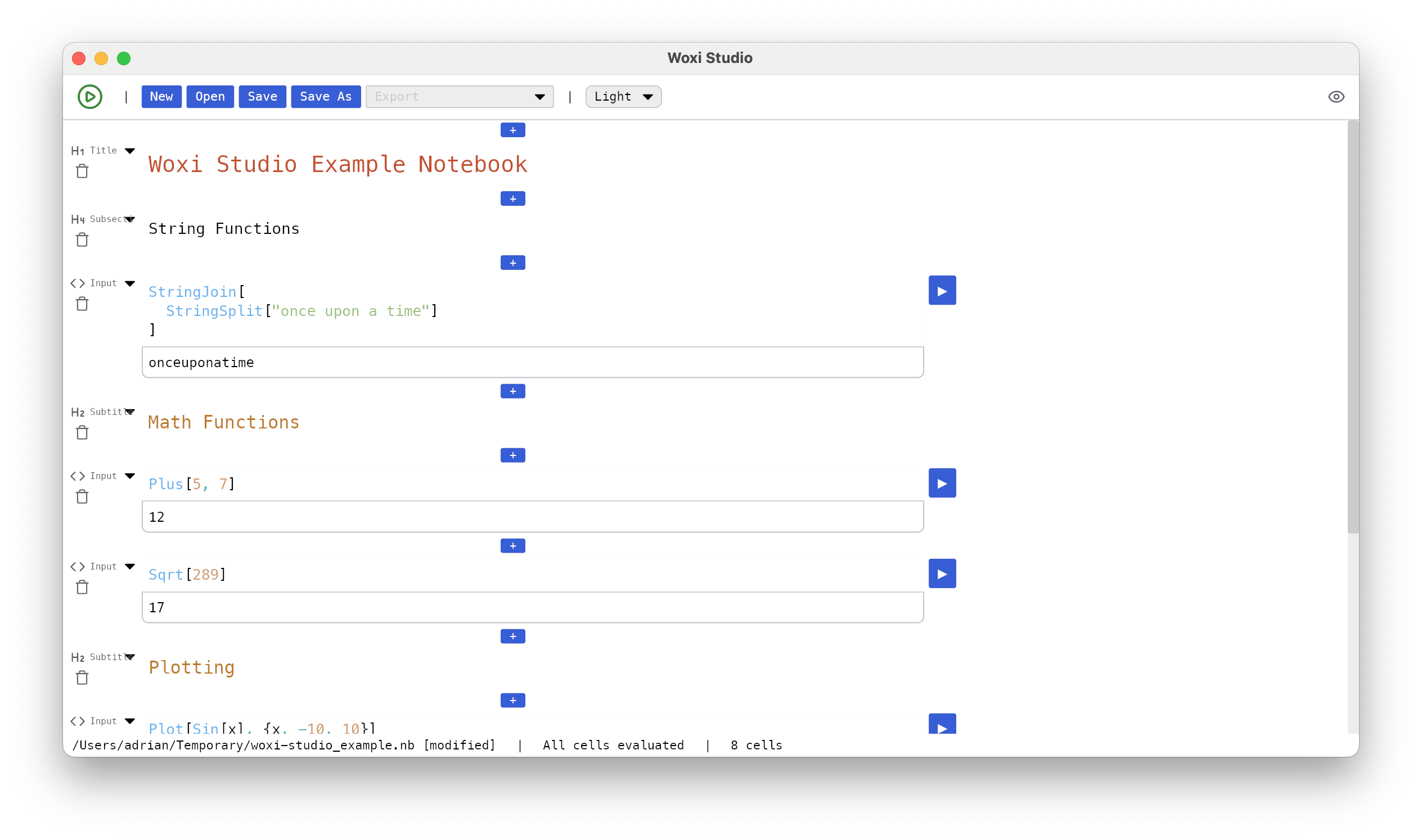 ### Woxi Studio Native notebook editor for Wolfram Language`\.nb`files\. Cell\-based editing, inline graphics, and export to`\.ipynb`, Markdown, LaTeX, Typst, and PDF\. Read the documentation →](https://woxi.ad-si.com/docs/studio/)
Rhun is a small, fast, open-source code editor written in assembly, offering tabs, syntax highlighting, fuzzy search, Vim mode, and an optional AI coding agent across Windows, Linux, and macOS.
Rex is a statically typed, pure functional workflow language designed for scientific computing and data processing, featuring parallel execution, content-addressable storage, and Docker isolation.
Wu is a fast, native code editor written in Rust that aims to deliver native-app speed while keeping the familiar feel of VS Code. Open sourced and launched on Product Hunt under the productivity and developer-tools categories.
Waku is a native application built with Rust and GPUI that unifies the management of coding agent CLIs, offering local-first storage, keyboard-driven control, and checkpointing features for seamless developer workflows.
Wyrm is an open-source symbolic algebra engine in TypeScript that powers a gesture-based algebra app for iOS and Android. It guarantees soundness by construction through conditional rewrite rules, allowing users to solve equations by touch.