@GitHub_Daily: Making indie games or 3D printing models, once the model is built and you get to the texturing step, mainstream softwar…
Summary
ArmorPaint is an open-source 3D PBR texture painting tool that uses GPU acceleration and now includes locally-run AI nodes for generating textures from text or photos, compatible with multiple platforms.
View Cached Full Text
Cached at: 09/14/26, 09:21 AM
Making indie games or 3D printing models, once the model is built and you get to the texturing step, mainstream software requires yearly subscriptions, and students and indie developers end up shelling out money that really hurts.
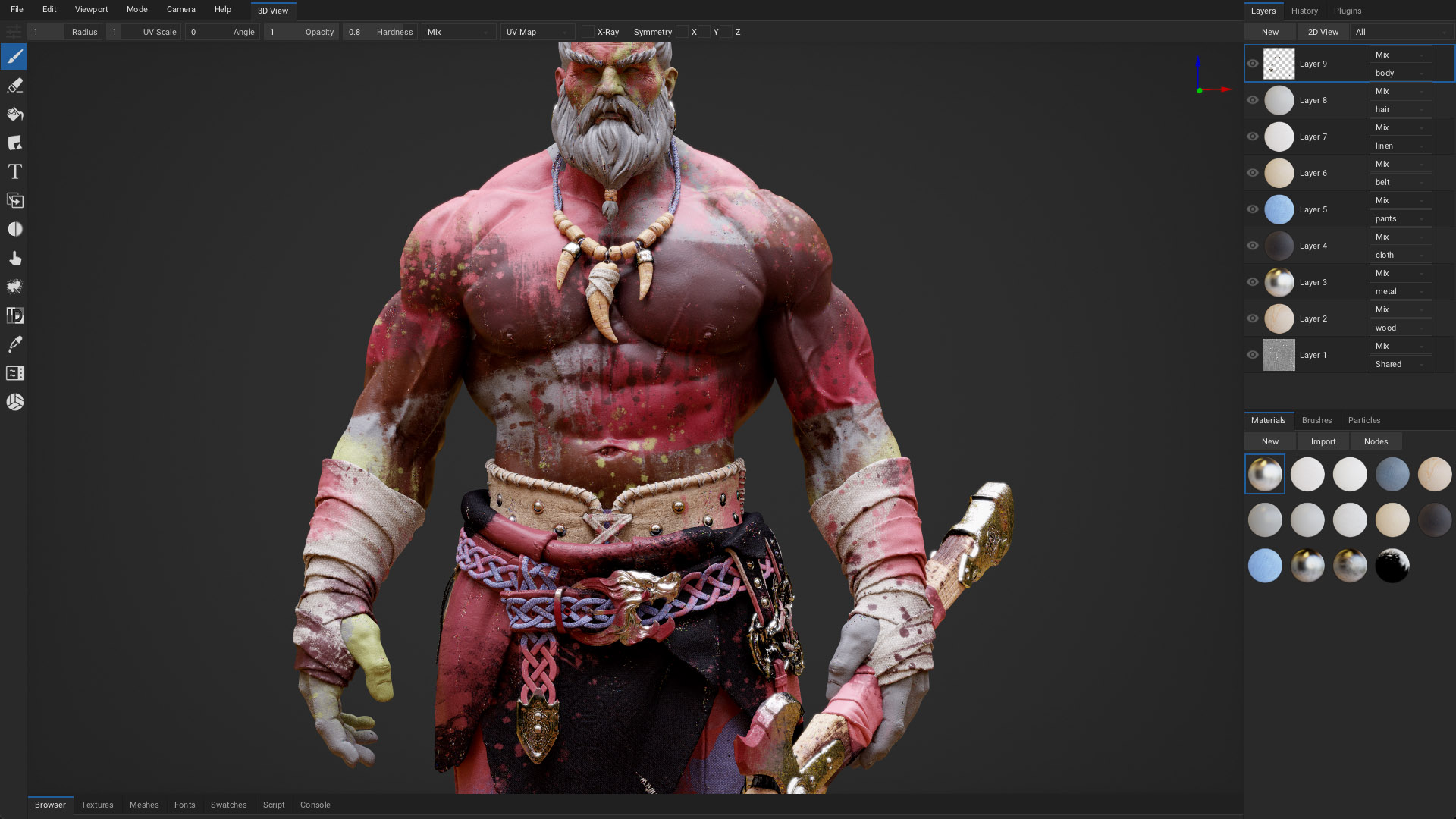
ArmorPaint takes the open-source route, specifically designed for 3D PBR texture painting. Just drag the model in and paint directly on it, with real-time lighting effects visible right in the viewport.
It’s entirely built from scratch around the GPU, so even a mid-range integrated graphics card can smoothly handle 4K texturing, and on high-end GPUs, 16K doesn’t lag either.
Materials and brushes are all node-based, allowing for fully procedural materials and fill layers.
Baking, drawing effects, and viewport rendering all use ray tracing, and it even comes with real-time integration plugins for Blender, Unreal, and Unity.
GitHub: http://github.com/armory3d/armorpaint…
The new version adds locally-run AI nodes, where a piece of text or a photo can generate seamless textures, and photos can even be broken down into separate maps for color, height, normal, and roughness.
After downloading the model, no internet connection is needed, and VRAM is recommended to be 6GB or more.
It runs on Windows, Linux, macOS, iOS, and Android, with the desktop version being portable (no installation required), and the installer package is under 10MB.
armory3d/armorpaint
Source: https://github.com/armory3d/armorpaint
armorpaint
ArmorPaint is a software for 3D PBR texture painting - check out the manual.
Note 1: This repository is aimed at developers and may not be stable. Distributed binaries are paid to help with the project funding. All of the development is happening here in order to make it accessible to everyone. Thank you for support!
Note 2: If you are compiling git version of ArmorPaint, then you need to have a compiler (Visual Studio with clang tools - Windows, clang + dependencies - Linux, Xcode - macOS / iOS, Android Studio - Android) and git installed.
git clone https://github.com/armory3d/armorpaint
cd armorpaint/paint
Windows (x64)
..\base\make
# Open generated Visual Studio project at `build\ArmorPaint.sln`
# Build and run
Linux (x64)
../base/make --run
macOS (arm64)
../base/make
# Open generated Xcode project at `build/ArmorPaint.xcodeproj`
# Build and run
Android (arm64)
../base/make --target android
# Open generated Android Studio project at `build/ArmorPaint`
# Build for device
iOS (arm64)
../base/make --target ios
# Open generated Xcode project `build/ArmorPaint.xcodeproj`
# Build for device
WASM
../base/make --target wasm --compile --embed
Generating a locale file
./base/make --js base/tools/extract_locales.js <locale code>
# Generates a `paint/assets/locale/<locale code>.json` file
Embedding data files
# Requires compiler with c23 #embed support (clang 19 or newer)
../base/make --embed
Similar Articles
armory3d/armorpaint
ArmorPaint is a software tool for 3D PBR texture painting, with a GitHub repository providing build instructions and notes on distribution for developers.
@IndieDevHailey: Qunhe has just launched its self-developed 3D generation model Lux3D. With just an image or a sentence, it can produce mesh + PBR materials, with the fastest mode taking about 20 seconds. The material performance for glass, metal, and ceramics is a highlight, and it supports Harness for batch generation, with integration for Codex / Blender.
Qunhe has released its self-developed 3D generation model Lux3D, which supports quick generation of mesh and PBR materials from images or text, with a maximum speed of 20 seconds, and is compatible with tools like Blender.
Anyone tried self-hosting 3D object generation?
The author shares personal experiences testing self-hosted AI tools for creating 3D models and simple games, discussing challenges with limited hardware and potential workflow setups.
@oliviscusAI: Someone just open-sourced a desktop app that generates 3D models from images and runs 100% locally. It's called Modly. …
Modly is an open-source desktop app that generates fully textured 3D meshes from images, running 100% locally on your GPU with pluggable AI model extensions.
DALL·E: Introducing outpainting
OpenAI introduces Outpainting for DALL·E, enabling users to extend generated or uploaded images to create large-scale images in any aspect ratio while maintaining visual consistency with shadows, reflections, and textures.