Hackers have quickly created functional Doom ports for the Neo Geo, disproving earlier claims that such a port was impossible due to hardware limitations, using clever workarounds like the console's fix layer and sprite memory.
<p>Last month, we passed along Modern Vintage Gamer's (MVG) confident assertion that <a href="https://arstechnica.com/gaming/2026/06/why-a-neo-geo-port-of-doom-is-functionally-impossible/"><em>Doom</em> is functionally impossible to run on the Neo Geo</a>, owing to the console's sprite-based display hardware and lack of a frame buffer. We all should have known better than to tell a dedicated group of hackers that something is "impossible," though, as two recent projects have made great progress toward functional <em>Doom</em> ports on stock Neo Geo hardware.</p>
<div class="ars-video ars-video--horizontal"><div><div class="relative" allow="fullscreen" loading="lazy" src="https://www.youtube.com/embed/VJwffCeo4jU?start=0&wmode=transparent"></div></div></div>
<p>Both of these projects have significant graphical compromises that limit how viable they would have been for a marketable, '90s-era console port, as <a href="https://www.youtube.com/watch?v=VJwffCeo4jU">MVG lays out in a new video</a>. Still, they stand as a testament to the surprising results that clever, determined coders can coax out of legacy hardware.</p>
<h2>It looks like <em>Doom</em> if you squint</h2>
<p>To create the <a href="https://github.com/FrenkelS/Doom64KB">Doom64KB</a> project for the Neo Geo, coder FrenkelS adapted <a href="https://github.com/FrenkelS/Doom8088">an earlier <em>Doom</em> port</a> they designed to run on 16-bit PC processors like the 8088 and 286. Using that engine, the Neo Geo code then makes a kind of proto-frame-buffer out of <a href="https://wiki.neogeodev.org/index.php/Fix_layer">the console's fix layer</a>, an area of display memory that's usually used to display menus and HUD information on top of gameplay.</p><p><a href="https://arstechnica.com/gaming/2026/07/hackers-quickly-prove-that-neo-geo-doom-ports-are-not-impossible/">Read full article</a></p>
<p><a href="https://arstechnica.com/gaming/2026/07/hackers-quickly-prove-that-neo-geo-doom-ports-are-not-impossible/#comments">Comments</a></p>
# Hackers quickly prove that Neo Geo Doom ports are not "impossible"
Source: [https://arstechnica.com/gaming/2026/07/hackers-quickly-prove-that-neo-geo-doom-ports-are-not-impossible/](https://arstechnica.com/gaming/2026/07/hackers-quickly-prove-that-neo-geo-doom-ports-are-not-impossible/)
Last month, we passed along Modern Vintage Gamer’s \(MVG\) confident assertion that[*Doom*is functionally impossible to run on the Neo Geo](https://arstechnica.com/gaming/2026/06/why-a-neo-geo-port-of-doom-is-functionally-impossible/), owing to the console’s sprite\-based display hardware and lack of a frame buffer\. We all should have known better than to tell a dedicated group of hackers that something is “impossible,” though, as two recent projects have made great progress toward functional*Doom*ports on stock Neo Geo hardware\.
Both of these projects have significant graphical compromises that limit how viable they would have been for a marketable, ’90s\-era console port, as[MVG lays out in a new video](https://www.youtube.com/watch?v=VJwffCeo4jU)\. Still, they stand as a testament to the surprising results that clever, determined coders can coax out of legacy hardware\.
## It looks like*Doom*if you squint
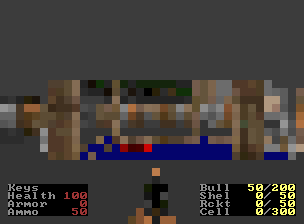
To create the[Doom64KB](https://github.com/FrenkelS/Doom64KB)project for the Neo Geo, coder FrenkelS adapted[an earlier*Doom*port](https://github.com/FrenkelS/Doom8088)they designed to run on 16\-bit PC processors like the 8088 and 286\. Using that engine, the Neo Geo code then makes a kind of proto frame buffer out of[the console’s fix layer](https://wiki.neogeodev.org/index.php/Fix_layer), an area of display memory that’s usually used to display menus and HUD information on top of gameplay\.
[](https://cdn.arstechnica.net/wp-content/uploads/2026/07/doom64kb.png)
If this is what*Doom*usually looks like to you, consult an eye doctor immediately\.
If this is what*Doom*usually looks like to you, consult an eye doctor immediately\.Credit:[Doom64KB](https://github.com/FrenkelS/Doom64KB)
By rendering to this fix layer, the Doom64KB engine can animate a relatively smooth version of*Doom*maps, albeit one that uses chunky, 8×8 pixel tiles at an effective resolution 28×32 \(and just 16 colors, limiting the “light diminishing” effect as walls recede into the distance\)\. A slight modification of the same idea builds a frame buffer from the Neo Geo’s sprite memory, increasing the effective resolution to 80×56 by using 4×4\-pixel blocks\. While that increase comes at a noticeable cost to frame rate, things could get smoother with further optimization or with overclocked hardware like that on[the upcoming Neo Geo AES\+](https://plaionreplai.com/products/neogeo-aes)\.
A technical analysis explains why porting Doom to the Neo Geo console is functionally impossible due to hardware limitations, though a simpler raycasting demo approximating Wolfenstein 3D is possible.
A detailed technical analysis of why the fastDOOM port achieves significant performance improvements over the original Doom executable, covering the history of Doom's source code lineage and specific optimization techniques.
MIT researcher Lauren Ramlan published a paper demonstrating that the classic game Doom can be played on a display made from E. coli cells, though at an extremely slow frame rate that would take centuries to complete a single playthrough.
The author revives his custom bytecode VM (UVM) and builds a Clang backend by parsing textual LLVM IR with AI assistance, successfully porting Doom to the VM.
A developer describes porting Perfect Dark 64 levels to noclip.website, highlighting the challenges of reading N64 display lists and reimplementing the rendering engine.