Cached at:
08/28/26, 03:56 PM
# An update on AI’s most important number
Source: [https://epochai.substack.com/p/an-update-on-ais-most-important-number](https://epochai.substack.com/p/an-update-on-ais-most-important-number)
*This post is part of Epoch AI’s[Gradient Updates](https://epochai.substack.com/s/gradient-updates)newsletter, which shares more opinionated or informal takes on big questions in AI progress\. These posts solely represent the views of the authors, and do not necessarily reflect the views of Epoch AI as a whole\.*
OpenAI and Anthropic are growing about as fast, or[faster](https://epoch.ai/gradient-updates/openai-is-projecting-unprecedented-revenue-growth)than any company of their size has grown in history\. It’s[extremely rare](https://www.exponentialview.co/p/can-openai-reach-100-billion-by-2027)for a tech company making more than $1 billion to be growing over 100% per year\.[1](https://epochai.substack.com/p/an-update-on-ais-most-important-number#footnote-1)
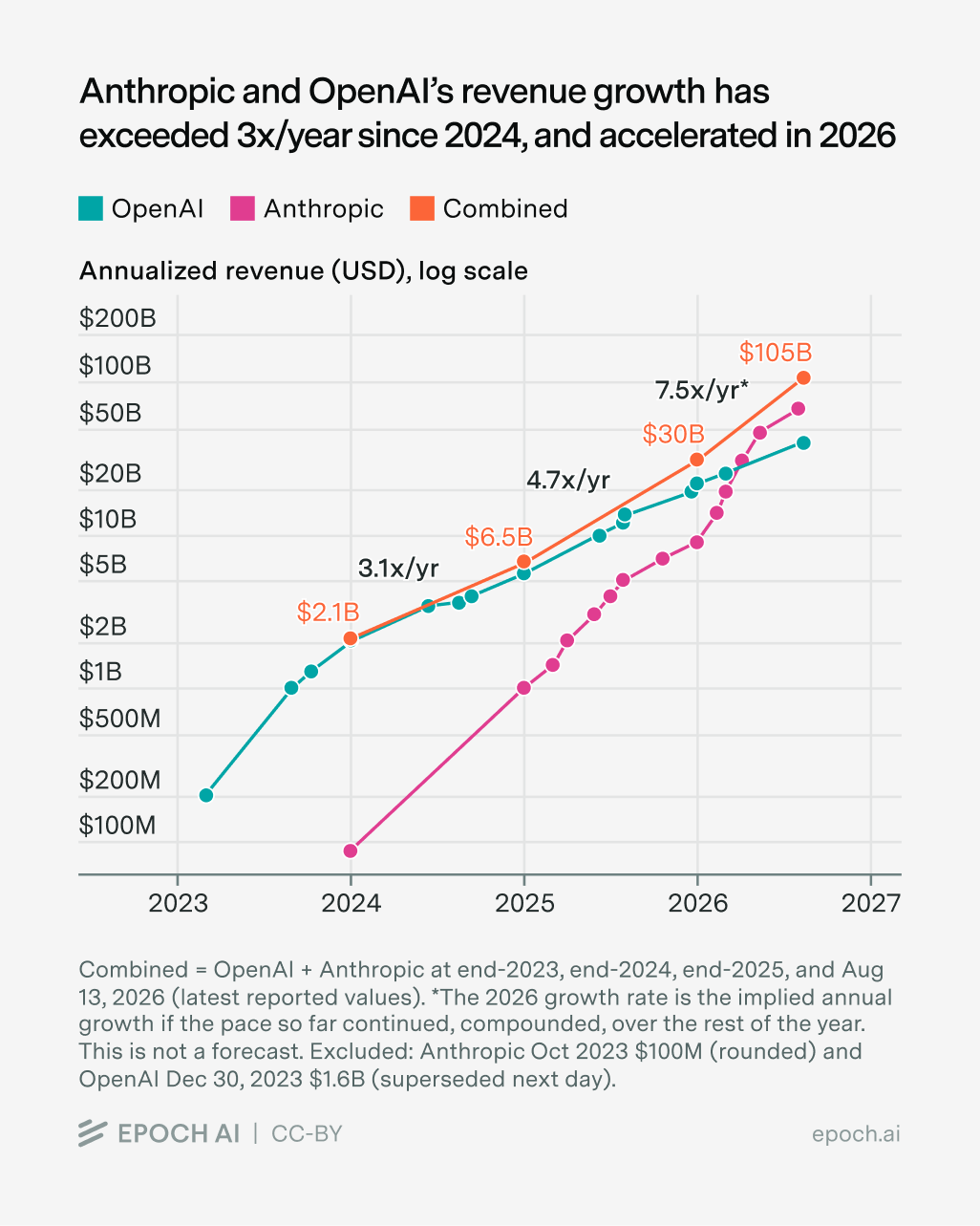
In fact, both labs are way above that threshold\. OpenAI tripled its revenue run rate \(recent revenue extrapolated to an annual rate\) in the past year, from $13 billion last August to over $40 billion now\. Anthropic grew its revenue from $1 billion to $9 billion in 2025, and its growth rate*accelerated*from there: Anthropic more than tripled its run rate in just the first quarter of 2026\.[Reportedly](https://www.axios.com/2026/08/17/anthropic-revenue-run-rate-ipo-openai), it reached $65 billion by the end of July\.[2](https://epochai.substack.com/p/an-update-on-ais-most-important-number#footnote-2)
Now, some of these eye\-popping Anthropic growth rates should be taken with a caveat: Anthropic was coming from behind and overtaking its initially larger rival, OpenAI\.[3](https://epochai.substack.com/p/an-update-on-ais-most-important-number#footnote-3)To factor this out, we might look at Anthropic and OpenAI combined\. Their growth rates have been both extremely rapid and remarkably robust since 2023: together, they tripled in 2024, and then grew more than fourfold in 2025\. And this year they’ve already grown by 3\.5×, from $30B to $105B combined, and it’s only August\! Remember: the 2025 growth rates were already record\-breaking, and now these labs are growing*faster*from a*higher*baseline\.[4](https://epochai.substack.com/p/an-update-on-ais-most-important-number#footnote-4)
[](https://substackcdn.com/image/fetch/$s_!zHKQ!,f_auto,q_auto:good,fl_progressive:steep/https%3A%2F%2Fsubstack-post-media.s3.amazonaws.com%2Fpublic%2Fimages%2F61ba2f0b-1802-426e-b6f6-f49cac44f93e_1026x1283.png)
*A priori*, it’s natural to think that 3× or 4× annual growth of an industry the scale of frontier AI today is just unsustainable\. Perhaps LLMs are seeing rapid technical progress and rapid diffusion because these technologies are so new\. But as these companies grow, especially when they approach the size of the[largest firms](https://companiesmarketcap.com/largest-companies-by-revenue/)in the world today with hundreds of billions in annual revenue, this growth will slow\. The frontier labs will run out of technical low\-hanging fruit, their models and products will mature, and the adoption curves will saturate\. Revenue growth rates will slow down, from 3× per year to 2×, then 50% per year, then 20\-30% per year \(a la mature tech giants in recent years\)\.
In this light, the fact that revenue growth was so robust in 2025 vs 2024 was surprising, and the 2026 acceleration is simply astonishing\. So how should we interpret it?
One approach is to see this as a temporary acceleration, driven by the labs’ coding agents reaching a critical threshold around the time Opus 4\.5 was released late last year\. We previously saw this pattern with ChatGPT’s original launch\. GPT\-3 was a niche product earning OpenAI at most tens of millions of dollars in revenue per year\.[5](https://epochai.substack.com/p/an-update-on-ais-most-important-number#footnote-5)ChatGPT, and the subsequent GPT\-4, led to an explosion in usage growth and revenue, taking OpenAI to $1 billion annualized in 2023, or more than tenfold growth\. OpenAI’s revenue growth then slowed down to 3× in 2024\.
Similarly, the explosion in revenue from coding agents might settle down very quickly in the coming months, and frontier AI might finally enter a period of decaying growth and maturation\. Of course, this depends on what critical thresholds lie beyond Opus 4\.5\-level coding agents — e\.g\. undertaking large projects, or going outside coding to broadly automate white collar work\. Given that growth curves are often just a series of[stacked S\-curves](https://www.writingsbyraykurzweil.com/the-law-of-accelerating-returns), we’re left with the question of how many of these thresholds lie ahead of AI now\.
Will the unusual pace of growth continue? Each year that frontier growth does not slow down could be interpreted as evidence that AI is simply defying gravity\. Unlike other tech industries that mature and saturate their markets, AI is simply on a path to automate and transform the entire economy\. Or, will this be just the last major growth spurt in frontier LLMs, or AI generally? Gravity may reassert itself, and frontier AI’s growth will slow down to match previous industries\.
The answer partly depends on whether revenue growth comes from*progress*or*diffusion*\. Progress continues as long as progress continues\.[6](https://epochai.substack.com/p/an-update-on-ais-most-important-number#footnote-6)Diffusion meanwhile slows significantly after a few years\. Obviously, both have played a key role in the revenue growth of the last four years\. But it matters whether each new level of capabilities creates its own diffusion curve, which suggests each step up leads to further revenue growth, or whether frontier AI in general just saturates\.
Anthropic and OpenAI together are now earning revenue at a rate of $100 billion per year\. Exponential View estimates that the whole generative AI market is[approaching $200B/year](https://intelligence.exponentialview.co/assets/ev-state-of-ai-economy-2026.pdf)in total\. This is already around one\-thousandth the size of the[world economy](https://en.wikipedia.org/wiki/List_of_countries_by_GDP_(nominal))\.
This puts a real\-world handle on the usefulness of today’s AI\. Claude and GPT models are currently good enough that the world pays almost ten billion dollars per month to use them; if model progress flatlined tomorrow, revenue would almost certainly continue to grow for a while due to diffusion\. If both benchmark scores and revenue grow briskly in the next year and combined revenue exceeds $300 billion per year, then even if capabilities progress freezes starting in August 2027, AI will still eventually be a trillion\-dollar industry\.
But if frontier AI continues to grow its revenue 3× per year, or ~10× every two years, then naively — very naively — it would take about six years for it to grow to the size of the current world economy\.[7](https://epochai.substack.com/p/an-update-on-ais-most-important-number#footnote-7)This is not really a reasonable forecast, but it does provide a good frame to understand the*current*growth rate\. Either frontier AI growth slows down in the next six years, or it will have dramatically reshaped the entire economy\.[8](https://epochai.substack.com/p/an-update-on-ais-most-important-number#footnote-8)If frontier AI triples its revenue again in the next year, that’s one down, five left to go\.
This is why we’re watching these numbers so closely\. Each passing year, or frankly each passing quarter with continued hypergrowth in frontier AI revenue provides important evidence on AI’s trajectory\.[9](https://epochai.substack.com/p/an-update-on-ais-most-important-number#footnote-9)In the short run, it means that AI has proven substantially more useful than it was several months ago\. Revenue, and the investments motivated by that revenue, also feeds into the*compute feedback loop*, wherein better AI begets more revenue begets more compute begets better AI\.
But it’s also crucially important how*robust*this revenue growth is: when will we see the growth curve start to bend, if ever? This tells us whether frontier AI is on a fundamentally different trajectory than the technologies we’ve seen so far\.