Cached at:
09/10/26, 05:17 PM
# How Big Tech and Silicon Valley are Transforming the Military-Industrial Complex
Source: [https://costsofwar.watson.brown.edu/paper/how-big-tech-and-silicon-valley-are-transforming-military-industrial-complex](https://costsofwar.watson.brown.edu/paper/how-big-tech-and-silicon-valley-are-transforming-military-industrial-complex)
Paper
Anthropologist Roberto González \(Professor, San José State University\) examines how America’s military\-industrial complex has been rapidly expanding from the Capital Beltway to Silicon Valley\. Although much of the Pentagon’s budget is spent on conventional weapons systems, the Defense Department has increasingly sought to adopt AI\-enabled systems\. Big tech companies, venture capital, and private equity firms benefit from multi\-billion dollar Defense contracts, and smaller defense tech startups that “move fast and break things” also receive increased Defense funding\. Dr\. González's report illustrates how a growing portion of the Defense Department’s spending is going to large, well\-known tech firms, including some of the most highly valued corporations in the world\.
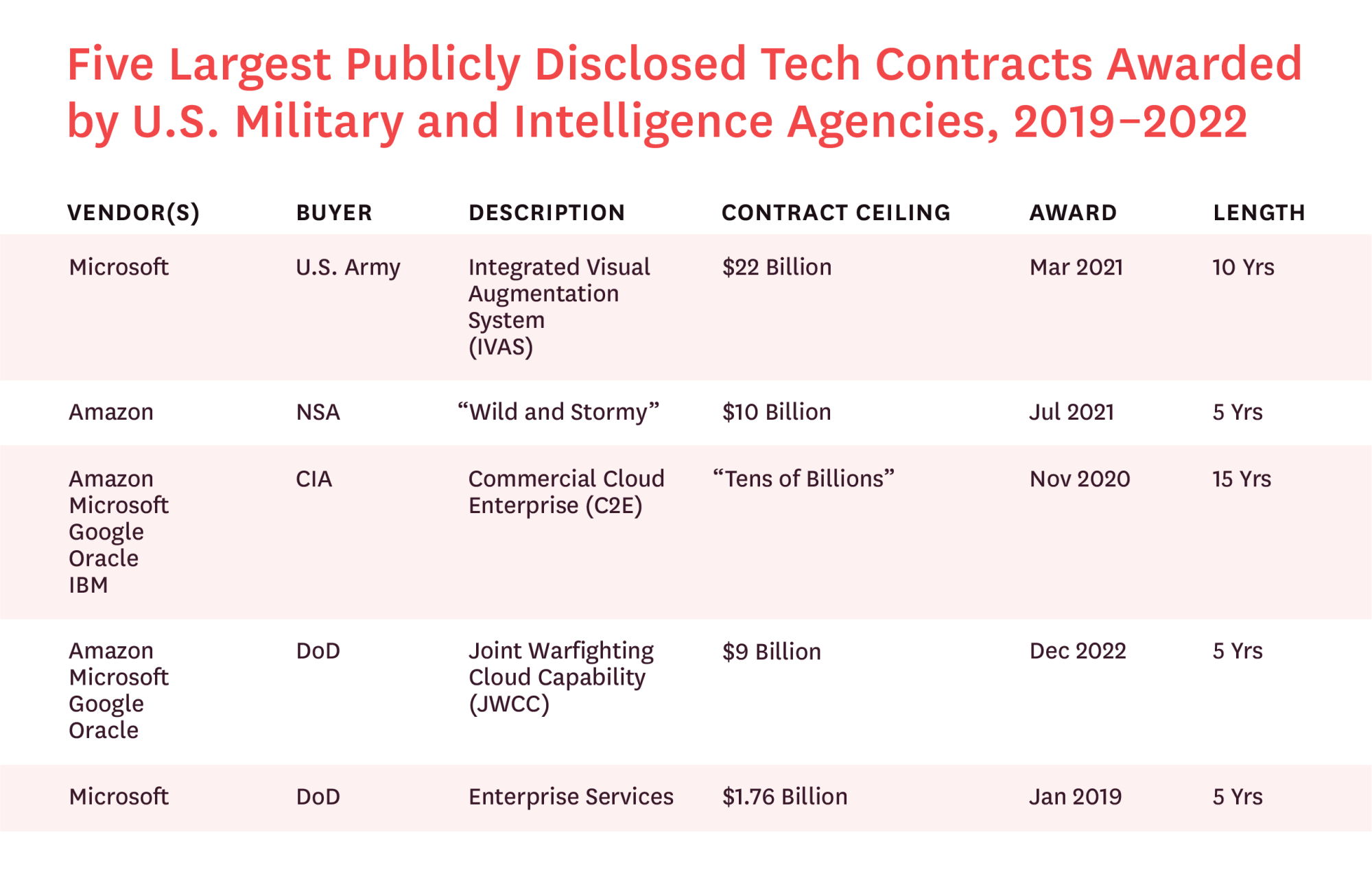
Given the often\-classified nature of large defense and intelligence contracts, a lack of transparency makes it difficult to discern the true amount of U\.S\. spending diverted to Big Tech\. Yet, research reveals that the amount is substantial, and growing\. According to the nonprofit research organization[Tech Inquiry](https://techinquiry.org/docs/InternationalCloud.pdf), three of the world’s biggest tech corporations were awarded approximately $28 billion from 2018 to 2022, including Microsoft \($13\.5 billion\), Amazon \($10\.2 billion\), and Alphabet, which is Google’s parent company \($4\.3 billion\)\. This paper found that the top five contracts to major tech firms between 2019 and 2022 had contract ceilings totaling at least $53 billion combined\.
From 2021 through 2023, venture capital firms[reportedly](https://pitchbook.com/news/articles/defense-tech-boom-ukraine-china-israel)pumped nearly $100 billion into defense tech startup companies — an amount 40 percent higher than the previous seven years combined\. This report examines how Silicon Valley startups, big tech, and venture capital who benefit from classified Defense contracts will create costly, high\-tech defense products that are ineffective, unpredictable, and unsafe – all on the American taxpayer’s dime\.
.png)
- [https://costsofwar.watson.brown.edu/people/roberto-gonzalez](https://costsofwar.watson.brown.edu/people/roberto-gonzalez)### [Roberto González](https://costsofwar.watson.brown.edu/people/roberto-gonzalez) Roberto J\. González is a cultural anthropologist whose work focuses upon science, technology, and society; militarization and culture; processes of social and cultural control; and ethics in social science\. He has conducted ethnographic research in Latin America and the United States\. Professor González has taught a wide range of graduate and undergraduate courses for the anthropology department since joining the faculty in 2001\. He has published many articles in academic journals, newspapers, and other periodicals\. Professor González has authored several books including*Zapotec Science: Farming and Food in the Northern Sierra of Oaxaca*\(2001\),*Anthropologists in the Public Sphere: Speaking Out on War, Peace, and American Power*\(2004\),*American Counterinsurgency: Human Science and the Human Terrain*\(2009\),*Militarizing Culture: Essays on the Warfare State*\(2010\), and the co\-edited volumes*Up, Down, and Sideways: Anthropologists Trace the Pathways of Power*\(2014\) and*Militarization: A Reader*\(2019\)\. Professor González also co\-produced the documentary film*Losing Knowledge: 50 Years of Change*\(2013\)\. His most recent books are*Connected: How a Mexican Village Built Its Own Cell Phone Network*\(2020\) and*War Virtually: The Quest to Automate Conflict, Militarize Data, and Predict the Future*\(2022\)\.