@giohuh_: What can Astra do when given a humanoid embodiment? We built HomeBody to find out. Controlled by GPT Astra, it carries …
Summary
HomeBody is a humanoid robot controlled by GPT Astra that explores unseen environments, builds a digital twin, and performs long-horizon tasks like tidying and retrieving objects without environment-specific training.
View Cached Full Text
Cached at: 09/27/26, 09:16 AM
What can Astra do when given a humanoid embodiment?
We built HomeBody to find out. Controlled by GPT Astra, it carries out long-horizon tasks in a previously unseen kitchen—from tidying up across the room to retrieving remembered objects from ambiguous requests—without environment-specific training data or additional policy learning.
Here’s how we did it 👀: https://tml.stanford.edu/homebody/
HomeBody: A Humanoid That Explores, Remembers, and Acts on Its Own
Source: https://tml.stanford.edu/homebody/ 01
Long Horizon Humanoid Loco-Manipulation
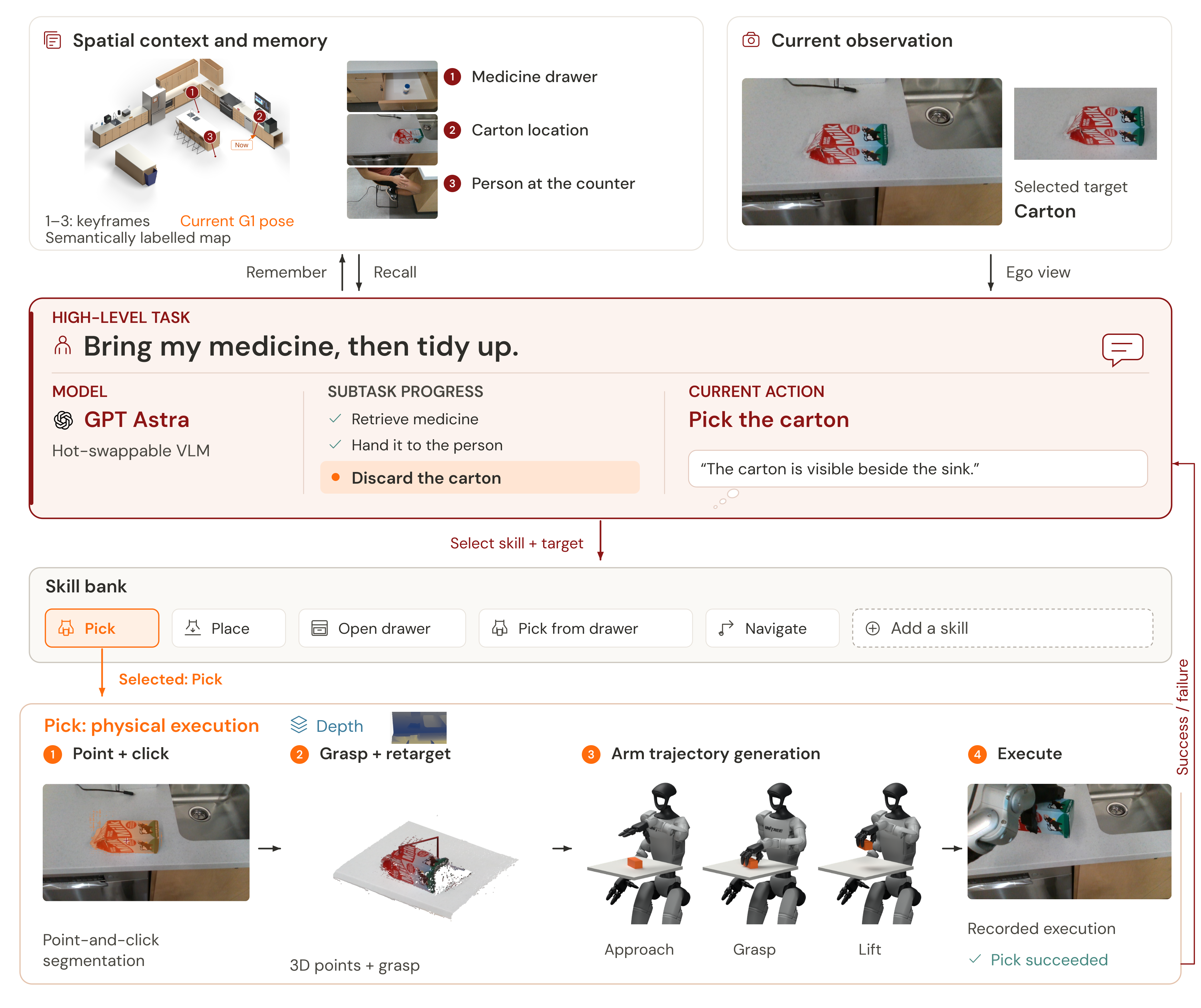
Long-horizon loco-manipulation takes a humanoid beyond what its ego view can show. To act across a room, it needs an internal spatial model that connects visible objects with remembered locations and helps resolve ambiguous requests. This context guides where to go, what to act on and how to sequence walking and manipulation. HomeBody combines that spatial memory with composable skills whose execution feedback lets the VLM revise its next decision when an action or transition fails.
Tidy the kitchen
Clean up all of the coffee bags and put them in the middle, and throw away all of the milk and orange juice cartons that have gone bad.
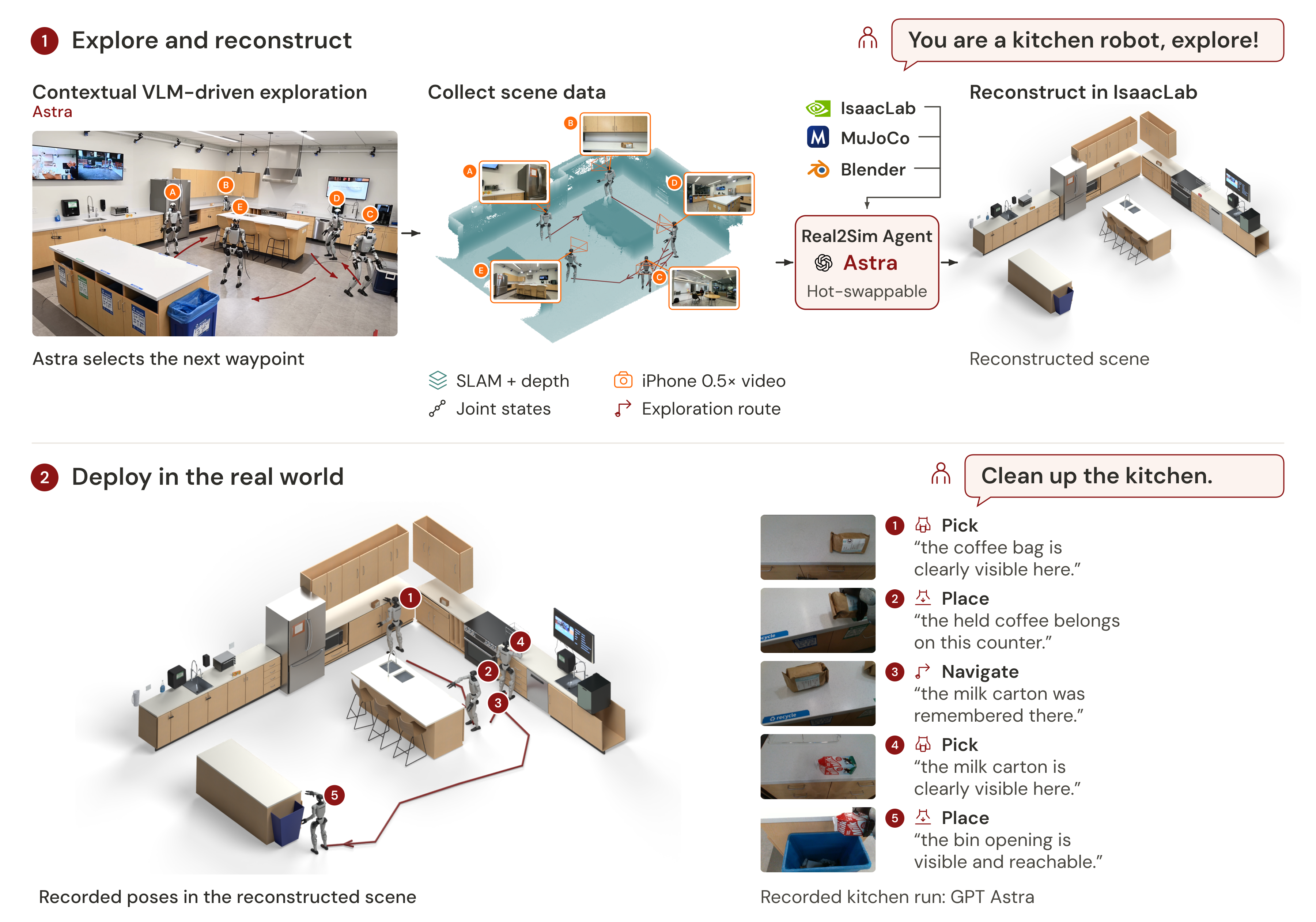
Cleaning the kitchen means deciding what to keep, what to throw away and how to move each object to the right place. HomeBody gathers the coffee bags on the island and discards the specified cartons, coordinating repeated trips, grasps and placements across the room. Its view changes with every move, so memory and action feedback help it track what is done and what still needs attention.
Retrieve the medicine
I forgot my medicine, can you get it for me? Also throw out the bad carton while you are at it.
The medicine is initially out of view. HomeBody uses stored keyframes to locate the drawer, retrieves the medicine, hands it to the person, and then discards the carton. Across the room, it uses the right hand to grasp the drawer handle and open the drawer, then the left hand to discard the carton. Selecting between the two arms lets it access targets on both sides of the body.
Step 1. Explore
First, we give the humanoid context about its role and let it explore an unseen environment. HomeBody collects 0.5× iPhone video, D435i camera observations, LiDAR scans with SLAM, joint poses and waypoints chosen by Astra. Exploration captures the room from the humanoid’s own viewpoint, grounding its spatial context in what it can see as it moves and interacts with the space. HomeBody retains this context when objects leave the ego view.
Exploration instructionYou are a kitchen robot, please explore the space!
HomeBody guides exploration of the kitchen, choosing useful viewpoints and saving observations for later tasks.
Step 2. Real2Sim
HomeBody uses Astra as its Real2Sim agent to build a digital twin in Isaac Sim[2]from the humanoid’s own collected data. This grounds its observations in a spatial model of the world, helping the high-level VLM reason about locations beyond the ego view. Seewhat accurate Real2Sim reconstruction requiresand how the reconstructions compare.
FROM EXPLORATION TO A DIGITAL TWIN
Grounding HomeBody’s Real2Sim agent in data from its own exploration, including SLAM geometry, ego views, joint states and waypoints, helps it build a geometrically, semantically and visually accurate digital twin for reasoning at deployment.
Step 3. Give your humanoid an everyday task
Give the robot an instruction such as “tidy up the kitchen.” HomeBody uses its spatial context to choose actions and targets without an action-level script. Send the instruction below to replay an illustrative cleanup in the digital twin.
Reconstructed kitchenIllustrative rollout
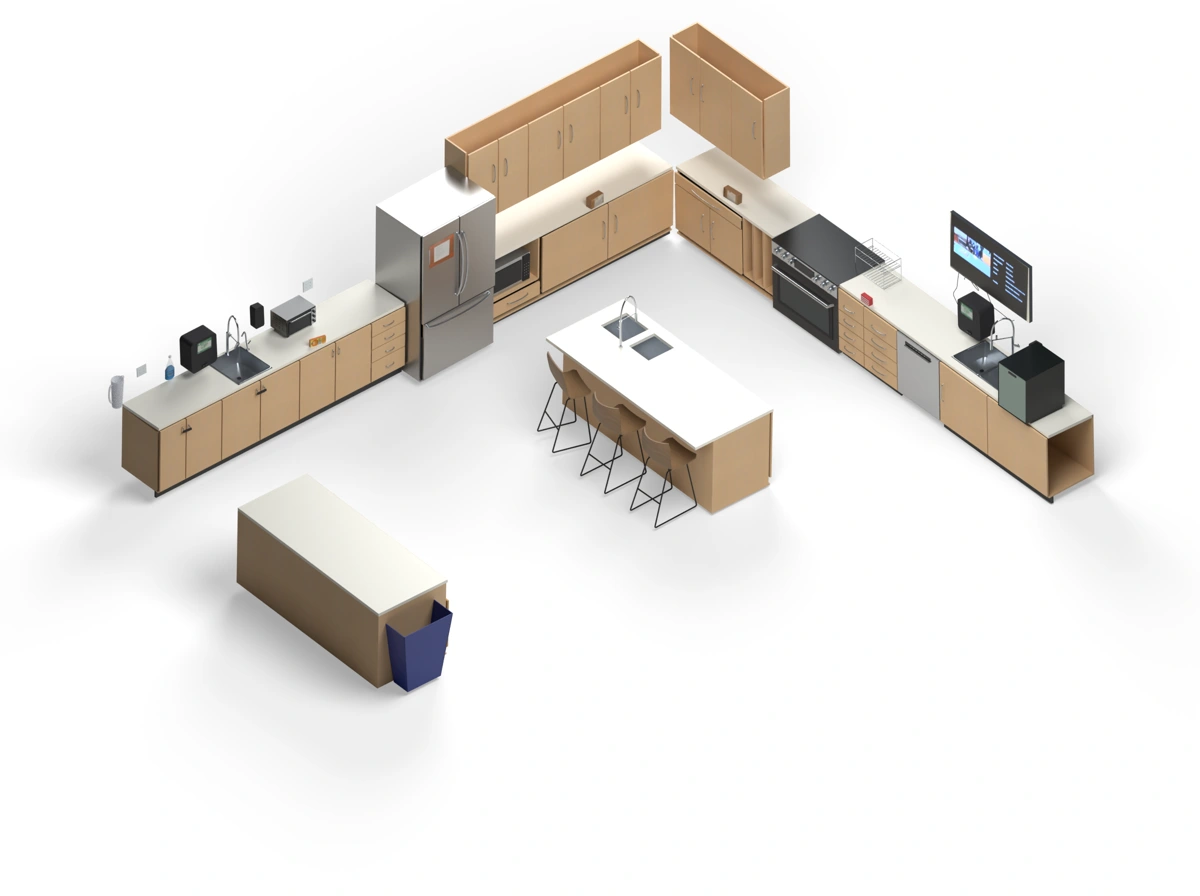
Click the room or Send to explore in 3D
HomeBody
Instruction
Tidy up the kitchen. Put the coffee bags on the island and throw away the spoiled cartons.
03
Our Implementation
 Expandable skill libraryWatch the humanoid navigate, grasp, place and open drawers.Explore skills****Close libraryNavigation, picking, placing and drawer opening form HomeBody’s action vocabulary. Skills share an interface for targets and execution results, so the VLM can compose them at deployment. Local retries and visual feedback correct execution errors.
SKILL 01REAL ROBOT · 1.25×
Pick
Grasp and lift the object selected in the ego image.
SKILL 02REAL ROBOT · 1.25×
Place
Move a held object to a selected 3D release point.
SKILL 03REAL ROBOT · 1.25× · retry
Open drawer
Visually align with the handle, hook it, and walk backward to open the drawer.
SKILL 04REAL ROBOT · 14× → 4×
Pick from drawer
Reach into an open drawer and lift the selected object clear of its edge.
SKILL 05REAL ROBOT · 1.25×
Navigate
Follow a planned route to a location in the Real2Sim map.
Add your own skill
Connect a learned policy, a classical algorithm or another controller through the shared interface. HomeBody’s VLM can chain it with existing skills to carry out new tasks.
Most skill previews are sped up to about 7–10 seconds. Drawer opening and grasping include recorded reattempts. The drawer-pick preview starts with the drawer open and keeps the retries continuous, slowing down for the final successful grasp.
Our Architecture
 ### FAQ
What is required for accurate Real2Sim reconstruction?### Human-recorded video
SLAM reference
HomeBody (Ours)
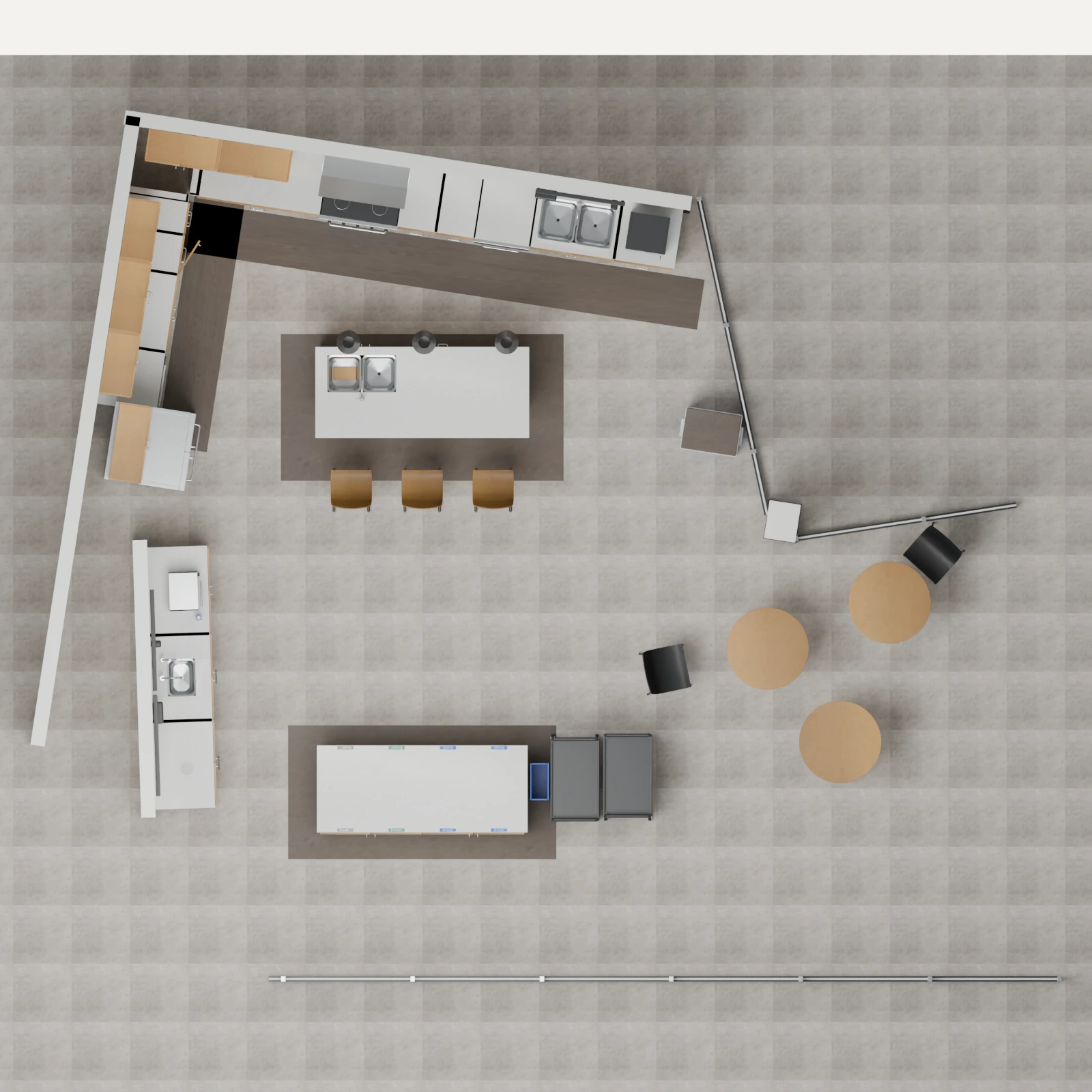
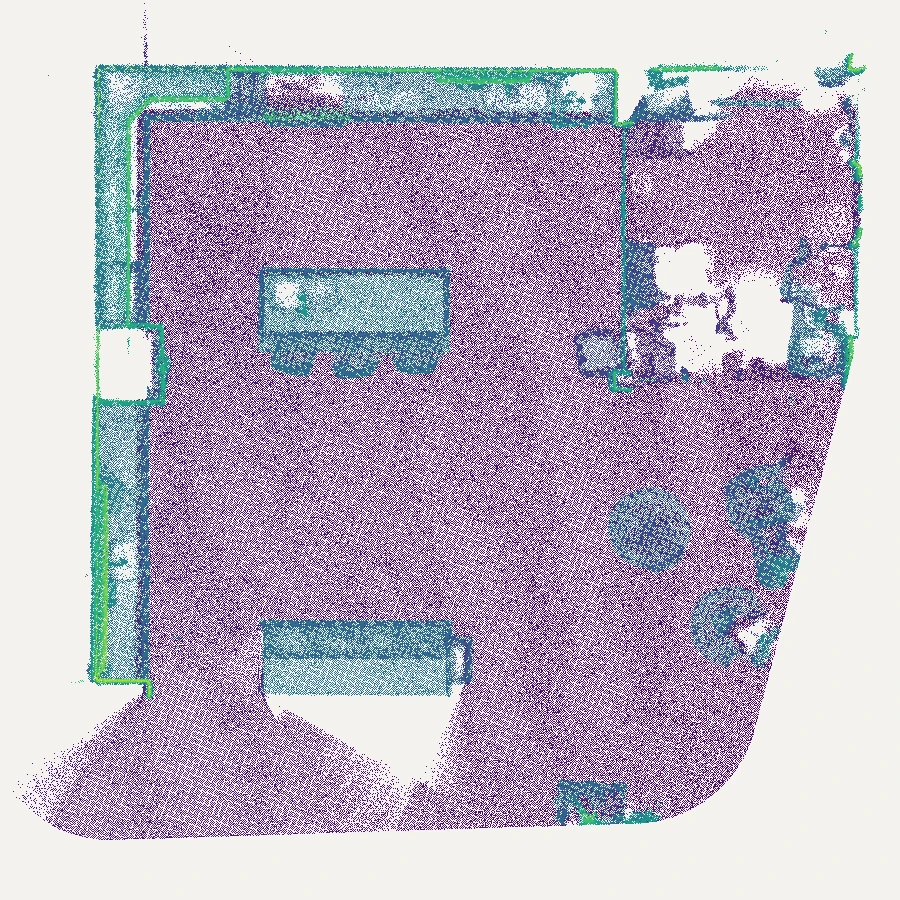
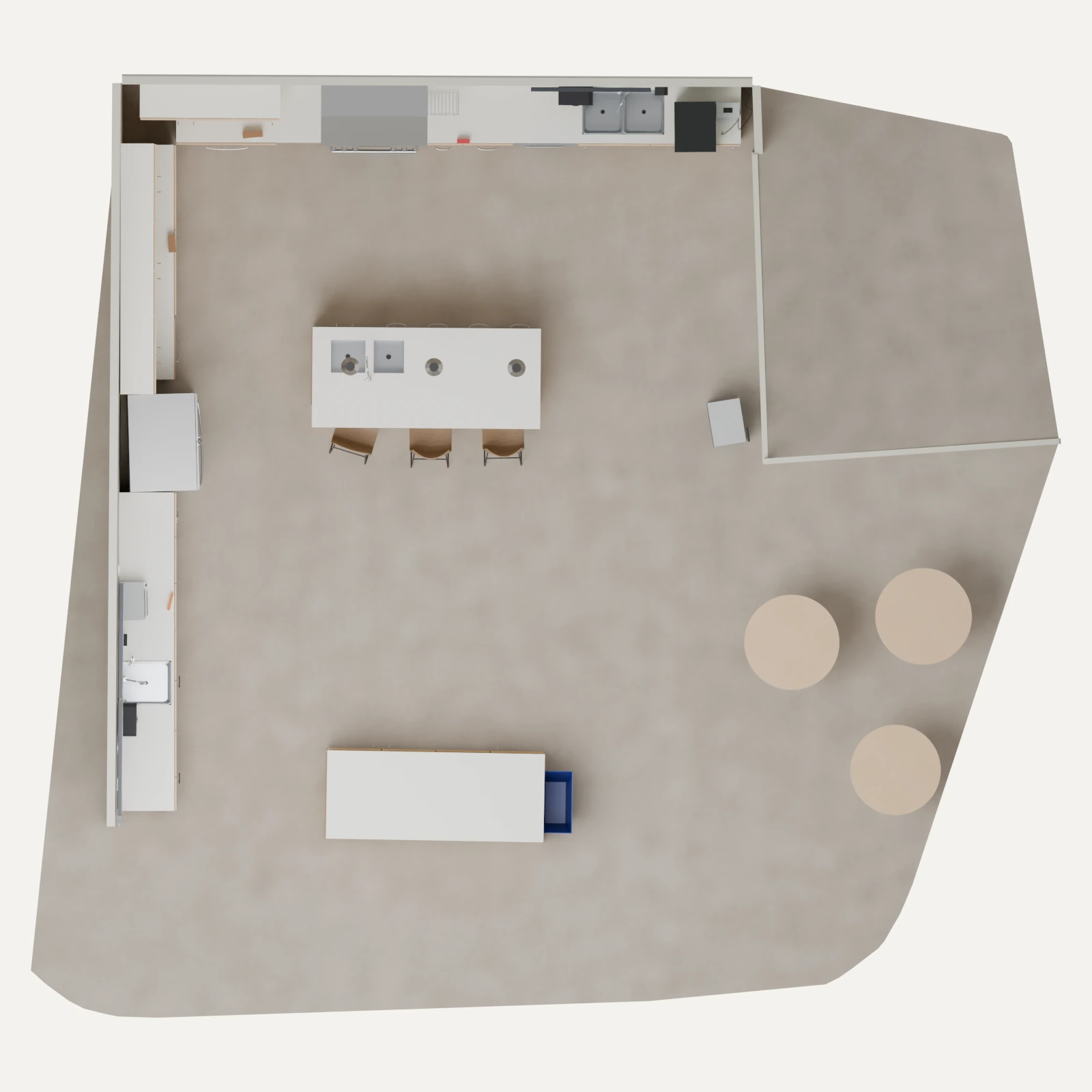
Human-recorded video provides rich visual detail for aligning a reconstruction with the room’s appearance. HomeBody also needs accurate geometry to navigate through the room, position the humanoid and reach objects. HomeBody uses the humanoid’s own exploration data as grounding for the Real2Sim agent, including camera observations, measured SLAM geometry, joint poses and selected waypoints. This grounding supports geometrically accurate spatial reasoning alongside semantic understanding of the space.
With video alone, the Real2Sim agent estimates the room’s dimensions from appearance. HomeBody also provides measured geometry from SLAM to constrain those dimensions. The middle and right panels use the same viewing angle and scale so their layouts can be compared directly. Colors in the SLAM map distinguish points at different heights.
How does HomeBody localize in a known environment?To plan how to complete a task, HomeBody needs to know both where relevant objects are and where the G1 is relative to them. This spatial context helps the planner choose where to move and how to sequence actions across the room. To ground these decisions in a shared coordinate frame, we localize the G1 with Super Odometry[1]and align its SLAM map with the reconstructed simulation using iterative closest point (ICP) registration. HomeBody stores ego camera observations in this shared frame, together with descriptive content. HomeBody can use this spatial information to return to the recorded position.
How does HomeBody turn a VLM decision into physical action?HomeBody uses spatial targets to connect task reasoning to physical execution. The VLM selects a skill and its target from the current ego view, map context, gripper state, recalled observations and the previous result. It passes this selection through a structured tool call, leaving the skill to plan and execute the motion. The VLM therefore does not need to know the skill’s low-level implementation.
For picking, the call specifies an image point normalized to 0–1000 and which hand to use. The point prompts segmentation[3], while Fast-FoundationStereo[4]estimates depth from D435i stereo images. Camera calibration projects the masked geometry into 3D, where we predict the grasp analytically. To reach that pose, the arm planner builds a spline reference with minimum-jerk timing, solves inverse kinematics along the path and checks the swept motion for collision clearance.
Other skills use targets suited to their actions. Navigation takes a 2D goal and facing point in map coordinates, measured in meters. A placing call specifies which hand to use, a 3D release target in the torso frame and a release distance. The skill moves the held object to the target and opens the hand. Drawer opening combines handle alignment, a hooking posture and backward walking into one skill, coordinating the transition from reaching to pulling.
How does HomeBody correct mistakes and retry?The target can shift in the camera view as the humanoid approaches. Segmentation identifies the object, and SAM 2.1 tracking with SAMURAI memory selection[5]follows it in subsequent frames. We integrate visual servoing to use these tracking updates to correct alignment during the approach, without requiring a new VLM decision for each adjustment.
If a grasp closes without contact, the pick skill can try another grasp candidate or adjust its stance and replan. These local retries are bounded. When recovery is exhausted or the failure needs a different action, the skill returns the reason to the VLM, which can reposition, choose a new target or change its plan.
HomeBody retries picking up a pill bottle from a drawer. How does HomeBody coordinate walking and manipulation?Long-horizon loco-manipulation requires maintaining balance while the upper body reaches and manipulates objects. HomeBody uses pretrained AMO[6]for its upper-body-aware lower-body control, which accounts for arm targets when coordinating the lower body. Arm and hand commands run at 250 Hz, with the AMO policy updated every fifth control tick at 50 Hz.
What compute does HomeBody run on?The current skills built for HomeBody run alongside perception and motion planning on a single Razer Blade laptop with an RTX 4090 GPU. GPT Astra runs remotely, sending skill requests and targets to the laptop and receiving execution results. This provides a lightweight setup for running HomeBody in the wild, with local skill execution and network access to the frontier model.
Scope and limitations
Real2Sim reconstruction adds setup time and API costs. Task length is also constrained by the humanoid’s reach, manipulation capabilities, and hardware endurance, including finger-servo overheating during extended operation. GPT Astra’s reasoning latency introduces pauses between skills. The current local stack requires an RTX 4090 laptop GPU. Adding heavier perception models or skills may require more compute.
Acknowledgments
Gio Huh is supported by Caltech as aMark Reinecke SURF Fellowfor research on long-horizon humanoid loco-manipulation atThe Movement Lab,Stanford University. He participated in Stanford’sUndergraduate Visiting Research Intern (UGVI)program.
We thank theStanford Robotics Center (SRC)for providing the kitchen space andThe Movement Lab (TML)atStanford Universityfor providing API credits. We thankAlan YuandSarthak Kamatfor insightful discussion.
References1. Super Odometry: IMU-centric LiDAR-Visual-Inertial Estimator for Challenging Environments 2. NVIDIA Isaac Sim 3. SAM 2: Segment Anything in Images and Videos 4. Fast-FoundationStereo: Real-Time Zero-Shot Stereo Matching 5. SAMURAI: Adapting Segment Anything Model for Zero-Shot Visual Tracking with Motion-Aware Memory 6. AMO: Adaptive Motion Optimization for Hyper-Dexterous Humanoid Whole-Body Control
Cite this workGio Huh, Cayden Gu, Takara E. Truong, C. Karen Liu, and Guy Tevet. “HomeBody: A Humanoid That Explores, Remembers, and Acts on Its Own.” 2026.
@misc{huh2026homebody,
  author = {Huh, Gio and Gu, Cayden and Truong, Takara E. and Liu, C. Karen and Tevet, Guy},
  title = {{HomeBody}: A Humanoid That Explores, Remembers, and Acts on Its Own},
  year = {2026},
  url = {https://tml.stanford.edu/homebody/}
}
Similar Articles
GPT-6 Astra can now control a humanoid robot in a room it has never seen, remember where objects are, clean up across the room, and fetch things later from vague human requests using a G1 Unitree humanoid robot
GPT-6 Astra demonstrates advanced capabilities by controlling a humanoid robot in unfamiliar environments, remembering object locations, performing cleanup tasks, and retrieving items based on vague human requests using a Unitree G1 robot.
@VraserX: GPT-6 Astra just crossed a line for me. Give it a drone, videos of an unfamiliar office, and the goal of finding and fo…
GPT-6 Astra can autonomously navigate a drone to find and follow a specific person, beating human baselines on Drone-Bench tasks, suggesting strong general capabilities for perception, planning, and action despite low reliability.
@VraserX: Everything we know about OpenAI’s GPT Astra so far OpenAI officially calls Astra its “next major model” An internal Ast…
OpenAI's GPT Astra is a next-generation AI model with long-horizon autonomy, capable of solving complex research problems and raising cybersecurity concerns, leading to internal security measures.
GPT Astra controlling a robot and cleaning a table(with COT)
A video demonstrates an AI system called "GPT Astra" using chain-of-thought reasoning to direct a robot to clean a table.
GPT-6 Astra can now turn a video of a real room into an interactive 3D world that robots can train in and AI video models can render from new viewpoints
GPT-6 Astra introduces the ability to convert real-room videos into interactive 3D environments, enabling robot training and novel viewpoint rendering for AI video models.