Cached at:
06/24/26, 01:52 PM
# François Englert (1932 – 2026) – Home
Source: [https://home.cern/francois-englert-1932-2026/](https://home.cern/francois-englert-1932-2026/)
Written by:
—
19 June, 2026
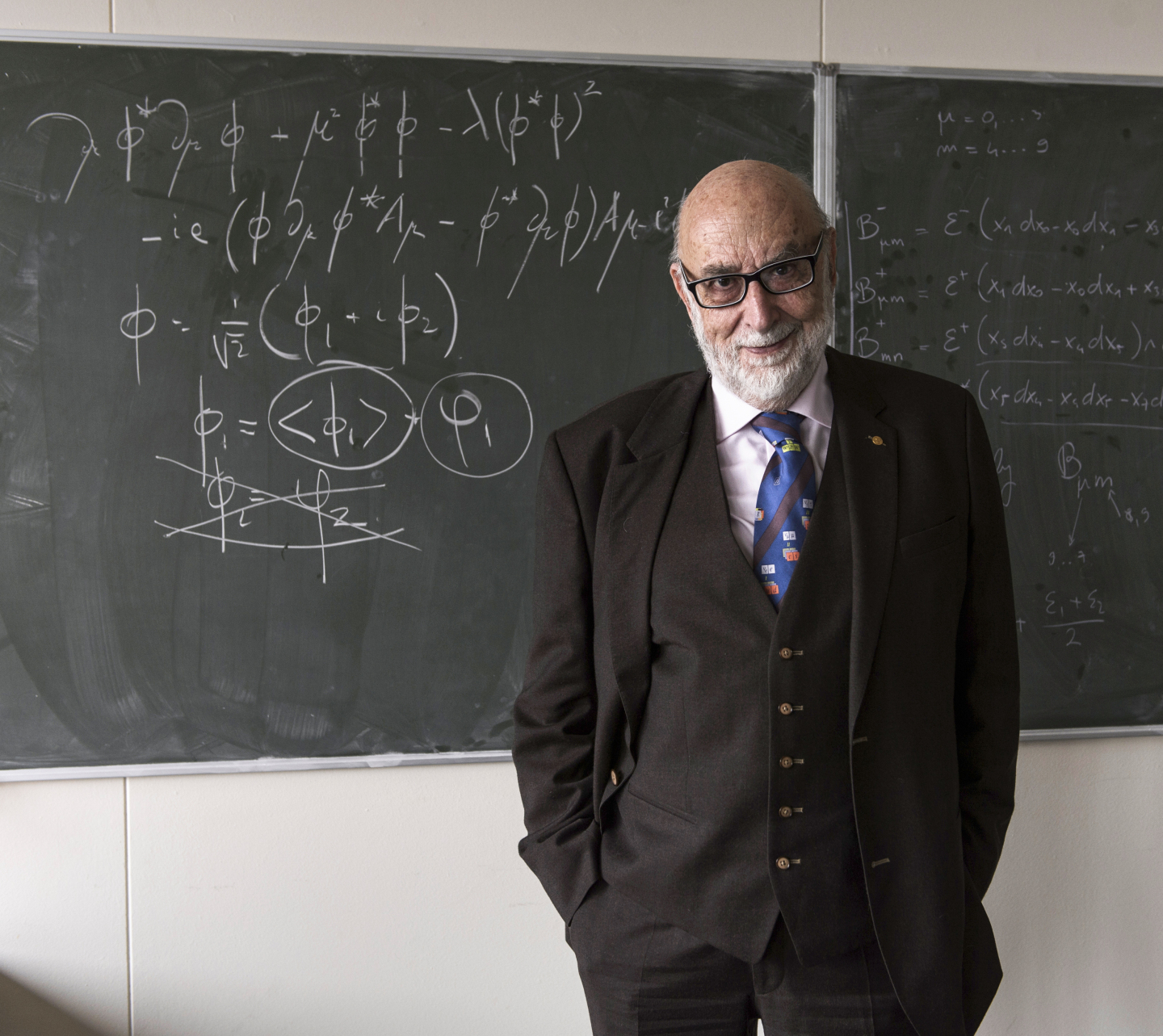François Englert during a visit to CERN in 2014 \(Image: CERN\)François Englert, a Belgian theoretical physicist, passed away on 18 June at the age of 93 in Uccle \(Brussels, Belgium\)\. With his associate, Robert Brout, he demonstrated that fundamental particles could acquire mass by interacting with a fundamental field that exists throughout the universe\. At the same time, British physicist[Peter Higgs](https://home.cern/news/obituary/physics/cern-pays-tribute-peter-higgs)had independently hypothesised the existence of the same mechanism\. The existence of the Brout\-Englert\-Higgs field was proved in 2012 with[the discovery](https://home.cern/science/physics/higgs-boson/how)of its[associated particle](https://home.cern/science/physics/higgs-boson)by the ATLAS and CMS experiments at the LHC\. The following year, the[Nobel Prize in Physics](https://www.nobelprize.org/prizes/physics/2013/summary/)was awarded jointly to François Englert and Peter Higgs\.
François Englert, who completed a PhD in physics at the*[Université libre de Bruxelles](https://actus.ulb.be/)*\(ULB\) in 1959, began his career at Cornell University in the United States as an assistant to Robert Brout\. This meeting would mark the start of a long history of friendship and scientific collaboration between the two theorists, first in the United States, then from 1961 at the*Université libre de Bruxelles*\.
Interested in phase transitions in ferromagnetism and superconductivity, they took inspiration from the work of[Yoichiro Nambu](https://www.nobelprize.org/prizes/physics/2008/summary/), adapting spontaneous symmetry breaking into the quantum field theory: the theoretical framework of the[Standard Model](https://home.cern/science/physics/standard-model)\. This work led them in 1964 to theorise symmetry breaking that would generate the masses of particles that are force carriers of interactions \(also known as vector bosons\) through their interaction with a hypothetical fundamental field\. At the same time,[Peter Higgs](https://home.cern/news/obituary/physics/cern-pays-tribute-peter-higgs)submitted the same idea, adding the concept that such a field must have an associated particle, which would later be named the “Higgs boson”\.
The existence of the Brout\-Englert\-Higgs field solved a key problem which emerged in the early 1960s\. Electroweak theory, which describes the electromagnetic and weak interactions in a single framework, involved vector bosons devoid of mass\. This is the case for electromagnetism but not for the weak force, whose range is limited to the nucleus, and which had to be carried by bosons with mass\.
François Englert continued his brilliant career at ULB\. With Robert Brout, he founded a research group on fundamental interactions, which conducted studies in many different areas, from understanding strong interactions to general relativity and cosmology\. Englert was particularly interested in what he considered to be the defining question of fundamental interactions: reconciling general relativity with quantum theory\. A professor emeritus of ULB from 1998, he stayed up to date with developments in theoretical physics\. After 2012, he made several visits to CERN, where he was able to converse with colleagues with the courtesy and tact for which he was well known\.
The discovery of the Higgs boson has had major implications for particle physics\. The study of this unique particle has opened up a new field of research, which the[ATLAS](https://atlas.cern/Discover/Physics/Higgs)and[CMS](https://cms.cern/news/pieces-precision-building-higgs-bosons-clearest-portrait-date)experiments have been investigating since 2012, and which could lead scientists to physics beyond the Standard Model\. It was to be at the heart of research at the[LHC](https://home.cern/science/accelerators/large-hadron-collider), the[High\-Luminosity LHC](https://home.cern/science/accelerators/high-luminosity-lhc)and future colliders\.
François Englert explains the equations of the Brout\-Englert\-Higgs mechanism, which gives fundamental particles their mass\. \(Video: CERN\)\.Source:[CERN \(CDS\)](https://videos.cern.ch/api/files/cddd1907-4316-44cd-ab2f-cae1c950ed73/720p.mp4)
## **Related Articles**
[View all news](https://home.cern/news/)
No posts were found\. Try to change the category or the date filters\.