An AI developer named Thomas has used AI coding tools to create free, open source clones of Adobe creative apps like Premiere and Photoshop, funded through token-based access to the Artcraft visual AI model, sparking debate about the future of proprietary software.
<p>For a while, those hoping to <a href="https://arstechnica.com/civis/threads/is-adobe-really-this-bad.1471693/">avoid the difficulty and expense of dealing with Adobe's Creative Suite</a> have been able to use <a href="https://github.com/KenneyNL/Adobe-Alternatives">several free and/or open-source alternatives</a> that replicate some or all of those capabilities. Now, one developer is using AI-powered reverse engineering to mimic the look, feel, and functionality of Adobe's well-known software with what he hopes will soon be perfect fidelity.</p>
<p><a href="https://github.com/storytold/artcraft">Artcraft</a> got its start <a href="https://web.archive.org/web/20250315000000*/https://getartcraft.com/">last year</a> as a "controllable AI for artists" that allows for precise post-generation editing of AI-crafted images and videos. Over the weekend, though, the brand <a href="https://web.archive.org/web/20261003233252/https://getartcraft.com/">debuted its pivot</a> to <a href="https://getartcraft.com/apps">a suite of seven open source apps</a> recreating the user interface and tools found in Adobe's Photoshop, Illustrator, Premiere, Lightroom, After Effects, InDesign, and Acrobat Pro.</p>
<p>In <a href="https://www.reddit.com/r/SaaS/comments/1wwnhbt/ive_created_open_source_100_rust_cleanroom/">announcing those new apps on Reddit</a> earlier this week, <a href="https://www.linkedin.com/in/possibilistic/">software developer Brandon Thomas</a> said he used Anthropic's Claude Opus 5.5 to create "clean-room replacements" for Adobe's closed source software in Rust (with WebAssembly versions available for use in a browser). And while commenters <a href="https://news.ycombinator.com/item?id=49960138">on Hacker News</a> and <a href="https://bsky.app/profile/chinnyvision.bsky.social/post/3mxcfhzfgpc2c">elsewhere</a> have <a href="https://bsky.app/profile/whatabouttheken.bsky.social/post/3mxcc3ey72c2f">taken pains</a> to point out the new software's many current shortcomings, Thomas make the grandiose promise that <a href="https://news.ycombinator.com/item?id=49959605">the current "super early alpha" state</a> will soon lead to something just as functional as anything Adobe has ever put out.</p><p><a href="https://arstechnica.com/ai/2026/10/software-is-over-bold-ai-developer-takes-aim-at-adobe-with-open-source-clones/">Read full article</a></p>
<p><a href="https://arstechnica.com/ai/2026/10/software-is-over-bold-ai-developer-takes-aim-at-adobe-with-open-source-clones/#comments">Comments</a></p>
# “Software is over”: Bold AI developer takes aim at Adobe with open source clones
Source: [https://arstechnica.com/ai/2026/10/software-is-over-bold-ai-developer-takes-aim-at-adobe-with-open-source-clones/](https://arstechnica.com/ai/2026/10/software-is-over-bold-ai-developer-takes-aim-at-adobe-with-open-source-clones/)
## Is software over?
Thomas, who says he has about a decade of experience working on large\-scale Rust projects,[wrote on Hacker News](https://news.ycombinator.com/item?id=49934228#49934844)that he was inspired to create his own open source Adobe software alternatives after being “bit by the dark pattern ‘cancellation fee’ one too many times\.” Development of the totally free options offered here under MIT/Apache licenses will be funded, Thomas[wrote](https://www.reddit.com/r/SaaS/comments/1wwnhbt/comment/pe799hc/), by selling token\-based access to[the pre\-existing Artcraft visual AI model and IDE](https://github.com/storytold/artcraft), which is offered as an imagery\-generation option inside the apps alongside third\-party models\. This revenue stream will help ensure these apps aren’t “going to be some orphaned small\-team project,” Thomas wrote\. “We have a team building popular software for filmmakers, so supporting this is fully funded\.”
[](https://cdn.arstechnica.net/wp-content/uploads/2026/10/filmcraft.webp)
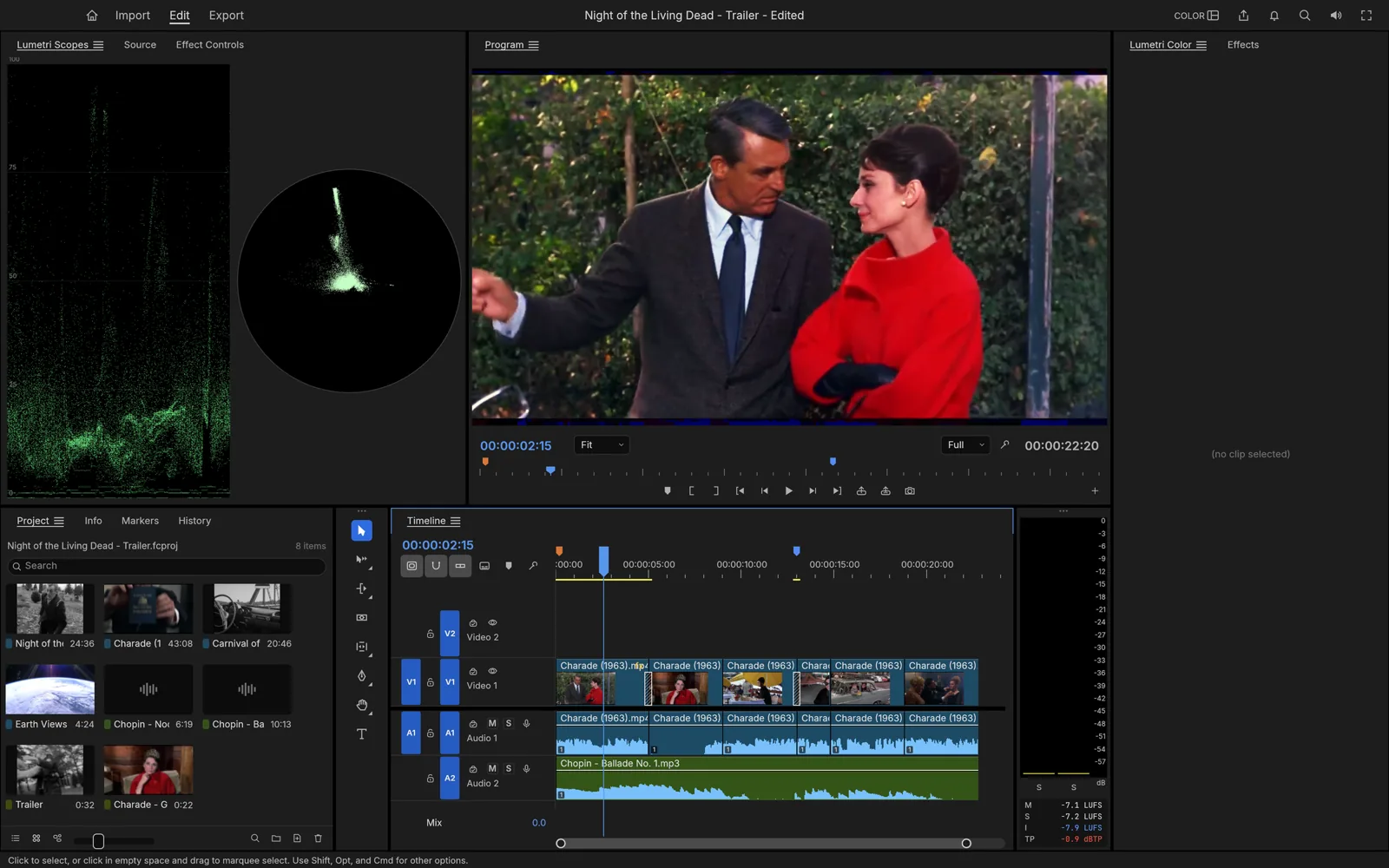
Filmcraft closely mimics the look and feel of Adobe Premiere\.
Filmcraft closely mimics the look and feel of Adobe Premiere\.Credit:[ArtCraft](https://getartcraft.com/apps/filmcraft)
Thomas is the[latest in a long line](https://arstechnica.com/ai/2026/03/ai-can-rewrite-open-source-code-but-can-it-rewrite-the-license-too/)of coders using AI tools to speed up the[long\-standing but labor\-intensive practice](https://arstechnica.com/gaming/2020/05/beyond-emulation-the-massive-effort-to-reverse-engineer-n64-source-code/)of reverse engineering \(i\.e\., replicating the functionality of a piece of software without directly copying the code itself\)\. While that practice has[generally been found legally acceptable](https://www.eff.org/issues/coders/reverse-engineering-faq), the ArtCraft apps[could still face legal trouble](https://arstechnica.com/gaming/2012/06/defining-tetris-how-courts-judge-gaming-clones/)if their “trade dress” too closely mimics Adobe’s familiar appearance and interface\.
After coding exclusively with AI tools since February, Thomas[said](https://news.ycombinator.com/item?id=49934228#49934844)he foresees a near future when everyday developers can re\-create open source versions of popular paid software to “take back the internet and own tech forever\.”
“Now you can just create 1:1 functional equivalents, clean room, that are highly performant and cross\-platform\. Nothing is stopping you,” Thomas wrote\. “We’ll replace Google Search, we’ll build our own smartphones, we’ll build better infra\. We’ll remove all the ads and de\-enshittify the entire tech world\.”
“Software is over,” he gloated in[an earlier comment](https://news.ycombinator.com/item?id=49922569#49928088), claiming to have “one\-shotted Photoshop\. The whole thing\.”
A person spent $2000 on AI tokens to build a free, open-source Photoshop alternative that runs offline and supports professional features, highlighting how AI is reducing barriers to software development.
A viral post highlights how an anonymous developer built ComfyUI, a powerful free open-source AI image tool, contrasting it with Adobe's subscription fees and recent DOJ settlement. It praises ComfyUI's free, local, GPL-3.0 releases.
The article discusses how generative AI models are undermining the balance of copyright and openness in software, threatening the creative commons and the foundational principles of the internet.
The article questions the forced use of AI in software development, advocating for the freedom to handcraft software to preserve developers' core skills and creativity, while highlighting risks associated with over-reliance on AI.