The “mechanical miracle” that ruined Mark Twain’s life
摘要
A historical essay about the Paige Compositor, the complex typesetting machine Mark Twain invested in for over a decade, which ultimately led to his financial ruin and depression.
暂无内容
查看缓存全文
缓存时间: 2026/08/11 02:38
# The "mechanical miracle" that ruined Mark Twain's life
Source: [https://resobscura.substack.com/p/the-mechanical-miracle-that-ruined](https://resobscura.substack.com/p/the-mechanical-miracle-that-ruined)
“All the other wonderful inventions of the human brain sink pretty nearly into commonplaces contrasted with this awful mechanical miracle\.”
Such was Mark Twain’s verdict on the Paige Compositor, a typesetting device which was among the most complex machines ever built up to that point in history\. It was also a ruinous disaster for everyone involved —*despite being a good idea*\.
Twain came to see Paige’s machine as an “immense historical birth”: the point of origin for new mechanical lifeforms that would someday mimic the human mind\. In a[1889 letter](https://www.google.com/books/edition/The_Greatest_Works_of_Mark_Twain_370+_Ti/7yPmEAAAQBAJ?hl=en&gbpv=1&dq=%22inventions%20of%20the%20human%20brain%20sink%22&pg=PT7003&printsec=frontcover)to his invention\-mad brother Orion, Twain called the Paige machine “a cunning devil, knowing more than any man that ever lived” and claimed it would make “telephones, locomotives,” even “Babbage calculators” seem like “mere toys, simplicities\!”
[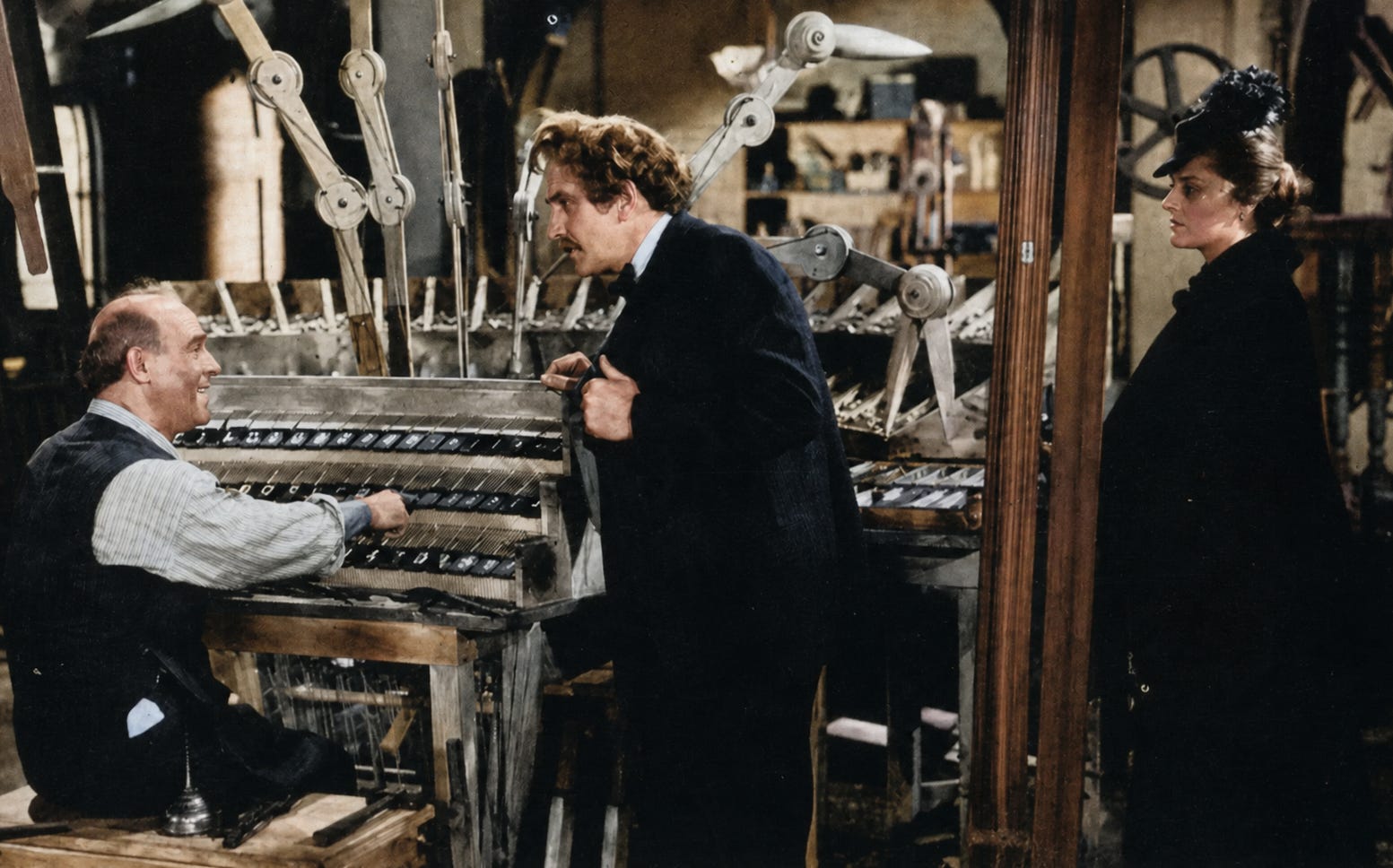](https://substackcdn.com/image/fetch/$s_!Zpj4!,f_auto,q_auto:good,fl_progressive:steep/https%3A%2F%2Fsubstack-post-media.s3.amazonaws.com%2Fpublic%2Fimages%2F96f75737-4dd0-4fd9-a427-0c3ff00e03aa_1553x968.png)Twain visiting Paige and his machine, as depicted in the 1944 film*The Adventures of Mark Twain*\(colorized\)\.
The verdict of Twain’s biographers is that the author’s decade\-long quest to automate the printing industry basically destroyed his life\. One[calls](https://www.google.com/books/edition/Irving_to_Irving_Author_publisher_Relati/yT1ZAAAAMAAJ?hl=en&gbpv=1&bsq=%22a+remorseless+Frankenstein+monster%22&dq=%22a+remorseless+Frankenstein+monster%22&printsec=frontcover)the Paige machine “a remorseless Frankenstein monster\.”Twain’s most recent biographer, Ron Chernow,[labels](https://www.google.com/books/edition/Mark_Twain/ksDAEQAAQBAJ?hl=en&gbpv=1&dq=%22a+full-blown+monomania%22&pg=PA282&printsec=frontcover)his obsession “a full\-blown monomania,” and I find it hard to argue otherwise\.
Reading Chernow’s biography, I was shocked at the degree to which “the Machine” took over the life of Twain’s family during his prime creative years following*Huck Finn*, and the extent to which its failure was responsible for both his financial ruin and subsequent depression\.
So what was the machine actually trying to do?
It began in 1880, when Twain met a “little bright\-eyed, alert, smartly dressed inventor” named James W\. Paige\. Twain had once been a “[printer’s devil](https://en.wikipedia.org/wiki/Printer%27s_devil)” himself, and although he was initially skeptical Paige’s new machine would automate away much of the costly human labor involved in setting the metal type of books and periodicals, he soon became a convert\. The machine, Twain[concluded](https://www.google.com/books/edition/Mark_Twain/ksDAEQAAQBAJ?hl=en&gbpv=1&dq=%22I+never+saw+such+an+inspired+bugger%22&pg=PA281&printsec=frontcover), was not just a mechanical wonder but a surefire path to riches: “I never saw such an inspired bugger of a machine\. Anybody can set type with it\.\.\. I reckon it will take about a hundred thousand machines to supply the world, and I judge the world has got to buy them\.” The financial advantages of a machine that “does not get drunk” and “does not join the printer’s union” were simply too vast for anyone to ignore\.
As you can probably guess, Paige was not quite the towering hero\-inventor that Twain believed him to be\. He*was*clearly a person of real ability, but his main talent appeared to have been his skill at raising money by promising the impossible — the 19th century version of Steve Job’s reality distortion field\. \(“When he is present I always believe him — I cannot help it,” Twain admitted\. “When he is gone away all the belief evaporates\. He is a most daring and majestic liar\.”\)[1](https://resobscura.substack.com/p/the-mechanical-miracle-that-ruined#footnote-1)
[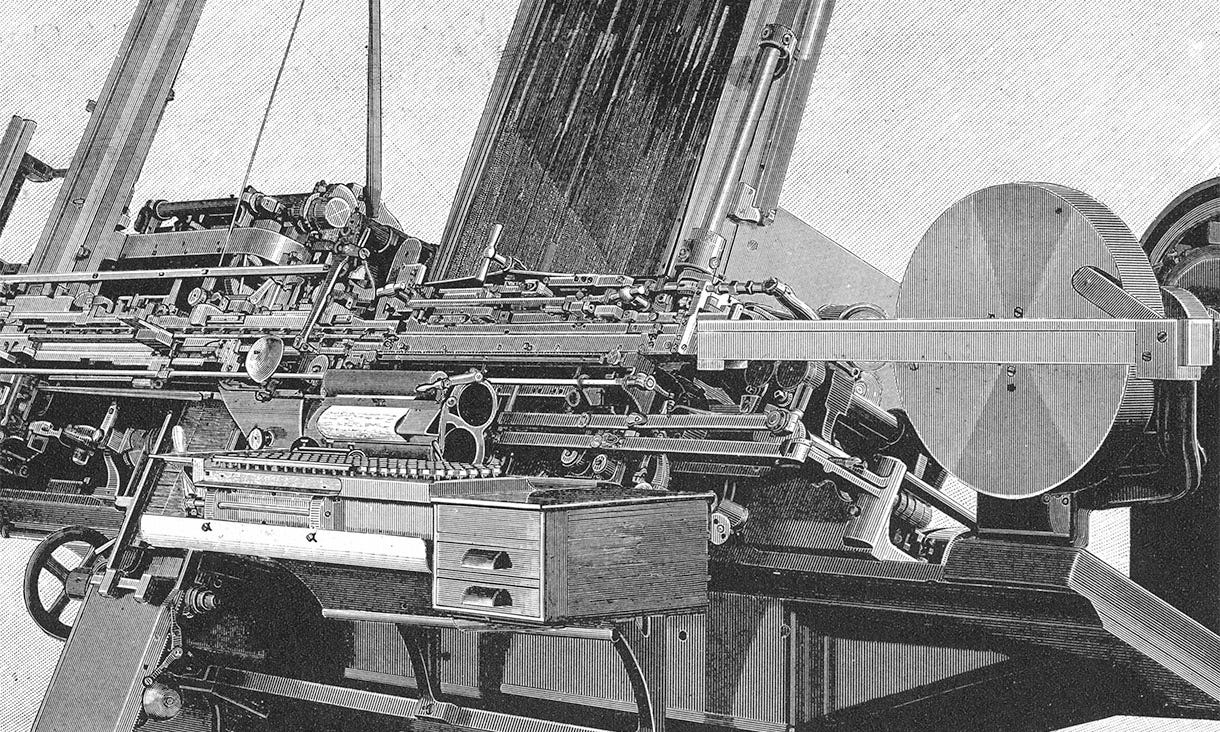](https://substackcdn.com/image/fetch/$s_!1dyE!,f_auto,q_auto:good,fl_progressive:steep/https%3A%2F%2Fsubstack-post-media.s3.amazonaws.com%2Fpublic%2Fimages%2F2c1e2738-0d60-4adf-9baa-d0c094543a2e_1220x732.jpeg)A detail of the most high\-resolution surviving image of the compositor\.
Twain ultimately invested the equivalent of roughly ten million dollars toward the machine: not just the bulk of his earnings from his books, but also of his wife’s inherited fortune, all of which he lost\.
The issue was complexity\.[According](http://www.twainquotes.com/paige.html)to his long\-suffering patent attorney, Paige “became lost in the wilderness of appalling details” as his device grew to over 18,000 distinct parts\. Paige’s patent application was known internally at the United States Patent Office as “The Whale\.” It took patent examiners a full 30 days just to read the initial application \(you can try it yourself[here](https://circuitousroot.com/artifice/letters/press/noncastcomp/paige/us-0547860-paige/index.html)\)\.
When, at last, they requested a functioning machine, none could be found\.
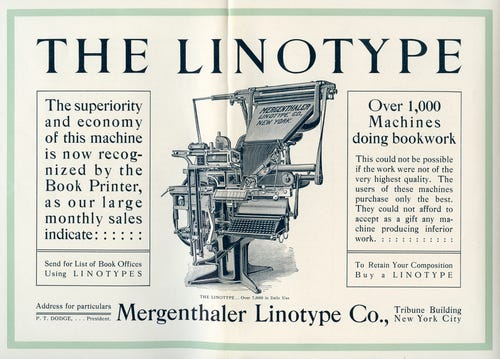
This was the crux of the problem: Paige’s typesetter was,*in theory*, superior to its simpler and cheaper competitor, the[Linotype](https://en.wikipedia.org/wiki/Linotype_machine)\. But the Linotype was far easier to mass produce and repair\.
The Linotype’s core advantage was that it did not attempt to mimic the human compositor’s every movement\. Instead, it simplified the problem by casting complete lines of type\. Paige sought to automate what humans were already doing, whereas the Linotype redesigned what the work was in the first place\.
[](https://substackcdn.com/image/fetch/$s_!25BQ!,f_auto,q_auto:good,fl_progressive:steep/https%3A%2F%2Fsubstack-post-media.s3.amazonaws.com%2Fpublic%2Fimages%2F50844899-23eb-4da6-a785-41593f1f1abc_500x359.png)
For Twain, though \(and one suspects for Paige himself\), the dream of mechanically mimicking human actions was what fascinated him most\. Twain’s writings from the 1880s almost make it sound like he was imagining something like the contemporary concept of AGI\. He came to see the Paige machine as a “creature” in its own right\. When developed to perfection, it would be as “complex as that machine which it ranks next to”: the human mind\.[2](https://resobscura.substack.com/p/the-mechanical-miracle-that-ruined#footnote-2)And it would bring immense power to those who controlled it\. Twain’s housemaid later recalled: “he was expecting such wonderful things from it\.\.\. he thought he’d make millions and own the world\.”
Instead he went bankrupt, and Paige died a complete unknown\.
Today, only one Paige machine survives\. A second model “[was donated](http://www.twainquotes.com/paige.html)to Cornell University and was later donated to a scrap metal drive during World War II\.”
Twain’s vision of hundreds of thousands of human\-like language machines taking over the world would have to wait a century or two\.
The easy moral of the story is that Twain was gullible and Paige a huxster\. Both are partly true\! But it’s*also*true that Paige and Twain were on the right track\. The production of the written word really*was*about to be transformed by automation\. And Twain was remarkably prescient, almost uniquely so, in grasping the world\-historical scale of that ongoing transformation\. I’d argue that there’s a clear line connecting the automation of typesetting and counting in the late 19th century to the rise of electrical computers a generation later, and then the early Internet and AI research a generation after that\.
Their mistake lay in assuming that*seeing*the future was the same thing as knowing how to bring it about\.
I think there are three transferrable lessons we can pull from this story:
1\)**“DIY\-friendly” design matters a lot**\. Inventors and investors encounter their would\-be revolutionary machines in a pristine environment, shielded from actual use\. But once a new technology is out in the world, it breaks in all sorts of ways no one imagined\. People end up putting their trust not in the technologies that work best when conditions are perfect, but in those whose failure modes are predictable and fixable by ordinary people\.
2\)**Society uptake of transformative inventions is almost always slower than their proponents expect**\.“*The world has got to buy them*,” Twain had written\. Twain felt that he had an insider’s perspective and could intuit how others in publishing would respond to the machine\. But he was a printer’s devil no longer: he was a famous, millionaire author\. Twain was cushioned, therefore, from the perspective of both the workers who his machine might automate out of a job, and from the practical challenges faced by the capital owners, who were in no hurry to replace their costly existing machines with untested new ones\.
3\)**Transformative technologies succeed by redesigning a task,**and usually not by simply trying to reproduce the*existing*forms of human labor\.Paige built an amazingly complex mechanical imitation of the human compositor which attempted to repeat a human worker’s actual movements\. By contrast, Linotype simplified the problem by doing something humans didn’t already do\. The Linotype was initially slower, but as it claimed the market with its machine\-centric approach of casting whole lines of type at once, it triggered a feedback loop of further improvements which meant it eventually became far superior\.[3](https://resobscura.substack.com/p/the-mechanical-miracle-that-ruined#footnote-3)
[Leave a comment](https://resobscura.substack.com/p/the-mechanical-miracle-that-ruined/comments)
[Share](https://resobscura.substack.com/p/the-mechanical-miracle-that-ruined?utm_source=substack&utm_medium=email&utm_content=share&action=share)
[](https://substackcdn.com/image/fetch/$s_!ye1S!,f_auto,q_auto:good,fl_progressive:steep/https%3A%2F%2Fsubstack-post-media.s3.amazonaws.com%2Fpublic%2Fimages%2F8a7962ec-7ec3-467e-a61a-fb4e967cfc00_3000x241.png)
•[Odd shapes hidden in dense Amazon rainforest reveal sprawling ancient civilization](https://www.science.org/content/article/odd-shapes-hidden-dense-amazon-rainforest-reveal-sprawling-ancient-civilization)\.
*•*“Building such monumental works in the rainforest must have required a large workforce, division of labour and an understanding of mathematics and geometry\. It is also clear that the construction and maintenance of such centres for around 1,500 years must have had administrative, sociocultural and cosmological motivations”\([from the actual article on the above, in](https://www.nature.com/articles/s41586-026-10835-7)*[Nature](https://www.nature.com/articles/s41586-026-10835-7)*\)\.
•[Interactive chart of the Indo\-European languages](https://djbinder.com/language-tree/)by Damon Binder\. Binder also made this[Random Lives](https://random-lives.github.io/random-lives/)site: “[About 70 billion people have ever lived](https://random-lives.github.io/random-lives/blog/how-many-people-have-ever-lived/)\. This project randomly samples just 250 of these lives, to give a window into what a ‘typical’ human experience was like\.”
• I’ve been working on an open source tool along similar lines, the[Historical Persona Generator](https://historical-persona-generator.vercel.app/)\(here’s the[Github](https://github.com/benjaminbreen/HistoricalPersonaGenerator)\), which differs in its approach because it is using procedural generation rather than pre\-written profiles — will be writing more on this when it is finished, the current version is very much a work in progress but I think it’s becoming interesting:
• I’ve also been adding more books and features to the[Book Prize Index](https://book-prize-index.vercel.app/), including[this fun visualization](https://book-prize-index.vercel.app/fun/what-nonfiction-talks-about)of the arguments and approaches of ~9,500 books over the past six decades\.
[Share Res Obscura](https://resobscura.substack.com/?utm_source=substack&utm_medium=email&utm_content=share&action=share)
相似文章
重现 IBM Selectric Composer 字体(2023) --- 在寻找比普通打字机字体更精致的字体时,我发现自己深入研究了 IBM Selectric Composer 的历史——这是一台 20 世纪 60 年代末至 70 年代的排版机器,凭借其精良的字体和比例间距功能,曾广泛用于专业出版领域。 ## 背景 IBM Selectric Composer 是 IBM Selectric 打字机系列的一个特殊变体,专为专业排版而设计。它使用可互换的"字球"(typeball,也称为"golf ball"),能够产生比普通打字机更接近专业印刷品质的输出效果。这台机器支持多种字体和字号,并具备比例间距功能,使其输出的文档看起来更接近专业排版。 ## 字体特点 Selectric Composer 的字体具有以下几个显著特点: - **比例间距**:不同字符占用不同宽度,而非等宽 - **多种字号**:支持从 7 到 12 点不等的字号 - **多种字体风格**:包括衬线体、无衬线体等多种风格 - **专业品质**:输出质量介于普通打字机和专业照相排版之间 ## 数字化复原工作 复原这些字体的过程涉及以下几个步骤: 1. **收集样本**:从历史文档、用户手册和档案资料中收集原始字体样本 2. **扫描与清理**:对样本进行高分辨率扫描,并清理图像中的噪点和瑕疵 3. **矢量化**:将光栅图像转换为矢量轮廓 4. **调整与优化**:对字符进行细致的调整,确保一致性和可用性 5. **添加元数据**:为字体文件添加适当的元数据和字距调整信息 ## 技术挑战 复原过程中遇到了几个主要的技术挑战: - 原始样本质量参差不齐,许多文档经过多次复印,质量有所降低 - 比例间距信息需要从原始文档中重新推算 - 某些字符(尤其是标点符号和特殊字符)的样本极为稀少 - 需要在忠实还原原始设计与提高现代可用性之间取得平衡 ## 成果 经过数月的工作,成功复原了多款 Selectric Composer 字体的数字版本,这些字体现已可供免费下载使用。这些字体为设计师和排版爱好者提供了一种独特的历史风格选择,同时也为保存这段印刷史上的重要遗产做出了贡献。 ## 结语 这个项目不仅是一次技术练习,更是对印刷历史的一次致敬。IBM Selectric Composer 在专业出版领域扮演了重要角色,帮助无数人制作出超越普通打字机水平的专业文档。通过将这些字体数字化,我们得以将这段历史延续下去,让现代设计师也能感受到那个时代独特的排版美学。
设计师 Jens Kutilek 记录了复刻 IBM Selectric Composer 字体背后的数学与历史研究,深入探讨了这款标志性 1960 年代打字机所采用的单位间距系统及其工程设计约束。该项目涉及对 IBM 9 单位字形宽度系统的逆向工程——这一系统被 Selectric Composer 的可更换"高尔夫球"字球所采用。
逆境中的优秀字体
一篇探讨意外字体现象与工艺的文章,包括显示屏上的卷帘快门效应以及对字体局限性的创造性应用。
机械铅笔:以插画致敬我们身边的工程设计
一位机械工程师兼艺术家通过拆解钢笔、Zippo打火机和Pez糖果盒等日常用品,用插画展示其工作原理,融合工程与艺术。
高保真磁带录音机永远改变了广播
本文探讨了Magnetophon的历史,这是一款20世纪30年代的高保真磁带录音机,它彻底改变了广播,并无意中导致了笑声轨的发明。
Emacs 写作机
一篇关于将旧 ThinkPad 改造为专用写作设备的博客文章,运行 Debian 和 Emacs,灵感来自 Veronica Explains 的 writerdeck 概念,包含配置和通过 Git 同步文件的技巧。