Cached at:
05/19/26, 04:46 PM
# THE CYBERNATION REVOLUTION
Source: [https://freesystems.substack.com/p/the-cybernation-revolution](https://freesystems.substack.com/p/the-cybernation-revolution)
Free Systems is very focused on the emerging politics of AI, and especially the risk that AI will concentrate economic and political power\. Because I find these questions to be so profound, I have to sometimes remind myself how hard it is to actually predict the future\. I don’t want to make the same mistake so many academics have made before, and obsess over a problem that turns out not to be the real problem \(remember The Population Bomb? Stanford is still wearing that embarrassment\.\)
Here’s a good cautionary tale\. In 1964, a group of important Americans, including Nobel Prize winning economist Gunnar Myrdal and Nobel Prize winning chemist[Linus Pauling](https://paulingblog.wordpress.com/2015/02/11/the-triple-revolution/), sent President Johnson their TRIPLE THREAT MEMORANDUM\. The[letter](http://pinguet.free.fr/triplefac.pdf)expressed their “foreboding about the nation’s future\.” They declared an urgent need for “**public measures that move radically beyond any steps now proposed or contemplated**\.”
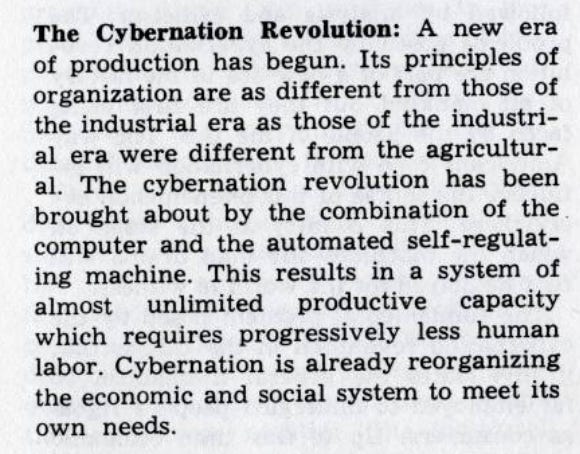
What were they so worried about? Something they called THE CYBERNATION REVOLUTION\.
[](https://substackcdn.com/image/fetch/$s_!uHGh!,f_auto,q_auto:good,fl_progressive:steep/https%3A%2F%2Fsubstack-post-media.s3.amazonaws.com%2Fpublic%2Fimages%2Ff4ffd209-4d3f-49b0-8319-ef7ff762121a_580x454.png)
They feared that no one would need to work due to automation, and that this would create a political crisis\. They recommended dramatic policy action “to develop ways to smooth the transition from a society in which the norm is full employment within an economic system based on scarcity, to one in which the norm will be either non\-employment, in the traditional sense of productive work, or employment on the great variety of socially valuable but ‘non\-productive’ tasks made possible by an economy of abundance; to bring about the conditions in which men and women no longer needed to produce goods and services may find their way to a variety of self\-fulfilling and socially useful occupations\.”
Sound familiar???? It’s almost eerie\. It is the exact same conversation the labs are having about AI today\.
Spoiler alert: the experts were SUPER wrong in 1964\. There was no urgent job displacement, and no need to pursue dramatic policies to forestall it or help Americans to adapt to it\.
Here’s the other part of the problem, though: what’s going on now really*does*feel different, though, doesn’t it? If you just use AI chatbots to help you write, I can definitely see how you’re underwhelmed and dubious on the whole thing\. But if you use coding agents, it’s hard to escape the feeling that something super profound is changing\.
Here’s a good recent example:
This piece is insane\! Just for fun, Rohit spun up an entire new simulation of evolution\. Reading it gave me a profound sense of awe—just a year ago, it would have been totally unthinkable that someone could casually drop a blog post like this\. It’s extraordinary\!
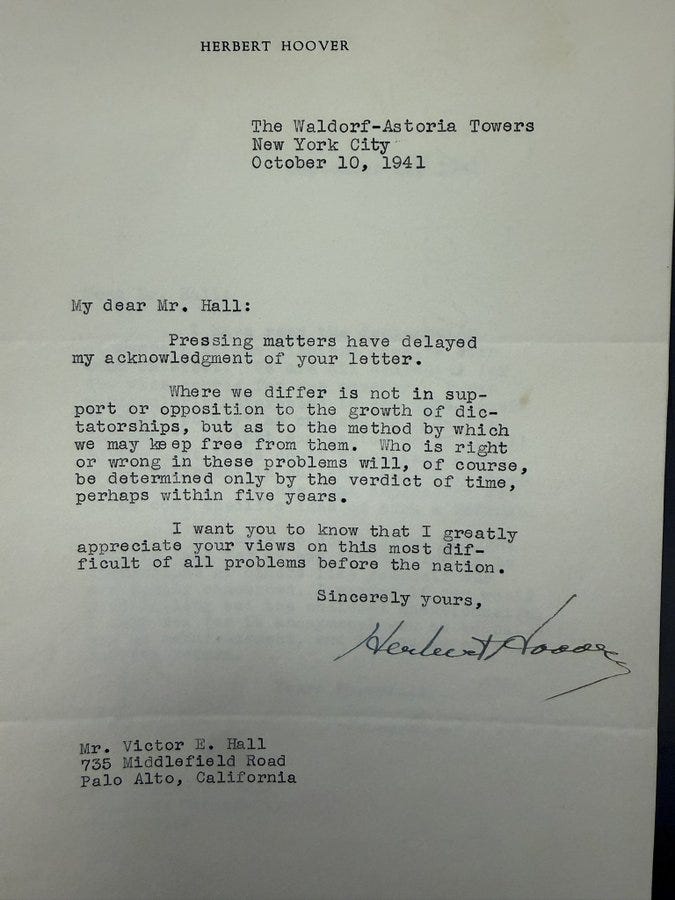
Whichever way AI heads, it’s always good to remember that the world is constantly facing immense crises\. I was reminded of this yesterday\. In helping my dad to clean out his office, we found this remarkable letter from Herbert Hoover to my grandfather in October, 1941\.
[](https://substackcdn.com/image/fetch/$s_!01lc!,f_auto,q_auto:good,fl_progressive:steep/https%3A%2F%2Fsubstack-post-media.s3.amazonaws.com%2Fpublic%2Fimages%2F97300648-4c33-4ee8-a947-dcc49bc921c4_675x900.png)
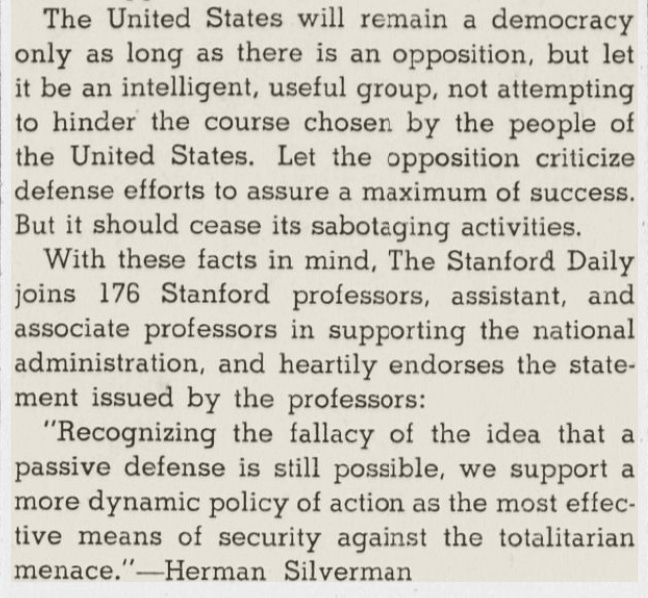
At the time, my grandfather was a professor at Stanford, and he was part of a group of faculty who had signed an open letter entitled “[Dynamic Defense](https://archives.stanforddaily.com/1941/09/29?page=4§ion=MODSMD_ARTICLE58#article)\.” Here’s an excerpt:
[](https://substackcdn.com/image/fetch/$s_!66wP!,f_auto,q_auto:good,fl_progressive:steep/https%3A%2F%2Fsubstack-post-media.s3.amazonaws.com%2Fpublic%2Fimages%2Ffd5b0922-6b60-42fe-90c1-67f891eb0143_648x598.png)
Hoover, who at the time led the Hoover Institution, wrote to my grandfather and they exchanged several letters—unfortunately I don’t have the full set, but I found this letter which concluded the back and forth\. From context, it seems that my grandfather accused Hoover of not taking the threat of isolationism and the rise of fascism seriously enough, which produced this final rejoinder\.
Again, it’s a good reminder that this is far from the first time we’ve felt like we’re on the edge of something enormous and consequential\. \(Another spoiler alert: my grandfather clearly turned out to be right, given what would happen that very December\.\)
[ Sonal Chokshi@smc90 "The only palliative is to keep the clean sea breeze of the centuries blowing through our minds, and this can be done only by reading old book"  QC@QiaochuYuan C\.S\. Lewis: \> Every age has its own outlook\. It is specially good at seeing certain truths and specially liable to make certain mistakes\. We all, therefore, need the books that will correct the characteristic mistakes of our own period\. And that means the old books\. \> All https://t\.co/cdxk624YCp 2:20 AM · May 16, 2026·883 Views 1 Repost·2 Likes](https://x.com/smc90/status/2055473521778962671?s=20)I talk to a lot of people in Silicon Valley about how we’ll keep the most essential, most intellectual parts of humanity alive in a rapidly transforming world\. One of the themes that resonates the most with me—and is suffused throughout this post—is a return to ancient wisdom\. I find myself craving old books, yellowed old journal articles from the mid 20th century, and histories of ancient times\.
I’m building out a “Free Systems Library” of classic books and papers that capture our philosophy\. Condorcet, Montesquieu, Madison, Paine, obviously, but more modern stuff too\. What titles should I include??
#### Discussion about this post
### Ready for more?