@addyosmani: Your team's using Claude Code, Codex, Cursor? @coderhq runs the agent on your own infra - isolated, any model, fully au…
Summary
Coder Agents is a platform for running AI coding agents on enterprise-controlled infrastructure, offering centralized governance, model flexibility, and auditing capabilities.
View Cached Full Text
Cached at: 08/18/26, 02:47 PM
Your team’s using Claude Code, Codex, Cursor? @coderhq runs the agent on your own infra - isolated, any model, fully audited. Real diffs, real control. https://t.co/PY15T8qudw https://t.co/d0syBMOi4Y
Coder Agents - AI Coding Agents on Your Infrastructure | Coder
AI is already used bydevelopers, marketing managers, designers, product managers, financial analysts, HR leaders. Now platform teams need a deployment model the enterprise can actually approve.
Govern and audit AI coding workflows.
The entire agent loop runs in the Coder control plane on infrastructure you control. Platform teams gain centralized visibility into prompts, tool calls, models, spend, and agent activity, with governance controls built for enterprise deployment.
-
Model Governance—Centrally approve providers, models, private endpoints, and enterprise API keys so developers use only sanctioned options.
-
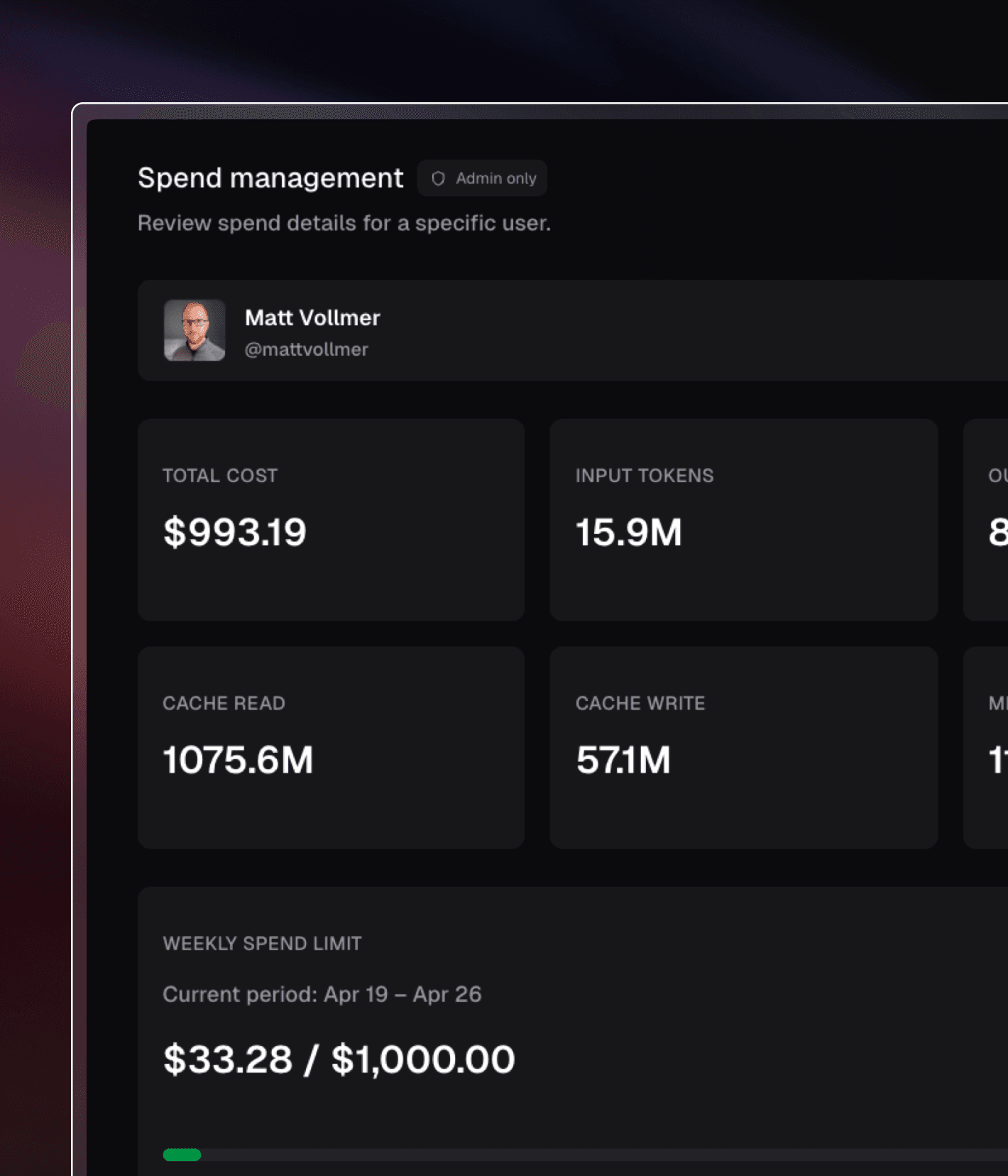
Usage Limits & Cost Tracking—Set per-user and per-group spend controls and monitor usage across models, users, and chats.
-
No API Keys in Workspaces—LLM credentials exist only in the control plane, eliminating a critical exfiltration path.
-
Workspace Governance—Restrict which workspace templates agents can use so they only run on approved infrastructure.
-
User Identity on Every Action—Tie every agent action to an authenticated identity through your existing SSO stack for attribution, auditability, and accountability.
-
Standardized MCP and Skills—Configure and extend agent behavior with centrally managed MCP tools, skills, and policies.
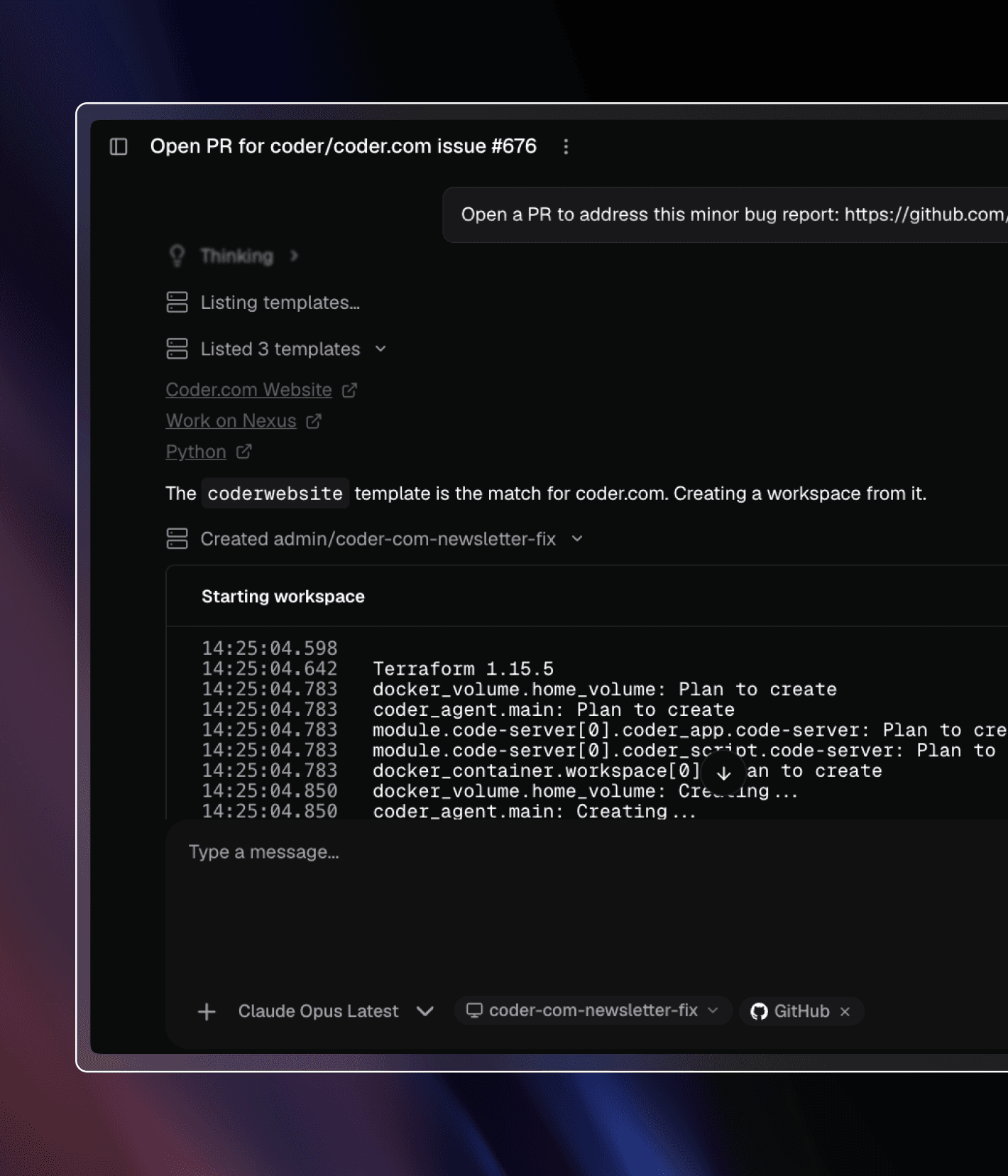
Use a single control plane to run agents and automatically provision workspaces only when compute is needed. No separate service to deploy, and no extra agent platform to set up or manage.

Bring any model.
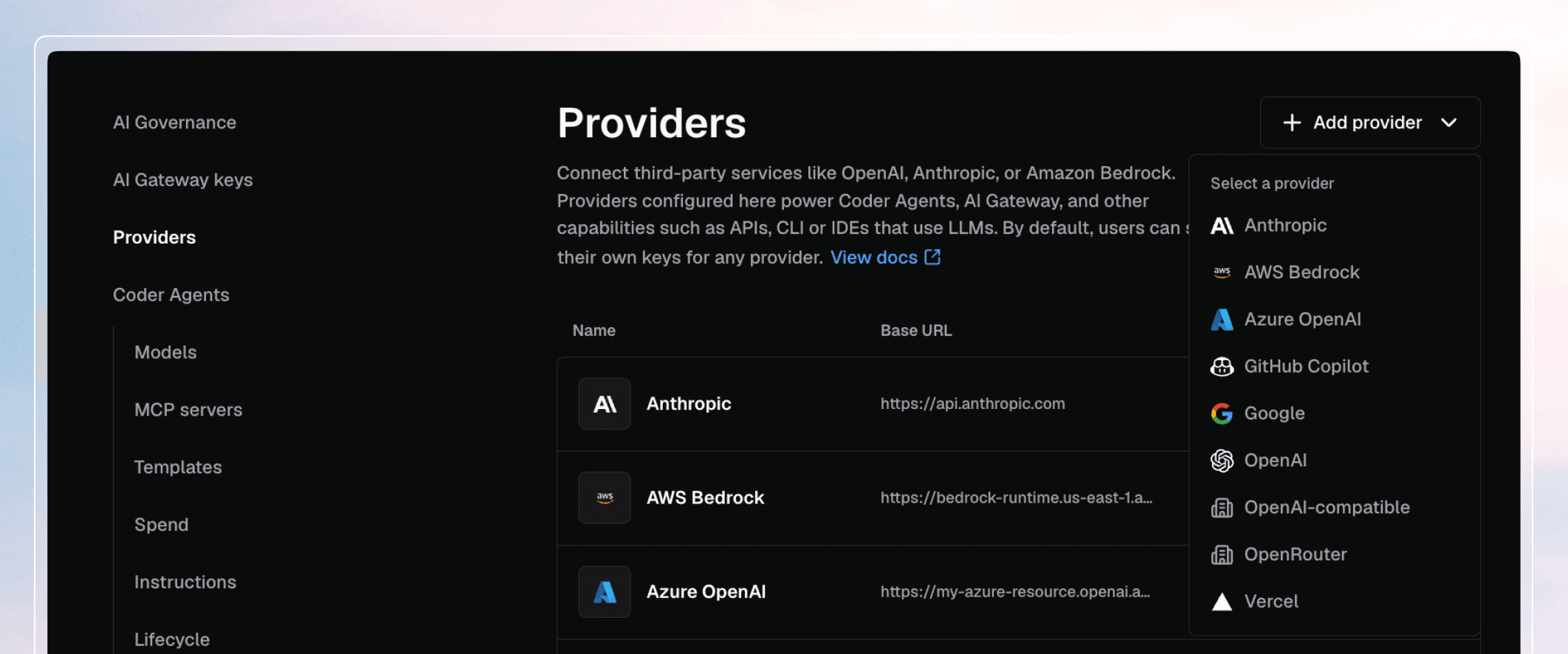
Connect the models that work for your organization, from Anthropic, OpenAI, Google, and Bedrock to self-hosted endpoints. Switching models is a configuration change, not a platform migration.
Trigger agents anywhere.
Use the chat UI for foreground work, or trigger background tasks through the Coder Agents API. Integrate with CI pipelines, GitHub Actions, Slack, Jira, and other systems to automate work end to end.
Measure adoption and outcomes.
Track usage, attribution, and outcomes across your organization, including token consumption, model selection, pull request activity, and merge rates.
Self-hosted and fully inspectable.
Run Coder Agents inside your VPC, on-prem environment, or air-gapped enclave. Source code stays inside your perimeter, and the agent architecture is open to inspection, extension, and control.
Similar Articles
@vintcessun: It turns out that having multiple AI agents work together as a team is better than a single general-purpose agent in this way: each role is bound to its best model, memory and skills accumulate across conversations. Instead of taking turns, a task is handed off with a brief handover note. Runs locally, all file states are in ~/.crew44, free MIT license.
Crew44 is a local-first orchestrator that turns coding agents like Claude Code and Codex into a coordinated team of specialists, each bound to its best model, with persistent memory and skill accumulation across sessions. It runs entirely on your machine with no cloud dependence and is free under MIT license.
@cursor_ai: Run agents on machines you manage or through supported sandbox providers like AWS Lambda, Coder, Cloudflare, Daytona, E…
Cursor introduces self-hosted machines for running cloud agents, allowing teams to manage their own infrastructure while using Cursor's AI orchestration for enhanced control and security in software development workflows.
@shao__meng: Why do Claude Code, Cursor, Codex, Aider, and Cline exhibit different agent behaviors despite potentially sharing the same underlying models? @addyosmani argues: It's due to the "shell" above the model — the Harness, which includes "prompts, ...
The article discusses how Addy Osmani argues that the performance difference between AI coding agents like Claude Code, Cursor, and Cline stems from their 'Harness'—the layer of prompts, tools, and constraints around the model—rather than the underlying model itself. It details best practices for harness engineering, including hooks, sandboxing, and context management, to bridge the gap between model capability and actual agent performance.
@JinjingLiang: Want to ditch Claude? Someone just released the any-agent version of 'Claude Agent View' Use Codex, Pi, Droid, whatever…
Orca is an open-source AI orchestrator that lets developers run multiple CLI agents like Claude Code, Codex, and Gemini side-by-side across repositories on macOS, Windows, and Linux.
@Yuchenj_UW: The future of coding is not one agent. It's a whole AI team. Omnigent lets you run a team of agents in one live session…
Omnigent is an open-source meta-harness by Databricks that lets you run a team of AI agents (Claude Code, Codex, Cursor, Pi, and your own) in one live session for coding.