Cached at:
05/15/26, 12:12 AM
# The economics of superstar AI researchers
Source: [https://epochai.substack.com/p/the-economics-of-superstar-ai-researchers](https://epochai.substack.com/p/the-economics-of-superstar-ai-researchers)
*[Gradient Updates](https://epochai.substack.com/s/gradient-updates)shares more opinionated or informal takes on big questions in AI progress\. These posts solely represent the views of the authors, and do not necessarily reflect the views of Epoch AI as a whole\.*
AI is one of those fields where the best winds up*much*better off than the rest\. Superstar researchers at frontier labs earn over ten times more than most of their colleagues, who earn measly million\-dollar salaries\. They might even earn over a hundred times more than your average AI postdoc:
[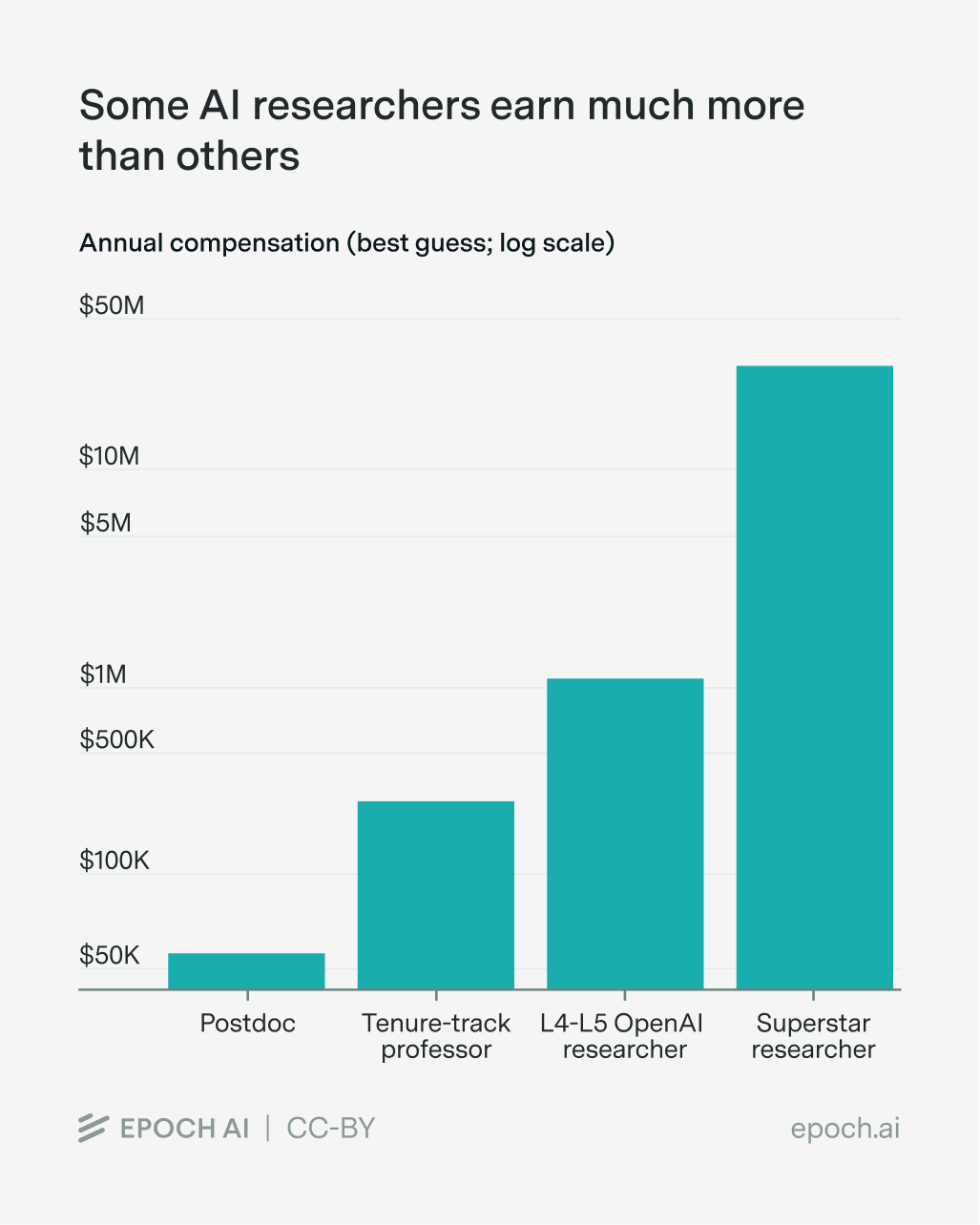](https://substackcdn.com/image/fetch/$s_!js8y!,f_auto,q_auto:good,fl_progressive:steep/https%3A%2F%2Fsubstack-post-media.s3.amazonaws.com%2Fpublic%2Fimages%2Fc9eb18de-c8e1-42b3-b6ef-606dbd58ae05_1027x1284.png)*Ballpark estimates of AI researcher compensation\. Postdoc compensation is estimated using[NSF report](https://ncses.nsf.gov/pubs/nsf26312)data\. For tenure\-track professors, I anchor on this[Taulbee 2024 survey](https://datavisualization.cra.org/TaulbeeSurvey/CRA_Taulbee_Survey_Report_2024.html)of computer scientists\. Compensation for frontier lab researchers is estimated from[Levels\.fyi](https://www.levels.fyi/companies/openai/salaries/software-engineer/title/research-scientist?country=254)for L4\-L5 OpenAI researchers, and[news](https://techcrunch.com/2025/06/27/meta-is-offering-multimillion-dollar-pay-for-ai-researchers-but-not-100m-signing-bonuses/)[reports](https://www.wired.com/story/mark-zuckerberg-meta-offer-top-ai-talent-300-million/)for superstars\.*
So why are the differences in pay so large? The naive explanation is that some researchers are just vastly superior\. Perhaps the superstar researchers have excellent[research](https://x.com/dwarkesh_sp/status/1993391989451014193)[taste](https://x.com/dwarkesh_sp/status/1927485816307142737)in designing algorithms and experiments\. Or they have a knack for pulling off “[yolo runs](https://x.com/_jasonwei/status/1757486124082303073?lang=en)” — training runs that implement many ambitious changes all at once, relying on deep intuition, whereas most people would need to systematically test the individual changes to make sure they work\. Under this framing, superstars are the “10× researchers” that Silicon Valley so deeply reveres, and it’s their quality that makes the difference in pay\.[1](https://epochai.substack.com/p/the-economics-of-superstar-ai-researchers#footnote-1)
The problem with this explanation is that it’s very incomplete\. In reality, we should expect to see big differences in pay*even if superstars were only a tiny bit better than your average postdoc*\. But why?
The short answer is this: there’s a well\-known economic dynamic which turns small differences in ability into big differences in pay\. Here are two illustrative examples:
- In the 100\-meter sprint, the gold\-medallist gets*much*more reward and attention than the silver\-medallist, despite them being quite literally neck\-and\-neck for most of the race\. Consider the London 2012 Olympics, where Usain Bolt won gold\. Most people have no idea who won silver, despite finishing just 0\.12 seconds behind — do you?
- Some musicians earn much more than others\. Consider Taylor Swift: last year, she earned $60\-70 million from Spotify\. I don’t doubt that she’s a “10× singer” compared to me\. But it’s very debatable whether she’s*that*much better than other extremely popular singers like Ed Sheeran, Blackpink, Charli XCX, and Lana Del Rey, who instead earned closer to $5\-25 million\.
Across these two cases, small differences in ability led to big differences in pay some way or another\. Economist Sherwin Rosen called this the “superstar effect,” and it kicks in when two conditions hold\.
1. **One person’s work can reach a big market\.**Usually this means a market with many people, but a few high\-paying people or firms work too\. For instance, potentially[billions of people](https://www.olympics.com/ioc/news/a-window-for-the-world-london-2012-olympic-games-to-set-broadcasting-milestone)watched Usain Bolt win the 100\-meter sprint\. The more people you can reach, the more pronounced the superstar effects\. Across the economy, jobs with broad reach — such as actors, musicians — show far bigger wage dispersion than jobs serving one client at a time, such as plumbers, nurses, and truck drivers:[2](https://epochai.substack.com/p/the-economics-of-superstar-ai-researchers#footnote-2)
[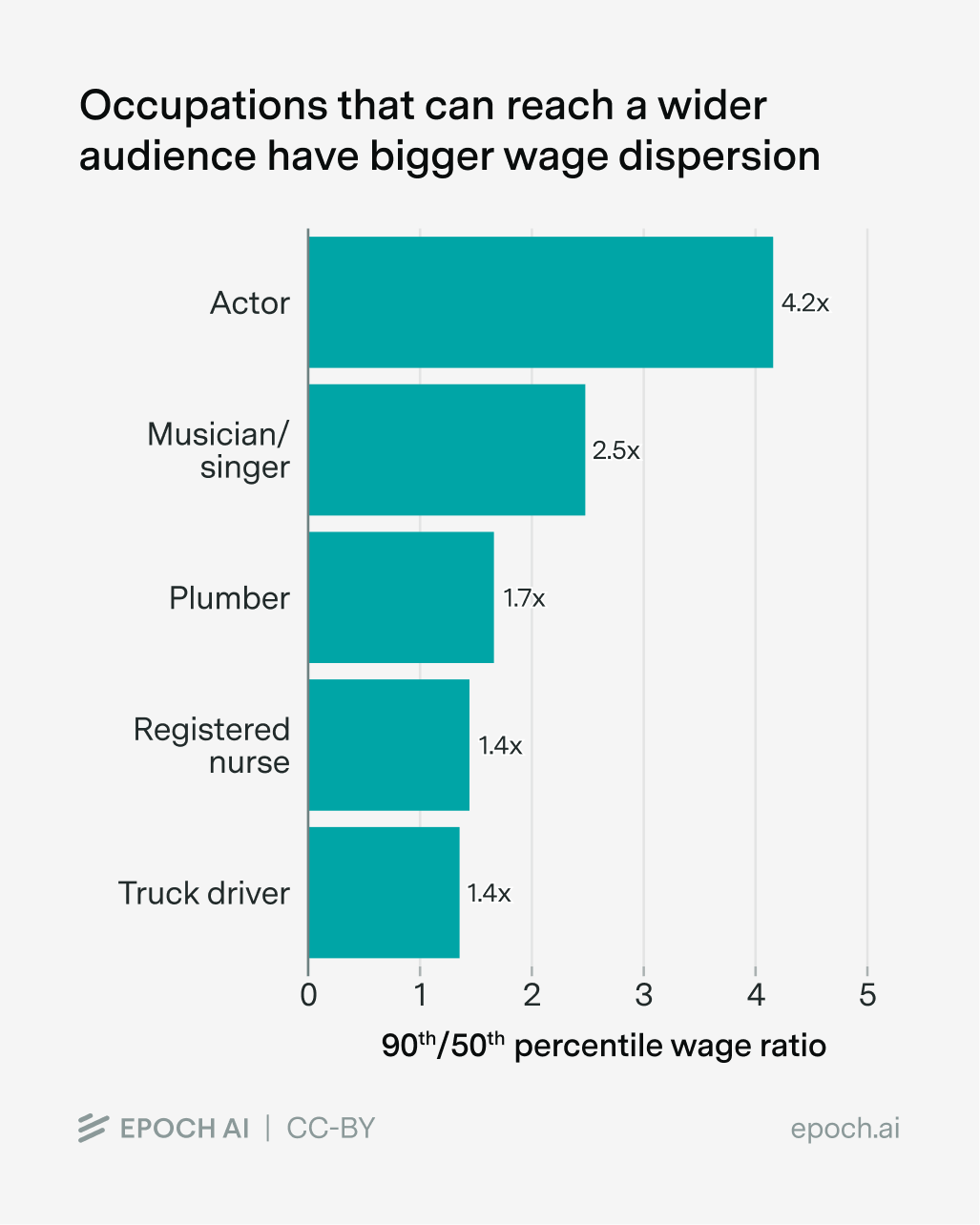](https://substackcdn.com/image/fetch/$s_!l5S2!,f_auto,q_auto:good,fl_progressive:steep/https%3A%2F%2Fsubstack-post-media.s3.amazonaws.com%2Fpublic%2Fimages%2F0107f09c-c5c5-4d8d-bd60-cadb54b6d0fa_1027x1284.png)*[Data](https://data.bls.gov/oes/#/industry/000000)from the Bureau of Labor Statistics across different occupations, showing the ratio of 90th percentile earnings to the median\. If we had data on the extremes \(e\.g\. 99th percentile\), I’d guess the difference in wage dispersion would be even larger\.*
1. **Quantity doesn’t easily make up for quality of labor\.**You can’t have multiple people take the place of a single sprinter, since that would break the rules of the race\. And if you like Taylor Swift more than Ed Sheeran, it’s hard to make up for missing a Taylor Swift concert by going to more Ed Sheeran ones\.
The first condition means a tiny quality edge captures enormous extra value, making it worth paying a lot for the best — that is, as long as you can’t make up for quality with quantity \(the second condition\)\. If you could, you’d just hire a lot more people with lower pay — you wouldn’t need to pay a ton just to hire the cream of the crop\.[3](https://epochai.substack.com/p/the-economics-of-superstar-ai-researchers#footnote-3)
AI researchers tick both boxes\. There’s a huge market: ChatGPT has[almost a billion users](https://epoch.ai/data/ai-companies?view=graph&tab=usage), served by the same handful of underlying models, so a single researcher’s contribution could scale to every user simultaneously\.
And in AI, researcher quantity doesn’t easily make up for quality: frontier labs are compute\-constrained, so they can only run so many experiments to test new[software innovations](https://epochai.substack.com/p/the-least-understood-driver-of-ai)\. Two “merely very good” researchers can’t replicate one Noam Brown if what’s needed is deep intuition about which experiments are worth running in the first place\. Not to mention the difficulties coordinating researchers if labs are short on time\.[4](https://epochai.substack.com/p/the-economics-of-superstar-ai-researchers#footnote-4)
This is how even a 2× researcher could earn far more than the median\. Scaled to a billion users, even a small quality edge generates enormous differential value\. And if the 2× researcher can add something that multiple 1× researchers can’t, then it’s worth paying a lot to capture this\.
Frontier AI labs are often described as being in a “race”\. I’m not sure what exactly they’re racing toward, but it often seems to involve automating huge swathes of human labor, a prize potentially worth[tens of trillions](https://epoch.ai/epoch-after-hours/ai-in-2030)of dollars a year — if you win\. This incentivizes AI labs to adopt an “all in or nothing” approach, and anything that improves their chances even a little might be worth a lot\. Hence Meta’s[\(alleged\) $100 million dollar compensation packages](https://www.wired.com/story/mark-zuckerberg-meta-offer-top-ai-talent-300-million/)to poach top researchers from OpenAI\.
In principle it’s even possible this pushes things well beyond what is socially valuable \(however you define that\) — it’s like how high frequency traders spend huge sums trying to execute a trade a tiny bit faster, to[almost no social benefit](https://academic.oup.com/qje/article/130/4/1547/1916146)\.
Other forces are at work too\. Top researchers carry valuable trade secrets in their heads — the results of expensive experiments competitors haven’t run, and which would cost a[fortune](https://epoch.ai/data-insights/openai-compute-spend)to[replicate](https://epoch.ai/gradient-updates/r-and-d-vs-training-compute)\. Many also manage teams, contributing more value than just their raw technical research ability; Noam Brown recently described himself as a “[manager at OpenAI](https://x.com/polynoamial/status/2047381460437635313)\.”[5](https://epochai.substack.com/p/the-economics-of-superstar-ai-researchers#footnote-5)Each of these may contribute to the wage gap, separate from the superstar premium\.
Additionally, it’s hard to quantitatively analyze the superstar effect\.[6](https://epochai.substack.com/p/the-economics-of-superstar-ai-researchers#footnote-6)I don’t know of a good way to quantify “researcher quality”\. There are some valiant efforts like METR’s[RE\-bench](https://metr.org/blog/2024-11-22-evaluating-r-d-capabilities-of-llms/), but these contain small isolated tasks \(think “finetuning GPT\-2”\) rather than projects with millions of lines of code, fuzzy objective metrics, and lots of coordination between different people\.
But despite these complications, I think the superstar effect tells us several useful things\. For one, I’ve seen a[couple of](https://fortune.com/2025/08/29/ai-talent-wars-100-million-or-corporate-culture/)[news](https://www.cnn.com/2025/07/25/tech/meta-ai-superintelligence-team-who-its-hiring)[articles](https://www.cnbc.com/2025/09/06/ai-talent-war-tech-giants-pay-talent-millions-of-dollars.html)about Meta’s attempts to poach researchers with exorbitant salaries, in their quest for[Personal Superintelligence](https://www.meta.com/superintelligence/)\. But these articles usually miss out on this important superstar effect \(though they often do touch on race dynamics\)\.
Another important implication is for how we think about the[intelligence explosion](https://epochai.substack.com/p/the-software-intelligence-explosion)\. If a 100× pay gap is driven by a 100× researcher quality gap, then simulating a top researcher might speed things up*much*more than simulating an average researcher\.[7](https://epochai.substack.com/p/the-economics-of-superstar-ai-researchers#footnote-7)But this isn’t the case if much of the pay gap is driven by the superstar dynamic — the gap in researcher quality might actually be much smaller\.
Finally, knowing about this effect gives us some hints at what’s to come in the near future\. I think that the superstar effect will only become more important moving forward\. That’s because lots more people will use AI, and each person will use AI systems much more heavily\. And as research increasingly shifts toward[managing an army of Claudes](https://x.com/bcherny/status/2007179832300581177), those with deep research intuitions and years of experience as research managers will probably see ever\-growing boosts to their productivity, as well as the sizes of their wallets\.
So if anything, superstar earnings might become an even bigger deal — $100 million annual compensation quite literally might not be enough\.
*I’d like to thank Andrei Potlogea, Phil Trammell, Josh You, David Owen, JS Denain, Cheryl Wu, Stefania Guerra, Robert Sandler, Lynette Bye, and many people at Trajectory Labs for their feedback and support\. Thanks also to Luis Garicano for inspiring me to write this essay in the first place\.*