@dotey: Claude 新的一篇博文《How Warp builds self-improving agents on Claude》 https://claude.com/blog/how-warp-builds-self-improving-a…
摘要
本文介绍了Warp如何利用Claude构建自改进的AI代理,通过人类反馈自动优化技能,并总结了有效代理开发的最佳实践。
查看缓存全文
缓存时间: 2026/08/30 00:10
Claude 新的一篇博文《How Warp builds self-improving agents on Claude》 https://claude.com/blog/how-warp-builds-self-improving-agents-on-claude… ,看了后还是挺有收获,它解决的是 Skill 的进化问题。
这个问题我以前也研究过,我写了一个反编译 JS 代码的 Skill(http://github.com/JimLiu/decode-codex/blob/main/.agents/skills/deobfuscate-javascript/SKILL.md#maintaining-this-skill-self-improvement-protocol…),每次 Agent 反编译的时候遇到新的场景解决了就自己更新自己的 Skill,效果还不错,能一直优化,就是 Skill 文件越来越大。
我还研究过写作的自我进化 Skill,那个就一言难尽,因为它其实没有自己统一的标准,经常负优化,越写越糟糕。
说回来 Warp 这个,Warp 是一个挺有名的终端工具,内部尝试借助 AI 做 Code Review。一开始让 Agent review 代码,效果并不理想,主要问题体现在 Agent 不了解你的项目,不知道你的团队规范,不知道历史经验教训,就算你指出来问题它下次还记不住。简单来说就是没有记忆。
初期他们采取了很多补救措施:
- 手动根据失败案例改系统提示词
- 完善项目的 AGENTS.md 文件(有意思的是这篇文章是 Claude 发的,但是用的是 AGENTS.md 而不是 CLAUDE.md,我记得 Claude 默认不支持 AGENTS.md 的)
但效果并不理想,一方面它依赖于人主动去做,成本较高;另一方面团队成员在 Code Review 时人工在 PR 写的高质量评论完全没用上。
所以他们搞了个解决方案,一个基础 Skill 负责做代码审查,一个改进 Skill 负责定期收集人类工程师在代码审查时的评论,尤其是对 Agent 审查结果的评论,根据人类工程师的评论去更新代码审查的 Skill。
换句话说,它不是依赖于模型自己去改进自己,而是 Agent 根据人类对模型结果的标注(人类对代码审查的评论),去改进技能。
只不过它把这个事做的摩擦力极低,不需要人手工去收集整理评论,不需要填写调查问卷,人只要自然的去代码下写评论,后面的事情都是 Agent 自动完成。
这可能正是 Agent 的最佳实践方案之一:人负责高纬度的标注、评论、反馈这些事情,Agent 去做执行的工作,Agent 根据人类的反馈去改进 Skill。
除此之外,他们还总结了一些最佳实践:
- 写原则,不要写死规则。
编写 skill 时,要像在指导一个聪明人,而不是在给计算机编程。在 Skill 中写“寻找重复代码”,比列出详尽的变量命名规则更有效。
-
解释为什么。 说明规则背后的理由,能让智能体针对问题进行推理,而不是机械执行僵化指令,也因此更容易举一反三。
-
让反馈没有摩擦毫不费力。 在人们原本工作的地方收集反馈,例如直接评论 PR 或 issue。同时让收集过程自动发生,不要增加额外的提交步骤。低摩擦才能让信号持续流动。如果反馈太麻烦,你就收不到反馈,也就无法改进 Skill。
-
保持 Skill 精简,并使用渐进式披露。 优秀的 skill 文件不会很庞大;它会引用资源文件和脚本,而不是一次性把所有内容都塞进上下文。
-
反馈质量大于数量,但数量也有帮助。
一位资深工程师给出的少量、详细且与领域相关的反馈,可能比大量草率反馈更有价值,因为简单的赞成/反对并不能说明“为什么”。
即使样本量相对较小,只要反馈来自掌握领域知识的人,而且足够详细,你也能得到非常好的信号——这些知识是智能体通过其他方式根本无法获得的。话虽如此,优质信号的语料越多,效果越好。
- 做好改进 Skill 的 Skill,可以用来改进其他 Skill。
把改进 Skill(也就是前面提到的一个代码审查 Skill 一个改进 Skill)做好,收益不只限于眼前这套 Agent 循环,因为改进 Skill 在不同用例之间具有很高的复用性。除了领域专用知识这一部分,它其实是一套相当通用、可复用的机制。代码审查 Agent 的改进 skill,也可以应用到其他 Skill 的改进上。
可能有人会担心:如果反馈本身是错的呢?
Warp 的做法是永远不让 Agent 盲目接受反馈。给它足够的上下文来做基本的合理性检查,限制谁的反馈有权影响技能更新(不是所有人的意见都同等重要),最后始终保留人在循环中审核改动。
对于那些有明确标准答案的领域,比如代码是否通过了测试、部署是否成功,可以先建一个验证基准,让 Agent 自己对着基准跑。没有标准答案的领域,比如代码风格、文档质量,就靠领域专家的判断,不要开放给所有人随意反馈。
How Warp builds self-improving agents on Claude
Source: https://claude.com/blog/how-warp-builds-self-improving-agents-on-claude In our series, , we highlight how startups are transforming their industries with AI. In this article, we share how Warp turned stateless user feedback into a self-improvement loop for its agents.
The quick pitchNameWarpFounded2020FoundersZach Lloyd (CEO)StackRust, Golang, GitHub Actions, internal agent orchestration platform (Oz), Claude PlatformGrowth$73M raised. 800K monthly developers build on Warp. 56% of the Fortune 500 uses Warp. 10M Claude Code sessions run inside Warp to date, 400K+ per week. 40M total Warp Agent conversations.
Agents need to handle recurring tasks reliably and effectively. A first-pass prompt that gets 80% of the task correct can create a noisy and annoying experience for the user. Warp learned this the hard way, and used this to inform its product strategy, creating an improved experience for nearly 1M developers worldwide.
Warp, the AI-powered terminal and agentic development environment, builds on the Claude Platform. The team ran into this “noisy experience” problem with their internal code review agent. Engineers complained that their agent made unhelpful comments and produced low-quality output.
The team initially tried stopgap solutions, like manually rewriting the prompt based on observed code review failures. This made output more usable but didn’t scale. Improving context files like AGENTS.md also helped, but was far from a complete fix.
Ultimately, they realized, the real issue was that feedback to an agent, no matter what its purpose, typically disappears when the session ends, removing critical context from the agentic loop. Their solution: anAgent Skills-based framework to create self-improving agents where feedback compounds over time to continually refine and enhance agent output.
Read on to learn how they built it with skills on top of the Claude Platform.
Agent self-improvement loops built on skills
The central technique is a self-improvement loop usingskills, which are file based encodings of knowledge that keep instructions out of the raw prompt. Warp evolved a self-improving agent architecture consisting of two skills, with human feedback in between.
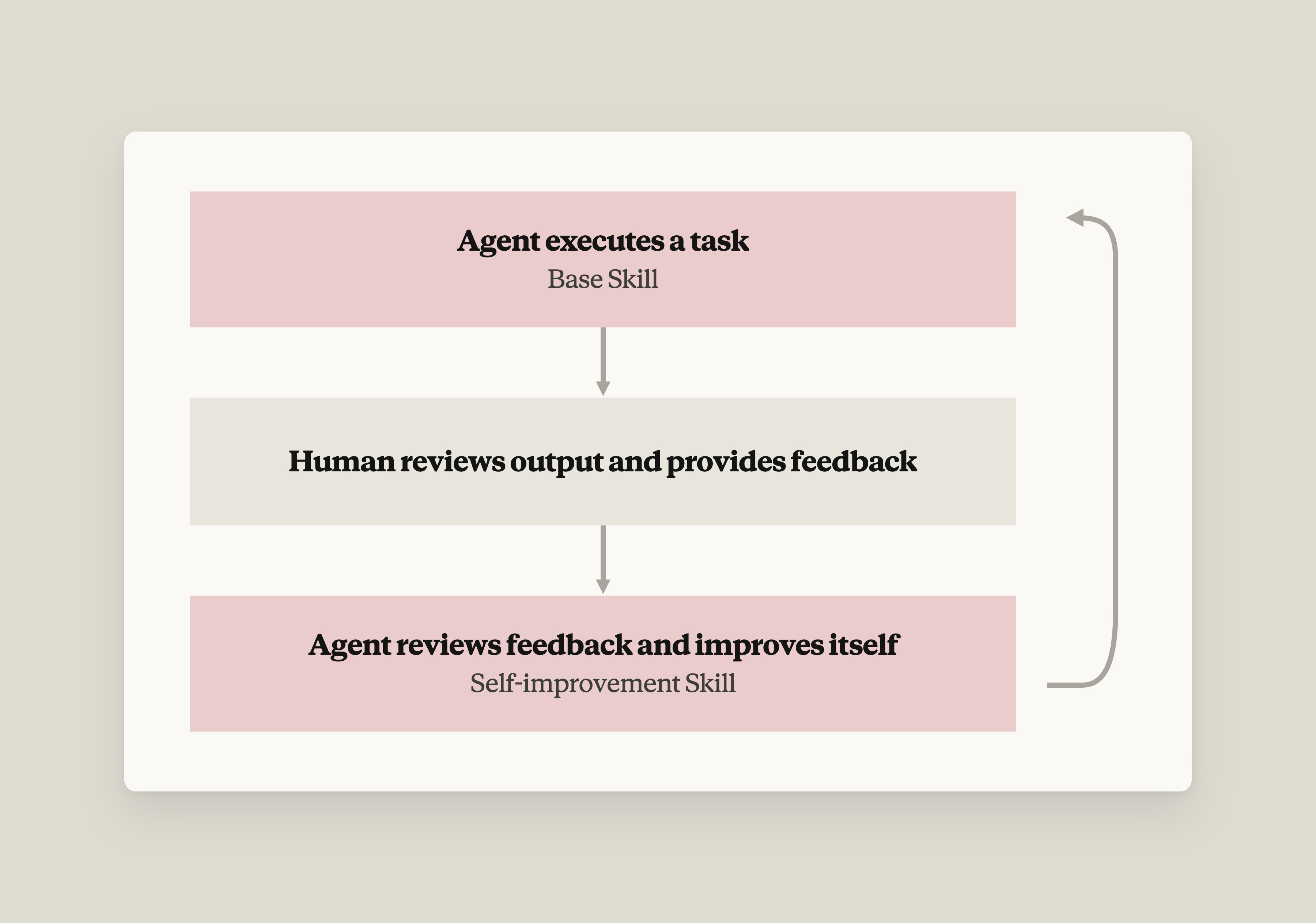
Theinner/base skillholds the functional domain knowledge and instructions. For example, when a PR is opened, Warp’s code agent executes using that base skill and context to produce its review.
Human feedbackon agent output is a critical component for the self-improvement loop. For code review this could be something as simple as a thumbs up, but the more explicit the better.
“A human could affirm, ‘this was a good, useful comment’,” Warp founder Zach Lloyd explains, “But the human could also give detailed reasons why a code review wasn’t good. Specifics like ‘you suggested renaming this variable, but our code base convention is this type of global variable uses this particular naming context’ tell the agent how to do it right next time.”
Theouter/improver skillfunctions as an observer agent that runs on a schedule rather than per-task. It pulls the accumulated human feedback, compares what the agent suggested against how humans responded, and proposes a small, focused edit to the base skill.
Because skills are plain files, agents are extremely good at updating them. These updates, which are reviewable, approvable, and mergeable, can flow through a normal PR/code-review workflow; once merged, the next run of the inner skill inherits the improvement.
Warp now runs this pattern across its entire open-source repo, with separate spec-writing, review, and triage agents, each carrying their own self-improvement loop.
“File-based skills are a way of encoding knowledge for agents without putting that knowledge directly in the prompt, as something the agent can simply look up in the course of doing its job,” says Zach. “The framework is really simple actually: there’s the base domain-specific skill and then there’s the improver skill that refines that domain-specific skill. This simplicity is the beauty of this approach.”
How to write self-improving skills for agents
Here are some of the Warp team’s tried and true tips for writing self-improving skills for agentic loops:
- Write principles, not rules.“Construct the skill as though you’re instructing a smart person, not like you’re programming a computer,” Zach says. “Including direction in the skill like ’Look for repeated code’ provides better direction than exhaustive variable naming rules.”
- **Explain the why.**Providing the rationale behind the rule lets the agent reason about the problem instead of following rigid instructions, again allowing for better generalization.
- **Make feedback effortless to give.**Capture it where people already work, like by commenting directly on a PR or issue. Also, make this happen automatically, with no extra submission step. “Low friction is what keeps signal flowing,” Zach notes. “If you make it too hard you’re not going to get the feedback and you’re not going to be able to improve the skill.“
- Keep skills small and use progressive disclosure.A good skillfile isn’t large; it references resource files and scripts rather than dumping everything into context at once.
- **Feedback quality > volume, but volume helps.**A small amount of detailed, domain-specific feedback from a senior engineer can be worth more than lots of cursory feedback because binary thumbs up/down doesn’t saywhy. “You can get really good signal even from a relatively small sample size if it’s very detailed feedback from a person around domain specific knowledge that the agent otherwise would have no way of getting,” Zach continues. “That said, the bigger the corpus of quality signal, the better. At Warp we’re using a loop to manage our whole open source repo. We have hundreds of people contributing and we’re doing thousands of code reviews.”
- Put extra effort into the improver skill. Putting extra effort into writing the improver skill (the observer agent) pays off beyond the immediate agent loop, because improver skills are very reusable across different use cases. “Outside of the domain specific knowledge component, this is a fairly reusable mechanism—the improver skill for a code review agent is not that different from the improver skill for any other agent.”
The loop in action: Warp’s issue triage agent
Warp’s issue triage agentdemonstrates the self-improving agent skills framework. The pattern is triggered whenever someone files a new GitHub issue: a GitHub Action fires an agent that analyzes the issue for complexity and feasibility, assigns labels, and suggests a direction for the fix. That triage agent runs off an inner skill file holding the domain knowledge about what each label means and how to research the codebase before acting.
On a sample issue, the first-stage inner skill did a solid job but missed one label, ready to spec, which signals that a contributor can start building product and technical specs against the issue. A maintainer on the Warp team caught the gap and left feedback directly on the issue, exactly where the work was happening. Critically, he explained both what he expected and why he expected it: actionable feedback easy for the agent to absorb later.
The outer improver skill runs inOz, Warp’s agent orchestration platform, as a scheduled “update triage” agent. The agent authenticated to GitHub, ran a Python script bundled with the skill to pull recent issues carrying feedback, summarized them into a JSON file, and read that back into context. The bundled script is itself a best practice; skills can reference resource files instead of writing fresh code on every run.
From there, the agent identified the concrete feedback signals in the maintainer comments and proposed the smallest edit that captured them. It opened a PR editing the inner skill to apply the “ready to spec” label when an issue describes a real problem, even though the exact UI or UX shape is not yet defined.
Because the whole update is a skill file, it moves through the normal code-review workflow. The PR arrived with a description explaining which signals prompted the change and what it altered. A human reviews, approves, and merges, and the next run of the triage skill inherits the new knowledge. That final human step closes the loop and keeps a person in control of what actually changes.
This is the same mechanism Warp now runs at scale across its open-source repo, where spec-writing agents, review agents, and triage agents each carry their own self-improvement loop.
Any agent, no matter what its task, gets better over time if you build one of these loops into it from the start to capture human feedback signals, turn them into skill updates, and expand agents from one-off helpers into capable systems that compound across your org.
Best practices from the Warp teamAre you conflating skills with memory?Skills are procedural and stable—“how to do X,” run-agnostic, changed deliberately. Memory is auto-written by the agent at inference time and never stops changing.Do you need one improver loop, or one per agent?Meet in the middle: a templated base loop captures the overlap across your agents, with domain-specific weights layered on. A handful of improvers can each own one; a hundred should share.What happens when the feedback is wrong?Assume it will be. Don’t let the agent accept feedback blindly — give it context to sanity-check, filter whose input counts, and keep a human in the loop at either the filtering or final-review stage.Is your domain verifiable?Build the verification harness first, then let the agent tune against it: generate a reference corpus, compare output to reference, fix, repeat.And if it isn’t domain verifiable?Lean on deterministic evals against golden outputs wherever they exist. Where you must use human feedback, restrict it to domain experts — don’t open the floodgates.How do you know the whole system is improving?Track the global metrics humans already eyeball—time to merge, contributor count, cost—and feed them back into the improver agents. Go crawl-walk-run on deployment.
View the full webinarfor a live demo and deeper discussion of how Warp uses Claude to build agents that learn from team feedback and improve themselves over time.
Start building with theClaude Platformtoday.
相似文章
Claude 推出自我改进型智能体(5 分钟阅读)
Anthropic 宣布为 Claude Managed Agents 带来多项新功能,包括用于自我改进记忆的“dreaming(梦境)”功能、基于结果的评估循环,以及多智能体编排能力。
@RealCodedAlpha: 这篇关于 Claude Code Dynamic Workflows 的 9 步指南真的讲透了! 很多人玩 multi-agent 都是直接开 swarm,结果一堆冲突、低质输出和 merge 地狱。 作者把核心说清楚了:结构化的 loo…
这篇推文介绍了Claude Code Dynamic Workflows的9步指南,强调了结构化循环和多智能体工作流的最佳实践,包括人工审查、工作树隔离和自动返工,指出这是将agent swarm从玩具变成生产力的关键。
@nash_su: 官方给出的 Claude Code 在大型代码库中的最佳实践 当然同样的方法论也可以用在 Codex 或任何 Agent 上,AI 会犯错,会糊弄人,项目越大 AI 债越多,文章中是一些基本的防护和优化方式。 本文使用 http://Wi…
官方给出的Claude Code在大型代码库中的最佳实践,同样适用于Codex或其他AI Agent,介绍了基本的防护和优化方式。
@max_ai_max: https://x.com/max_ai_max/status/2060221653259547069
本文分享了编写一个真正可用的Claude Skill的实践指南,涵盖运行机制、目录骨架、frontmatter写作、迭代方法等,帮助开发者高效构建和调试自定义技能。
@hwchase17: "用 Deep Agents 构建你自己的 Claude Code" 社区的一篇好文章,展示了如何构建一个类似 Claude Code 的代理……
一篇解释如何使用 LangChain 的 Deep Agents 库构建类似 Claude Code 的编码代理的文章,涵盖了架构和实现。