Cached at:
08/18/26, 12:58 PM
# Canon
Source: [https://tau.dev/2026/08/07/canon](https://tau.dev/2026/08/07/canon)
## My eight year old daughter wants to make video games\.
She’s obsessed with this idea\. She likes*playing*video games too, but it’s just not the same\. Experiencing the world, even defeating the world, is too passive\. She wants to*make*the world\.
So I made her a game where she can make games\. A multiplayer world made of text and images and a tiny new scripting language, where she can take anything and everything apart to see how it works\. I first learned to code in the days when*View Source*was a reliable teacher, and I think she deserves the same\.
The game has a lot of limitations\. The language,`Cant`, is not a very good language, and that’s on purpose\.
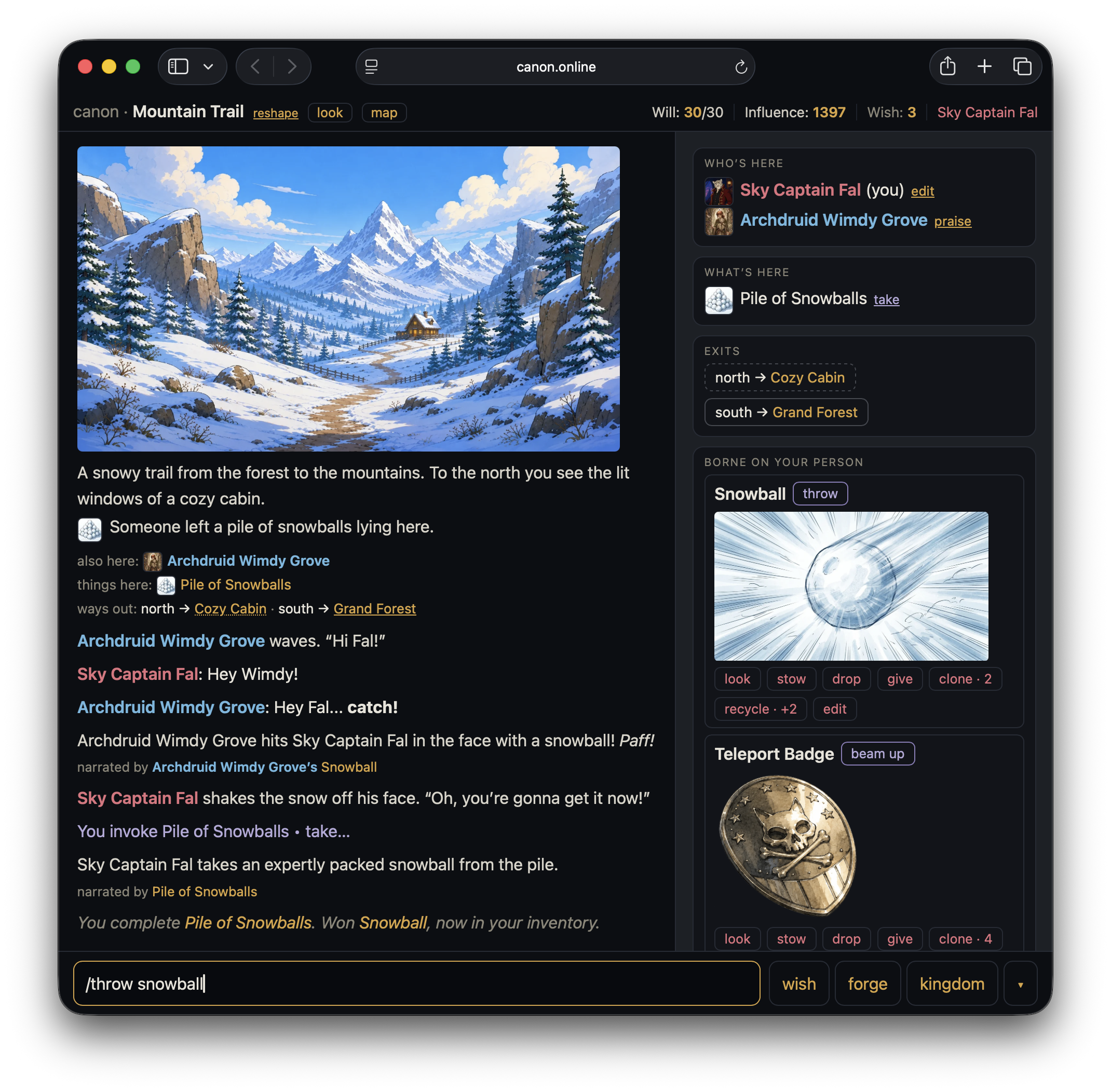
But it also turned out to be a lot of fun\. I call it:
[](https://tau.dev/assets/canon/canon.webp)
Canon is a modern, web\-based take on the classic[MUDs](https://en.wikipedia.org/wiki/Multi-user_dungeon)of the Old Internet\.
For the uninitiated: back before World of Warcraft made the MMORPG a big studio genre, we had text\-based MUDs \(and[MUCKs](https://en.wikipedia.org/wiki/MUCK)and[MUSHes](https://en.wikipedia.org/wiki/MUSH)\) where players could adventure and socialize in vast realms made of pure written words\.
I spent countless hours exploring these imaginary places\. I wanted to make something in that spirit that would feel more familiar to a modern audience\.
Canon has strong opinions about what makes a good MU\*, and what makes a good learning environment\. Every room, object, and interaction in Canon is player\-created, and it can all be inspected, copied, and modified\.
The kiddo loves it\. If you’re the kind of grownup who’s into roleplaying or text adventures, or has some nostalgia for the age of telnet and the early web, you might like it too\.
But first, recipe blog style, let me tell you how we got here\.
---
### [Training wheels for the bicycle for the mind](https://tau.dev/2026/08/07/canon#training-wheels-for-the-bicycle-for-the-mind)
Do you remember[HyperCard](https://en.wikipedia.org/wiki/HyperCard)? If not, do you remember[Myst](https://en.wikipedia.org/wiki/Myst)? \(If not, congratulations on being young\. Bear with me\.\)
Bill Atkinson dreamed up HyperCard in 1985 after an LSD trip\. I first encountered it in 1989, in my 4th grade computer lab, and also had my mind expanded\.
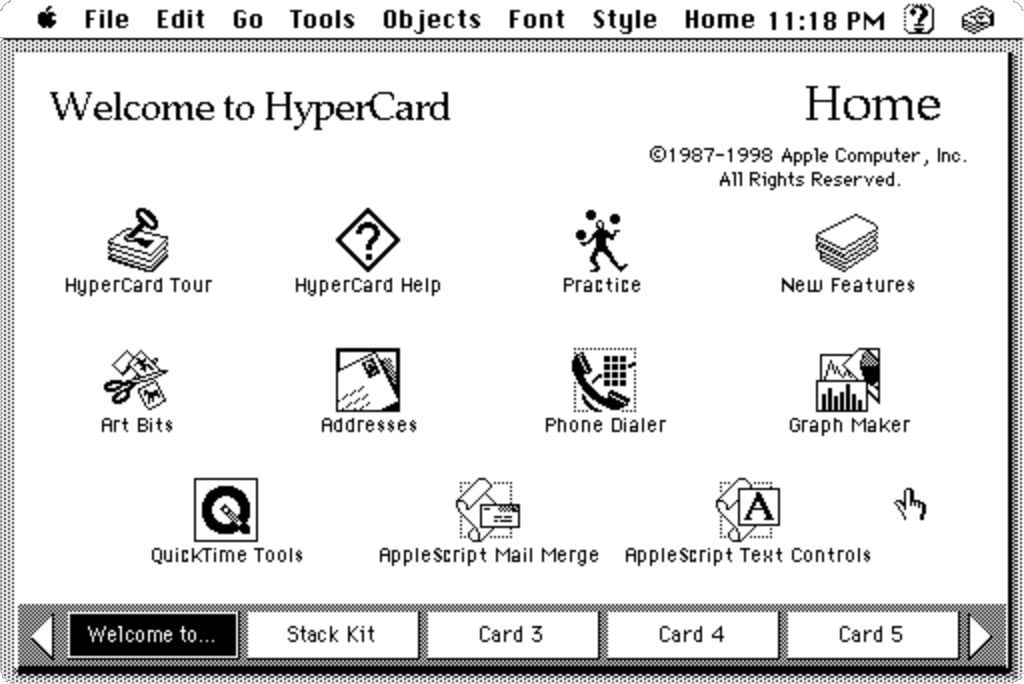
HyperCard works like this: there are cards\.
[](https://tau.dev/assets/canon/hypercard.png)
I mean, that’s pretty much it\. That’s the genius\. There are cards, and you can put computer things on them\. Buttons and text and pictures and video\. Cards get stacked together\. A HyperCard*app*is called a “stack”\. Get it?
And then all those buttons and pictures and things: you can make them clickable\. And you can tell them to move between cards in the stack\. It’s a choose your own adventure book as UX\.
\(If this sounds kind of like a web site, well, yes\. HyperCard was one of the first real usable instances of[HyperMedia](https://en.wikipedia.org/wiki/Hypermedia)and influenced Tim Berners\-Lee’s development of the World Wide Web\.\)
```
on mouseUp
go to card id 123
end mouseUp
```
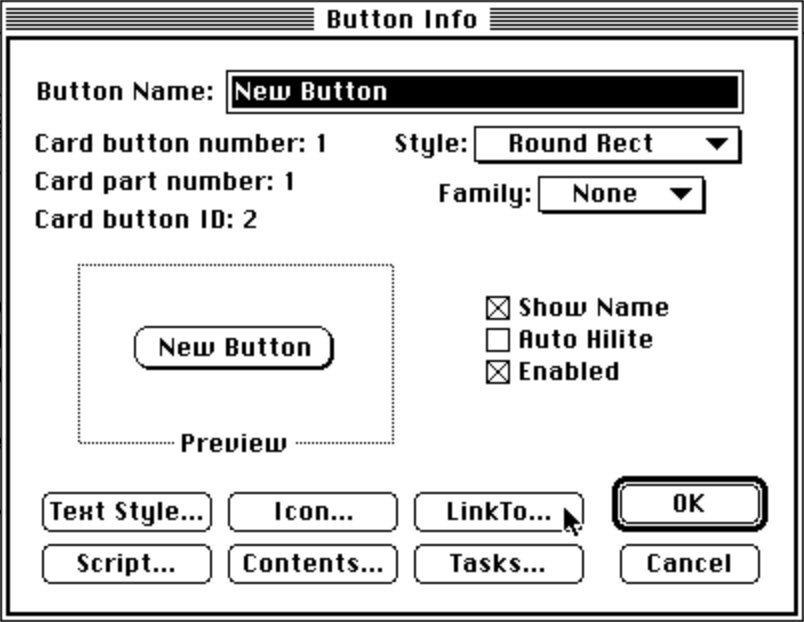
That there is valid[HyperTalk](https://en.wikipedia.org/wiki/HyperTalk), the programming language underlying HyperCard\. But for the most basic interactions like that – click a button, go to a card – you don’t even need to know HyperTalk\. You can wire things up using a simple GUI editor\.
[](https://tau.dev/assets/canon/newbutton.png)
If you can click a button you can use HyperCard\. And if you can*use*HyperCard, you can*program*HyperCard\.
I could write a whole series of posts about this\. But the two things I want to impart to you now are as follows:
1. HyperCard was**magic**\.
2. HyperCard**sucked**\.
---
### [It was magic and it sucked](https://tau.dev/2026/08/07/canon#it-was-magic-and-it-sucked)
In many ways HyperCard stacks were[not good apps](https://daringfireball.net/2002/08/why_hypercard_failed)\. They were heavily constrained by the card metaphor\. They used input elements from the MacOS visual language, but they did not, and could not, feel like normal native MacOS applications\. HyperTalk made the same mistake later repeated by[AppleScript](https://en.wikipedia.org/wiki/AppleScript): trying to make a programming language look more like natural language, thus failing to be either thing well\.
To any real programmer it was a frustrating underpowered environment\. But those same flaws and constraints made it magically accessible to two hungry groups:**non\-programmers**and**curious kids**\.
The first group produced a ton of stuff\. The Internet Archive has a playable[collection of thousands of stacks](https://archive.org/details/hypercardstacks)\. If you remember the Early Web, just browsing the thumbnails should give you a familiar feeling\. Games\! Zines\! Fandoms\! Manifestos\! Somehow porn\! Before the web, people with a Mac and Something To Say traded stacks on floppies\.
I fell into the second camp\. At nine years old I found HyperCard on my elementary school’s[Macintosh SE](https://en.wikipedia.org/wiki/Macintosh_SE)and quickly discovered that unlike most computer programs,*everything in HyperCard was editable*\. I started making the first thing that popped into my mind, which was a[Street Fighter](https://en.wikipedia.org/wiki/Street_Fighter)style fighting game with two crudely drawn players\.
[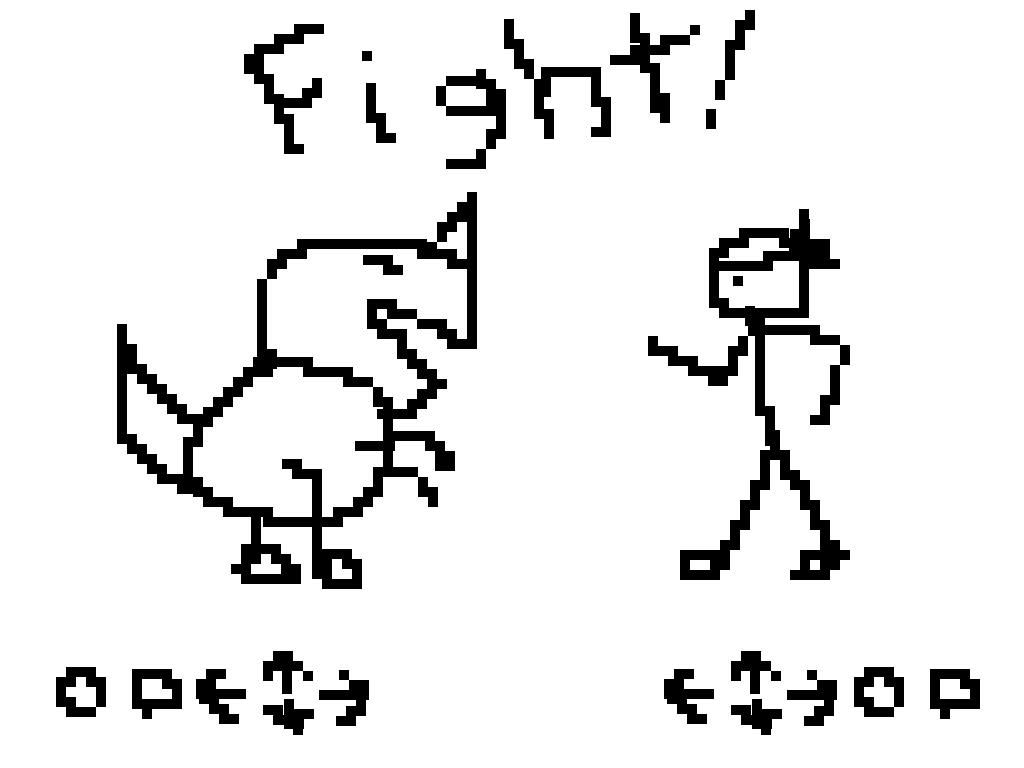](https://tau.dev/assets/canon/fight.png)Artist’s recreation\. Alas, the original stack is lost to The Ages\.
Which is what I call the box of dead floppies in my parents’ basement\.I didn’t know anything about programming, much less advanced gamedev concepts like*sprites*\. But I knew I could link buttons to cards\. So I did that\. With the determination only a hyperfocused child can muster, I set about*drawing individual cards for every possible combination of player moves and positions*, with buttons as “controls” to move between them\. I’d found me a hammer, and I could see how to make a game out of nothing but nails\.
> You’re on card 154\. Player 1 is in quadrant 2, idling\. Player 2 is in quadrant 3, defending\. If player 1 presses the “attack” button, go to card\.\.\.
It took me*weeks*staying late after school\. But it worked\. I*made a game*\. I could play my own creation\. I’ve spent my whole career chasing that high\.
But that was just the beginning\. One of the really clever things Bill Atkinson did was to make it so when you edited HyperCard behaviors with the GUI, it just*wrote the corresponding code*for you\. About halfway through my laborious clicking\-and\-linking project, I noticed the`Script…`button in the editor, pieced together its implications, and started using a copy & paste HyperTalk snippet and a systematic naming scheme for all my hundreds of cards to speed up development\.
Near the end the computer teacher \(I’m pretty sure we just called the class “computers”\) noticed what I was up to and dug the*HyperCard Reference Manual*out of a drawer for me\. This was my first experience reading a tech manual cover to cover\.
---
### [Many years later…](https://tau.dev/2026/08/07/canon#many-years-later)
I’m not going to make my daughter learn HyperCard\. I’m a bit of a[Troll Dad](https://www.gocomics.com/calvinandhobbes), but not*that*mean\.
But I did want to reproduce the magical combination of creative freedom and mechanical constraints that made HyperCard so eye\-opening for young Nick\. Canon needed:
- Instant gratification\. As soon as you put a thing on screen, it’s already part of the game\.
- View Source\. Everything in the game should be built with the game’s own tools, and freely editable/copyable/take\-apart\-able\.
- A GUI for the simplest interactions\.
- A smooth learning gradient from GUI to writing raw code\.
- Just enough power in that code to build a wide range of fun game mechanics, and to teach basic programmer ways of thinking\.
- But limited enough that a beginner could grasp the entire set of primitives\.
---
### [Instant gratification](https://tau.dev/2026/08/07/canon#instant-gratification)
The great thing about a text\-based world is that you can add anything you want just by typing “there is a \[thing\] here”\. You’re constrained in*how*you can build – no fancy 3D visualizations or impressively realistic physics engines – but have unlimited freedom in*what*you can build\.
Canon is made of three things:
1. Players
2. Rooms
3. Items
**Players**and**Rooms**are both just text descriptions and, optionally, images\. To make either, you just answer a question:*what does this look like?*
[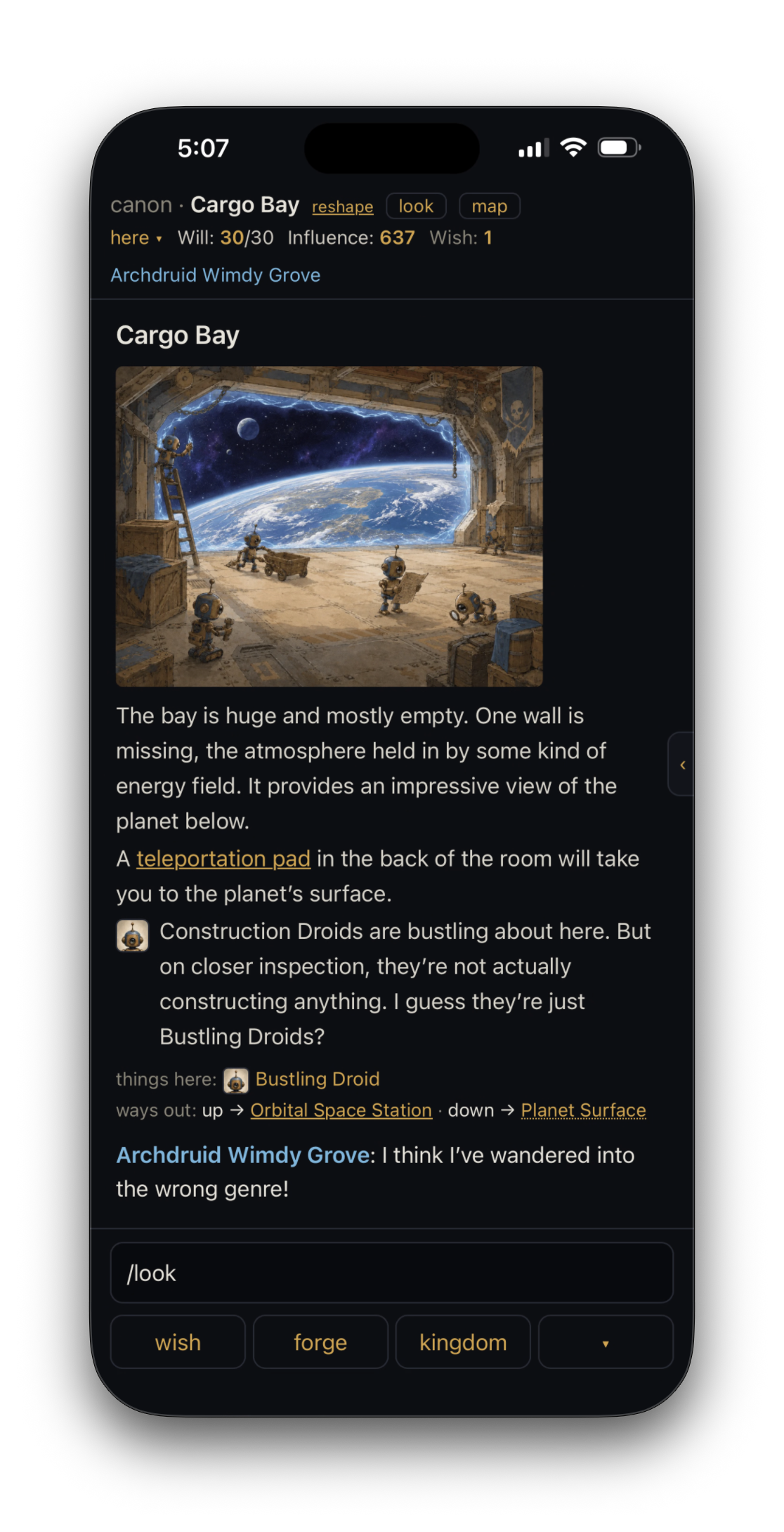](https://tau.dev/assets/canon/lookhere.webp)[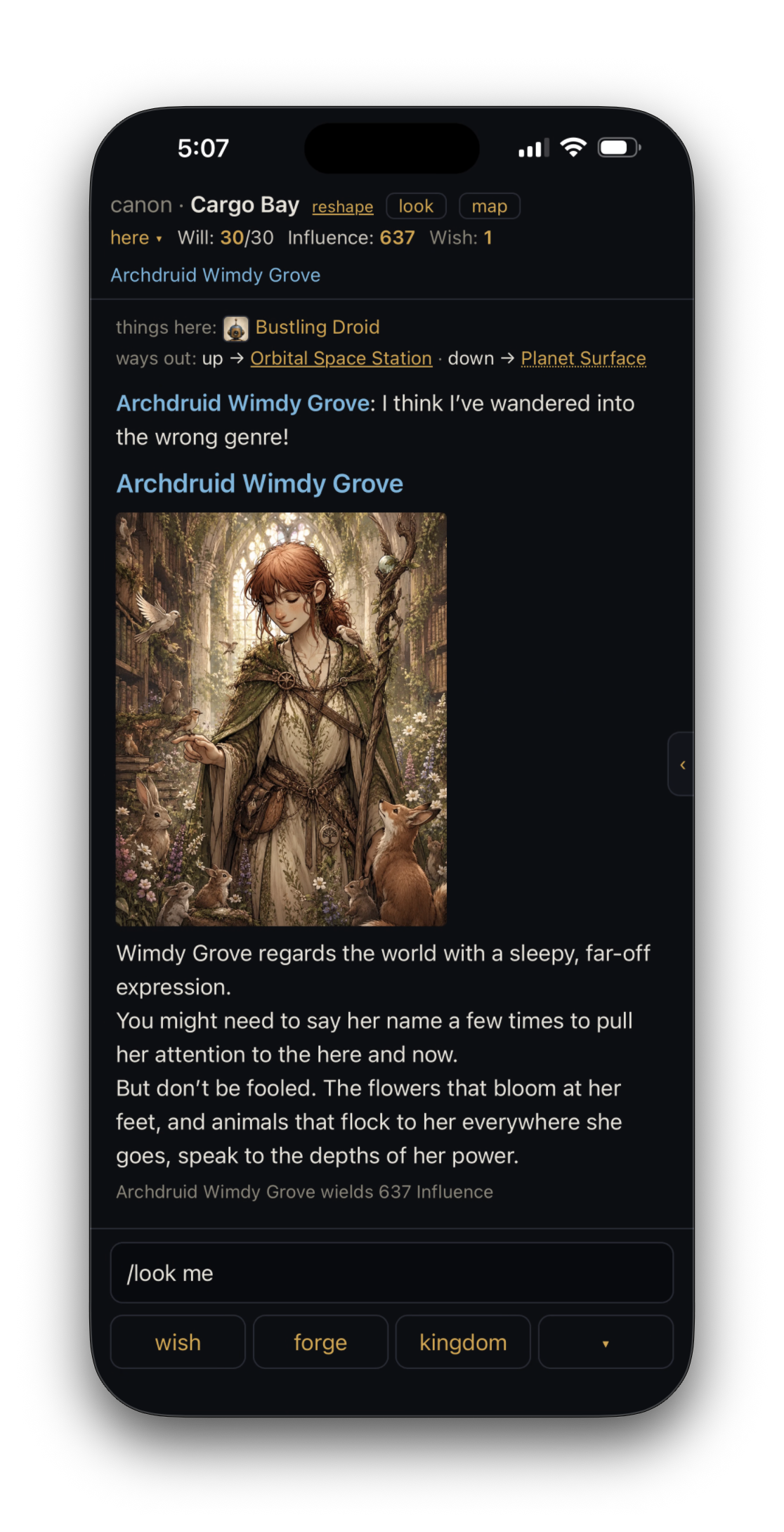](https://tau.dev/assets/canon/lookme.webp)
---
### [View source](https://tau.dev/2026/08/07/canon#view-source)
**Items**are*everything else*\. They are also text descriptions and images, so you can flavor an item as anything you want: an inanimate object, a pet, an NPC, a spell effect, a vehicle, a doorway, a quest marker, a message, etc\.
But in addition to text and images, items are also made of*actions*and*state*, via`Cant`\. It looks like this:
```
item "Hooded Lantern" {
describe "An iron lantern with a hinged hood."
on "light" {
narrate "{player}’s {item} swings open and warm light spills out."
}
}
```
That’s enough to produce a lantern the player can light:
[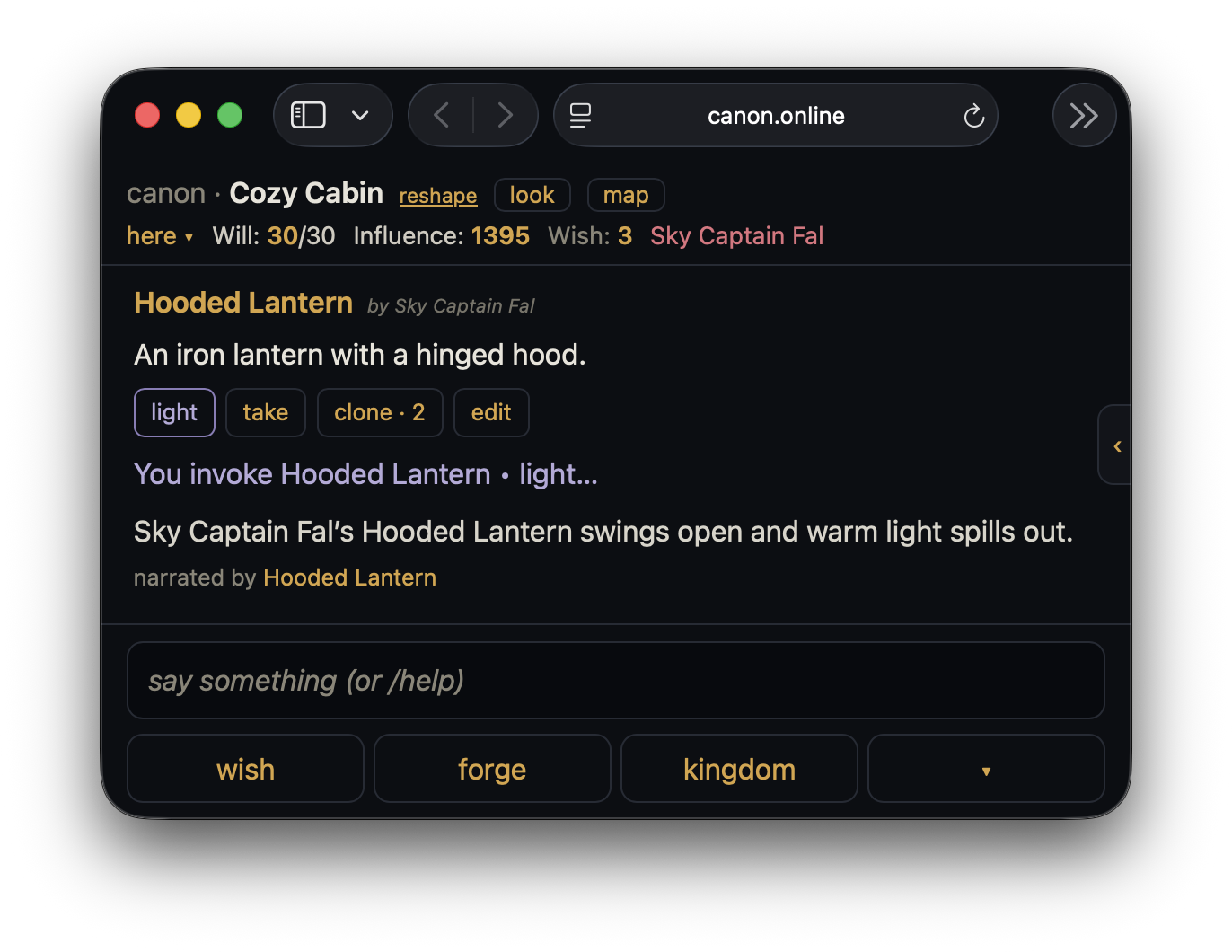](https://tau.dev/assets/canon/lantern.webp)
Here’s a slightly more complicated item, a magic 8\-ball:
```
item "Magic 8-Ball" {
describe "A prophetic billiard ball. Give it a shake?"
or "Give it a shake to see your future."
or "Dare you shake it?"
on "shake" {
say
"It is certain."
or "Outlook good."
or "Signs point to yes."
or "Don’t count on it."
or "My sources say no."
or "Reply hazy, try again."
or "Ask again later."
}
}
```
The`or`keyword works anywhere Cant takes a text string\. It randomly picks a variant each time the string is used: when a player looks at an item, or triggers an action\. I wanted this baked into Canon at the lowest level\.
There’s something especially delightful, to a new programmer, about an RNG\. You tell the computer what to do, and it does it\. But you also told it to exercise a tiny bit of its own agency\. It’s both surprising and not surprising\. You programmed every response, you know all the things it can say, and yet you don’t know exactly what it will say when you press the key or click the button\. It’s like suddenly being able to tickle yourself\.
[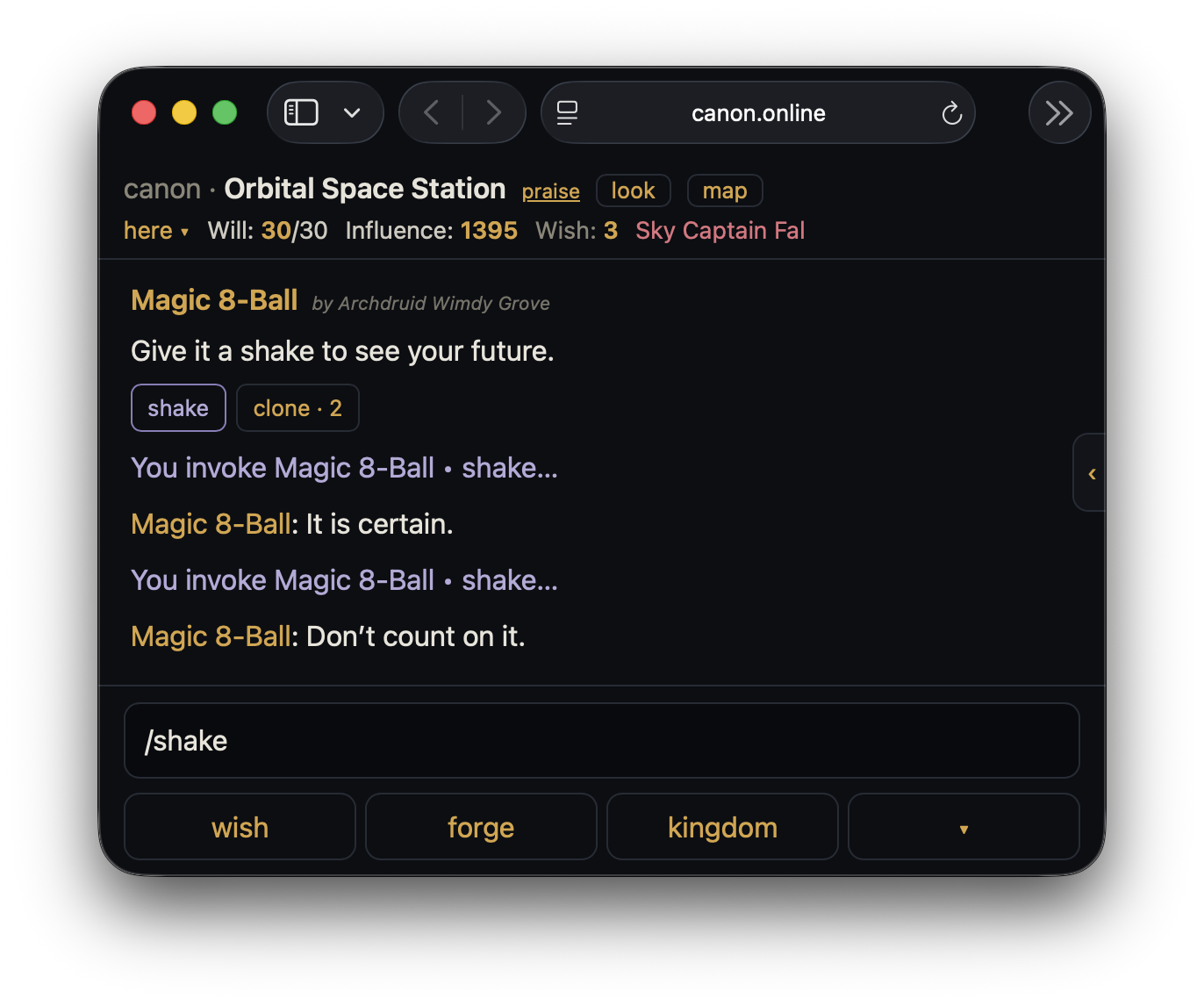](https://tau.dev/assets/canon/8-ball.webp)
Notice in addition to`shake`, this item has a`clone`button\. Every item in Canon can be cloned\. Items you own \(which include anything you’ve cloned\) can be edited\. Every game or toy or quest made by another player is also a*tutorial*\.
---
### [A GUI for the simplest interactions](https://tau.dev/2026/08/07/canon#a-gui-for-the-simplest-interactions)
The 8\-ball is one of the first toys I made to tempt the kiddo\. I left it lying in the starting zone\. Even when you know nothing about conditional logic, even if you don’t look at the code, it’s easy to see how it works from a few minutes of playing with the ball\. And it’s easy to imagine how you could modify it into a flipping coin, or an NPC that tells random jokes\.
[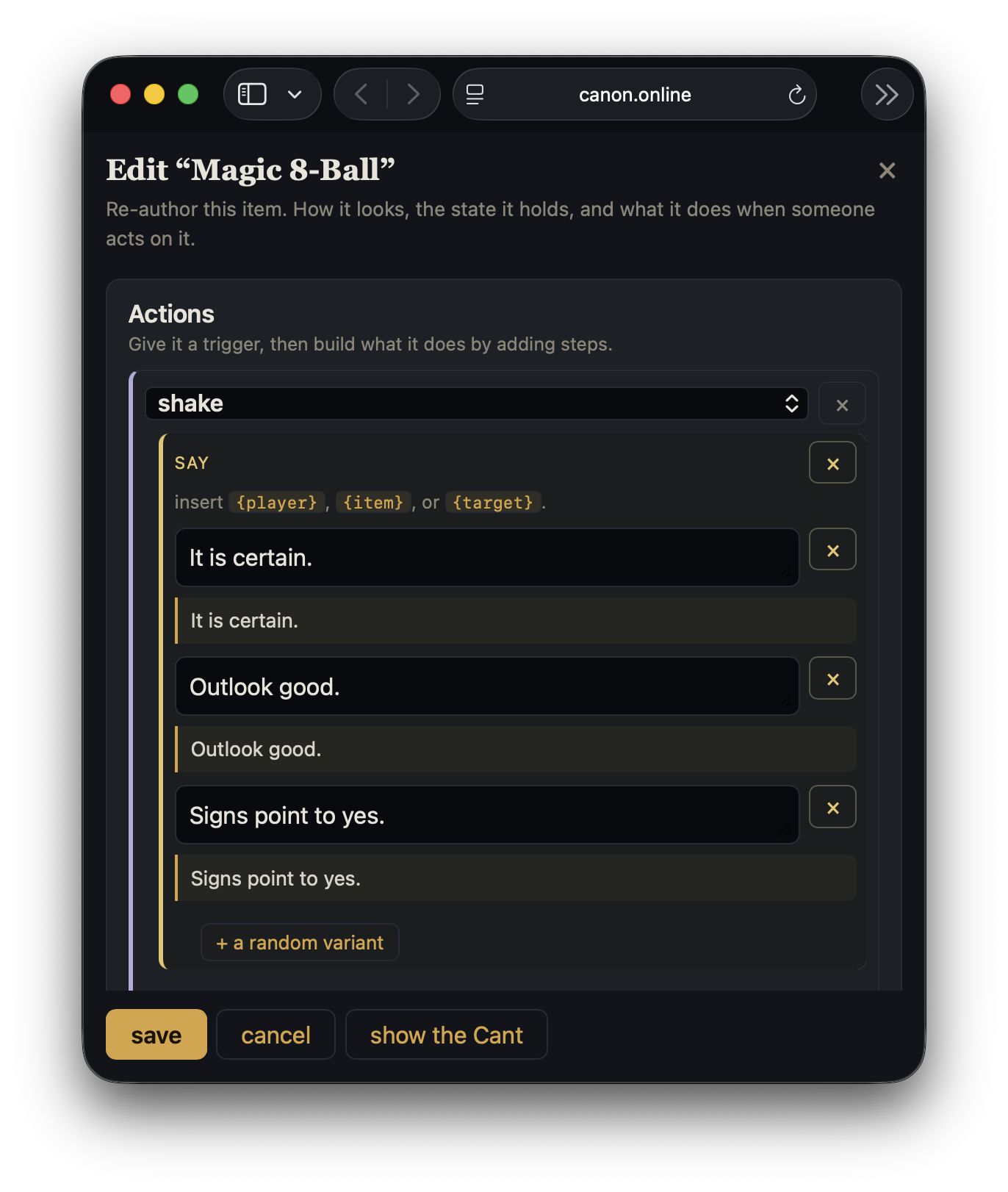](https://tau.dev/assets/canon/8-ball-simple-edit.webp)[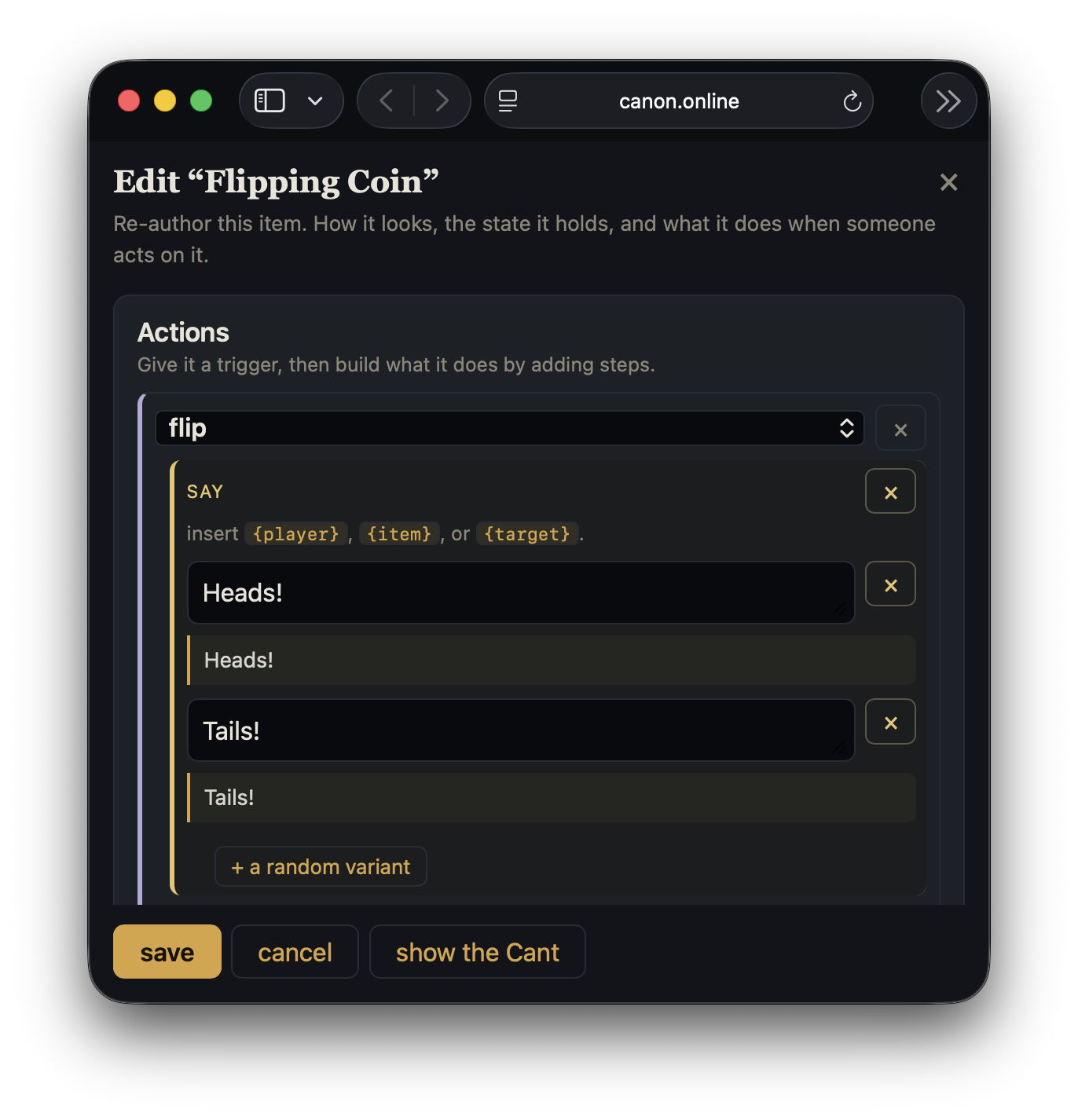](https://tau.dev/assets/canon/flipping-coin.webp)
Or, say, a D20:
[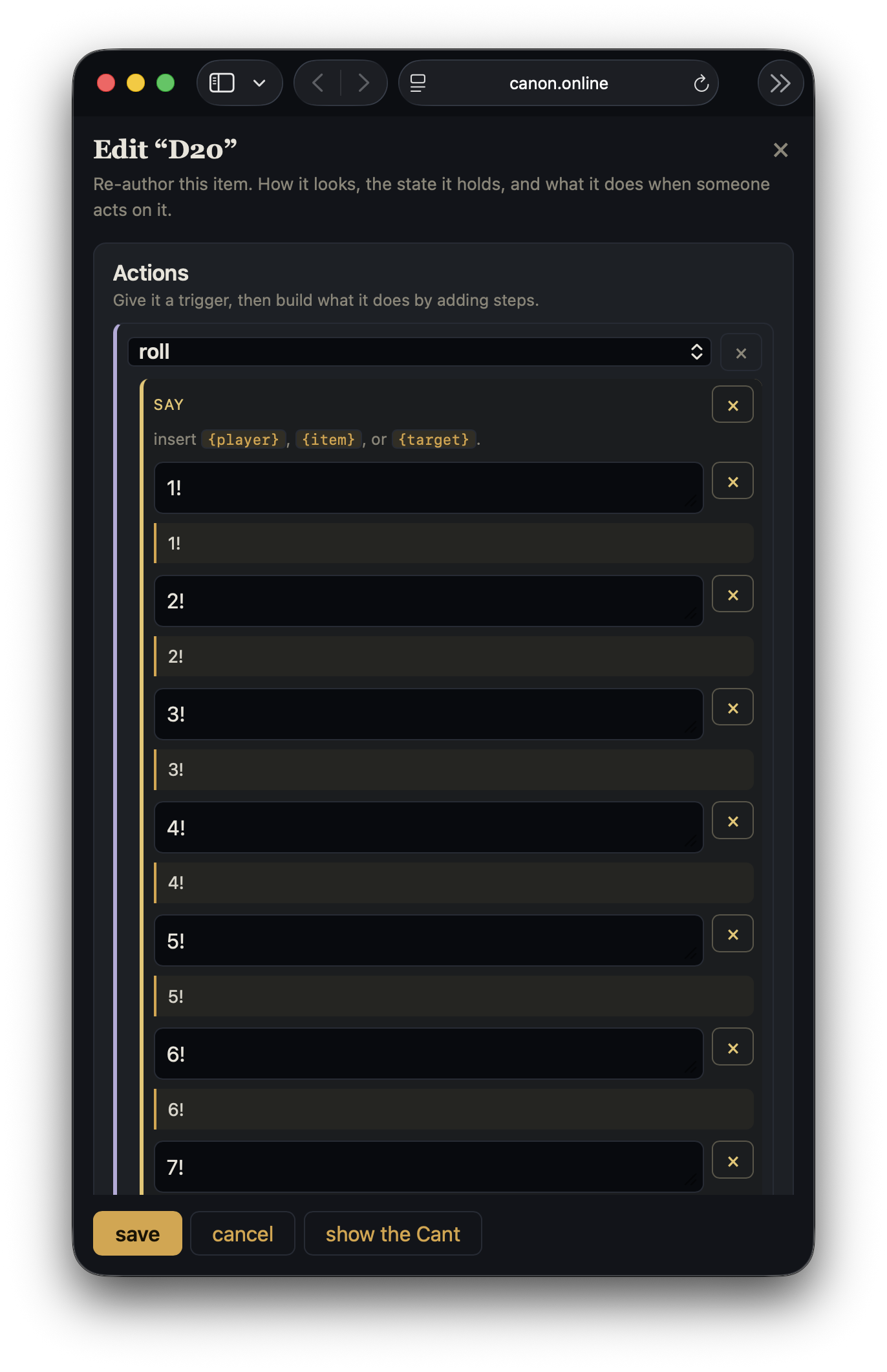](https://tau.dev/assets/canon/d20.webp)I am completely serious\.If you are a programmer, one thing you might notice about this is that it’s horrible\. This is an inefficient way to write something that could obviously be`randInt\(1,20\)`\. But it is extremely*approachable*\.
Cant is a language designed to be bad in educational ways\. It’s optimized for ease of understanding over speed of writing\. It’s the opposite of[DRY](https://en.wikipedia.org/wiki/Don't_repeat_yourself)\.
---
### [A smooth gradient from GUI to code](https://tau.dev/2026/08/07/canon#a-smooth-gradient-from-gui-to-code)
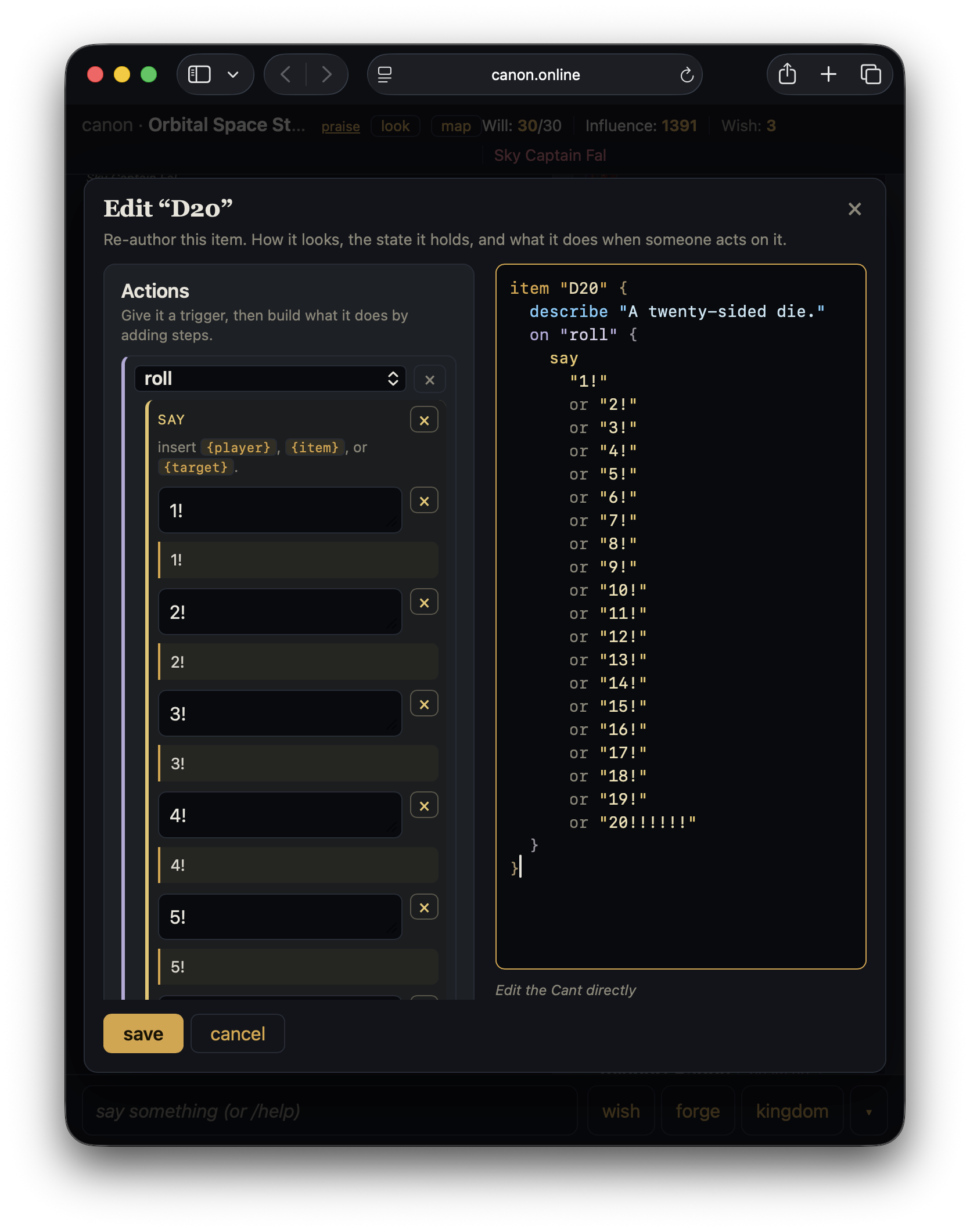
Let’s expand that editor window a little:
[](https://tau.dev/assets/canon/d20-with-code.webp)
An experienced programmer will notice this code could’ve been a one\-liner\. But a beginner will notice the code is already a lot less work than clicking 20 buttons and 20 text inputs\.
The code and the structured editor are synced\. Any valid expression in one immediately updates the other\. I wanted this to tempt the kiddo the same way HyperCard’s`Script…`button tempted me\.
---
### [Just enough power](https://tau.dev/2026/08/07/canon#just-enough-power)
Okay,[saying random strings](https://man.cat-v.org/unix_8th/6/fortune)is fun, but it’s not much of a game\. What else can this thing do?
A few examples:
```
item "Dueling Wand" {
describe """
A hazel {item} wound with copper wire, humming faintly.
{when item vigor <= 0}Its light is out. A defeated duelist’s wand, until someone mends it.{end}
"""
borne "A hazel {item} {when item vigor <= 0}hangs dark and quiet{else}crackles with impatience{end} in {player}’s grip."
afield "A hazel {item} lies here, {when item vigor <= 0}its lights dimmed{else}crackling with magic potential{end}."
state {
vigor 30
}
on "fireball" {
when item vigor > 0 {
when target vigor > 0 {
subtract target vigor 1d20
narrate "{player}’s {item} roars! A ball of fire breaks over {target}."
when target vigor <= 0 {
narrate "{target}’s wand goes dark. {player} stands victorious."
}
}
otherwise {
narrate "{player}’s {item} finds no one standing to strike."
}
}
otherwise {
narrate "{player} attempts to cast but their {item} is dark until mended."
}
}
on "mend" {
when target vigor >= 30 {
narrate "{player}’s wand hums, finds nothing to mend on {target}, and declines to waste the charm."
}
otherwise {
add target vigor 1d10
narrate "Green light from {player}’s {item} knits itself over {target}."
when target vigor > 30 {
narrate "{target} sparkles briefly with excess power."
set target vigor 30
}
}
}
}
```
This is a*PVP*encounter\. Two or more players can pick up Dueling Wands and fight each other\. The key thing to notice here is:
```
state {
vigor 30
}
```
Items in Canon can hold two kinds of state:**marks**and**numbers**\.
Marks are boolean flags\. A lantern could be`LIT`, an NPC could be`SUSPICIOUS`, a door could be`LOCKED`\.
Numbers are what they sound like\. A campfire could have`warmth 10`, an NPC could have`health 20`, a pickable lock could have`attempts 5`\.
Marks are always UPPERCASE, numbers always lower\. The casing is the type\.
Note also that`vigor`above is*on the wand*, not the player\. Players have no state themselves, only on the items they carry\. When you target a player with a fireball, you are targeting their wand\. Or rather, you are targeting*any items they carry that answer to state`vigor`*\.
In this way, all encounters and mini\-games in Canon are*consensual*and*opt\-in*\. Don’t want to duel? Simply don’t pick up the wand\.
State names are completely arbitrary\. This wand has`vigor`, but another set of weapons might have`life`or`health`or`stamina`\. You can build a suite of items that all answer to the same state and interact, or pick unique names for unique encounters\.
Here’s an NPC using both marks and`dialog`:
```
item "The Dialog Tree" {
describe "A talking tree, only too happy to bend your ear about the joys of being a plant."
remembers
state {
PLEASED false
}
on "chat with the tree" {
dialog
"Welcome, welcome, have a seat…"
or "Hello there, little animal…"
{
choice "How’s being a tree?" {
dialog "Oh, the absolute best! You simply must try photosynthesis."
mark item PLEASED
}
choice "Uh, excuse me, I was just leafing…" {
narrate "{item} looks a little crest… er, branchfallen."
unmark item PLEASED
}
}
}
}
```
This creates your classic RPG dialog box\. Dialog can nest arbitrarily deep, and contain any other Cant effect as the result of a dialog choice, or present different choices based on number and mark state\.
[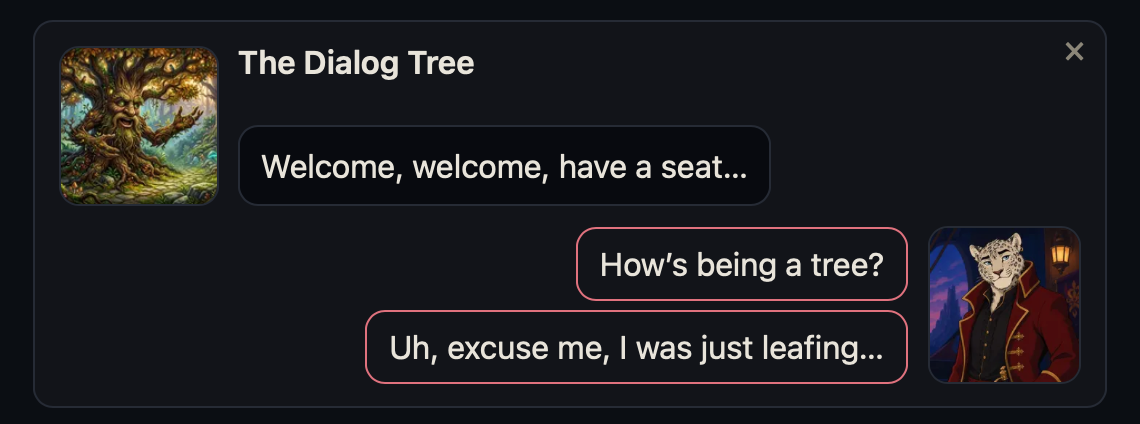](https://tau.dev/assets/canon/dialogtree.webp)
Notice the tree’s mood changes depending on your answer, tracked by the`PLEASED`mark\.
[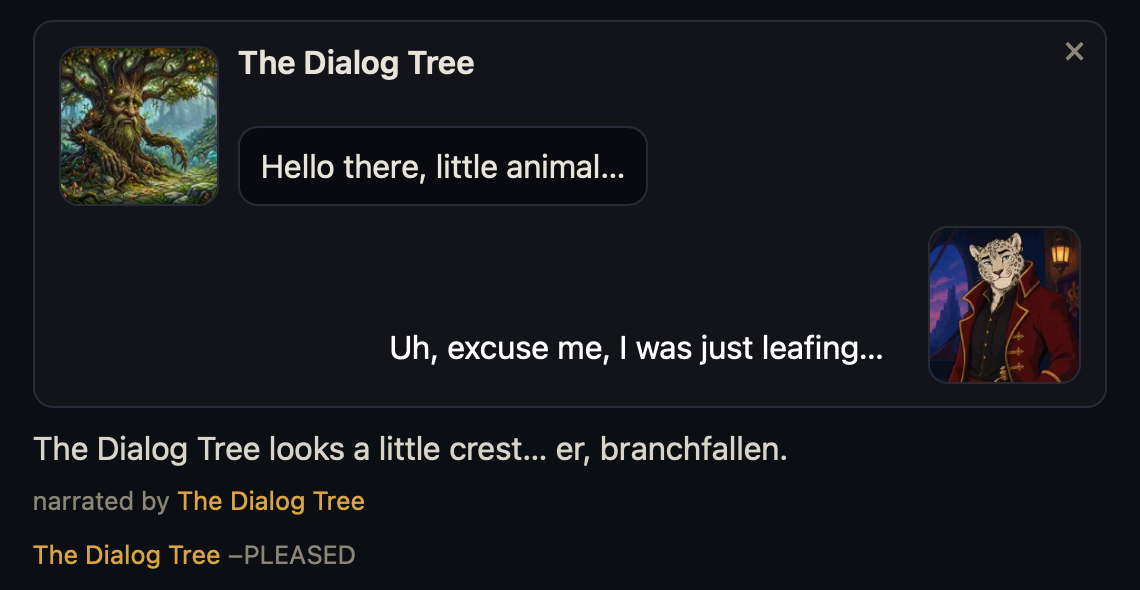](https://tau.dev/assets/canon/dialogtreesad.webp)
The`remembers`keyword tells an item to retain its state when left alone in an empty room\. Without it, state resets when no players are around so encounters are fresh for new visitors\. In the Dialog Tree’s case, we want it to retain its mood from whoever last spoke to it\.
If you look closely you can also see the Dialog Tree’s image changes\. Item images can respond to marks and numbers\. Cant is all about text, so images are handled separately in the item editor:
[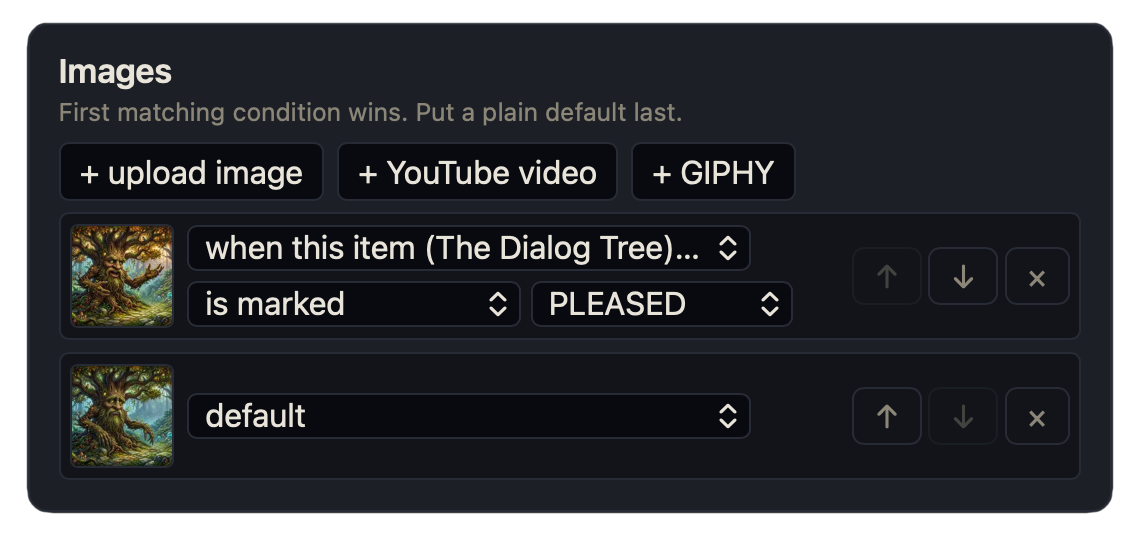](https://tau.dev/assets/canon/dialogtreeimages.webp)
The same is true for**Players**\. You can change your character’s image based on the state of whatever items they carry\. Here’s a simple*paper doll*item that has no action, but does set a state:
```
item "Fancy Red Pirate Coat" {
describe "A fancy red coat, fit for a pirate captain."
state {
OVERCOATED true
}
}
```
And here is a player where both*text description*and*active image*respond to the presence or absence of the coat:
[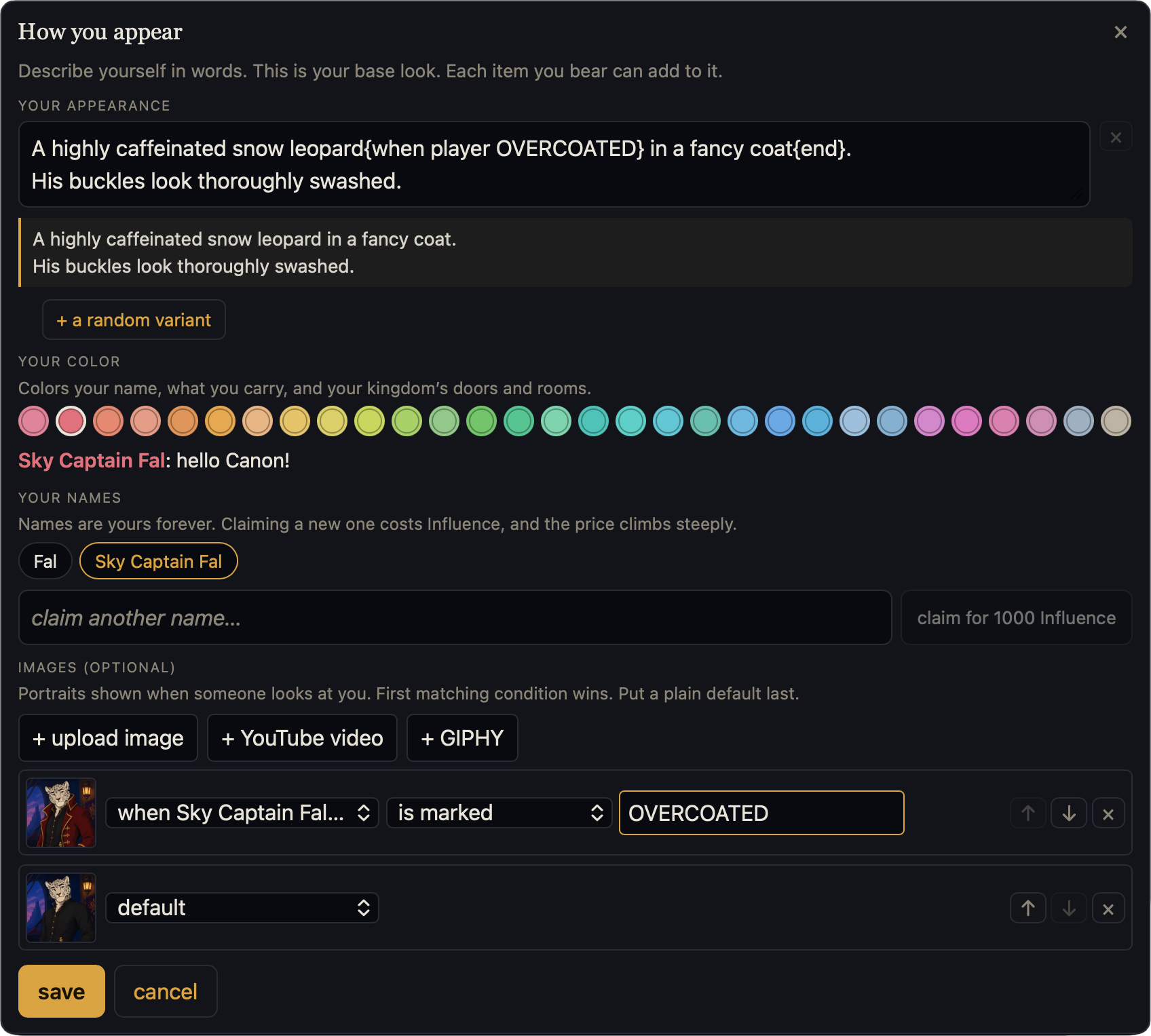](https://tau.dev/assets/canon/falcoat.webp)
Rather than \(or in addition to\) altering a player’s descriptive text, we can also give items an optional`borne`description which is appended to the player’s description\.
```
item "Fancy Red Pirate Coat" {
describe "A fancy red coat, fit for a pirate captain."
borne "{player} is fashionably draped in a {item}."
state {
OVERCOATED true
}
}
```
[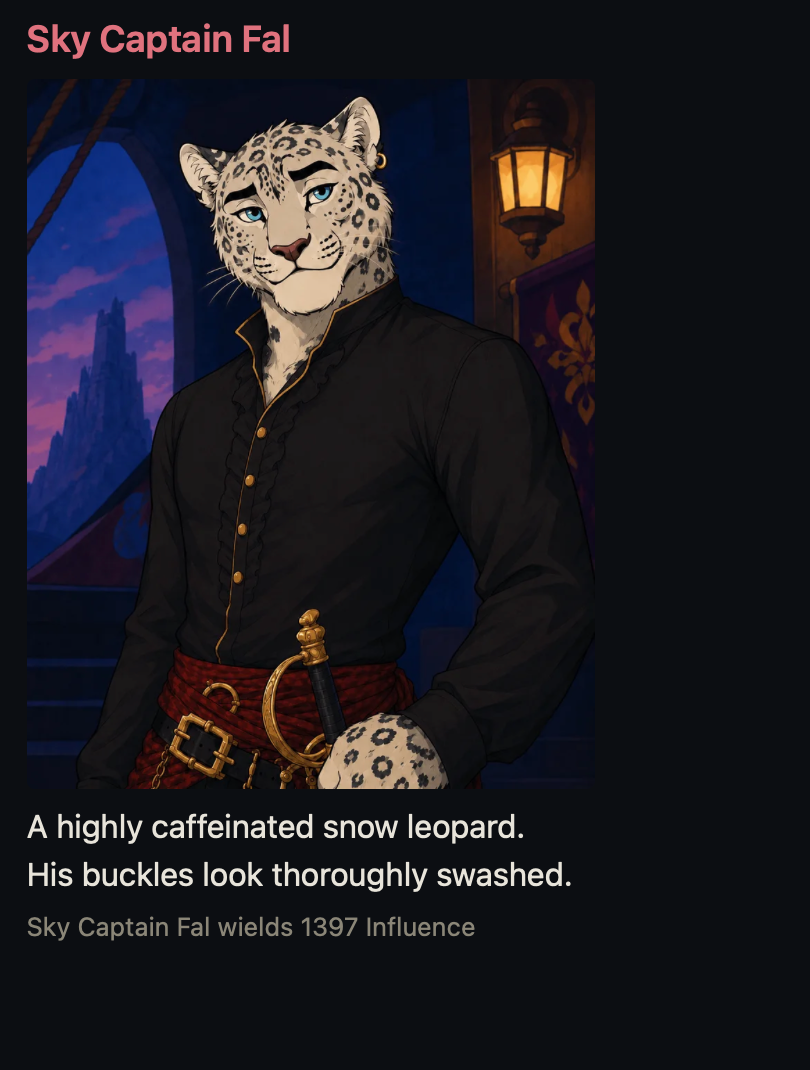](https://tau.dev/assets/canon/falcoatoff.webp)[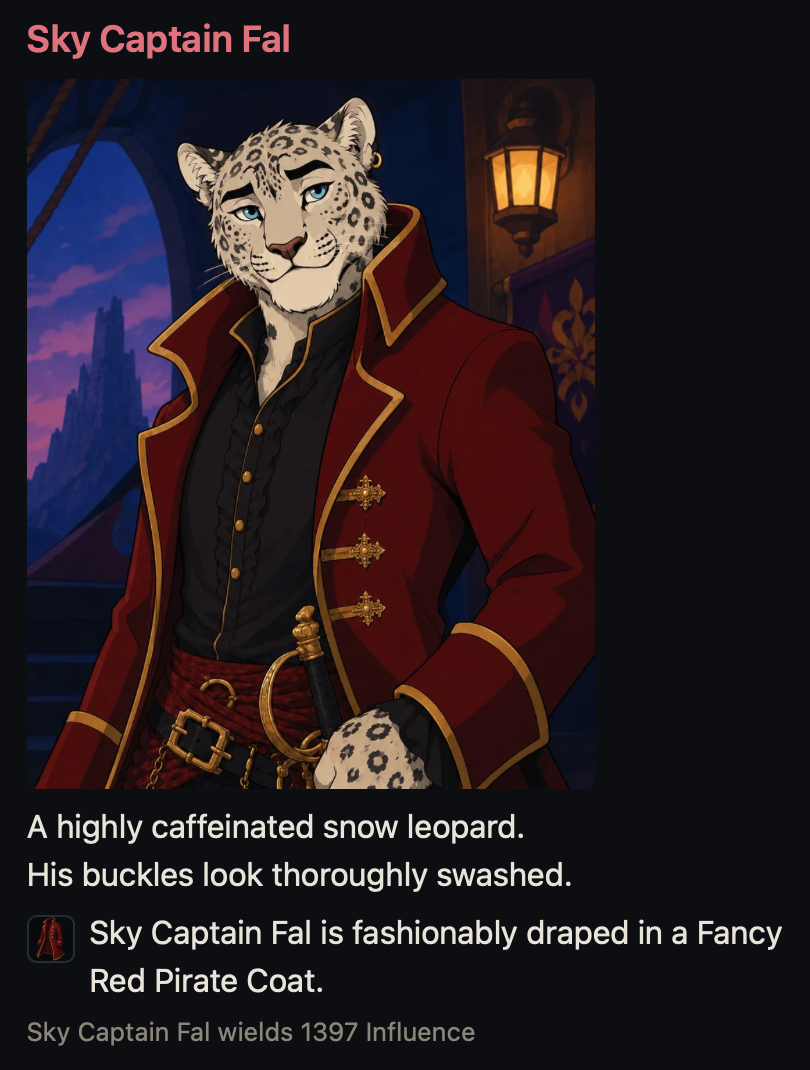](https://tau.dev/assets/canon/falcoaton.webp)
You can play*character customizer*\(many people’s favorite game in any game\!\) all day long, with just text and images\.
You can make a lot of fun dynamic objects with images and conditionals and state\. But a simple bit of flavor text is still often the best part\. Out of all the items I’ve made, my daughter’s favorite \(or at least most frequently employed\) remains the humble snowball:
```
item "Snowball" {
describe "An expertly packed snowball."
on "throw" {
narrate "{player} hits {target} in the face with a snowball! _Paff!_"
}
}
```
---
### [But not too much](https://tau.dev/2026/08/07/canon#but-not-too-much)
You may notice in both the**Dueling Wand**and responsive player/item images above, conditionals are very limited\. Each`when`takes a single condition\. There is no`and`,`or`, etc\. There is also no equivalent of`else if`\.`when`takes a single condition, and a single optional`otherwise`block\. If you want more complicated control flow, you can nest`when`\. Again, this will probably strike an experienced programmer as bad, but it serves a purpose\.
For one thing, the structured editor is complicated enough\. The Dueling Wand alone, while far from the most sophisticated item you can build, gets visually noisy:
[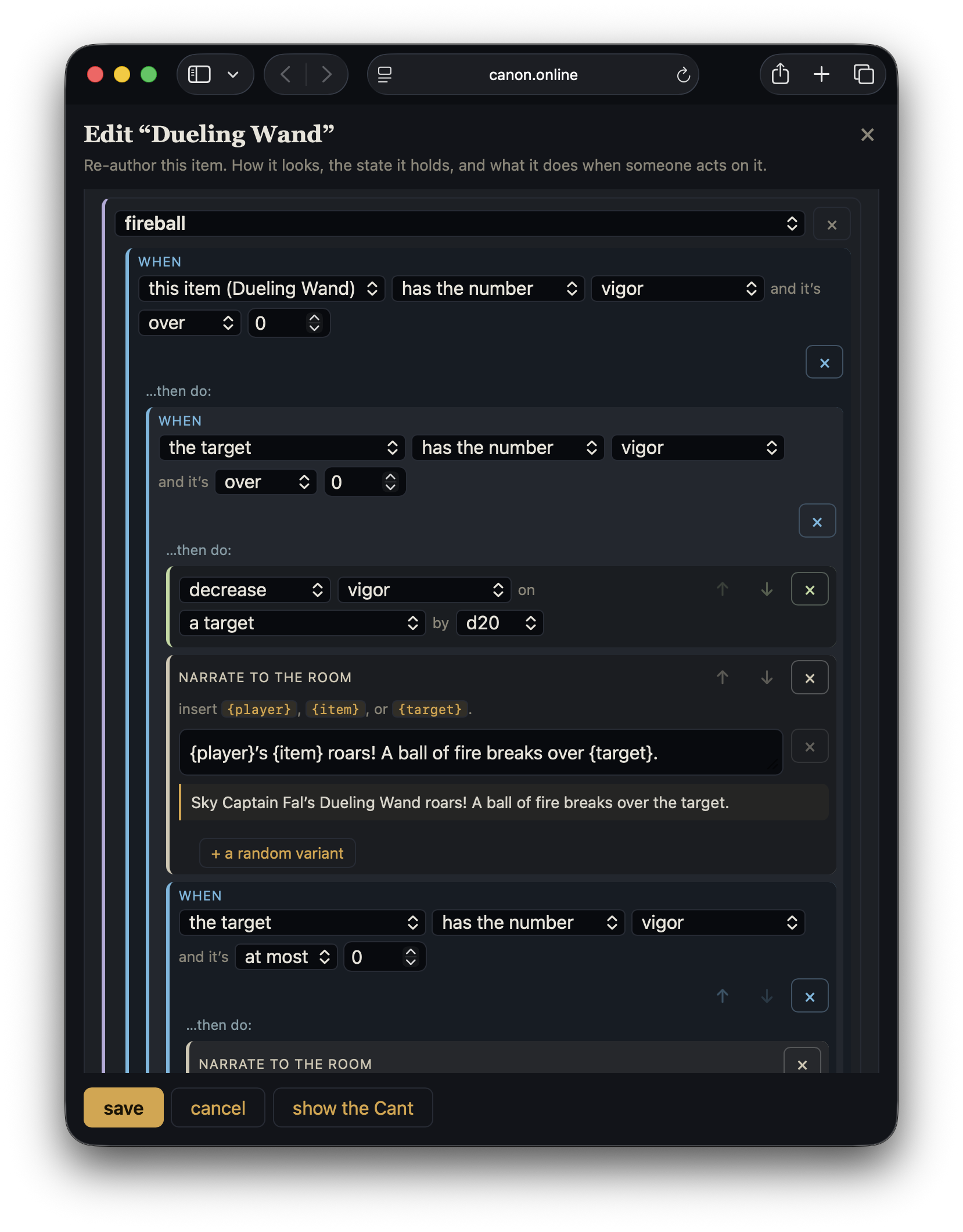](https://tau.dev/assets/canon/nestedwhens.webp)
Adding optional combining blocks would make it harder to navigate\. But more to the point, the simple`when`is meant to be good enough exactly until it isn’t\.
Cant is a language designed to be frustrating in enlightening ways\. A reasonable objection might be that it will teach bad coding habits\. But from my own childhood experience, what it will actually teach is*why the good habits are good*and how the layers of abstraction and expressibility get built one on top of another\.
The kiddo is already building cool stuff with Cant\. Eventually she’ll become annoyed with its limitations\. But at that point she will also be able to*articulate those limitations*, and imagine ways it could be improved\. And that will be a gateway\. When she graduates to a bigger fuller more expressive programming language, she’ll understand why it’s better\.
---
### [Adversarial mindset](https://tau.dev/2026/08/07/canon#adversarial-mindset)
Another thing I want Canon to teach is how to*hack*\. Programming outside the lines\. The kid is already very fond of mischief and loopholes, so this is playing to her strengths\.
You may have noticed a slight flaw in some of the examples above\. If you can edit every Dueling Wand, you can just edit your own wand to give yourself extra vigor, or never take damage\. If you can edit every dialog, you can just sneak a peek to see which choices give you the ending you want\. Every encounter is hackable\.
This, too, is intentional\. For purposes of nurturing a growing engineer brain, creating puzzles, beating puzzles, and hacking puzzles are all win conditions\.
From the broader game perspective, it’s part of “everything is consensual”\. Canon has no permanent points to win or lose\. There are no scarce resources attached to your character that someone can cost you\. The only reason to have a PVP duel is to have fun with your friends\. The only reason to play a mini\-game, or fulfill a quest someone crafted, is to have the experience they crafted for you\. Or if you’re the sort of person who has more fun taking apart the experience to see how they made it, you can do that too\.
That said, there are a*few*concessions to authorial control\. The main one is**Kingdoms**\. The Canon map consists of a shared overworld, and individual zones belonging to each player\. The overworld is mostly a flavorful way to travel between Kingdoms, and not a secure place to leave things\. Anything you set down in the overworld can be picked up by another player\. But in your Kingdom, only you can place items in a room, and only you can remove them\. Other players can*clone*your creations to figure out how they work, but they can’t modify the originals\. This lets you create stable multi\-room, multi\-item games and encounters\.
Want a quest where you talk to a series of NPCs in different villages to piece together a mystery? Or have to find the right keycards to open the right doors in a maze? Or you collect and tend to an egg with the right magical ingredients to hatch a baby dragon? Those are all easy to make in your Kingdom\.
---
### [Chutes and ladders](https://tau.dev/2026/08/07/canon#chutes-and-ladders)
A Canon map looks like this:
[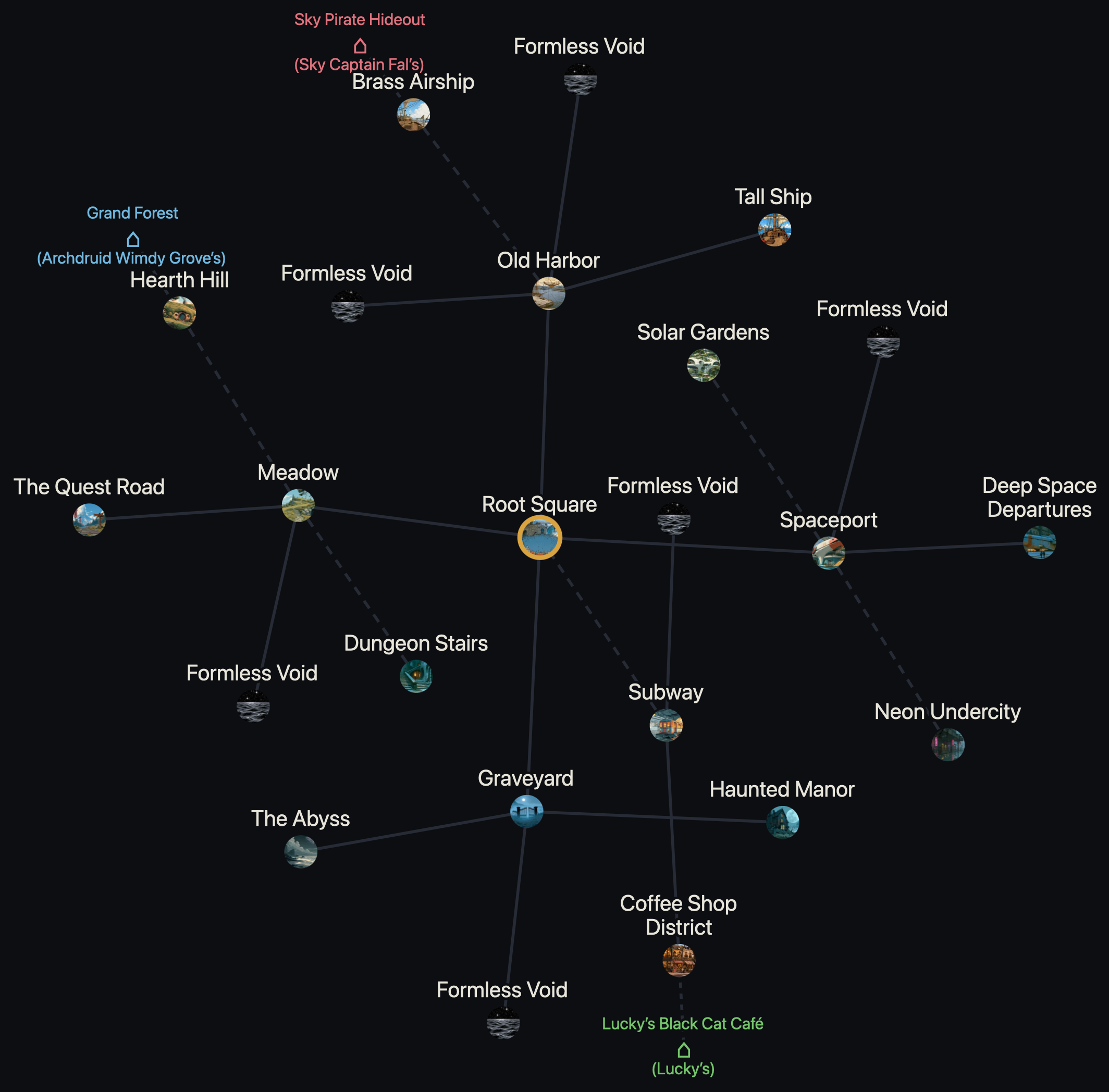](https://tau.dev/assets/canon/map.webp)
This is an overworld\. The colored nodes with`⌂`glyphs are entrances to Kingdoms, which have their own maps\. In both cases, the map data structure is a*tree*, or an*undirected acyclic graph*\. The map grows only by budding new rooms, never by connecting two existing rooms\.
This has some desirable properties:
- With no fixed dimensions, a “room” can be anything you describe\. You can make a literal single room in a building, or a whole building, or a vast terrain\. An empty void\. A pocket universe\. A state of mind\. The abstract map matches the total freedom of text\.
- It allows Kingdom owners to*lock their doors*, creating private lairs, invite\-only guild halls, and puzzles that depend on gated movement, while enforcing that locks only work*in the direction away from the root node*\. In Canon you can lock someone out, never in\. You can make lairs, but you can’t make dungeons\.
- It teaches the kiddo something about user interface abstractions and the clever sorts of[hacks that go into game design](https://www.pcgamer.com/heres-whats-happening-inside-fallout-3s-metro-train/)\. For example:
Many popular level designs cannot be expressed purely in Canon’s map structure\. Imagine a network of treehouses, connected by rope bridges, above a forest floor\. The treehouse village is a series of connected rooms to the north, south, east and west\. The forest floor is the same\. Each forest floor room should*also*be connected to its matching canopy room by up and down exits, but these would form cycles in the map graph\.
Canon solves this the way[DOOM](https://doomwiki.org/wiki/Room-over-room)did: by faking it\. A`teleport`Cant action attached to an item offers to transport players between arbitrary rooms\.
```
item "Rope Ladder" {
describe "A rope ladder, dropping out of the canopy like an invitation."
on "climb" {
say "The rungs creak under you."
teleport "lomise-anthil-nara"
narrate "{player} hauls up out of sight."
}
}
```
The quoted address is the destination room’s`locus`: a randomly generated id you can only learn by standing in the room\. This is so the Cant remains portable, but you can’t simply guess the address of an unfamiliar room, since*teleportation can bypass locks*\. \(That’s right, token security is also on the curriculum\!\)
Ladders and elevators are just the start\. You can use teleportation to build:
- **Mounts**: create a`Horse`or a`Motorcycle`or a`Dragon`to carry you to different destinations with a`ride`action\.
- **NPCs**: combine`dialog`and`teleport`for an`Elevator Attendant`or`Portal Mage`\.
- **Hearthstones and Bookmarks:**found a cool spot on the map? Craft yourself a quick teleport to return to it any time\.
---
### [Agents and gen α](https://tau.dev/2026/08/07/canon#agents-and-gen)
I seeded Canon with a bunch of toys and games for the kiddo to take apart and remix\. But I wanted to make sure she could create her own stuff from the start\. So I also included a`Wish`function\. Once a day, each player can`Wish`to the Machine God\. An LLM will craft an item to your specifications, including functional Cant with explanatory comments\.
[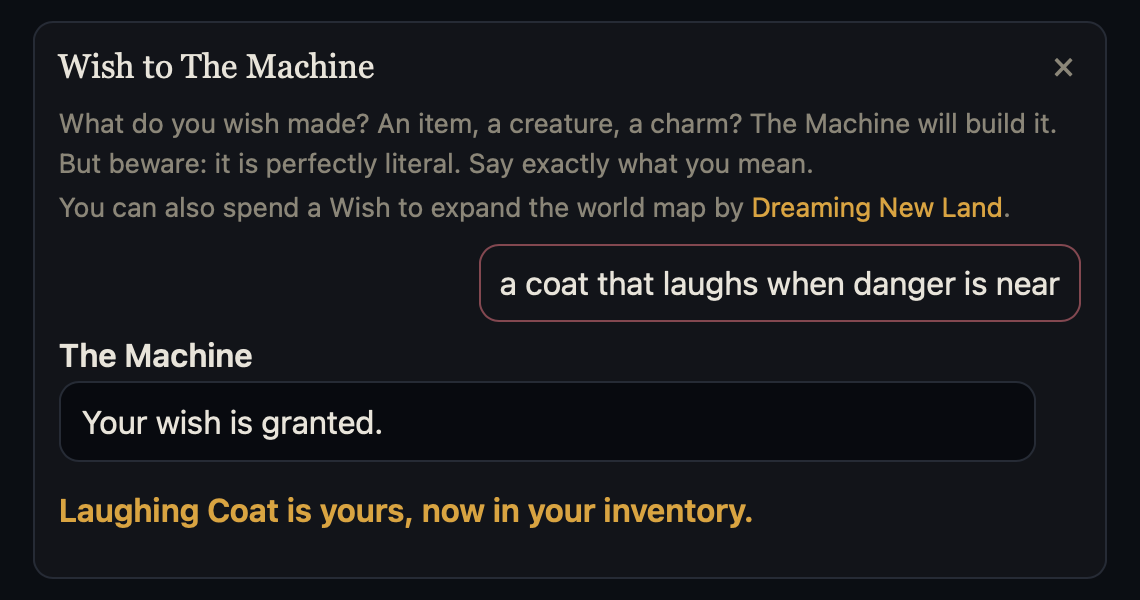](https://tau.dev/assets/canon/wish.webp)
```
# Built by The Machine, but yours to change. Edit freely!
item "Laughing Coat" {
describe "A long coat of storm-grey wool, its collar high and its lining stitched with a grinning seam that never quite lies flat, as if it is always about to find something funny."
borne "A long coat rides {player}’s shoulders, and every so often it shudders and lets out a low, delighted chuckle at some peril only it can see, as though danger were the finest joke ever told."
on "pickup" {
# fires by itself whenever someone takes this up – narrate paints the moment for the whole room
narrate "{player} shrugs into a long grey coat, and it settles across their back with a satisfied little snicker."
}
on "drop" {
# …and this fires when it is set down again
narrate "A long grey coat slips from {player}’s shoulders and folds itself into a heap, its laughter dwindling to a sleepy, contented wheeze."
}
}
```
Cool, right?
Here are two pieces of feedback I’ve received, each from multiple adults who’ve tried Canon:
1. > “I love everything except Wish\. I hate AI and don’t want it anywhere near my creative outlets\. You should warn people when they sign up that this includes an LLM\.”
2. > “Instead of just uploading my own images, there should be a button I can press to make an AI generate an image from the description I wrote\!”
I’m not sure what to make of this\.
`Wish`is the only AI feature in Canon, and it’s strictly limited to a single tutorial item per day\. In a gameworld where everything else is explicitly written by humans for humans\. And that alone was instantly polarizing\.
Among grownups, anyway\. The kiddo had a healthier attitude: total indifference\. She took right to wishing for things, and then immediately overwriting them with her own words and imagination\. She is equally likely to use images from GIPHY, Image Playground, and her own Photo Library full of original pictures and drawings\. AI is just another tool to her\.
Canon started many years ago, before the kiddo was born\. I like virtual worlds and wanted to try my hand at making one\. \(I was going to include a section here about all the opinionated stuff I put into Canon that*isn’t*about programmer pedagogy, but about making a friendly, collaborative, social place out of text\. But this is very long already\. Perhaps that’ll be a separate post\.\)
Alas, I had far more ideas than time to devote to it, so it went on the shelf\.
Lately I’ve been dusting off old side projects and 10xing them with[Claude](https://claude.ai/)\. Far from spoiling the magic, it’s reinvigorated my love of coding\. Making Canon was delightful, involved a whole lot of my judgement and years of experience as an engineer, and went way faster than I could have accomplished alone\.
But then I also did make a game where my kid and I lovingly hand craft code together\. Even if the future is agentic everything, I think learning Cant will teach her useful skills and mental habits\. And it’s just*fun*\. That, too, has been reinvigorating\.
---
### [Yoink](https://tau.dev/2026/08/07/canon#yoink)
I’ll leave you with some quotes from my satisfied user base of one energetic eight year old:
> “You mean I can make anything I want?\! Characters? Quests? Stories?\! :D”
> me: “Why is your inventory so full? Wait, why do you have ten of everything? You know you can just keep one and clone it, right?” kiddo: “Yeah, I know\. But**I have ten\!**” me: “You’ve managed to be a loot goblin in a game with no loot\.” kiddo: \[maniacal giggling\]
> kiddo: “I broke into your house and stole all your stuff\!” me: “You mean you solved my riddle\. Good job\. But you can’t steal from my kingdom, only clone\. I would know, I wrote it that way\.” kiddo: “Yeah, but I cloned everything ten times, which means I have**more of your stuff than you do\!**” me: … kiddo: \[maniacal giggling\]
> “I know what we should make\! We should make an item that’s a computer\. And when your character plays the computer,**they’re playing Canon\!**”
Only eight and she already thinks recursion is funny\. She really is my little engineer\.
---
### [Try it for yourself](https://tau.dev/2026/08/07/canon#try-it-for-yourself)
Canon is decidedly beta, but you can play it\! Just shoot a short human\-to\-human email to[nick@tau\.dev](mailto:
[email protected])and I will personally send you an invite code\.
Once in you’ll be able to invite friends with your own code\. I want to keep growth slow for now, but everyone genuinely curious is welcome\.
There are Canon and Cant features I haven’t touched on here\. Documentation is sparse, but that’s part of the game\. Poke and prod and tinker\. Your inner eight year old knows what to do\.