A memory shortage is driving global smartphone shipments to historic lows, but Apple and Samsung are benefiting as they maintain sales while other OEMs struggle.
<p>Smartphone shipments started to plateau a few years back, ending the days of guaranteed double-digit growth for any company that wanted to make phones. Fewer smartphone manufacturers exist today, and they're facing new pressure in the age of AI. A new report claims that smartphone shipments cratered 11 percent in the last quarter. Some are weathering the storm better than others, though.</p>
<p><a href="https://counterpointresearch.com/en/insights/global-smartphone-shipments-q2-2026">According to Counterpoint</a>, this substantial drop brings smartphone shipments to their lowest second-quarter level since 2013. Analysts place the blame for this drop squarely on the <a href="https://arstechnica.com/gadgets/2026/01/high-ram-prices-mean-record-setting-profits-for-samsung-and-other-memory-makers/">increasing price</a> of DRAM and NAND chips. Manufacturers have largely shifted to supporting the AI computing boom, which leaves <a href="https://arstechnica.com/gadgets/2026/01/the-ram-shortages-silver-lining-less-talk-about-ai-pcs/">fewer components for consumer devices</a> like smartphones and PCs. As prices climb higher, fewer people are interested in buying new phones.</p>
<p>This problem has been particularly vexing for people who are happy to purchase budget devices. A <a href="https://omdia.tech.informa.com/blogs/2026/july/global-smartphones-priced-below-400-dollars-will-decline-by-22percent-as-memory-costs-soar">recent report</a> from market research firm Omdia noted that higher memory costs are particularly bad for phones priced at $500 or less. In these segments, memory can now easily account for half of the total manufacturing cost. These devices have seen quicker and larger price increases compared to flagship devices, for which memory is now more than a quarter of the cost. That's a significant increase in the past year, but there's still more profit to be had at the high end.</p><p><a href="https://arstechnica.com/gadgets/2026/07/apple-and-samsung-benefit-as-memory-shortage-pushes-smartphone-shipments-to-historic-lows/">Read full article</a></p>
<p><a href="https://arstechnica.com/gadgets/2026/07/apple-and-samsung-benefit-as-memory-shortage-pushes-smartphone-shipments-to-historic-lows/#comments">Comments</a></p>
# Apple and Samsung benefit as memory shortage pushes smartphone shipments to historic lows
Source: [https://arstechnica.com/gadgets/2026/07/apple-and-samsung-benefit-as-memory-shortage-pushes-smartphone-shipments-to-historic-lows/](https://arstechnica.com/gadgets/2026/07/apple-and-samsung-benefit-as-memory-shortage-pushes-smartphone-shipments-to-historic-lows/)
[https://cdn.arstechnica.net/wp-content/uploads/2026/07/f4767e70-7eb6-11f1-afbf-c59e4fc8b4cc.png](https://cdn.arstechnica.net/wp-content/uploads/2026/07/f4767e70-7eb6-11f1-afbf-c59e4fc8b4cc.png)[https://cdn.arstechnica.net/wp-content/uploads/2026/07/f4767e70-7eb6-11f1-afbf-c59e4fc8b4cc.png](https://cdn.arstechnica.net/wp-content/uploads/2026/07/f4767e70-7eb6-11f1-afbf-c59e4fc8b4cc.png)[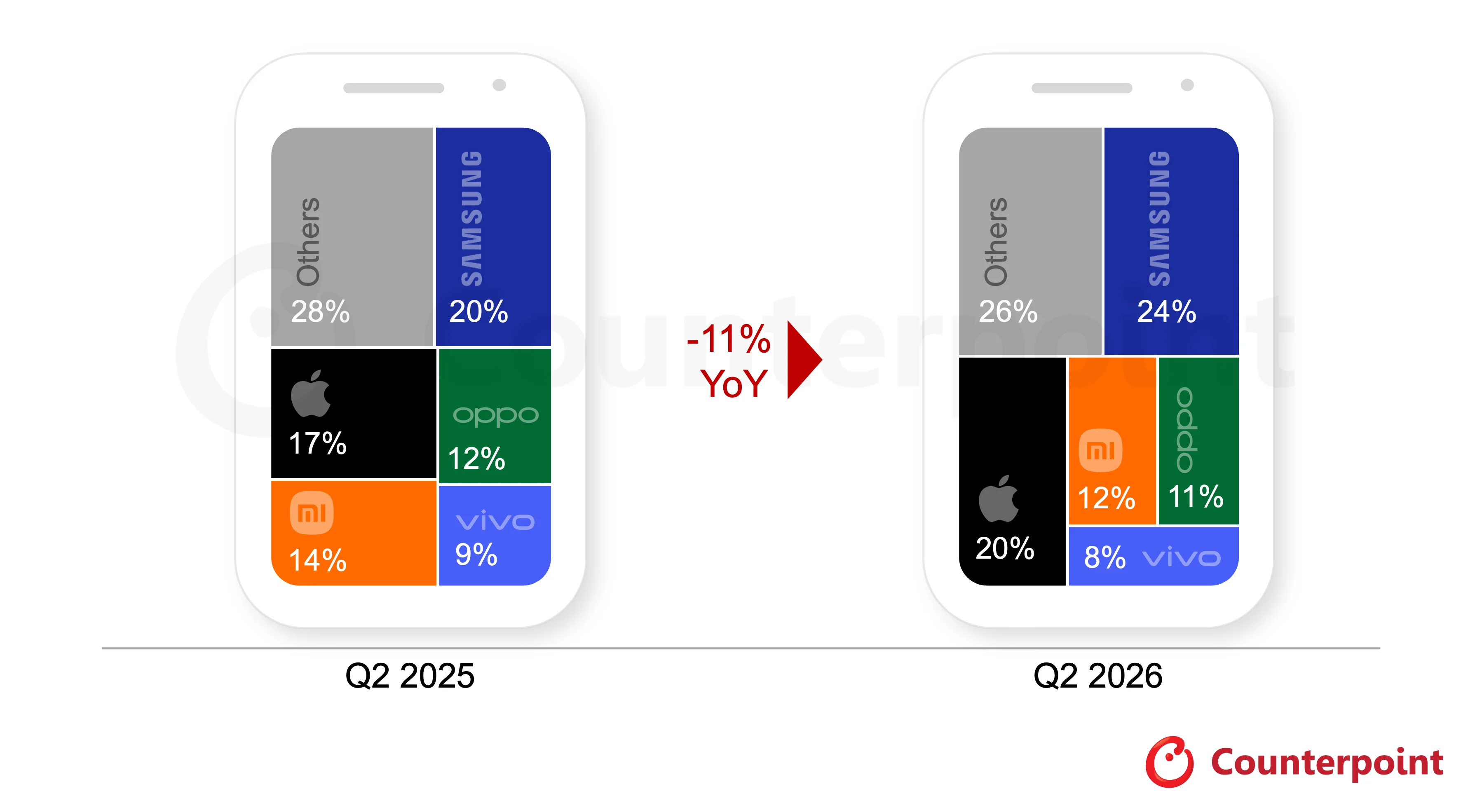](https://cdn.arstechnica.net/wp-content/uploads/2026/07/f4767e70-7eb6-11f1-afbf-c59e4fc8b4cc.png)
Credit: Counterpoint
Credit: Counterpoint
Samsung’s shipments were up as well, once again making it the largest global smartphone OEM by shipments, at 24 percent\. Samsung’s focus on flagship phones has apparently helped it even as it raised prices on budget devices\. The Galaxy S26 series, and particularly the Ultra variant, have sold better than last year’s models in spite of higher prices\. Samsung is also strong in markets like India and the Middle East where lower prices and aggressive promotions have buoyed sales\.
For what it’s worth,[Omdia is reporting](https://omdia.tech.informa.com/pr/2026/july/global-smartphone-market-down-4-percent-in-2q26-while-apple-and-samsung-soared)a smaller 4 percent drop for Q2 smartphone shipments, but it, too, shows Samsung and Apple sustaining sales as other OEMs fall\. In its report, Omdia puts Samsung at 22 percent of all smartphone shipments, with Apple just behind at 20 percent\.
Like other OEMs, Samsung has boosted prices on its mid\-range and budget offerings, which has depressed sales\. Budget\-conscious buyers are just holding onto their current devices longer, taking advantage of a recent shift toward longer update support\. Samsung and Google, for example, now support phones for seven years\. That’s on par with Apple’s support window\.
Speaking of Google, the company’s Pixel phones don’t get it anywhere close to the top five list, but its shipments are still growing at an impressive rate\. Counterpoint says Google saw a 16 percent year\-over\-year increase in Q2 thanks to strong Pixel 10 sales\.
Increasingly, it looks like AI hysteria is going to be a watershed moment for smartphone makers\. Every analysis \(including Counterpoint’s\) expects the component shortage to continue at least into next year\. Even if AI is a bubble, smartphone makers will probably spend the next year eliminating budget phones with low margins and increasing prices on the models that remain\. This will encourage people to treat smartphones more like appliances, purchased less often and with the expectation of lengthy support\.
AI-driven demand for memory chips is causing a shortage and price hikes for standard memory used in smartphones, leading to a 10% drop in India's smartphone shipments in Q2, with the biggest impact on low-cost phones.
AI-driven demand for high-bandwidth memory (HBM) is constraining consumer RAM production, causing price increases for devices like cheap smartphones, especially in emerging markets.
Apple reported strong Q3 2026 earnings with iPhone sales up 22% and Mac sales up 29% despite a RAM shortage, but warned that supply constraints will worsen and memory costs will rise. The company also announced a new Upgrade program and is preparing for a more personalized Siri AI with the iPhone 18.
Micron and Samsung executives say the memory shortage, driven by surging AI demand for HBM and server DRAM, will persist through 2028, with production capacity prioritized for AI over consumer devices.
Micron is thriving amid the AI-driven memory chip shortage, reporting record quarterly earnings and a strategic deal with Anthropic, while consumers face rising prices.