Cached at:
06/26/26, 04:13 PM
# Open Source, APIs, and the Rise of Agent-Led Growth
Source: [https://theapplied.substack.com/p/from-product-led-to-agent-led-growth](https://theapplied.substack.com/p/from-product-led-to-agent-led-growth)
For years, SaaS companies optimized growth around human users\. Better onboarding, tuned interfaces, faster time to value\. That still matters, but AI agents are changing how software gets discovered, recommended, and implemented\.
Agents are not the buyer or the final decision\-maker, yet\. But they increasingly influence implementation and recommendation\. They read docs, write code, call APIs, test integrations, debug errors, and connect tools together\. This gives open\-source and API\-first companies a stronger distribution advantage\.
[](https://substackcdn.com/image/fetch/$s_!8ix9!,f_auto,q_auto:good,fl_progressive:steep/https%3A%2F%2Fsubstack-post-media.s3.amazonaws.com%2Fpublic%2Fimages%2Fce638863-39ee-4306-829a-db2c916f85fc_2040x1998.png)
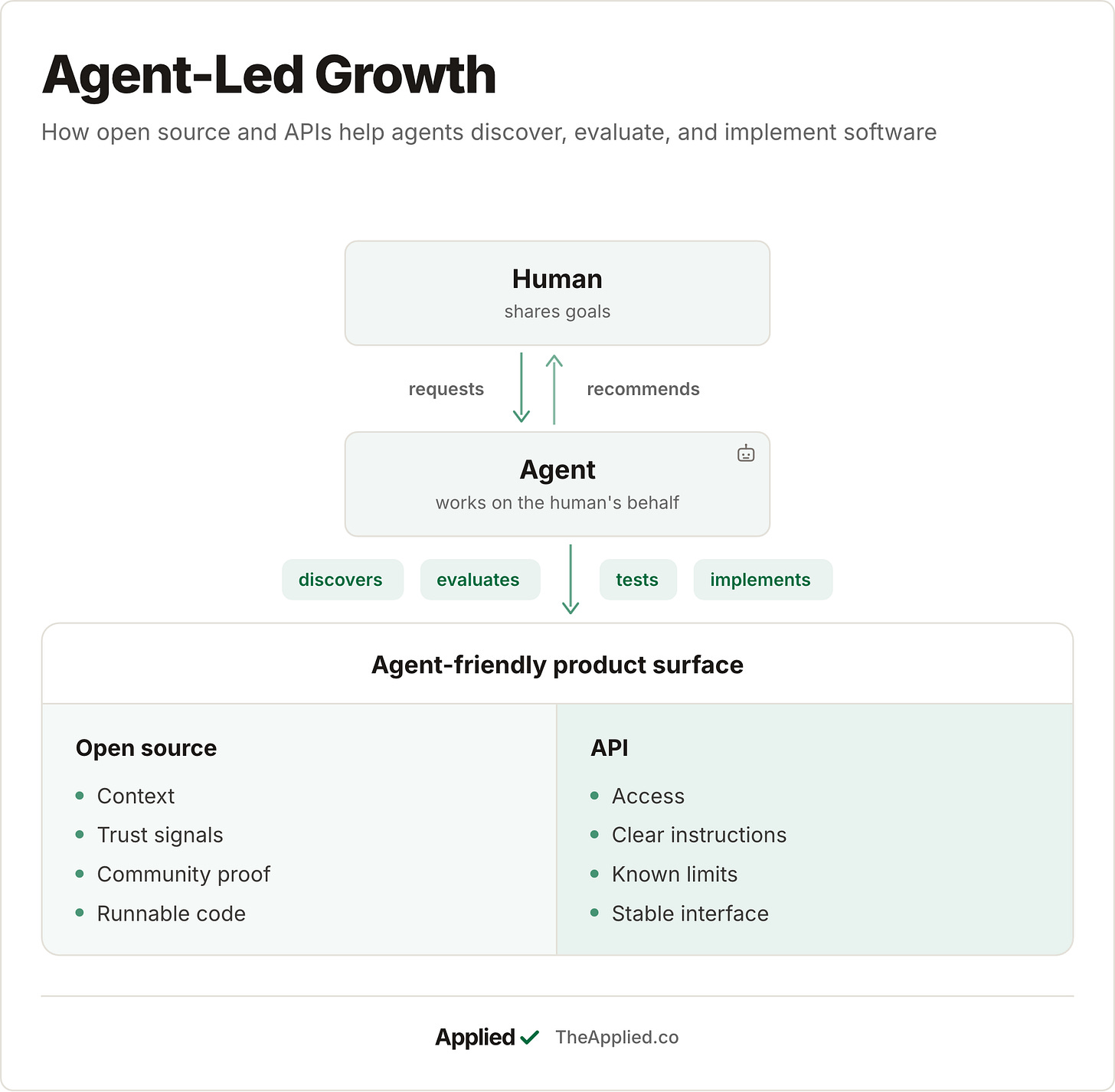
Agents need software they can understand, test, and use\. Open source gives them context\. APIs, SDKs, and integrations give them a way to act\. Freemium removes early friction\.
Today, we are looking at four companies that show this pattern clearly: Supabase, Resend, PostHog, and n8n\. They did not start by building for agents, but their open\-source nature and API\-first design made them unusually well suited for this shift\.
Supabase is a strong example of how open\-source, API\-first infrastructure is becoming easier to adopt in the agent era\. The product gives teams a hosted Postgres backend, authentication, storage, edge functions, realtime subscriptions, and generated APIs in one platform\. For developers, this removes a lot of setup work\. For AI agents, it creates a clear backend primitive they can understand, configure, and connect to an application\.
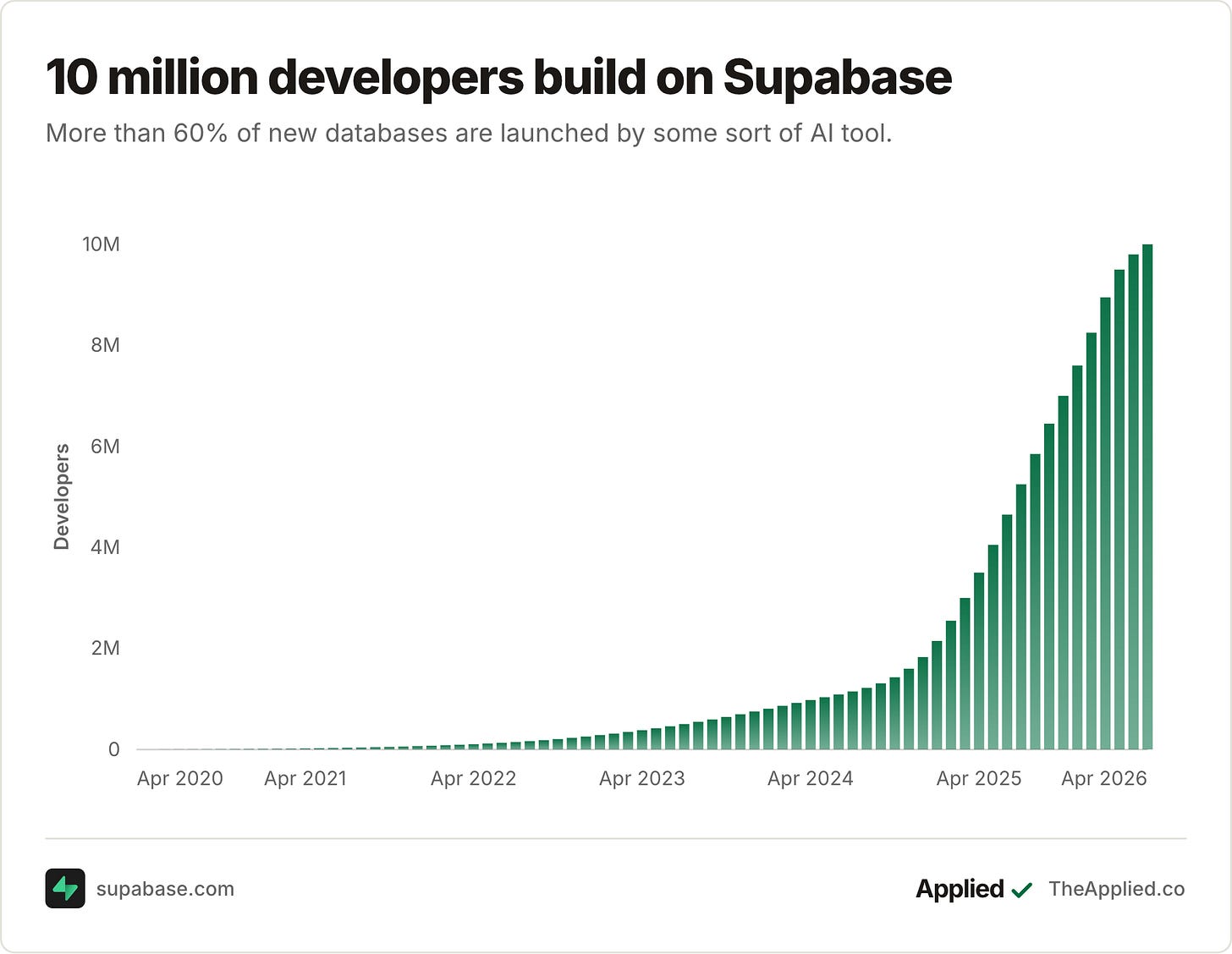
The growth numbers are hard to ignore\. From 1 million users to 10 million in two years\.
[](https://substackcdn.com/image/fetch/$s_!XNpm!,f_auto,q_auto:good,fl_progressive:steep/https%3A%2F%2Fsubstack-post-media.s3.amazonaws.com%2Fpublic%2Fimages%2Fd329cd7d-bc59-4e49-bac9-023def003021_2040x1581.png)
In June 2026, Supabase raised $500 million at a $10 billion pre\-money valuation, roughly doubling its valuation in eight months[1](https://theapplied.substack.com/p/from-product-led-to-agent-led-growth#footnote-1)\.
The valuation is important, but the timing matters more\. Supabase is growing during a period where more software is being created with AI assistance\. Agents can help generate interfaces, prototypes, dashboards, and internal tools, and most of those products need a backend that works\.
In the past year, database launches on**Supabase have grown 600%\.**More than**60% of new databases are launched**by some sort of**AI tool**\.
**Nearly 10 million developers**build on Supabase today, more than doubling since our last fundraising announcement eight months ago\. Growth is accelerating since January as**Claude Code and Codex expand the number of people who can build\.**
Paul Copplestone,
CEO & Co\-Founder, Supabase
> ✅**[Applied](https://theapplied.co/)**uses Supabase for our living map of AI use cases, tools, vendors, and models\.
Email is a basic infrastructure need for almost every product\. Teams need welcome emails, login codes, receipts, notifications, alerts, and reports\. Resend makes this easier by turning email into a developer\-friendly API instead of a messy setup process\.
This fits well with AI\-assisted product creation\. When an agent is helping build an app, email can be added as another product primitive, similar to a database or analytics library\. The agent can read the docs, install the SDK, configure the API key, and generate the first implementation\.
Resend is not fully open\-source as a product, but its open\-source surface is meaningful\. React Email is open\-source, and Resend maintains official open\-source SDKs across several languages\. That gives developers and agents public context to understand how the product works and how to implement it\. This public surface has helped Resend stand out in AI search results\.
[ Zeno Rocha@zenorocha our OpenAI traffic 3x'd\. the cause: ChatGPT added branded links inside answers instead of burying them in citations\.¹ but that's the small story\. Codex went from 600k to 5m weekly users\.² agents are choosing the stack now\.  2:17 PM · Jun 4, 2026·154K Views 24 Replies·19 Reposts·349 Likes](https://x.com/zenorocha/status/2062539292035915973?s=20)The growth signal is extremely strong\. Zeno Rocha shared a x10 growth in paying customers, from 9,000 in June 2025, to 92k in June 2026\.
> ✅**[Applied](https://theapplied.co/)**uses Resend for all our emails \(except for the Substack reports\)\.
The company started with product analytics, but now covers web analytics, session replay, error tracking, feature flags, experiments, surveys, data warehouse, CDP, and an AI product assistant\. The scope has expanded, but the core job is still clear\. PostHog helps teams understand how users behave and what needs to improve\.
[](https://substackcdn.com/image/fetch/$s_!9FSK!,f_auto,q_auto:good,fl_progressive:steep/https%3A%2F%2Fsubstack-post-media.s3.amazonaws.com%2Fpublic%2Fimages%2Fa521ec21-c268-4b9a-8659-30f717f4769a_1282x642.png)
In this ear, an agent can generate a landing page, build a dashboard, connect a database, or ship a small internal tool\. Once that product is live, the team still needs to know what works, what breaks, where users drop off, and what should change next\.
PostHog gives agent\-built products a feedback layer from the start\. Analytics, flags, experiments, replay, and error tracking are not just dashboard features\. They are signals agents can use to understand behavior, find issues, and improve\.
The open\-source model strengthens that position\. PostHog says it is open\-source and freely available to self\-host, with a free Docker Compose deployment under an MIT license\. It also says most of its code is under MIT, while paid features use a proprietary license\. This gives developers a way to inspect, test, and self\-host the product, while giving agents more docs, code, concepts, and examples to work with\.
The growth evidence supports the pattern\. Sacra estimates PostHog reached $57\.5 million ARR in February 2026, up about 99% year over year[2](https://theapplied.substack.com/p/from-product-led-to-agent-led-growth#footnote-2)\. The company also reached unicorn status after raising $75 million at a $1\.4 billion valuation in 2025\.
In a world where agents help create more software, tools like PostHog can reduce the weight on developers\. Agents can not only install analytics, but also use product signals to measure, test, and improve what they build\.
> ✅**[Applied](https://theapplied.co/)**uses Posthog for analytics, A/B testing, usage insights and all kinds of dashboards to understand how you use Applied\.
n8n is a workflow automation platform that helps teams connect apps, APIs, data, and AI steps into repeatable workflows\. That makes it especially relevant in the agent era, because agents and automation experts need more than prompts\. They need reliable systems that can take action across CRMs, spreadsheets, email tools, internal APIs, support platforms, and other business systems at scale\.
It is slightly different from the other examples because it is not open\-source in the classic MIT or Apache sense\. n8n uses a Sustainable Use License, which it describes as a fair\-code license\. The source is available, users can use and modify it, but there are commercial restrictions\. That nuance matters, but the product still has many of the advantages of an open, developer\-first company: public code, extensibility, templates, integrations, and a large community around it\.
[](https://substackcdn.com/image/fetch/$s_!EnpK!,f_auto,q_auto:good,fl_progressive:steep/https%3A%2F%2Fsubstack-post-media.s3.amazonaws.com%2Fpublic%2Fimages%2Fad55fd06-c715-4ef7-94bf-6f975a1d1fce_1638x2048.png)
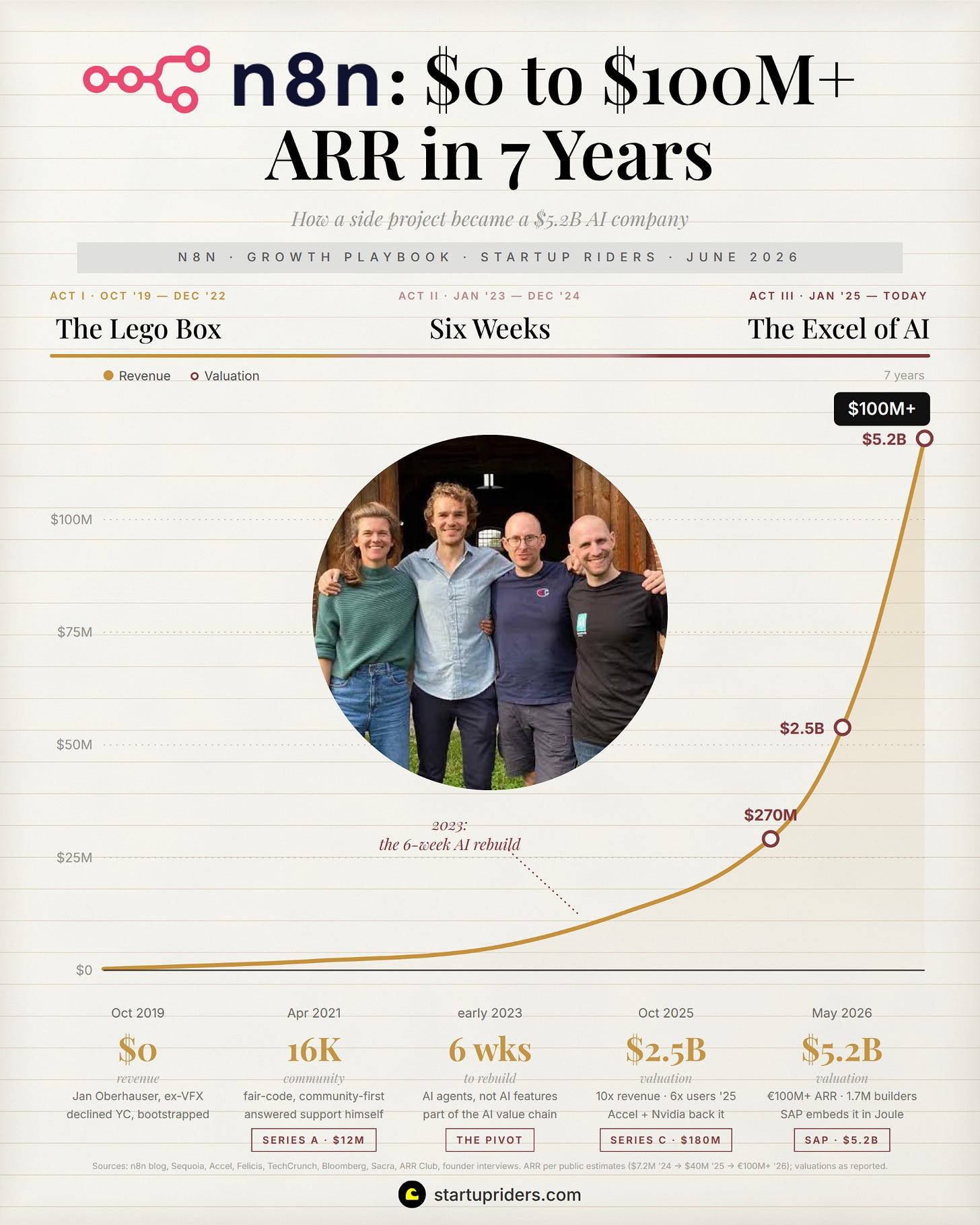
*Source:[n8n’s Growth Playbook: 0 to $100M ARR](https://www.startupriders.com/p/n8n-growth-playbook)by[Startup Riders](https://open.substack.com/pub/startupriders)*
That community is part of the growth story\. n8n has built strong distribution through developers, automation builders, creators, templates, social media examples, and workflow sharing\. This matters because agents and humans both learn from public examples\. The more workflows, integrations, and use cases exist in public, the easier it becomes to understand what n8n can do and copy it into new work\.
In May 2026, Tech Funding News reported that SAP invested in n8n at a $5\.2 billion valuation, up from $2\.5 billion in October 2025\. The same report said n8n had more than 1,400 enterprise customers and 1\.7 million monthly active developers and builders globally\. The SAP partnership also points to where the enterprise market is going\. SAP plans to integrate n8n into Joule Studio inside SAP’s Business AI Platform[3](https://theapplied.substack.com/p/from-product-led-to-agent-led-growth#footnote-3)\.
Supabase, Resend, PostHog, and n8n are different companies, but they share a similar role in the agent\-led growth loop\. They are easy to understand, test, and plug\.
That matters because agents need more than a product name\. They need enough public context to understand what the product does, verify how it is used, and generate a working implementation\.
Open source helps with discovery and evaluation\. Public repos, docs, examples, SDKs, changelogs, issues, and community content give agents more context to read and developers more evidence to trust\.
APIs, SDKs, and integrations turn that understanding into implementation\. Supabase can become the backend, Resend can send email, PostHog can capture product signals, and n8n can connect workflows… And basically all infra will operate this way, at least for new technologies\.
Enjoying this report? Share it with your network…
[Share](https://theapplied.substack.com/p/from-product-led-to-agent-led-growth?utm_source=substack&utm_medium=email&utm_content=share&action=share)
Freemium removes the next barrier\. Free tiers, self\-hosting, templates, and usage\-based pricing let teams test the product before a sales process\.
AI does not remove the need for infrastructure\. It expands the number of people who can create software, which can increase demand for infrastructure that is simple, open, programmable, and easy to start with\.
Product\-led growth removed friction for humans: try the product, invite teammates, and expand usage before sales gets involved\.
Agent\-led growth applies the same logic to agents\. The question expands from whether a human can find, understand, and find value in the product, to whether an agent can find, understand, build and recommend it\.
That changes how companies should think about distribution\. Docs, SDKs, MCPs, examples, repos, and APIs become growth surfaces\.
The product is now every surface that helps an agent understand and use the tool\.
Open source alone is not enough\. Many open\-source projects are hard to use, poorly documented, or difficult to monetize\. Being public gives agents and developers more context, but it also creates maintenance, security, and licensing responsibilities\. It does not create adoption by itself\.
API\-first is not enough either\. A confusing API with weak docs is still hard to use\. If authentication is painful, rate limits are unclear, errors are hard to debug, or versions break without warning, agents and developers will struggle to build on top of it\.
The winners combine open surfaces with a clear use case, strong docs, reliable infrastructure, simple governance, and easy paths into real workflows\. Open source helps agents discover and understand the product\. APIs help agents use it\. The product still needs to solve a clear problem\.
#### Discussion about this post
### Ready for more?