Cached at:
06/05/26, 02:12 AM
# Meta's smart glasses companion app ships a complete, dormant face-recognition pipeline on a stock account.
Source: [https://www.buchodi.com/meta-glasses-facial-recognition/](https://www.buchodi.com/meta-glasses-facial-recognition/)
04 Jun 2026
Stella is the companion app for Meta's smart glasses\. Inspecting version`273\.0\.0\.21`of the Android build \(`com\.facebook\.stella`\), I found the entire computational and storage stack for on\-device facial recognition: three face models, a local database schema, a cosine\-similarity vector index dimensioned to match the models, a write path that stages biometric records to disk, a fully wired notification surface, and a user\-facing "Connections" widget\.
I want to be precise about what that does and does not mean, because the gap between the two is important\.
**What I can demonstrate:**the machinery is present, it is wired together\. Several facial extraction and facial fingerprinting models are present and I was able run the recognition pipeline end\-to\-end on a test image and it detected a face, generate a 2048\-dimension biometric embedding, searched a local index, and on a match fired an Android notification stating to the user "Person Recognized"\. To get the pipeline to run I invoked its existing handler directly with a test photo\.
**What I cannot demonstrate:**that any of this is active for ordinary users\. On a stock, unenrolled account the user\-facing UI does not appear, and the screen the recognition notification deep\-links to is missing from the build\. I also did not observe Meta server\-pushing identity data to the relevant database on my test account\.
So this is not "Meta is secretly identifying the people you look at\." It is: the complete apparatus to do exactly that is sitting on the device, assembled and functional, gated by Meta\.
All findings below are reproducible against`com\.facebook\.stella`v273\.0\.0\.21\.
---
## Three face\-recognition models ship on the device \(~100 MB\)
Three ExecuTorch \(`\.pte`\) models arrive on the device via NMLML, Meta's asset\-delivery system, downloaded from Meta\.
Asset name \(Meta's naming\)FileSizeFunction`android\_facerec\_scrfd``SCRFD\.pte`3\.4 MBDetects faces in an image`android\_facerec\_kps\_aligner``KPSAligner\.pte`117 KBCrops and aligns each detected face`android\_facerec\_sface``SFace\.pte`96 MBConverts a face into a 2048\-number embedding \(the biometric fingerprint\)These map onto open\-source architectures, the same model families that other apps and academic projects already use:
- **SCRFD***Sample and Computation Redistribution for Efficient Face Detection*\(InsightFace, ICLR 2022\)\. Reference implementation:`github\.com/deepinsight/insightface`\.
- **SFace***Sigmoid\-Constrained Hypersphere Loss for Face Recognition*\(Zhong et al\., 2021\)\. Reference:`github\.com/zhongyy/SFace`
- **KPSAligner**keypoint\-based alignment, standard practice since 2015 \(MTCNN, dlib, InsightFace\)\.
Meta's SFace variant seems to be scaled larger than the public reference \(96 MB vs\. ~40 MB; 2048\-dimension output vs\. the reference's 128–512\)\.
Worth stating plainly:**shipping detection and embedding models is not, by itself, evidence of recognition**\. Plenty of apps run on\-device face detection for framing or autofocus\.
---
## A cosine\-similarity face index, dimensioned exactly to the on\-device fingerprinter
The recognition pipeline that actually runs and reads into this database:
```
/data/user/0/com.facebook.stella/files/rldrive/person_profiles/objects.db
```
This lives under**RLDrive**, Meta's cross\-device sync framework, in a`person\_profiles`namespace designed to be populated remotely\. I did**not**directly observe Meta pushing data to`person\_profiles`specifically on my test account\. I want to be clear that I'm describing the channel's existence, not an observed transmission\.
The schema:
```
CREATE TABLE person (
nodeid INTEGER PRIMARY KEY,
name TEXT,
uri TEXT,
blob BLOB,
deleted INTEGER,
version BLOB
);
CREATE TABLE face (
nodeid INTEGER PRIMARY KEY,
mediaPath TEXT, -- the face_id used in the deep link
personUri TEXT, -- soft reference back to person.uri
blob BLOB,
deleted INTEGER,
uri TEXT,
version BLOB
);
CREATE VIRTUAL TABLE face_mediaPath_vec
USING vec0(mediaPath float[2048] distance_metric=cosine);
-- 2048-float biometric fingerprint per face, cosine-distance search
-- (uses the sqlite-vec extension)
```
Each`face`row points at a`person`via`personUri`\. Each`face\.mediaPath`is the primary key into`face\_mediaPath\_vec`, which stores the 2048\-number embedding\. Recognition is a cosine\-similarity query against that index, followed by a join into`person\.name`for the notification text\.
A few things line up:
- `vec0`is the open\-source**sqlite\-vec**extension, which turns SQLite into a vector\-similarity engine\.
- The dimension`float\[2048\]`is the exact output shape of the SFace embedder shipped on the app\.
- The`cosine`metric is the standard choice for comparing face embeddings\.
The schema permits multiple`face`rows per`personUri`\(no`UNIQUE`constraint\), but whether a production deployment uses one\-to\-one or one\-to\-many is not visible from a non\-enrolled device\.
**End\-to\-end test confirms both branches and isolates where writes go\.**I SHA\-256\-snapshotted and row\-counted the database, then ran the full recognition pipeline twice: once against an empty index \(no\-match\), once against an index pre\-loaded with a single embedding \(match\):
- **No match**\(empty`face\_mediaPath\_vec`\): one`\(uuid\.jpg, uuid\.emb\)`pair was written to`NameTagsPending/`\. No notification\.
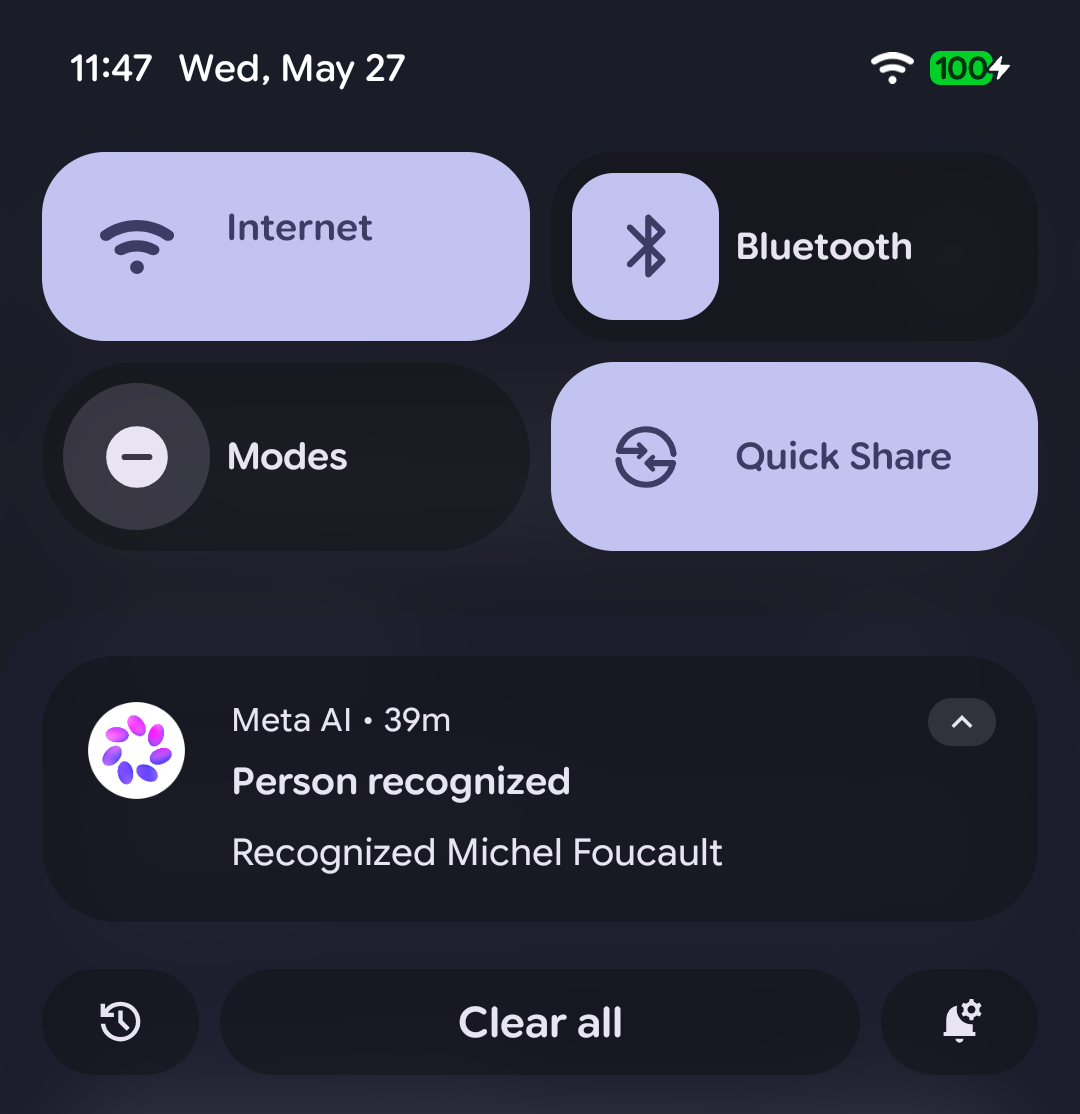
- **Match**: an Android notification fired through the production`nametags\_recognition`channel \- title*"Person recognized"*, body*"Recognized Michel Foucault"*\. Nothing was added to`NameTagsPending/`\.
---
When the device sees a face that the local index does not match, Stella writes it to:
```
/data/user/0/com.facebook.stella/files/NameTagsPending/
```
Each unrecognized face produces a pair of files named with a fresh UUID:
- a`\.jpg`— the cropped, aligned face, the output of SCRFD \+ KPSAligner; and
- an`\.emb`— the 2048\-number SFace fingerprint\.
The directory is mode`0700`and survives reboots\. Writes happen**only**on the no\-match branch; matched faces go to a notification and leave no on\-disk trace\.
I verified the embedding's structure directly:
```
File: NameTagsPending/1566ab46-[...].emb
Size: 8,192 bytes (2048 × float32, big-endian)
L2 norm: 0.999999 ← canonical L2-normalized face embedding
Min/max: −0.092110 / +0.098950
Mean: +0.000292
```
Together,`\(uuid\.jpg, uuid\.emb\)`is a complete, indexable biometric record of one face — the same shape and encoding the cosine index in`person\_profiles/objects\.db`is built to match against\.
The name*NameTagsPending*most literal reading is "faces pending a name" — biometrically encoded, awaiting a label\. I'll note the structural fact and let it carry its own weight: a face image and its fingerprint, stored side by side in plaintext, mode`0700`, surviving reboots, is precisely the dataset you would assemble if you intended to retroactively identify faces once a label arrives\.
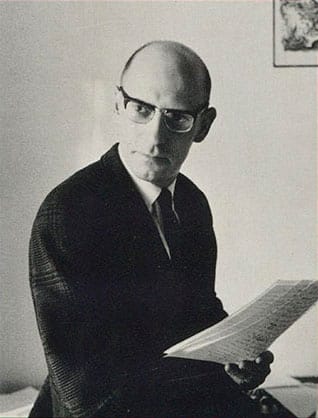****The original photo****the pipeline received as input \(1970 portrait of Michel Foucault by Jerry Bauer, 1970, 318×418 px JPEG, 28 KB\) Public domain, via[Wikimedia Commons](https://commons.wikimedia.org/wiki/File:Photo_of_Michel_Foucault_on_1970_dustjacket_of_The_Order_of_Things.jpg?ref=buchodi.com)\.****The cropped face Stella's pipeline produced****and wrote to NameTagsPending/\. Output of SCRFD \(detector\) \+ KPSAligner \(aligner\)\. 83×118 px RGB JPEG, 4,396 bytes
---
## The notification surface is fully wired
Stella defines a dedicated Android notification channel
```
NotificationChannel{
id = "nametags_recognition"
name = "NameTags recognition"
description = "Notifications for recognized NameTags connections"
importance = IMPORTANCE_HIGH (heads-up + sound + badge)
sound = system notification sound
}
```
The notification template is hardcoded in the recognition handler\. Title is always*"Person recognized"*; body is always`"Recognized " \+ name`, where`name`comes from the`person`table in`person\_profiles/objects\.db`:
```
NotificationCompat.Builder(ctx, "nametags_recognition")
.setContentTitle("Person recognized")
.setContentText("Recognized " + matched_name)
.setAutoCancel(true)
.setContentIntent(
PendingIntent.getActivity(
ctx,
matched_name.hashCode(),
Intent.ACTION_VIEW with
Uri "fb-viewapp://name_tags?face_id=" + face_id,
FLAG_IMMUTABLE | FLAG_UPDATE_CURRENT))
.build()
NotificationManagerCompat.notify(matched_name.hashCode(), notification)
```
The notification is tappable: its`contentIntent`is a deep link of the form`fb\-viewapp://name\_tags?face\_id=<face\_id\>`, a Meta\-authored URL scheme meant to open a person\-profile screen inside Stella\.
One honest caveat: in v273,**I could not find that destination screen**\. Tapping the notification routes Stella to its default tab, because the target Compose destination is absent from the navigation graph\. The notification fires; the screen it points at isn't built into this release\.
---
## A user\-facing "Connections" entry point exists in the APK
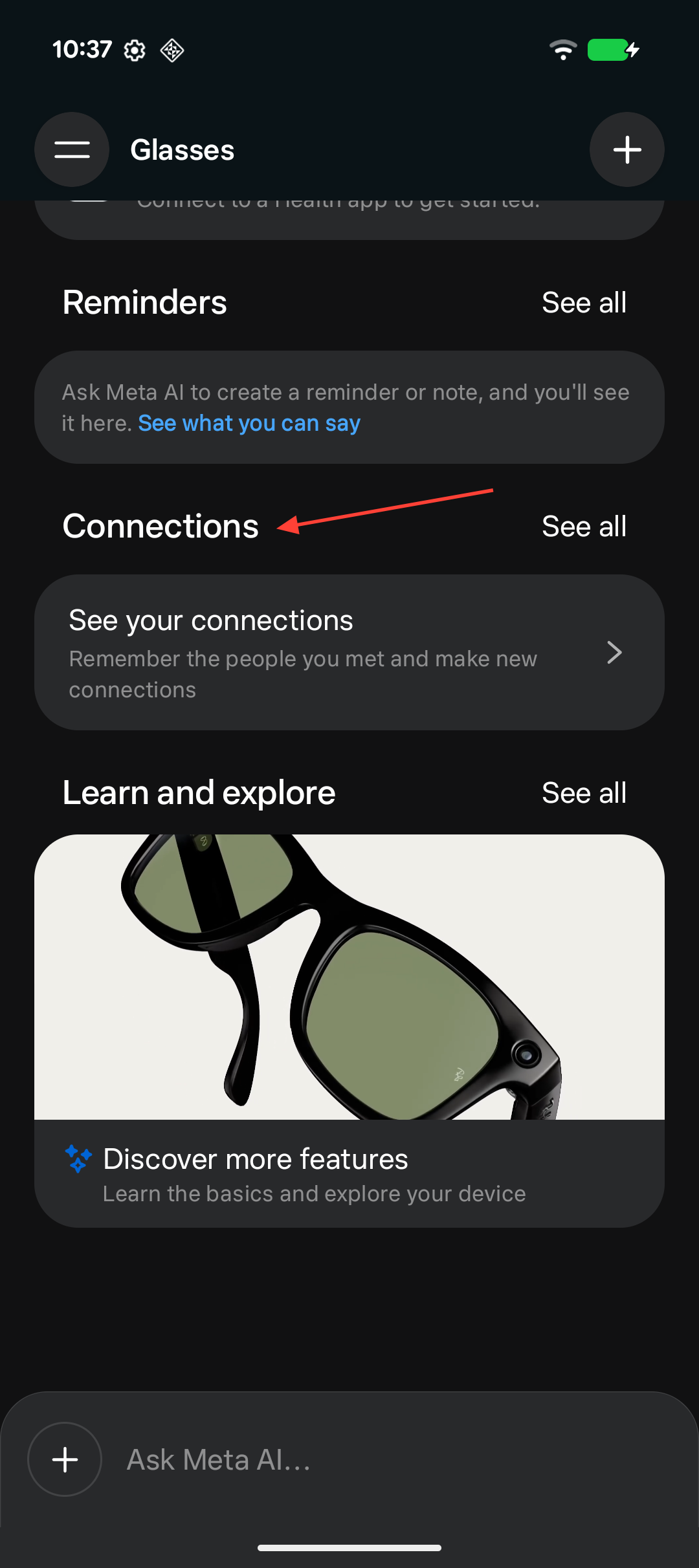
Stella v273 contains a widget rendering a card under a section header titled**"Connections"**, with the text*"See your connections"*/*"Remember the people you met and make new connections\."*Both strings are hardcoded literals in the APK not server\-pushed\.
On a stock, unenrolled account, the card does**not appear**on the Glasses tab at all\. It became visible during testing\. In normal use, a user would not see this\.
---
## What this adds up to
1. The full on\-device face\-recognition stack: detection, alignment, embedding, vector index, storage, write path, and notification surface is present and assembled in Stella v273\.
2. It is functional\. Run end\-to\-end, it recognizes a known face and names it in a notification, and it stages unknown faces \(crop \+ fingerprint\) to disk\.
3. The index dimension, embedding shape, and storage schema are mutually consistent, this is a coherent system, not stray dead code\.
4. The pieces a user would actually touch: the "Connections" card and the profile screen the notification opens are either absent from the build or buried deeper\.
5. The database the live pipeline uses sits in a sync namespace Meta populates server\-side, alongside other namespaces it already populates, but I did not observe a push to the face namespace on my account\.
What I am**not**claiming: that Meta is identifying strangers for users today, that enrollment data is flowing, or that any of this is enabled in production\.
What's hard to wave away: building, shipping, and wiring this much apparatus down to an 2048\-dimension facial fingerprinting and a hardcoded "Person recognized" notification, is an engineering investment\. Capability that doesn't ship by accident\. Whether and when it goes into production is Meta's to answer\.
*This research is published alongside reporting in WIRED\.*