Cached at:
11/25/26, 09:51 PM
# Agentic Algorithm Engineering (AAE)
Source: [https://chszlab.github.io/AgenticAlgorithmEngineering/](https://chszlab.github.io/AgenticAlgorithmEngineering/)
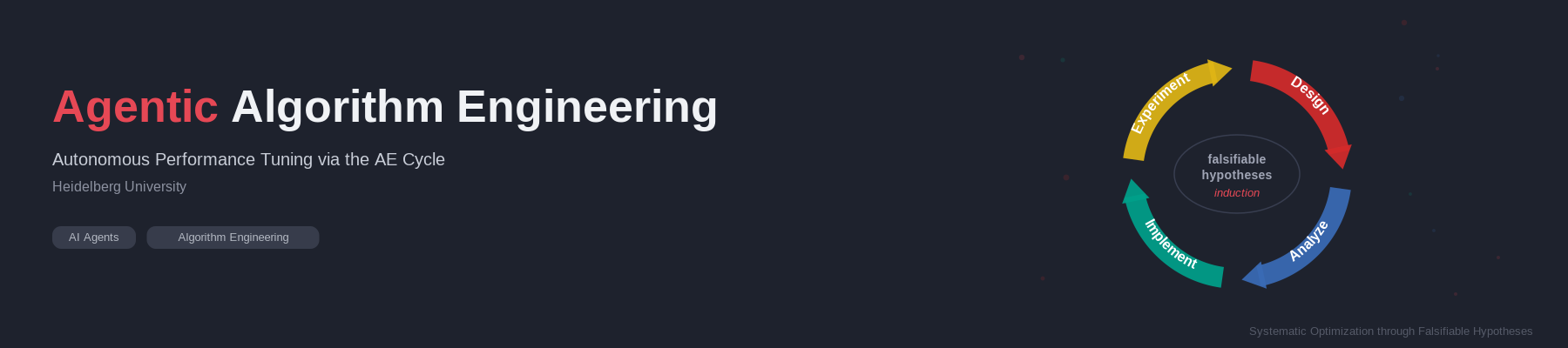Agents that optimize your code like an algorithm engineer: a falsifiable hypothesis before every experiment, correctness checked after every change, one reviewable patch per accepted change, and a PDF report of the whole session\.
A skill for Claude Code and Codex, from the Algorithm Engineering Group at Heidelberg University\.
## Results on established open\-source codes
Every kept change was checked against the original output\.
## How it works: theAlgorithm Engineeringcycle
Algorithm Engineering is a cycle of design, analysis, implementation and experiment, driven by falsifiable hypotheses\. AAE hands this cycle to an autonomous agent\. During setup you agree with the agent on the benchmark, the metric, the correctness assertions and the budget; then it runs on its own\.
### Design
A falsifiable hypothesis: "changing X will improve the metric by roughly Z, because \.\.\."
### Analyze
Predict direction and size of the effect before measuring, from profiling and analysis\.
### Implement
A minimal change, committed to Git, with the correctness assertions checked\.
### Experiment
Run the benchmark; keep the change only if it is better and still correct, otherwise revert\.
## What you get
**Faster, still correct code**Every change is checked against assertions you agreed on, e\.g\. bit\-identical output\.
**One patch per accepted change**Numbered Git patches in`patches/`, each with its hypothesis, easy to review and apply\.
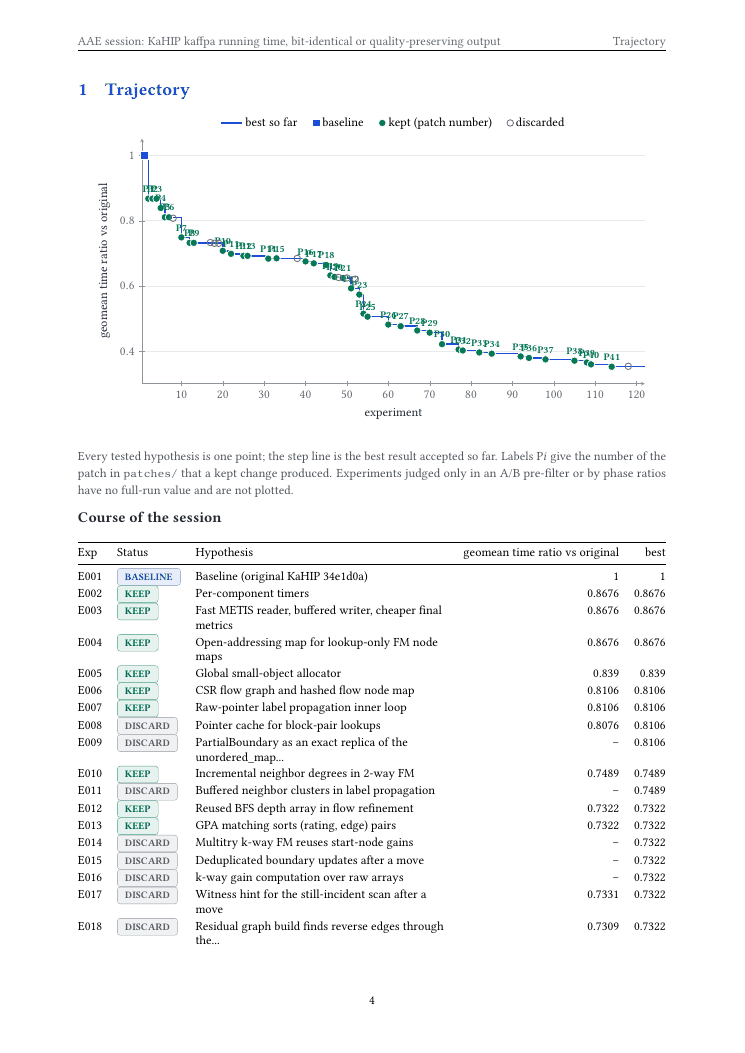
**A PDF report**The trajectory of the metric and one page per tested hypothesis: intuition, prediction, measurements, verdict\.
[](https://github.com/CHSZLab/AgenticAlgorithmEngineering/blob/main/examples/reports/kahip_kaffpa_speed_report.pdf)[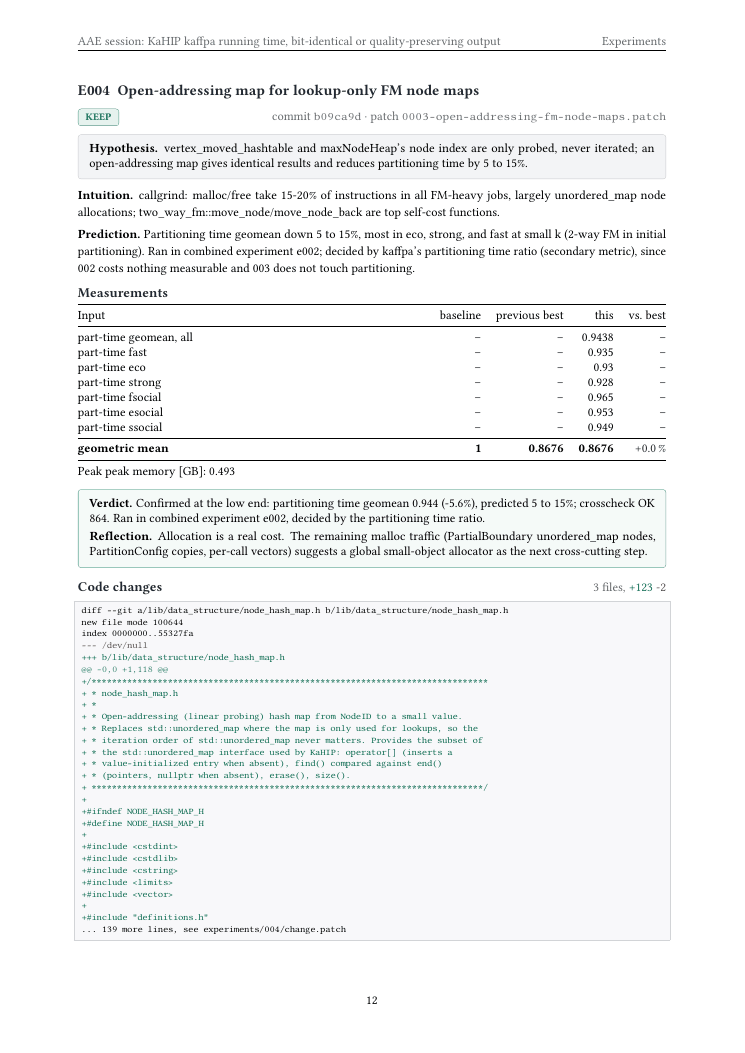](https://github.com/CHSZLab/AgenticAlgorithmEngineering/blob/main/examples/reports/kahip_kaffpa_speed_report.pdf)
From the report of the KaHIP`kaffpa`session: 122 experiments, 69 hypotheses, 41 patches, 3\.9x faster in total\.
## Quick start
In Claude Code:
```
/plugin install aae --marketplace CHSZLab/AgenticAlgorithmEngineering
/aae:aae make the solver in src/ faster on the graphs in data/
```
In Codex, install the skill with`scripts/install\_codex\_skill\.py`and call it with`$aae`; any other agent can follow[AAE\.md](https://github.com/CHSZLab/AgenticAlgorithmEngineering/blob/main/AAE.md)\. To try it first, run the[10\-minute quick\-start example](https://github.com/CHSZLab/AgenticAlgorithmEngineering/tree/main/examples/quickstart): a slow but correct shortest\-path program with a benchmark and a correctness check\.
## How AAE compares
## Knowledge base
Sessions share what they learned: the[knowledge base](https://github.com/CHSZLab/AgenticAlgorithmEngineering/tree/main/knowledge-base)collects optimization techniques and experiment results, and agents read it before they start\. Contributions from your own sessions are welcome\.
## Citation
David A\. Bader, Adil Chhabra, Ernestine Großmann, Monika Henzinger, Alexander Noe, and Christian Schulz\.*Agentic Algorithm Engineering: Improving Shared\-Memory Exact Minimum Cuts\.*In 13th DIMACS Implementation Challenge Workshop: Network Flows 2\.0, OASIcs, 2027\. To appear\. Preprint:[arXiv:2609\.07204](https://arxiv.org/abs/2609.07204)\.
```
@inproceedings{bader2027agenticalgorithmengineering,
title = {Agentic Algorithm Engineering: Improving Shared-Memory Exact Minimum Cuts},
author = {David A. Bader and Adil Chhabra and Ernestine Gro{\ss}mann and Monika Henzinger and Alexander Noe and Christian Schulz},
booktitle = {13th DIMACS Implementation Challenge Workshop: Network Flows 2.0},
series = {OASIcs},
publisher = {Schloss Dagstuhl -- Leibniz-Zentrum f{\"u}r Informatik},
year = {2027},
note = {To appear},
eprint = {2609.07204},
archivePrefix = {arXiv},
url = {https://arxiv.org/abs/2609.07204}
}
```
To cite the software itself, use its Zenodo DOI[10\.5281/zenodo\.24537749](https://doi.org/10.5281/zenodo.24537749), which always resolves to the latest release\.