Cached at:
06/08/26, 12:16 PM
# How much of Thermo Fisher’s antibody data has been manipulated?
Source: [https://reeserichardson.blog/2026/05/28/how-much-of-thermo-fishers-antibody-data-has-been-manipulated/](https://reeserichardson.blog/2026/05/28/how-much-of-thermo-fishers-antibody-data-has-been-manipulated/)
**\[ TL;DR: As of 3 June 2026, we have identified more than 450 images bearing signs of manipulation in verification data advertised by Thermo Fisher Scientific in its online primary antibodies catalog \(\+1 by Abcam\)\. See the full repository of problematic images, curated by myself and Sholto David, here:**
**[Zenodo – Problematic images in vendor antibody verification data](https://doi.org/10.5281/zenodo.20402475)**
**You are welcome to contribute new findings at[this Google form](https://forms.gle/AHawpDxrorMXihaW8)\.**
**This blog post was original posted on 28 May 2026 and has not been edited to update counts since that date\. \]**
A week and a half ago, while looking for trustworthy data demonstrating a cell line’s deficiency in the protein p53,[Sholto David](https://www.youtube.com/@Sholto_David)came across the following image of a Western blot in Thermo Fisher Scientific’s online antibodies catalog:
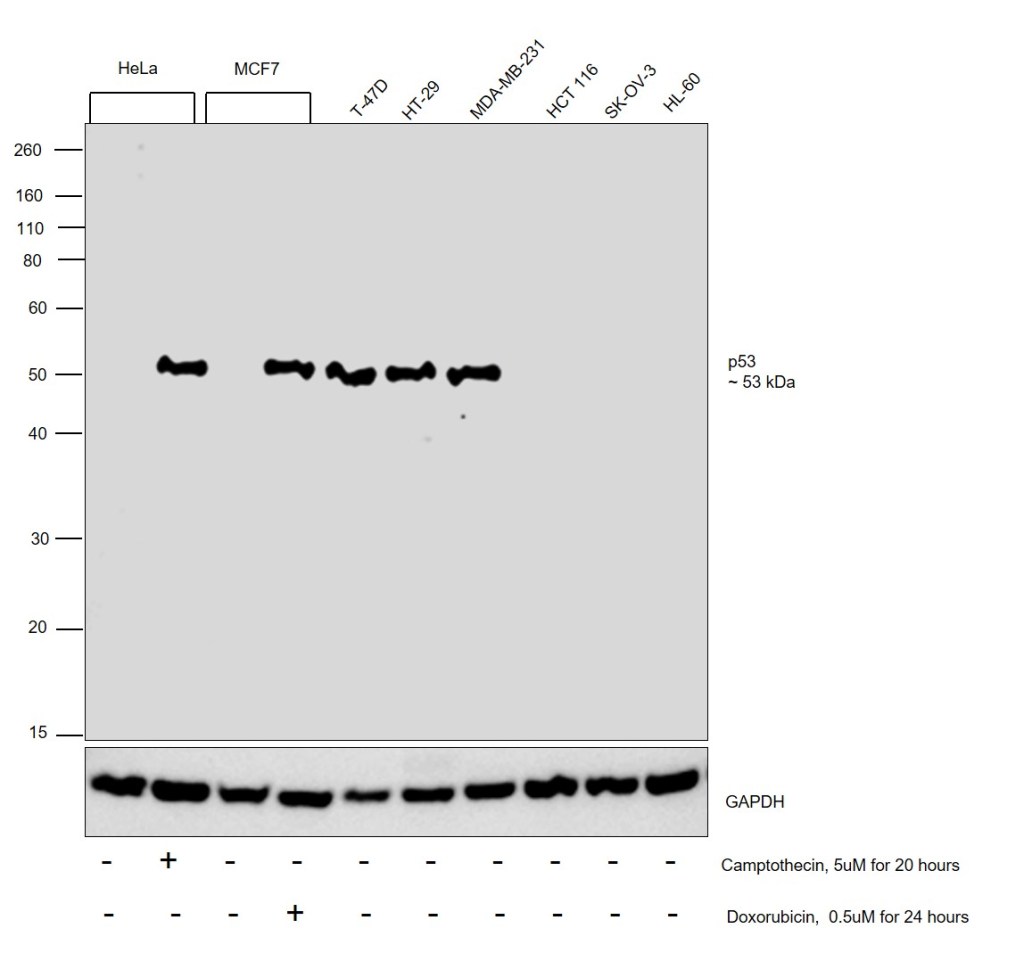*A Western blot presented as “Advanced Verification” data for an[anti\-p53 monoclonal antibody](https://www.thermofisher.com/antibody/product/p53-Antibody-clone-DO-7-Monoclonal/MA5-12557)*\.This image is supposed to demonstrate that[the antibody being sold](https://www.thermofisher.com/antibody/product/p53-Antibody-clone-DO-7-Monoclonal/MA5-12557)works as intended\. It is labeled as[“Advanced Verification”](https://www.thermofisher.com/us/en/home/life-science/antibodies/invitrogen-antibody-validation.html)data on Thermo Fisher’s site and its caption implies that the data was produced internally \(other images in the catalog that have not been produced internally are labeled under “Published Figures”\)\.
This Western blot appears to be fabricated\.[As annotated by Sholto](https://bsky.app/profile/sholtodavid.bsky.social/post/3mm2wk2jqgk2b), several of the bands in the image are identical after flipping and rotation:
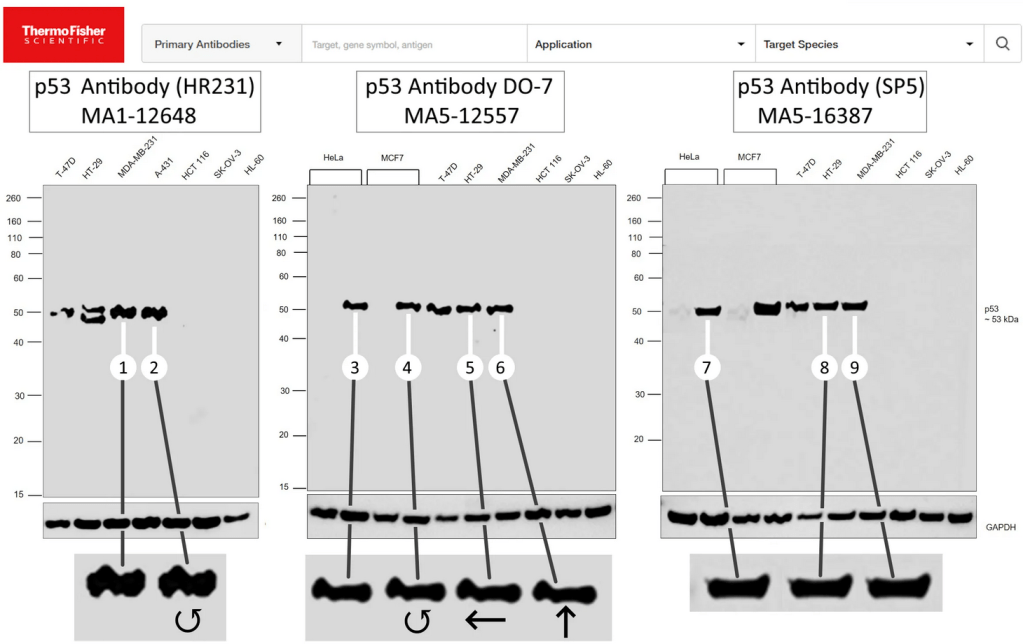
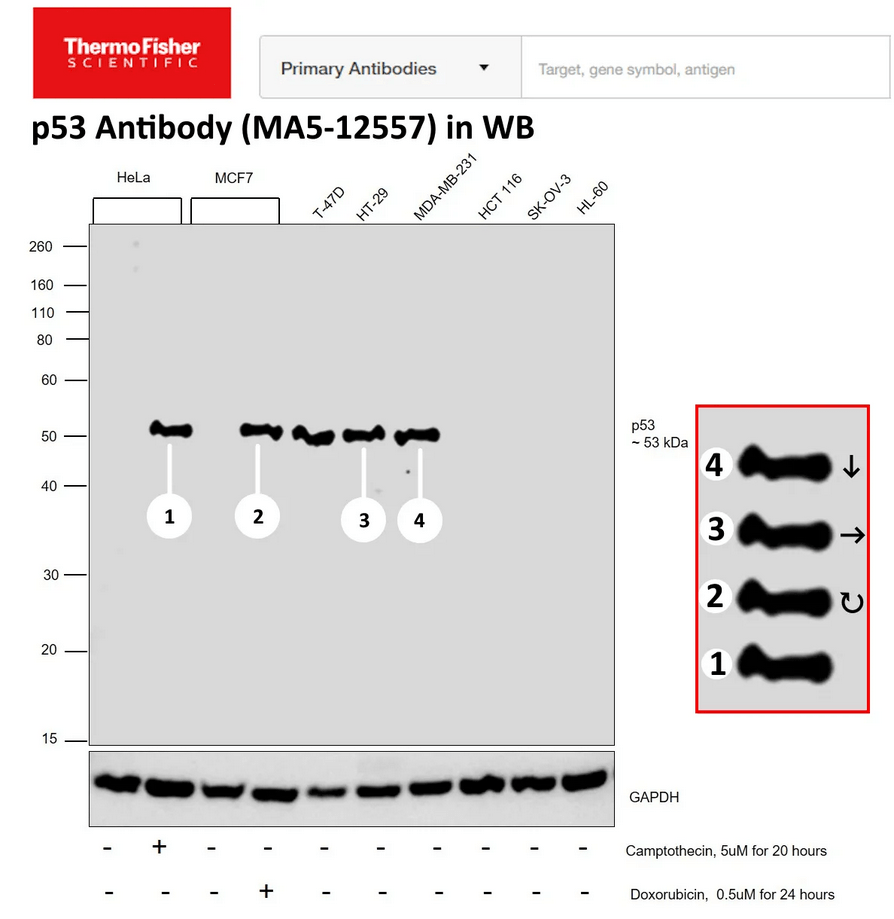*The bands labeled 1 through 4 are all identical to one another after a vertical flip, a horizontal flip or a 180 degree rotation\.*Shortly after,[Johan Duchêne](https://www.ipek-research.com/labs/duchene-megens-lab/7b685bd41ca8d010)noticed[a similarly suspicious image](https://bsky.app/profile/johanduchene.bsky.social/post/3mmefh7b5rc26)of another anti\-p53 antibody in Thermo Fisher’s catalog\. I decided to go looking myself and[quickly turned up](https://bsky.app/profile/reeserichardson.bsky.social/post/3mmfhauptfs2r)ten more suspicious images on eight other antibody products offered by Thermo Fisher\.
Sholto and I have now documented more than 100 images provided as verification data in Thermo Fisher’s antibody catalog that have apparently been manipulated\. You can see all of them at[this Zenodo repository](https://doi.org/10.5281/zenodo.20402475), which we’ll try to update regularly\. This repository also contains a handful of instances that are less suggestive of manipulation, but the data is still problematic \(e\.g\., the same image being presented as verification data for two different antibodies\)\.
Here are some highlights:
Some images are similar to the example that started this excursion and also feature bands that are unusually similar to one another\.
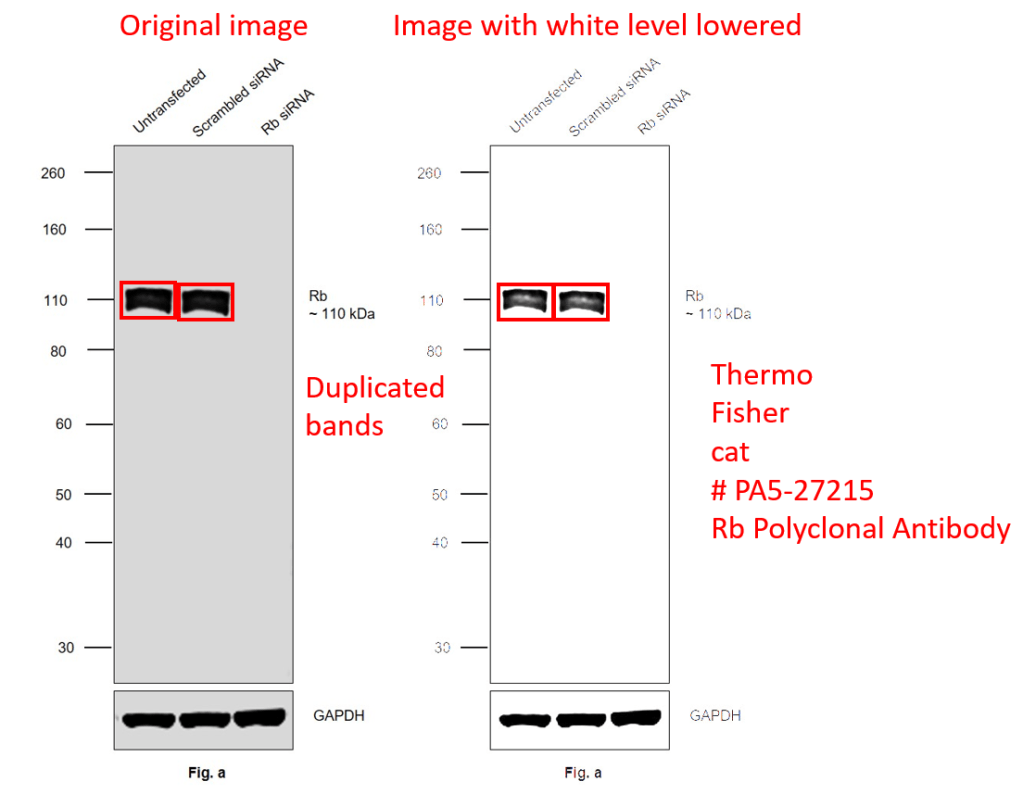Many images, if you adjust the contrast, feature conspicuous “brushstrokes”, suggesting that part of the image has been painted over in a program like Photoshop\.
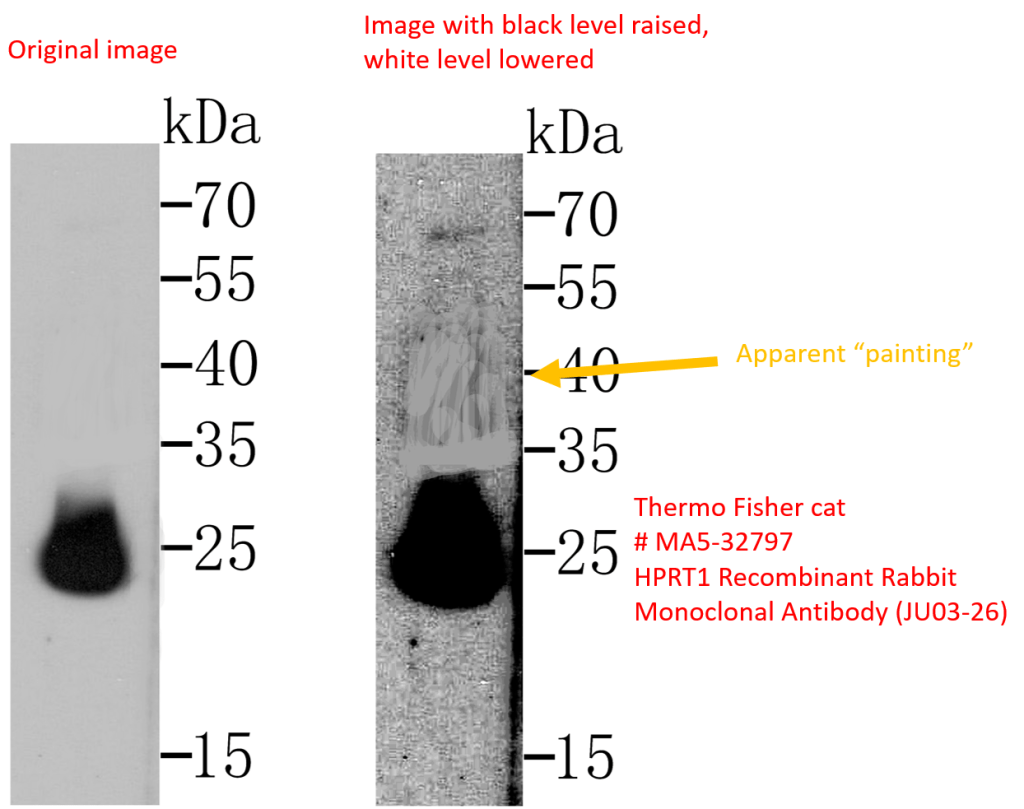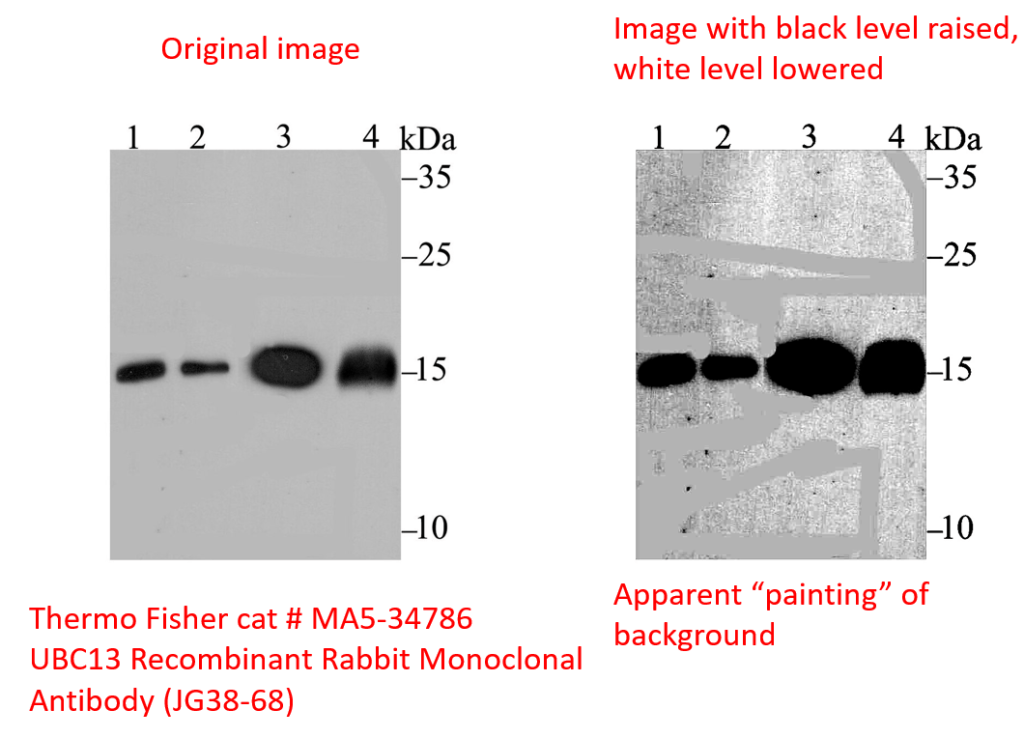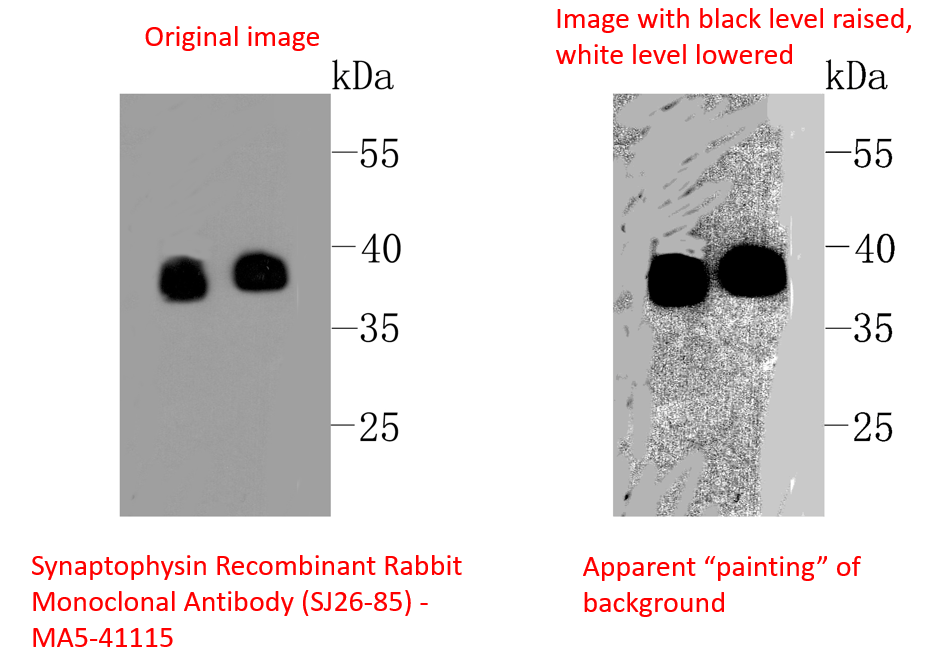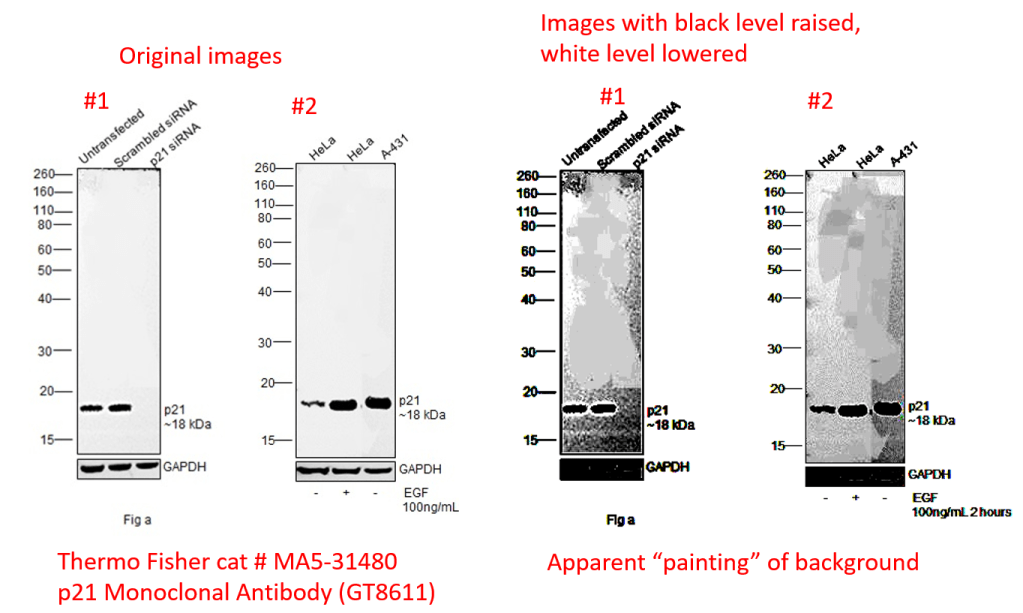Other images feature repetitive blocks of background noise, suggesting that parts of the image were copy\-pasted over each other\. They might also feature sudden unexpected discontinuities in the pattern of background noise\.
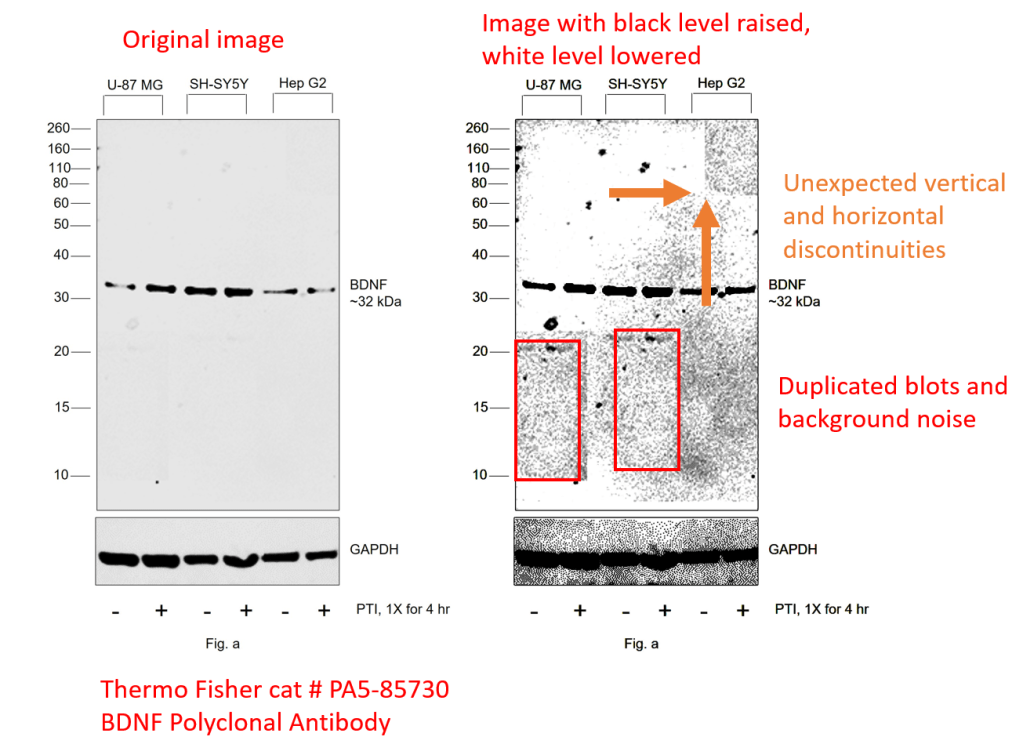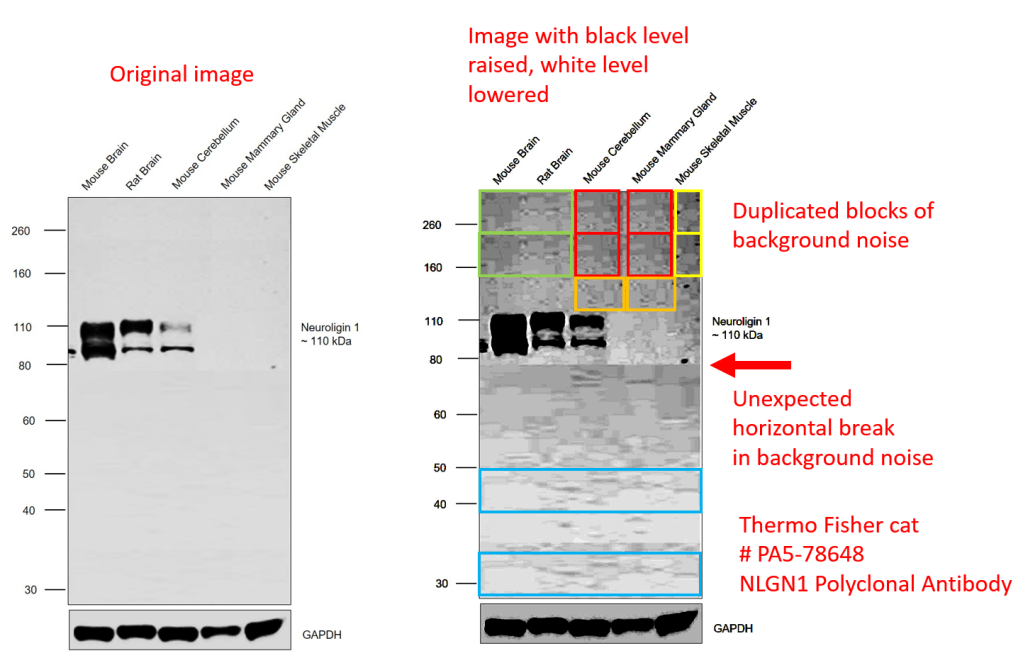In one instance, I thought I had stumbled across another one of these instances of duplicated blocks of background noise…
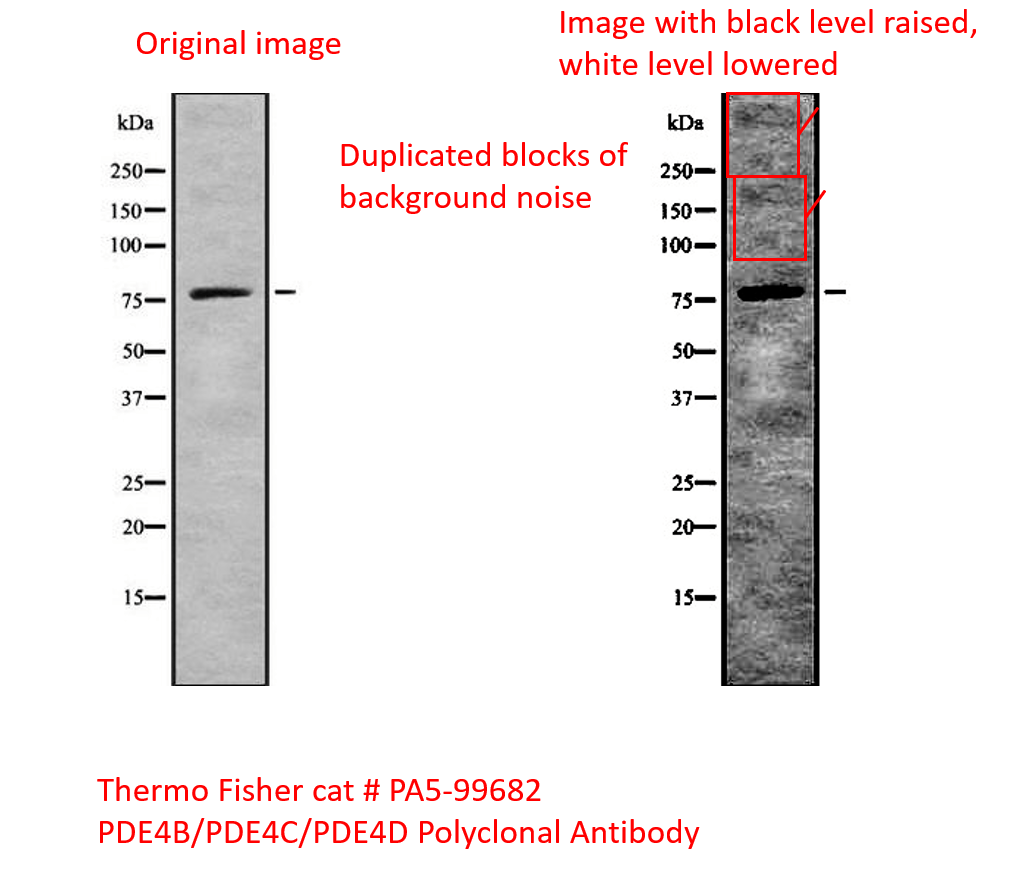…only to discover that dozens of antibodies for sale from Thermo Fisher present a verification Western blot that features this exact background pattern, just with minimal edits such that the single band is positioned where one would expect to see the protein of interest\.
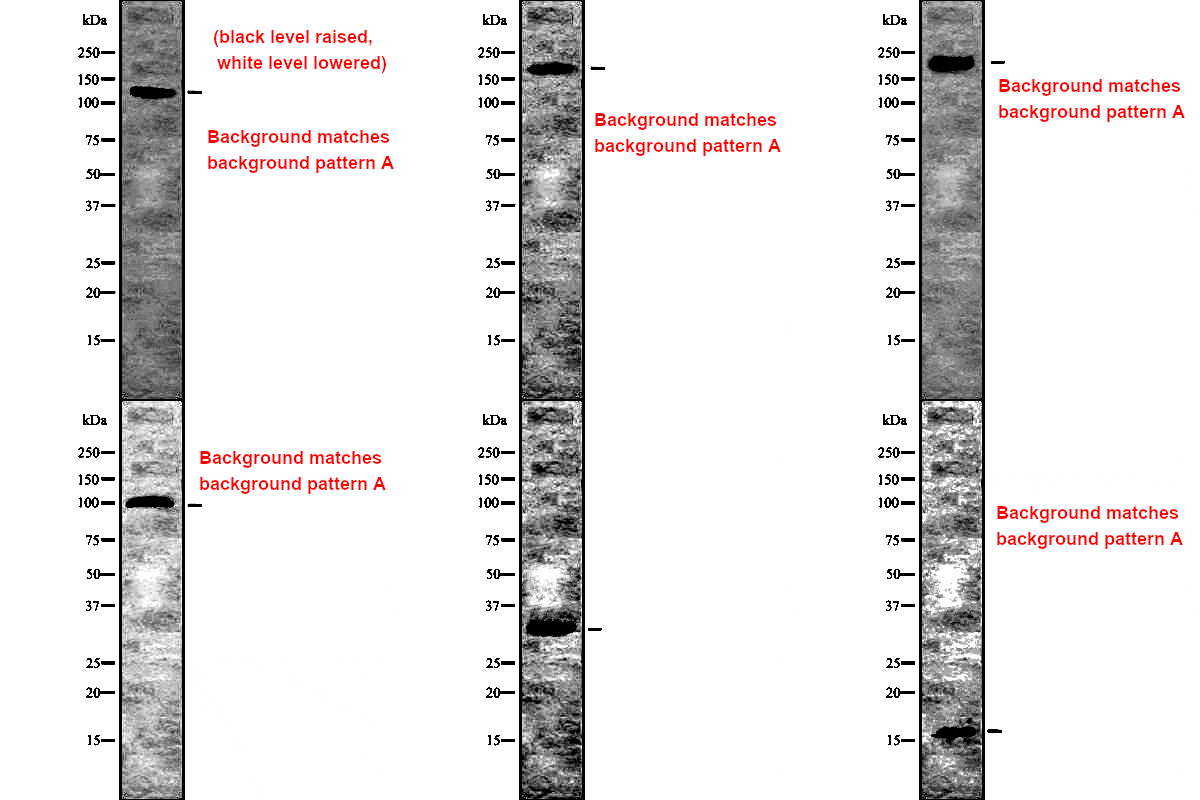*A slideshow of contrast\-adjusted Western blots all featuring “background pattern A”\.*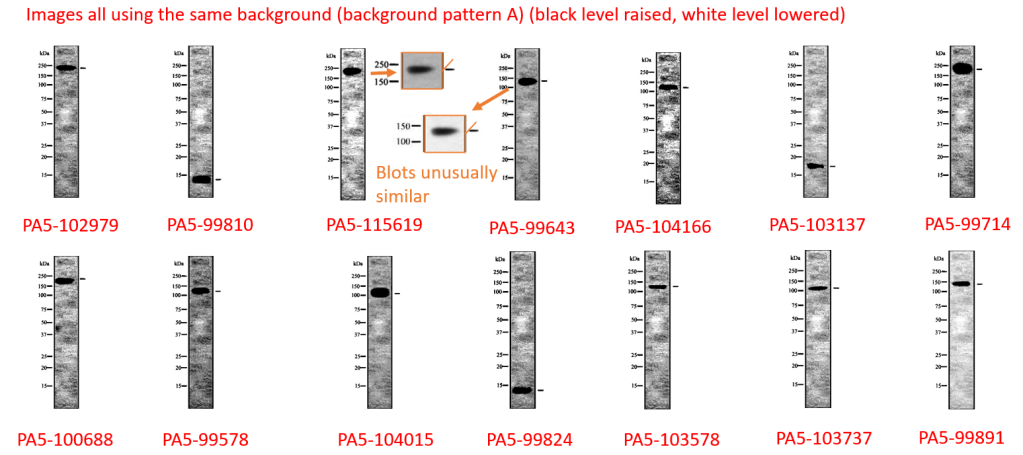At the time of writing, we’ve documented 50 instances of this background pattern appearing in verification data on Thermo Fisher’s site, but this is far from an exhaustive list\. “Similar image” searches using Google Lens, Bing Images or DuckDuckGo betray hundreds more that we have yet to document\.
Antibodies are near\-ubiquitous but notoriously fickle laboratory reagents in biomedical research\. For many applications, it is absolutely crucial that the antibodies that you use are selective \(i\.e\., the antibody binds strongly to the target protein\) and specific \(i\.e\., the antibody binds to the protein of interest and little else\)\. Commercially\-available antibodies often fail to meet these criteria\. Members of[YCharOS](https://ycharos.com/), an independent antibody validation initiative,[estimated in 2024](https://doi.org/10.7554/eLife.91645.2)that “more than 50% of all antibodies failed in one or more applications”\. Antibodies that don’t work as intended can delay experiments by weeks and non\-specific antibodies are a massive source of irreproducibility in the biomedical literature\. To learn more, check out Johan’s[September 2025 talk](https://www.youtube.com/watch?v=L4UIKzhsvmg)in which he details his experience with a study published using a non\-specific antibody\.
Antibody vendors like Thermo Fisher \(probably the largest laboratory reagent supplier in the world\) put verification data in their catalogs to demonstrate to scientists that the product works as intended\. While signs of manipulation in this verification data don’t necessarily imply that the antibodies in question don’t work as advertised, without reliable verification data available, scientists will have no way of knowing until they have actually purchased the antibody\. And antibodies are not cheap; at Thermo Fisher, a single vial containing a 0\.1 mL aliquot of antibody solution typically costs 400 to 500 USD\.
We created[our repository](https://zenodo.org/records/20402476)of problematic images in vendor antibody catalogs A\) to raise awareness among working biomedical scientists that the antibody verification data they see in a vendor’s catalog may be unreliable and B\) to encourage others to look for and report problematic vendor\-provided antibody verification data \(not limited to just Thermo Fisher\)\. If you spot anything, feel free to fill out this[Google form](https://forms.gle/adMZPMFa7rFDtugi8)so that it might be added to the spreadsheet and repository\.
A parting message:[always validate your antibodies](https://doi.org/10.1038/s41596-024-01108-6)\!