@compchemm: David Baker & Veesler labs "building viruses - Institute for Protein Design (IPD) -Two new Nature papers - "building vi…
Summary
Two Nature papers from Baker and Veesler labs describe AI-designed capsids that achieve quasi-symmetry, enabling larger protein shells than previously possible, clarifying that they designed architecture, not actual viruses.
View Cached Full Text
Cached at: 07/07/26, 11:30 AM
David Baker & Veesler labs “building viruses - Institute for Protein Design (IPD) -Two new Nature papers - “building viruses, at University of Washington” if you believe the headlines. What they’ve actually done is more interesting than that. https://ullahsamee.substack.com/p/david-baker-and-veesler-lab-building?r=3re8fb&utm_campaign=post&utm_medium=web&triedRedirect=true…
David Baker and Veesler lab “building viruses
Source: https://ullahsamee.substack.com/p/david-baker-and-veesler-lab-building?r=3re8fb&utm_campaign=post&utm_medium=web&triedRedirect=true You will have seen some version of the headline by now:**David Baker’s group along Veesler at the University of Washington(UW) has started using AI to build viruses.**That travels well on social media, and I understand the appeal. But it’s wrong in the way most exciting-sounding science headlines are wrong — not because nothing happened, but because the real result got flattened into something punchier and dumber on the way out the door.
So let me back up.Institute for Protein Design(IPD)has two papers out back-to-back in Nature — atwo-component versionfrom Wang et al. and asingle-component versionfrom Lee et al. — and they are about capsids, the protein shells that viruses use to package their genomes1-2. Nobody designed a virus. Nobody designed a genome, or a replication machine, or anything that could infect a cell and make copies of itself. What they designed is thearchitecture: the specific geometric trick that lets a virus build a shell far larger than its symmetry would ordinarily allow. And that turns out to be a genuinely hard problem people have wanted to crack for a long time.
More details can be accessed about professors and their group members involved in the study;

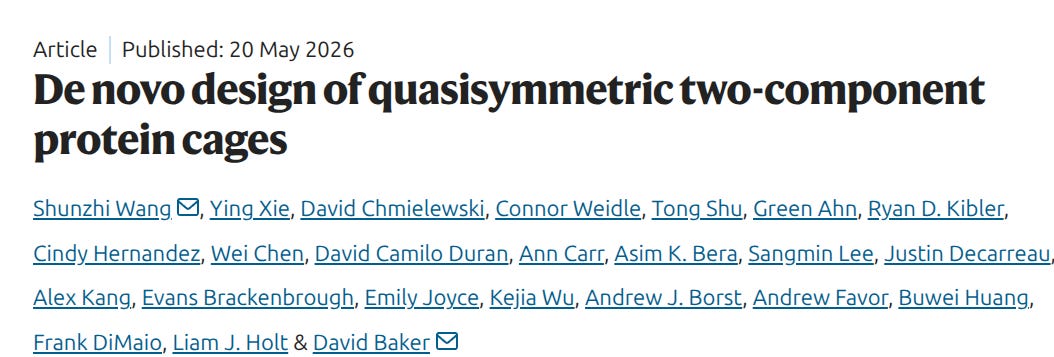 Here’s the thing about viral capsids that has fascinated structural biologists since Caspar and Klug worked it out in the early 1960s3-5. If you want to build a closed shell out of identical protein subunits using perfect symmetry, you top out fast: the largest fully symmetric object you can make from one repeated part is a 60-subunit icosahedron. And yet plenty of viruses build capsids out of hundreds or thousands of copies of a single protein. How? By cheating on the symmetry, just slightly. The same subunit sits in subtly different local environments in different parts of the shell, flexing into slightly different conformations depending on where it lands. Caspar and Klug called this***quasi-equivalence; the modern term is quasi-symmetry.***It’s what lets you tile a curved surface with mostly hexagons while sneaking in exactly the right number of pentagons to close the thing into a sphere. (You cannot tile a sphere with hexagons alone — the same geometric fact that puts twelve pentagons on a soccer ball, and the reason a flat sheet of hexagons will never curl up on its own.)
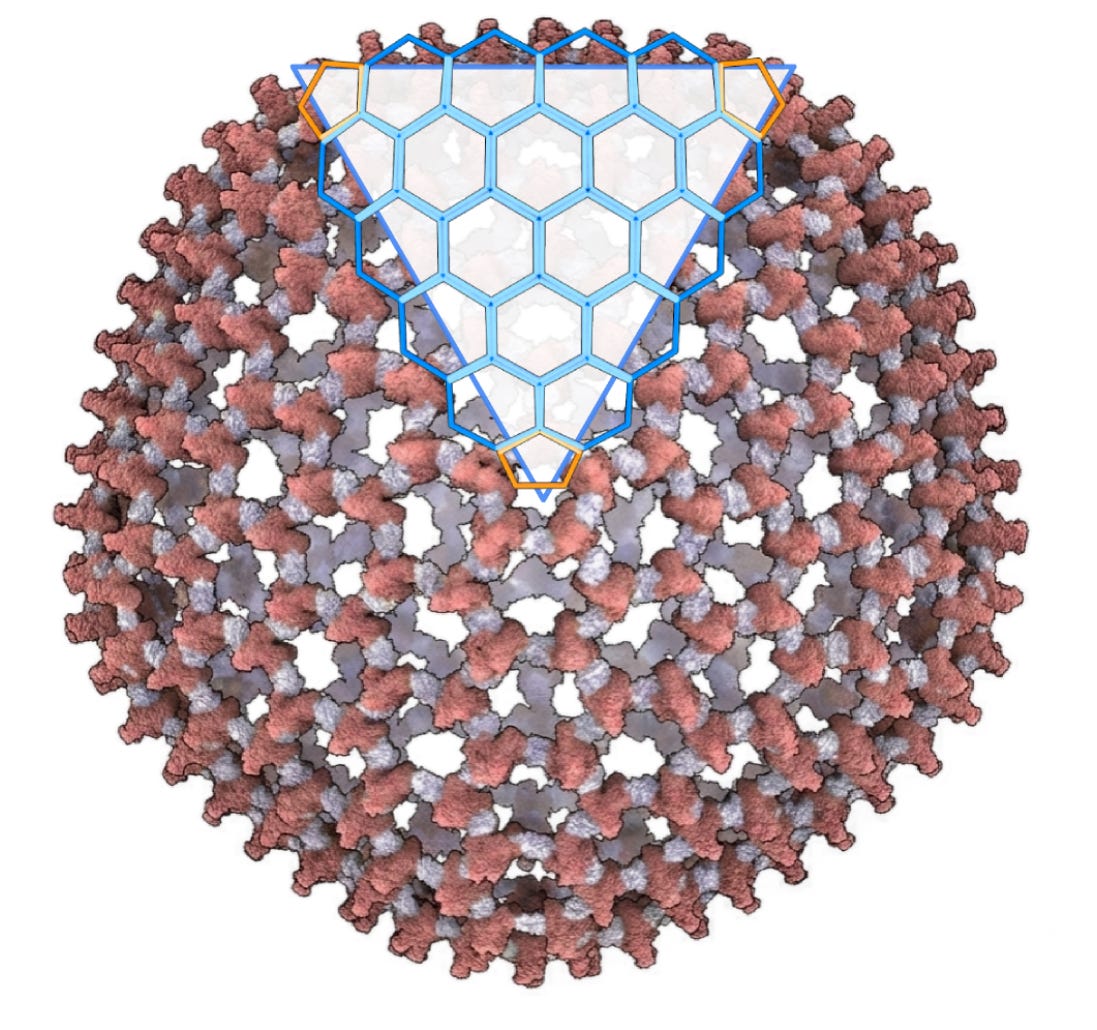 quasisymmetric two-component protein cages - Cartoon depiction of ideal two-component icosahedral cages with T values 25
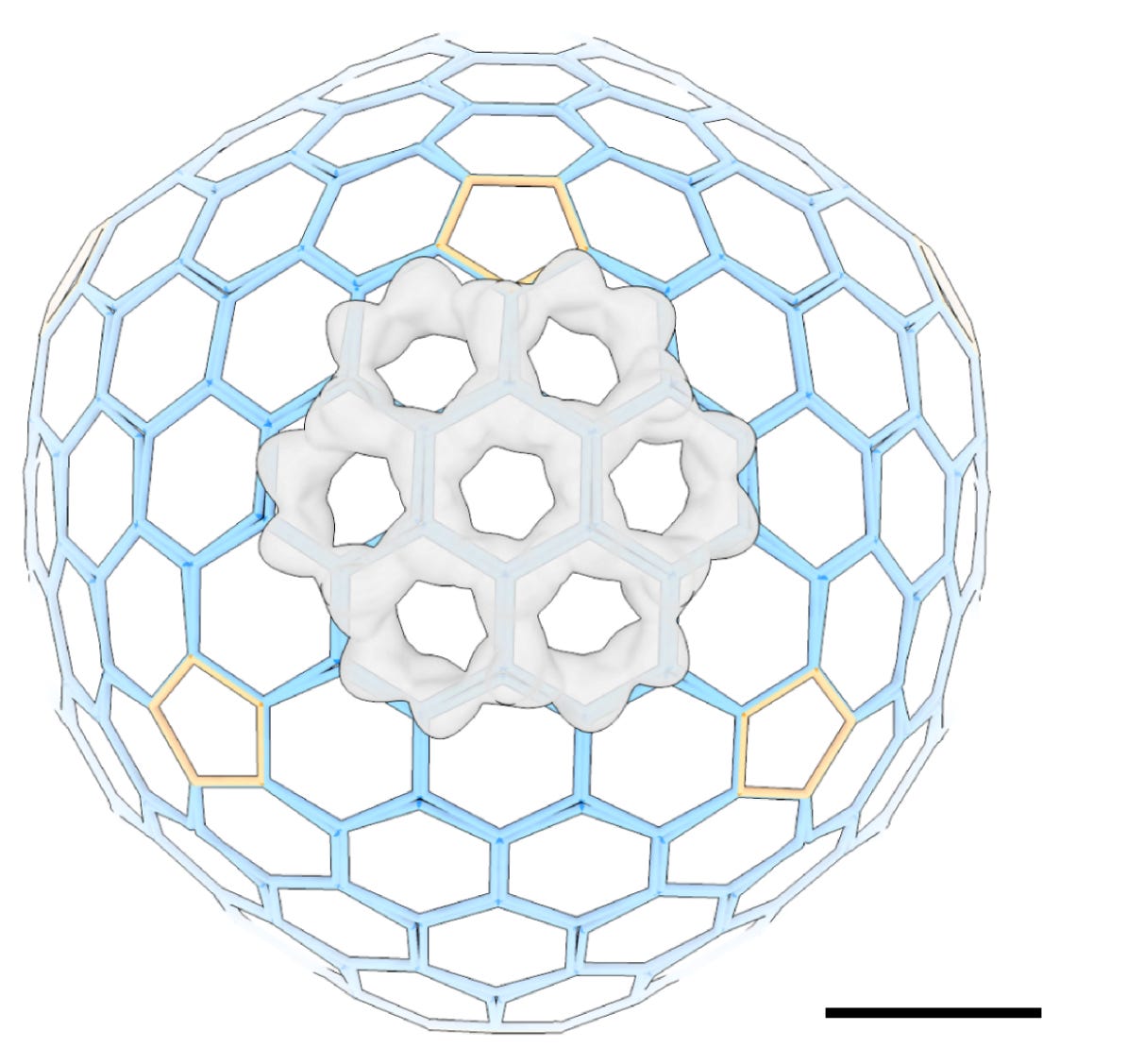 Top and side view of three-dimensional reconstructed maps corresponding to curved local hexagons.
Designing that is genuinely hard, for one reason: it’s a balancing act. Your subunit has to be rigid enough to assemble reproducibly — no pile of misfolded junk — but flexible enough that thesamepart can settle into several different positions without complaint. Too stiff and you get one small symmetric cage; too floppy and you get nothing in particular. What both papers do, by somewhat different routes, is find the sweet spot.
Top and side view of three-dimensional reconstructed maps corresponding to curved local hexagons.
Designing that is genuinely hard, for one reason: it’s a balancing act. Your subunit has to be rigid enough to assemble reproducibly — no pile of misfolded junk — but flexible enough that thesamepart can settle into several different positions without complaint. Too stiff and you get one small symmetric cage; too floppy and you get nothing in particular. What both papers do, by somewhat different routes, is find the sweet spot.
- **Two-component assembly(PDB:9OM3):**Input two distinct protein components to engineer a virus-like shell. - **Single-component assembly(EMD-70787):**Input a single protein component to trigger autonomous virus-like shell formation. EMD-70792
Thetwo-component papertakes the more controlled route: two designed proteins, a trimer and a dimer that acts as a linker, engineered so the local geometry is deliberately “frustrated” — strained toward a chosen curvature. (The trimer was an existing building block from the group’s earlier work; the dimer linkers are the new part, built with RFdiffusion.) By tuning how much curvature each linker encodes, they dial cage size from about 40 nanometers up past 200, with molecular weights from a couple of megadaltons to over fifty — real-virus territory. And they didn’t stop at pretty electron micrographs: they hung extra domains off the cages to load RNA-protein cargo and drive uptake into cells, and — the part I liked best — expressed fluorescently labeled versions inside living mammalian cells and used them as rheological probes, watching how particles of a defined size diffuse through the crowded cytoplasm. That’s a concrete use with nothing to do with delivery, and the kind of thing that makes me take a structural paper more seriously.
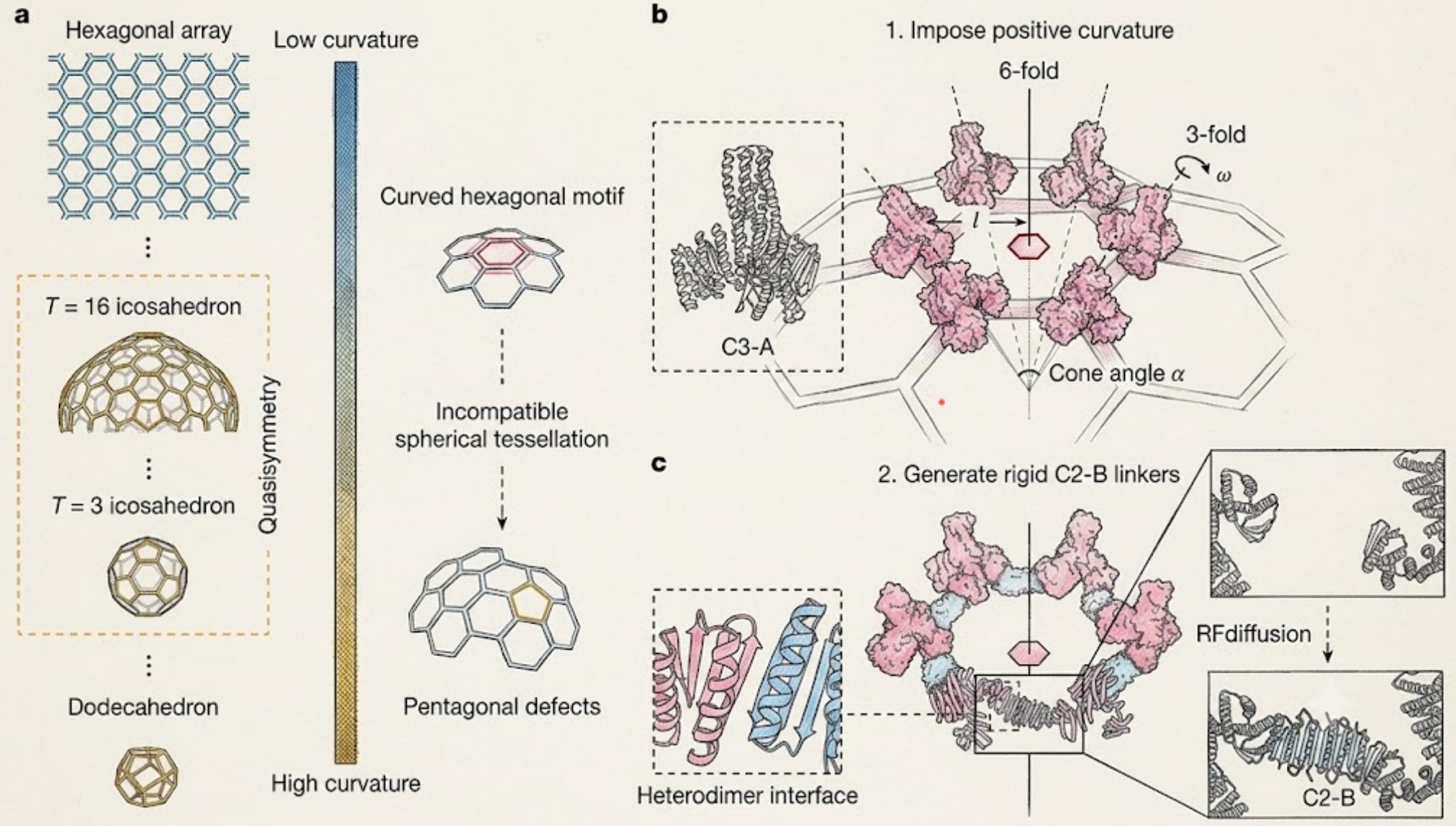 Design strategy for generating quasisymmetrics
Thesingle-component paperis the more audacious one, and it’s why the two make such a satisfying pair. Here there’s one protein, playing every role. The authors let quasi-symmetry emerge on its own: take a homotrimer, describe its interactions with a couple of angle parameters, and push those angles off the line of perfect symmetry. Rather than failing, the assembly spontaneously breaks symmetry — a T=1 cage becomes a T=3, the single subunit obligingly finding several distinct environments to sit in. The designed cages run from 180 up to 2,160 subunits, and 68 to 220 nm. That’s a lot to ask of one protein, and that it works at all is the headline result as far as I’m concerned.
Design strategy for generating quasisymmetrics
Thesingle-component paperis the more audacious one, and it’s why the two make such a satisfying pair. Here there’s one protein, playing every role. The authors let quasi-symmetry emerge on its own: take a homotrimer, describe its interactions with a couple of angle parameters, and push those angles off the line of perfect symmetry. Rather than failing, the assembly spontaneously breaks symmetry — a T=1 cage becomes a T=3, the single subunit obligingly finding several distinct environments to sit in. The designed cages run from 180 up to 2,160 subunits, and 68 to 220 nm. That’s a lot to ask of one protein, and that it works at all is the headline result as far as I’m concerned.
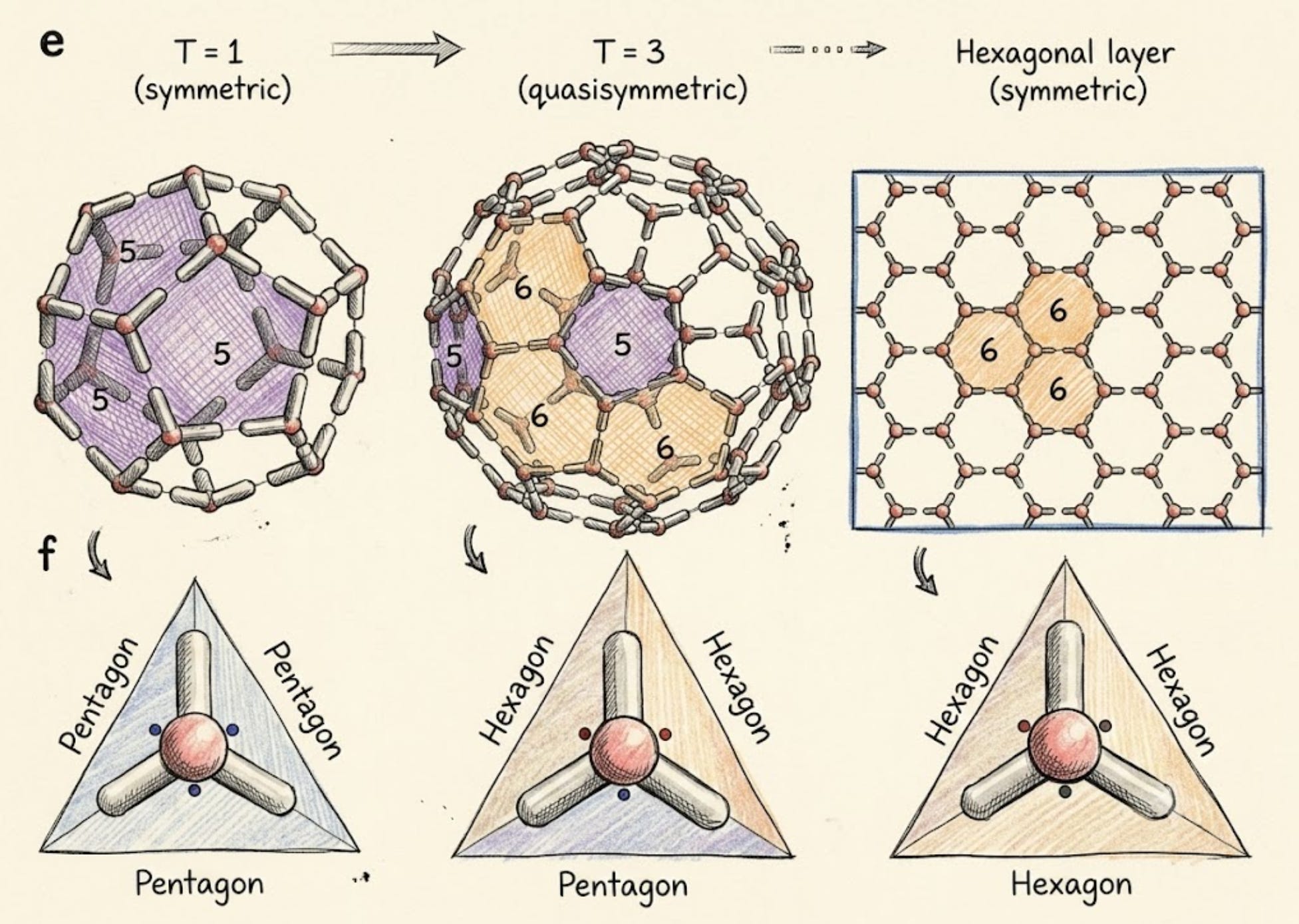 **Symmetry breaking in quasisymmetric cages.**Trimeric building blocks in the T=1 cage (f, left) and 2D hexagonal lattice (f, right) feature C3-symmetric environments surrounded by identical pentagons or hexagons. In contrast, the T=3 cage (f, middle) exhibits broken local symmetry due to the differing geometries of its neighboring pentons and hexons.
Text within this block will maintain its original spacing when published
**Symmetry breaking in quasisymmetric cages.**Trimeric building blocks in the T=1 cage (f, left) and 2D hexagonal lattice (f, right) feature C3-symmetric environments surrounded by identical pentagons or hexagons. In contrast, the T=3 cage (f, middle) exhibits broken local symmetry due to the differing geometries of its neighboring pentons and hexons.
Text within this block will maintain its original spacing when published
So what's it for? The application everyone reaches for — the labs included — is delivery. You can't discuss getting genetic payloads into cells for long without hitting AAV, lipid nanoparticles, and viral vectors, all with well-known headaches: limited cargo, pre-existing immunity, finicky manufacturing. An artificial cage that assembles as cleanly as a capsid, comes in a size you specify, holds a defined interior, and carries no viral genome and no ability to replicate is an obviously attractive alternative — on paper.
A designed shell is still a large foreign protein assembly
On paper. I’d apply the brakes, because we have watched a lot of delivery platforms look spectacular in a mouse and then spend a decade discovering why they weren’t ready.A designed shell is still a large foreign protein assembly, which means the immune system gets a vote — one that has ended more delivery programs than any assembly problem ever has. Cargo loading, release, tissue targeting, serum stability, scale-up at reasonable cost: none of it follows from a beautiful cryo-EM structure.
But that’s a caveat about timelines, not about whether the science matters. What these papers really show is that protein design has moved past single proteins, binders, small folds are largely a solved-in-principle problem now — and on to designingsystems: large assemblies whose interesting behavior belongs to the collective, not any one piece. Capsids, organelles, condensates, nanoparticles — things nature spent billions of years evolving, now treated as engineering problems. That’s the news.
Which brings us back to the headline. Did Baker and Veesler lab make a virus? No. They made the design logic underneath one — the ability to specify, from scratch, a self-assembling quasi-symmetric shell.
Since the headline was that Baker’s lab is building viruses, it’s worth being straight about the risk here rather than waving it away — and, just as much, about not overselling it.
Start with what these two papers actually put into the world: empty shells. No genome, no polymerase, no packaging signal, no replication machinery — nothing that lets a particle copy itself or hijack a cell into doing it.A capsid with no genome is about as infectious as a milk jug. The direct risk from this specific work is low, and anyone citing it as AI “creating pathogens” has the story backwards.
The honest concern isn’t this paper; it’s the slope it sits on. The design stack behind these cages — RFdiffusion, ProteinMPNN, AlphaFold — is general-purpose, and general-purpose protein design is dual-use by construction. A tool that can design a benign self-assembling shell is, in principle, a tool that could help design less benign things. And the delivery angle everyone’s excited about is exactly the part that gives a security-minded person pause: a programmable, genome-free, immune-evading container that comes in a size you specify and carries whatever cargo you attach is a wonderful vehicle for a gene therapy — and the qualities that make it good at that are not intrinsically fussy about what’s inside.
I’d keep it in proportion, though. Designing a shell is a long way from designing a working pathogen, which is a far harder and far more closely watched problem, and the real chokepoints for misuse have always been downstream — synthesizing the genes, culturing the agent, getting any of it to actually work — not the design step. Those chokepoints are where the guardrails live: nucleic-acid synthesis screening, know-your-customer rules at the DNA vendors, and the slow, unglamorous work of governing AI-plus-biology before the capability curve outruns it.
It’s worth noting who paid for this. The two-component work was funded in part by the Defense Threat Reduction Agency (grant no.HDTRA1-19-1-0003) — the Pentagon’s counter–weapons-of-mass-destruction arm. But one thing is clear that these researchers and professors labs are definitely using the money from the Defense departments - That’s a red flag.
None of this argues for slowing the work, and none of it says the sky is falling. It’s just the ordinary condition of a powerful general-purpose technology: the thing that lets you build a better delivery vehicle for medicine is the thing you have to keep an eye on.
These two research pieces signal a paradigm shift in therapeutic delivery: the future lies not just in modifying natural Adeno-Associated Viruses (AAVs), but in deploying AI-designed, synthetic viral capsids. Yet, for now, AAVs remain the gold standard of clinical gene therapy. While generative AI tools like can now dream up entirely novel protein shells from scratch, these synthetic vehicles must still navigate years of stringentsafety profiling, clinical trials, and manufacturing scale-up. Until then, traditional AAV vectors—backed by decades of clinical data and established infrastructure—will continue to carry the heavy load of modern genetic medicine.
References
- https://www.nature.com/articles/s41586-026-10464-0
- https://www.nature.com/articles/s41586-026-10554-z
- https://doi.org/10.1016/0022-2836(68)90050-8
- https://doi.org/10.1098/rstb.1999.0404
- https://doi.org/10.1016/0006-3002(57)90465-1
Discussion about this post
Ready for more?
Similar Articles
Large genome models used to design new viruses
Researchers used large genome models Evo 1 and Evo 2 to design new bacteriophage genomes, producing viruses with distinct features challenging to evolve naturally, raising questions about potential future design of vertebrate-targeting viruses.
Scientists Used AI to Create 16 New Viruses
Researchers at Stanford and the Arc Institute used AI models Evo 1 and Evo 2 to design hundreds of novel bacteriophage genomes, 16 of which produced fully functional viruses capable of infecting E. coli. The breakthrough opens new avenues for combating antibiotic resistance but raises biosecurity concerns.
Artificial Intelligence used to design brand new viruses
US researchers used generative AI models Evo1 and Evo2 to design complete virus genomes for the first time, creating 16 novel bacteriophages that can kill E. coli. The breakthrough could enable new disease treatments but raises urgent safety and security concerns.
@SurgeBiswas: New paper from the @nablabio team expanding generative drug design to multispecifics, the intracellular proteome, and p…
Nabla Bio's new paper (JAM-2) expands generative drug design to multispecifics and the intracellular proteome, achieving zero-shot design of a KRAS G12V-targeting bispecific that recruits T cells for picomolar cell killing.
MIT engineers design proteins by their motion, not just their shape
MIT researchers have developed VibeGen, an AI model that designs proteins based on their dynamic motion and mechanics rather than just static structure. This approach allows for the creation of proteins with specific vibrational and flexing behaviors, advancing the field of generative AI in science.