Google's ATLAS study of Gemini usage data reveals that AI is currently used as a complement to work rather than replacing jobs, with only 3% of occupations showing high AI integration.
<p>Anyone following the AI space is by now familiar with lofty claims that <a href="https://arstechnica.com/ai/2025/01/anthropic-chief-says-ai-could-surpass-almost-all-humans-at-almost-everything-shortly-after-2027/">AI models will soon be better than humans at everything</a> and <a href="https://arstechnica.com/ai/2026/03/how-did-anthropic-measure-ais-theoretical-capabilities-in-the-job-market/">capable of replacing vast swaths of the human workforce</a>. In a new study from Google Research, though, a team that looked at how workers are actually using Gemini "[did] not find evidence... to support the claims that AI is about to cause massive automation and displacement of white-collar work..."</p>
<p><a href="https://ai.google/static/documents/GoogleATLASv1.pdf">The paper</a>, released last week, introduces the "AI & Economy ATLAS," an Activity, Task, Landscape, and Adoption Study of 15 million anonymized AI interactions across the Gemini App, Google's AI Mode, and the Gemini API. Their initial review of the data finds that, while AI sees some significant use across a wide variety of occupations, that use "remains shallow and overwhelmingly collaborative in nature, with end-to-end task automation limited in scope."</p>
<h2>"AI appears useful for a subset of tasks..."</h2>
<p>To come to these conclusions, Google researchers used an automated classifier to sort work-based AI interactions using the <a href="https://www.bls.gov/oes/current/oes_stru.htm">Bureau of Labor Statistics' Standard Occupational Classifications</a> and <a href="https://www.onetonline.org/find/all">O*NET's more detailed database of specific work interactions</a>. While this method required some probabilistic classification of "inherently uncertain" interactions, verification by human reviewers found it to be a reliable gauge of how Gemini prompts were being used for work.</p><p><a href="https://arstechnica.com/ai/2026/07/despite-ai-hype-googles-data-shows-workers-arent-automating-themselves-away/">Read full article</a></p>
<p><a href="https://arstechnica.com/ai/2026/07/despite-ai-hype-googles-data-shows-workers-arent-automating-themselves-away/#comments">Comments</a></p>
# Despite AI hype, Google's data shows workers aren't automating themselves away
Source: [https://arstechnica.com/ai/2026/07/despite-ai-hype-googles-data-shows-workers-arent-automating-themselves-away/](https://arstechnica.com/ai/2026/07/despite-ai-hype-googles-data-shows-workers-arent-automating-themselves-away/)
[](https://cdn.arstechnica.net/wp-content/uploads/2026/07/Screenshot-2026-07-28-at-3.36.31-PM.png)
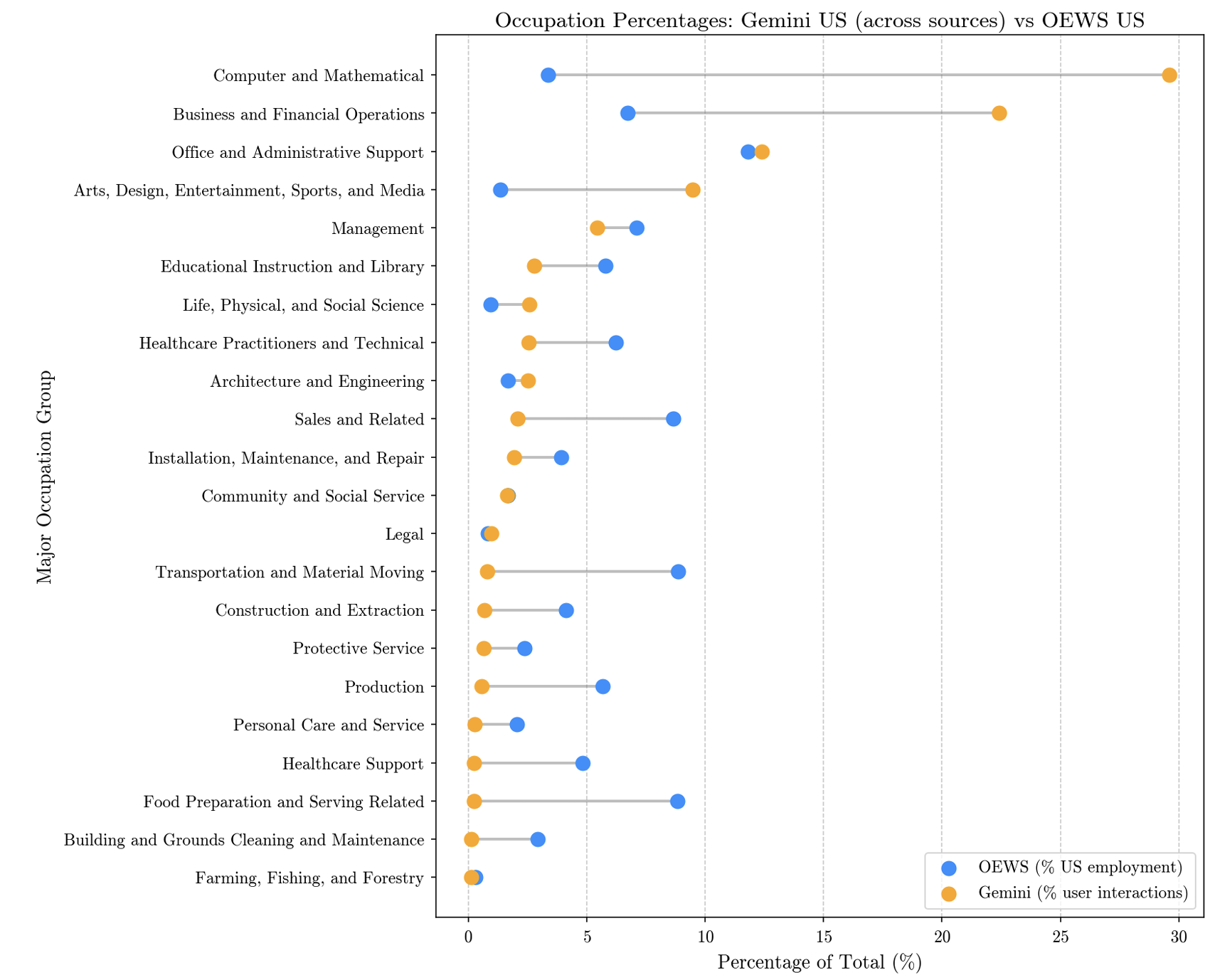
Certain white\-collar jobs are heavily over\-represented in the Gemini usage data\.
Certain white\-collar jobs are heavily over\-represented in the Gemini usage data\.Credit:[Google Research](https://ai.google/static/documents/GoogleATLASv1.pdf)
The researchers also attempted to measure how deeply AI was being integrated into various jobs, looking at how often individual, granular O\*NET work tasks were attempted using Gemini\. Across that entire database, the ATLAS researchers only classified 21 percent of all work\-related tasks as “Gemini tasks”—those that met a minimum threshold of 25 related interactions attempted in the massive sample\.
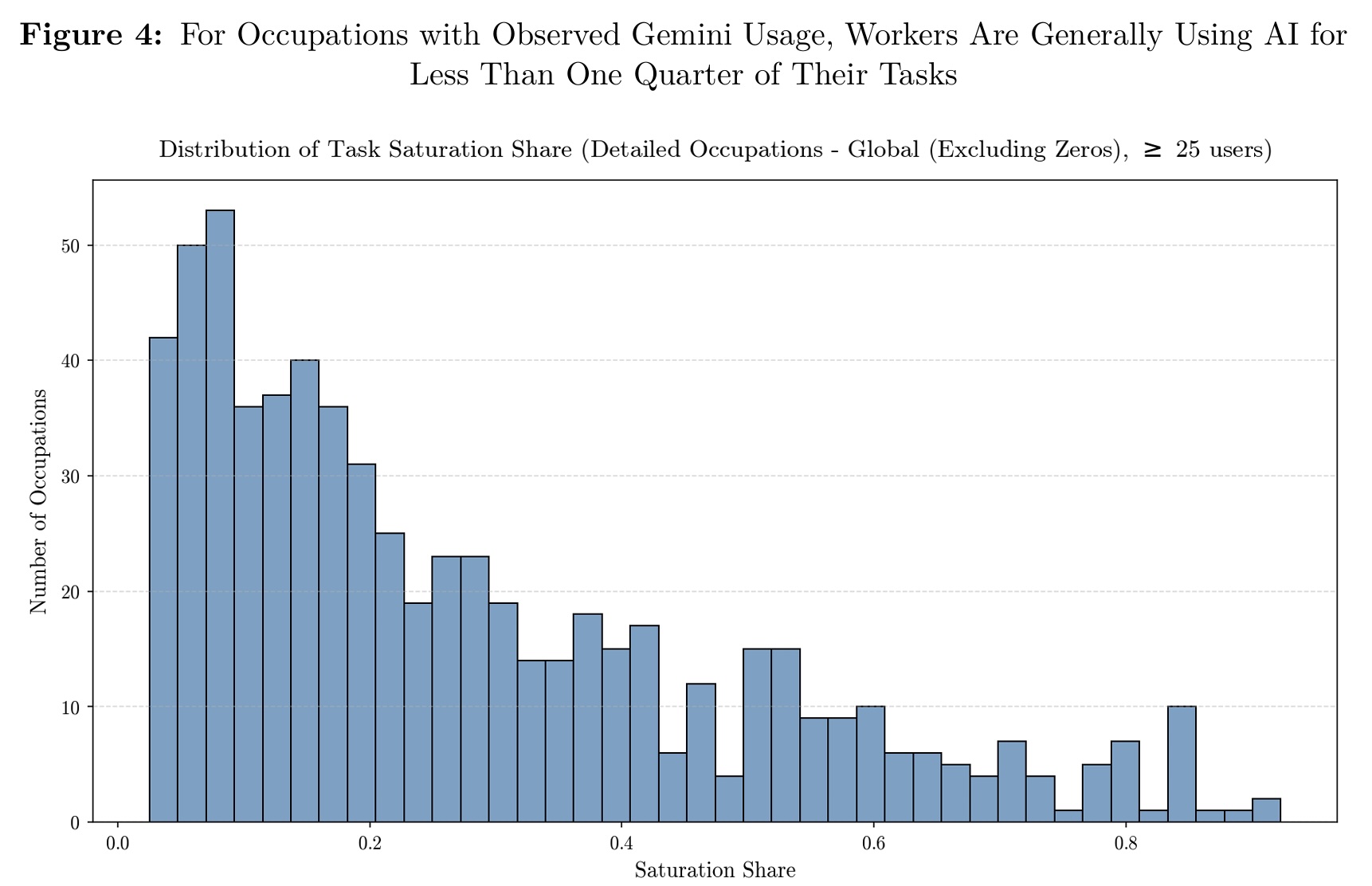
For many occupations \(29%\), not a single relevant work task achieved this “non\-negligible” Gemini usage threshold, suggesting those jobs have been minimally impacted by the AI revolution so far\. For another 30 percent of all occupations, less than one\-quarter of tracked tasks saw significant related Gemini usage, suggesting humans were still the ones responsible for the vast majority of the component parts of those jobs\.
In only 3 percent of occupations was Gemini being regularly consulted for at least three\-quarters of that job’s relevant tasks\. Jobs like software quality assurance analysts and testers, human resources specialists, and document management specialists fell into this bucket and are seemingly the most impacted by AI use in the study\.
[](https://cdn.arstechnica.net/wp-content/uploads/2026/07/geminiwork.jpg)
For the majority of jobs, less than 25 percent of O\*NET tasks saw significant attempted assistance from Gemini\.
For the majority of jobs, less than 25 percent of O\*NET tasks saw significant attempted assistance from Gemini\.Credit:[Google Research](https://ai.google/static/documents/GoogleATLASv1.pdf)
Altogether, the researchers write, these kinds of numbers suggest that “AI is currently serving primarily as a complement to existing work” and that “AI appears useful for a subset of tasks performed within occupations, but they do not currently appear to be comprehensively used for performing the work currently done by humans\.” While the researchers say that this state of affairs may change “as new AI breakthroughs emerge,” it’s also possible that new workflows “will maintain a degree of complementarity between workers and AI systems\.”
## Give AI the low\-expertise, non\-routine work
Beyond looking at high\-level occupations, the Google researchers also looked at the specific kinds of work tasks that Gemini users ask the model to undertake\. Cognitive tasks \(i\.e\. those that primarily involve thinking\) represented a whopping 86 percent of the Gemini interactions measured \(by volume\), while interpersonal and manual tasks were underrepresented in the sample compared to their workplace prevalence\.
Google launches ATLAS, a large-scale study analyzing 15 million AI interactions to understand how people use AI at work and in daily life, revealing broad but shallow adoption and collaborative use over automation.
A new article aggregates multiple surveys and usage studies showing that, contrary to hype, most people use AI rarely or not at all, with Gen Z adoption stalling and about 70% of working-age Americans not using AI.
An opinion piece critiquing the AI-driven productivity push, arguing that solving busywork misses underlying systemic issues, using Google's Gemini Spark agent as a case study.
Internal resistance and policy restrictions limit Google's adoption of its own Gemini model, with employees preferring disallowed tools like Claude Code.
Google's AI & Economy ATLAS launches new interactive data visualizations and research insights on global AI adoption in occupations, highlighting regional trends and time savings for scientists.