Doctors report a rare case of Milwaukee Shoulder Syndrome in a construction worker, whose shoulder joint was completely destroyed and the humeral head absent on X-ray.
<p>A 45-year-old construction worker went to the emergency department for his right shoulder, which was extremely swollen and becoming progressively more painful. Doctors took an X-ray to try to see what was causing the problem. But when the images came through, it was what they <em>didn't</em> see that explained the situation: His entire shoulder joint was gone, seemingly blasted apart into small, lingering pieces.</p>
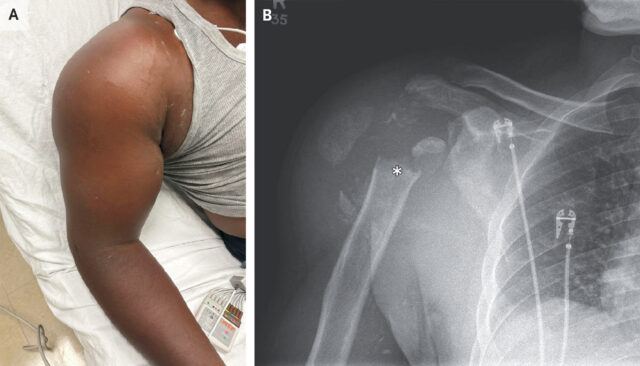
<p>The shoulder joint is a ball-and-socket joint, with the sphere-like head of the upper arm bone (humerus) sitting in the socket of the shoulder blade. According to <a href="https://www.nejm.org/doi/full/10.1056/NEJMicm2601847?startFrom=1">a case report in the New England Journal of Medicine</a>, the man's X-ray showed that he no longer had a ball at all or an intact socket. His upper arm bone was detached from the joint, and the sphere-like top of his upper arm bone (humeral head) was completely gone. The broken, headless humerus was instead left to float freely in the man's arm, unattached to his upper body.</p>
<img width="640" height="366" src="https://cdn.arstechnica.net/wp-content/uploads/2026/07/nejmicm2601847_f1-640x366.jpg" class="center medium" alt="" decoding="async" loading="lazy" srcset="https://cdn.arstechnica.net/wp-content/uploads/2026/07/nejmicm2601847_f1-640x366.jpg 640w, https://cdn.arstechnica.net/wp-content/uploads/2026/07/nejmicm2601847_f1-1024x586.jpg 1024w, https://cdn.arstechnica.net/wp-content/uploads/2026/07/nejmicm2601847_f1-768x440.jpg 768w, https://cdn.arstechnica.net/wp-content/uploads/2026/07/nejmicm2601847_f1-1536x879.jpg 1536w, https://cdn.arstechnica.net/wp-content/uploads/2026/07/nejmicm2601847_f1-2048x1172.jpg 2048w, https://cdn.arstechnica.net/wp-content/uploads/2026/07/nejmicm2601847_f1-980x561.jpg 980w, https://cdn.arstechnica.net/wp-content/uploads/2026/07/nejmicm2601847_f1-1440x824.jpg 1440w" sizes="auto, (max-width: 640px) 100vw, 640px">
The man's shoulder, visibly swollen, and his X-ray showing destruction of the humeral head with a free-floating upper arm bone.
Credit:
<a href="https://www.nejm.org/doi/full/10.1056/NEJMicm2601847?startFrom=1" target="_blank">New England Journal of Medicine, 2026</a>
<p>Magnetic resonance imaging, meanwhile, found that the man's rotator cuff—the group of muscles and tendons that holds the upper arm firmly in the socket—was also destroyed. Three of the four main tendons (supraspinatus, infraspinatus, and subscapularis tendons) had full-thickness tears.</p><p><a href="https://arstechnica.com/health/2026/07/doctors-took-a-look-at-mans-painful-shoulder-they-found-the-joint-was-missing/">Read full article</a></p>
<p><a href="https://arstechnica.com/health/2026/07/doctors-took-a-look-at-mans-painful-shoulder-they-found-the-joint-was-missing/#comments">Comments</a></p>
# Doctors took a look at man's painful shoulder—they found the joint was missing
Source: [https://arstechnica.com/health/2026/07/doctors-took-a-look-at-mans-painful-shoulder-they-found-the-joint-was-missing/](https://arstechnica.com/health/2026/07/doctors-took-a-look-at-mans-painful-shoulder-they-found-the-joint-was-missing/)
A 45\-year\-old construction worker went to the emergency department for his right shoulder, which was extremely swollen and becoming progressively more painful\. Doctors took an X\-ray to try to see what was causing the problem\. But when the images came through, it was what they*didn’t*see that explained the situation: His entire shoulder joint was gone, seemingly blasted apart into small, lingering pieces\.
The shoulder joint is a ball\-and\-socket joint, with the sphere\-like head of the upper arm bone \(humerus\) sitting in the socket of the shoulder blade\. According to[a case report in the New England Journal of Medicine](https://www.nejm.org/doi/full/10.1056/NEJMicm2601847?startFrom=1), the man’s X\-ray showed that he no longer had a ball at all or an intact socket\. His upper arm bone was detached from the joint, and the sphere\-like top of his upper arm bone \(humeral head\) was completely gone\. The broken, headless humerus was instead left to float freely in the man’s arm, unattached to his upper body\.
[](https://cdn.arstechnica.net/wp-content/uploads/2026/07/nejmicm2601847_f1.jpg)
The man’s shoulder, visibly swollen, and his X\-ray showing destruction of the humeral head with a free\-floating upper arm bone\.
The man’s shoulder, visibly swollen, and his X\-ray showing destruction of the humeral head with a free\-floating upper arm bone\.Credit:[New England Journal of Medicine, 2026](https://www.nejm.org/doi/full/10.1056/NEJMicm2601847?startFrom=1)
Magnetic resonance imaging, meanwhile, found that the man’s rotator cuff—the group of muscles and tendons that holds the upper arm firmly in the socket—was also destroyed\. Three of the four main tendons \(supraspinatus, infraspinatus, and subscapularis tendons\) had full\-thickness tears\.
The doctors diagnosed the man with a rare, ruinous condition called “Milwaukee Shoulder Syndrome” or MSS\. The term was coined in 1981 based on the cases of four elderly women in Wisconsin who, like the man, had severe destruction of their shoulder joints and massive tears to their rotator cuffs\. The condition is similar to—and possibly a subtype of—rapid destructive arthritis, which was identified a year later in 1982\.
Midjourney announced a pivot to medical imaging with an ultrasound body scanner, but experts are skeptical due to lack of evidence and the high-stakes nature of medicine.
A humanoid robot teleoperated through laparoscopic surgery at UC San Diego, achieving precision comparable to specialized systems at a fraction of the cost and footprint, with potential for deployment in remote clinics, battlefields, or space. The results were published in Nature.
A behind-the-scenes video of Midjourney's futuristic ultrasound scanner reveals more hardware details but fails to answer expert concerns about its medical viability and physics limitations.
An article from IEEE Spectrum recounting the story of Richard Greenhill and the Shadow Group's DIY bipedal robot, Shadow Walker, which used pneumatic air-muscles instead of motors, built in the late 1980s.
MIT researchers developed a wristband with ultrasound stickers that images muscles and tendons, using AI to translate those images into hand movements to wirelessly control a robotic hand with high dexterity.