Eco Wave Power uses NVIDIA AI infrastructure and digital twins to convert ocean wave energy into clean electricity, leveraging existing marine infrastructure to address growing AI energy demands.
<div id="bsf_rt_marker"></div><p><span style="font-weight: 400;">The next era of AI will not be defined by compute alone. Its growth will be determined by energy.</span></p>
<p><span style="font-weight: 400;"> </span><span style="font-weight: 400;">As accelerated computing scales across </span><a target="_blank" href="https://www.nvidia.com/en-us/glossary/ai-factory/"><span style="font-weight: 400;">AI factories</span></a><span style="font-weight: 400;">, </span><a target="_blank" href="https://www.nvidia.com/en-us/glossary/ai-agents/"><span style="font-weight: 400;">agentic AI</span></a><span style="font-weight: 400;">, </span><a target="_blank" href="https://www.nvidia.com/en-us/glossary/industrial-ai/"><span style="font-weight: 400;">industrial AI</span></a><span style="font-weight: 400;">, edge computing and </span><a target="_blank" href="https://www.nvidia.com/en-us/glossary/generative-physical-ai/"><span style="font-weight: 400;">physical AI</span></a><span style="font-weight: 400;"> — including robotics and autonomous systems — global electricity demand is rising at unprecedented speed. </span></p>
<p><span style="font-weight: 400;">In many regions, expanding grid infrastructure to meet that need requires years of permitting, transmission upgrades, land acquisition and capital investment.</span></p>
<p><span style="font-weight: 400;">This challenge is reshaping how the world thinks about energy infrastructure for AI.</span></p>
<p><span style="font-weight: 400;">Eco Wave Power, a member of the </span><a target="_blank" href="https://www.nvidia.com/en-us/startups/"><span style="font-weight: 400;">NVIDIA Inception</span></a> <span style="font-weight: 400;">startup program’s Sustainable Futures initiative</span><span style="font-weight: 400;">,</span><span style="font-weight: 400;"> is developing technology — powered by NVIDIA AI infrastructure and </span><a target="_blank" href="https://www.nvidia.com/en-us/glossary/digital-twin/"><span style="font-weight: 400;">digital twins</span></a><span style="font-weight: 400;"> — that converts energy from ocean waves into clean electricity using existing marine infrastructure. By using already-built coastal structures, wave energy generation can be deployed closer to areas with growing power demand — including ports, industrial zones and future AI infrastructure hubs.</span></p>
<p><span style="font-weight: 400;">“Wave energy is one of the largest renewable energy sources that exists,” said Inna Braverman, cofounder and CEO of Eco Wave Power. “</span><span style="font-weight: 400;">Everybody wants it, but nobody can do it, so I looked at the current problems with harnessing wave power and I asked: How do we simplify it?</span><span style="font-weight: 400;">”</span></p>
<h2><b>Turning the Sea Into a Power Source </b></h2>
<p><span style="font-weight: 400;">Harnessing Earth’s natural cycles for power generation isn’t a new concept. Wind and solar energy have been well established industries for decades. </span></p>
<p><span style="font-weight: 400;">Waves are on the way to completing this trifecta of power-producing elements. </span></p>
<p><img loading="lazy" decoding="async" class="aligncenter size-medium wp-image-94808" src="https://blogs.nvidia.com/wp-content/uploads/2026/06/Jaffa-Station-during-storm-960x640.jpg" alt="" width="960" height="640" srcset="https://blogs.nvidia.com/wp-content/uploads/2026/06/Jaffa-Station-during-storm-960x640.jpg 960w, https://blogs.nvidia.com/wp-content/uploads/2026/06/Jaffa-Station-during-storm-1680x1120.jpg 1680w, https://blogs.nvidia.com/wp-content/uploads/2026/06/Jaffa-Station-during-storm-1280x853.jpg 1280w, https://blogs.nvidia.com/wp-content/uploads/2026/06/Jaffa-Station-during-storm-1536x1024.jpg 1536w, https://blogs.nvidia.com/wp-content/uploads/2026/06/Jaffa-Station-during-storm-scaled.jpg 2048w, https://blogs.nvidia.com/wp-content/uploads/2026/06/Jaffa-Station-during-storm-630x420.jpg 630w" sizes="auto, (max-width: 960px) 100vw, 960px" /></p>
<p><span style="font-weight: 400;">In the U.S. alone, wave energy could produce over 60% of annual energy consumption, according to the Energy Information Administration. </span></p>
<p><span style="font-weight: 400;">It all starts with floaters — noninvasive floating infrastructure attached to breakwaters or sea walls to capture the power generated by waves breaking against the shoreline. </span></p>
<p><span style="font-weight: 400;">The density of seawater is roughly 800x the density of air, allowing larger amounts of energy to be generated using much smaller devices than wind turbines. </span></p>
<p><span style="font-weight: 400;">The next step is managing and distributing that power. While previous companies faced a bottleneck at this stage — due to having their computer hardware in the floater, leading to potential damages during rough currents — Eco Wave Power puts its computers, sensors, hydraulic conversion and electric parts on land at centers, keeping expensive hardware dry and safe from storms. </span></p>
<p><span style="font-weight: 400;">“Wave energy is the least intermittent source of renewable energy,” Braverman said. “Solar energy — for example — is great, but you have night, winter, cloud coverage and pollution that all impact production. With wave energy, you can generate around the clock.” </span></p>
<h2><b>AI Wave Energy Layer Using NVIDIA Omniverse Libraries and Accelerated Compute</b></h2>
<p><span style="font-weight: 400;">As AI infrastructure expands, energy systems themselves are becoming increasingly intelligent.</span></p>
<p><span style="font-weight: 400;">Digital twins of wave patterns and floating infrastructure — built with </span><a target="_blank" href="https://www.nvidia.com/en-us/omniverse/?utm_source=chatgpt.com"><span style="font-weight: 400;">NVIDIA Omniverse</span></a><span style="font-weight: 400;"> libraries — can simulate wave conditions, structural behavior, deployment configurations and operational scenarios before physical installation begins. These virtual environments can help optimize engineering decisions, reduce deployment risk and accelerate infrastructure planning.</span></p>
<div style="width: 1200px;" class="wp-video"><video class="wp-video-shortcode" id="video-94802-1" width="1200" height="675" preload="metadata" controls="controls"><source type="video/mp4" src="https://blogs.nvidia.com/wp-content/uploads/2026/06/EWP-project-and-digital-twin-from-NVIDIA-Keynote.mp4?_=1" /><a href="https://blogs.nvidia.com/wp-content/uploads/2026/06/EWP-project-and-digital-twin-from-NVIDIA-Keynote.mp4">https://blogs.nvidia.com/wp-content/uploads/2026/06/EWP-project-and-digital-twin-from-NVIDIA-Keynote.mp4</a></video></div>
<p><span style="font-weight: 400;">At the operational layer, NVIDIA accelerated computing and AI technologies enable real-time optimization of wave energy systems through predictive analytics, anomaly detection, environmental forecasting and predictive maintenance. AI models can continuously analyze ocean conditions, equipment performance and energy generation patterns to improve efficiency and operational resilience.</span></p>
<p><span style="font-weight: 400;">AI can also orchestrate energy-aware computing infrastructure by aligning energy-intensive workloads with periods of stronger renewable generation and dynamically optimizing power utilization across distributed systems.</span><span style="font-weight: 400;"> </span></p>
<h2><b>Ocean Powered Data Centers on the Horizon </b></h2>
<p><span style="font-weight: 400;">Eco Wave Power operates projects in Jaffa Port, Israel, created in collaboration with EDF Power Solutions and the Israeli Energy Ministry, and in the Port of Los Angeles, developed in collaboration with AltaSea and Shell. Eco Wave Power is also developing new projects in Portugal at the Port of Leixões, Suao Port in Taiwan, and Mumbai, India, with Bharat Petroleum. </span></p>
<p><span style="font-weight: 400;">Wave power has already demonstrated its ability to handle consumer energy needs — and is now showing potential to support data centers. </span></p>
<p><span style="font-weight: 400;">“We have a possibility to link AI factories directly to wave energy, because a lot of data centers are moving toward the coast,” Braverman said. “They need cooling and water, so they’re now located in ports.” </span></p>
<p><img loading="lazy" decoding="async" class="aligncenter wp-image-94814 size-medium" src="https://blogs.nvidia.com/wp-content/uploads/2026/06/Eco-Wave-Power-Digital-Twin-by-NVIDIA-960x443.jpeg" alt="" width="960" height="443" srcset="https://blogs.nvidia.com/wp-content/uploads/2026/06/Eco-Wave-Power-Digital-Twin-by-NVIDIA-960x443.jpeg 960w, https://blogs.nvidia.com/wp-content/uploads/2026/06/Eco-Wave-Power-Digital-Twin-by-NVIDIA-1680x776.jpeg 1680w, https://blogs.nvidia.com/wp-content/uploads/2026/06/Eco-Wave-Power-Digital-Twin-by-NVIDIA-1280x591.jpeg 1280w, https://blogs.nvidia.com/wp-content/uploads/2026/06/Eco-Wave-Power-Digital-Twin-by-NVIDIA-1536x710.jpeg 1536w, https://blogs.nvidia.com/wp-content/uploads/2026/06/Eco-Wave-Power-Digital-Twin-by-NVIDIA-630x291.jpeg 630w, https://blogs.nvidia.com/wp-content/uploads/2026/06/Eco-Wave-Power-Digital-Twin-by-NVIDIA.jpeg 2048w" sizes="auto, (max-width: 960px) 100vw, 960px" /></p>
<p><span style="font-weight: 400;">Pilots are already underway at the port of Los Angeles to showcase how wave energy can be the sole power source for a data center without tapping into the existing grid energy.</span></p>
<p><span style="font-weight: 400;">AI software serves as the control layer for this data center pilot, planning compute tasks based on the available power supply. For example, the software can monitor and predict when waves will be stronger throughout the week based on weather patterns — and accordingly allocate more intensive compute tasks for these periods. </span></p>
<p><span style="font-weight: 400;">“We exist, we work, we’re grid connected and we have so much of this resource,” Braverman said. “The energy is needed now, so I think we’re in the right place at the right time and we’re innovative, but we’re not futuristic, and that’s what sets us apart.” </span></p>
<p><i><span style="font-weight: 400;">Explore how NVIDIA is driving the </span></i><a target="_blank" href="https://www.nvidia.com/en-us/industries/energy/"><i><span style="font-weight: 400;">future of energy</span></i></a><i><span style="font-weight: 400;">.</span></i></p>
# Eco Wave Power Turns Waves Into Watts With NVIDIA AI Infrastructure and Digital Twins
Source: [https://blogs.nvidia.com/blog/eco-wave-power-ai-digital-twins/](https://blogs.nvidia.com/blog/eco-wave-power-ai-digital-twins/)
The next era of AI will not be defined by compute alone\. Its growth will be determined by energy\.
As accelerated computing scales across[AI factories](https://www.nvidia.com/en-us/glossary/ai-factory/),[agentic AI](https://www.nvidia.com/en-us/glossary/ai-agents/),[industrial AI](https://www.nvidia.com/en-us/glossary/industrial-ai/), edge computing and[physical AI](https://www.nvidia.com/en-us/glossary/generative-physical-ai/)— including robotics and autonomous systems — global electricity demand is rising at unprecedented speed\.
In many regions, expanding grid infrastructure to meet that need requires years of permitting, transmission upgrades, land acquisition and capital investment\.
This challenge is reshaping how the world thinks about energy infrastructure for AI\.
Eco Wave Power, a member of the[NVIDIA Inception](https://www.nvidia.com/en-us/startups/)startup program’s Sustainable Futures initiative,is developing technology — powered by NVIDIA AI infrastructure and[digital twins](https://www.nvidia.com/en-us/glossary/digital-twin/)— that converts energy from ocean waves into clean electricity using existing marine infrastructure\. By using already\-built coastal structures, wave energy generation can be deployed closer to areas with growing power demand — including ports, industrial zones and future AI infrastructure hubs\.
“Wave energy is one of the largest renewable energy sources that exists,” said Inna Braverman, cofounder and CEO of Eco Wave Power\. “Everybody wants it, but nobody can do it, so I looked at the current problems with harnessing wave power and I asked: How do we simplify it?”
## **Turning the Sea Into a Power Source**
Harnessing Earth’s natural cycles for power generation isn’t a new concept\. Wind and solar energy have been well established industries for decades\.
Waves are on the way to completing this trifecta of power\-producing elements\.
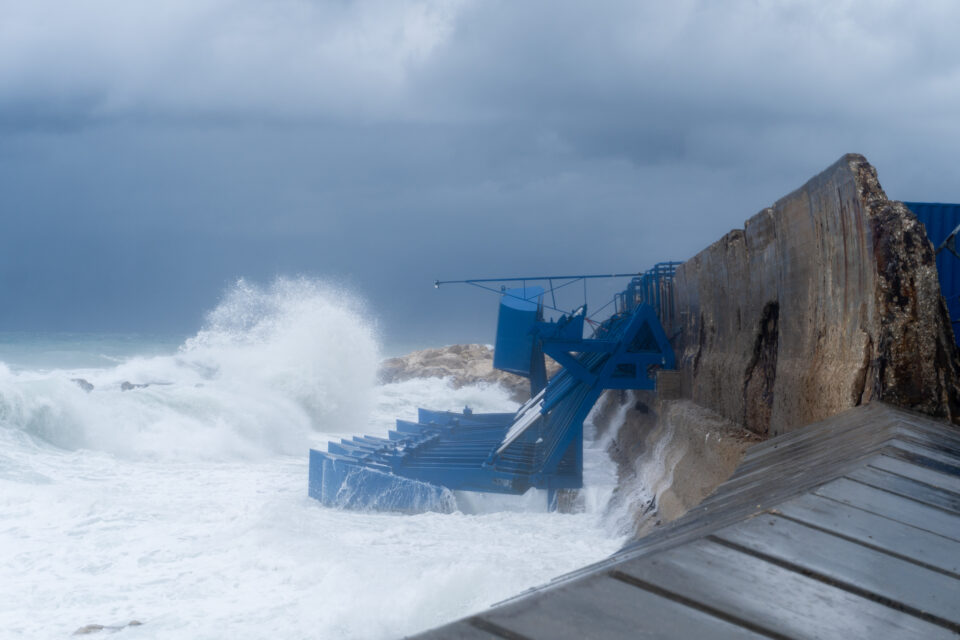
In the U\.S\. alone, wave energy could produce over 60% of annual energy consumption, according to the Energy Information Administration\.
It all starts with floaters — noninvasive floating infrastructure attached to breakwaters or sea walls to capture the power generated by waves breaking against the shoreline\.
The density of seawater is roughly 800x the density of air, allowing larger amounts of energy to be generated using much smaller devices than wind turbines\.
The next step is managing and distributing that power\. While previous companies faced a bottleneck at this stage — due to having their computer hardware in the floater, leading to potential damages during rough currents — Eco Wave Power puts its computers, sensors, hydraulic conversion and electric parts on land at centers, keeping expensive hardware dry and safe from storms\.
“Wave energy is the least intermittent source of renewable energy,” Braverman said\. “Solar energy — for example — is great, but you have night, winter, cloud coverage and pollution that all impact production\. With wave energy, you can generate around the clock\.”
## **AI Wave Energy Layer Using NVIDIA Omniverse Libraries and Accelerated Compute**
As AI infrastructure expands, energy systems themselves are becoming increasingly intelligent\.
Digital twins of wave patterns and floating infrastructure — built with[NVIDIA Omniverse](https://www.nvidia.com/en-us/omniverse/?utm_source=chatgpt.com)libraries — can simulate wave conditions, structural behavior, deployment configurations and operational scenarios before physical installation begins\. These virtual environments can help optimize engineering decisions, reduce deployment risk and accelerate infrastructure planning\.
[https://blogs\.nvidia\.com/wp\-content/uploads/2026/06/EWP\-project\-and\-digital\-twin\-from\-NVIDIA\-Keynote\.mp4](https://blogs.nvidia.com/wp-content/uploads/2026/06/EWP-project-and-digital-twin-from-NVIDIA-Keynote.mp4)
At the operational layer, NVIDIA accelerated computing and AI technologies enable real\-time optimization of wave energy systems through predictive analytics, anomaly detection, environmental forecasting and predictive maintenance\. AI models can continuously analyze ocean conditions, equipment performance and energy generation patterns to improve efficiency and operational resilience\.
AI can also orchestrate energy\-aware computing infrastructure by aligning energy\-intensive workloads with periods of stronger renewable generation and dynamically optimizing power utilization across distributed systems\.
## **Ocean Powered Data Centers on the Horizon**
Eco Wave Power operates projects in Jaffa Port, Israel, created in collaboration with EDF Power Solutions and the Israeli Energy Ministry, and in the Port of Los Angeles, developed in collaboration with AltaSea and Shell\. Eco Wave Power is also developing new projects in Portugal at the Port of Leixões, Suao Port in Taiwan, and Mumbai, India, with Bharat Petroleum\.
Wave power has already demonstrated its ability to handle consumer energy needs — and is now showing potential to support data centers\.
“We have a possibility to link AI factories directly to wave energy, because a lot of data centers are moving toward the coast,” Braverman said\. “They need cooling and water, so they’re now located in ports\.”
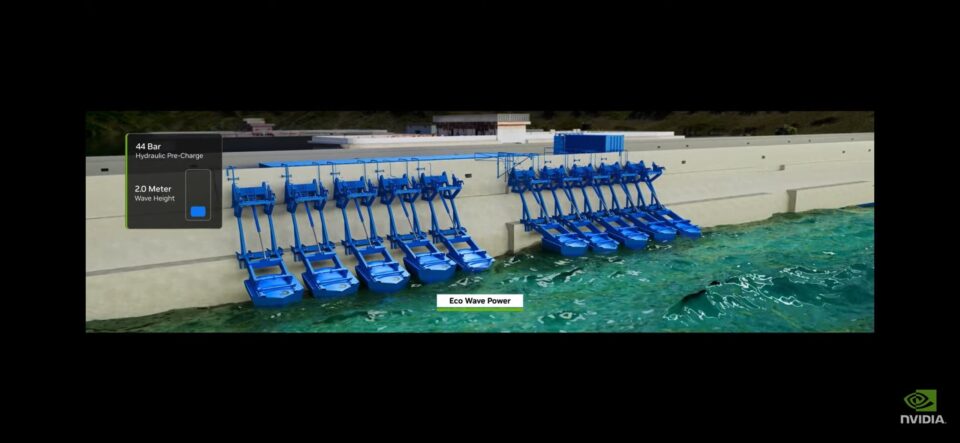
Pilots are already underway at the port of Los Angeles to showcase how wave energy can be the sole power source for a data center without tapping into the existing grid energy\.
AI software serves as the control layer for this data center pilot, planning compute tasks based on the available power supply\. For example, the software can monitor and predict when waves will be stronger throughout the week based on weather patterns — and accordingly allocate more intensive compute tasks for these periods\.
“We exist, we work, we’re grid connected and we have so much of this resource,” Braverman said\. “The energy is needed now, so I think we’re in the right place at the right time and we’re innovative, but we’re not futuristic, and that’s what sets us apart\.”
*Explore how NVIDIA is driving the*[*future of energy*](https://www.nvidia.com/en-us/industries/energy/)*\.*
NVIDIA and Emerald AI unveiled a collaborative approach at CERAWeek to treat AI factories as flexible grid assets, improving energy efficiency and grid reliability through intelligent power management. The initiative partners with major energy companies to optimize AI workload operations based on grid conditions while maximizing tokens per second per watt.
At New York Climate Week, NVIDIA showcases five companies using AI technologies to advance clean energy projects, including optimizing power grids, improving nuclear plant operations, and creating off-grid power solutions for AI factories.
NVIDIA explains how optimizing power management for AI factories using DSX Flex and partner platforms can boost efficiency, with Lambda validating a 24% throughput increase on a fixed power budget.
At the AI Infra Summit, NVIDIA showcased advancements in Vera Rubin and DSX Platform, focusing on energy efficiencies and optimizing tokens per watt for AI factories through new collaborations and technologies.