The AI Billboards Are Killing SF
摘要
An opinion piece argues that cryptic AI billboards blanketing San Francisco are psychologically damaging and alienating residents, making the city feel like it belongs to AI insiders rather than the community.
暂无内容
查看缓存全文
缓存时间: 2026/08/07 17:11
# The AI billboards are killing SF
Source: [https://sfstandard.com/pacific-standard-time/2026/08/07/sf-ai-billboards-dystopian-not-funny/](https://sfstandard.com/pacific-standard-time/2026/08/07/sf-ai-billboards-dystopian-not-funny/)
At some point last year, I stopped reading half the advertisements I saw around me in San Francisco\. They made me feel crazy\. And confused\. If I thought too much about them, they made me angry\. And I don’t have time to feel anger; I gotta hustle to pay my mortgage and raise my kids and try to cling to some semblance of[joy](https://sfstandard.com/pacific-standard-time/2026/01/30/pst-live-joy-in-2026/)\.
In most cities, outdoor advertising tries to sell you something you might need: online classes, a personal injury attorney, God\. In San Francisco, however, the words are nonsense\. “Your agents need agents\!” “Own your inference\.” “Book your hotel on the moon with[gru\.space\(opens in new tab\)](http://gru.space/)\!”[The SF Standard](https://sfstandard.com/2026/02/06/confusing-101-billboards-san-francisco/)and[The New York Times\(opens in new tab\)](https://www.nytimes.com/2025/08/04/business/tech-billboards-are-all-over-san-francisco-can-you-decode-them.html)have run quizzes trying to decipher these ads\. Whatever they mean, they are not selling something that I, or my neighbors, can buy\. They are, instead, riddles aimed at a tiny subset of AI insiders\.
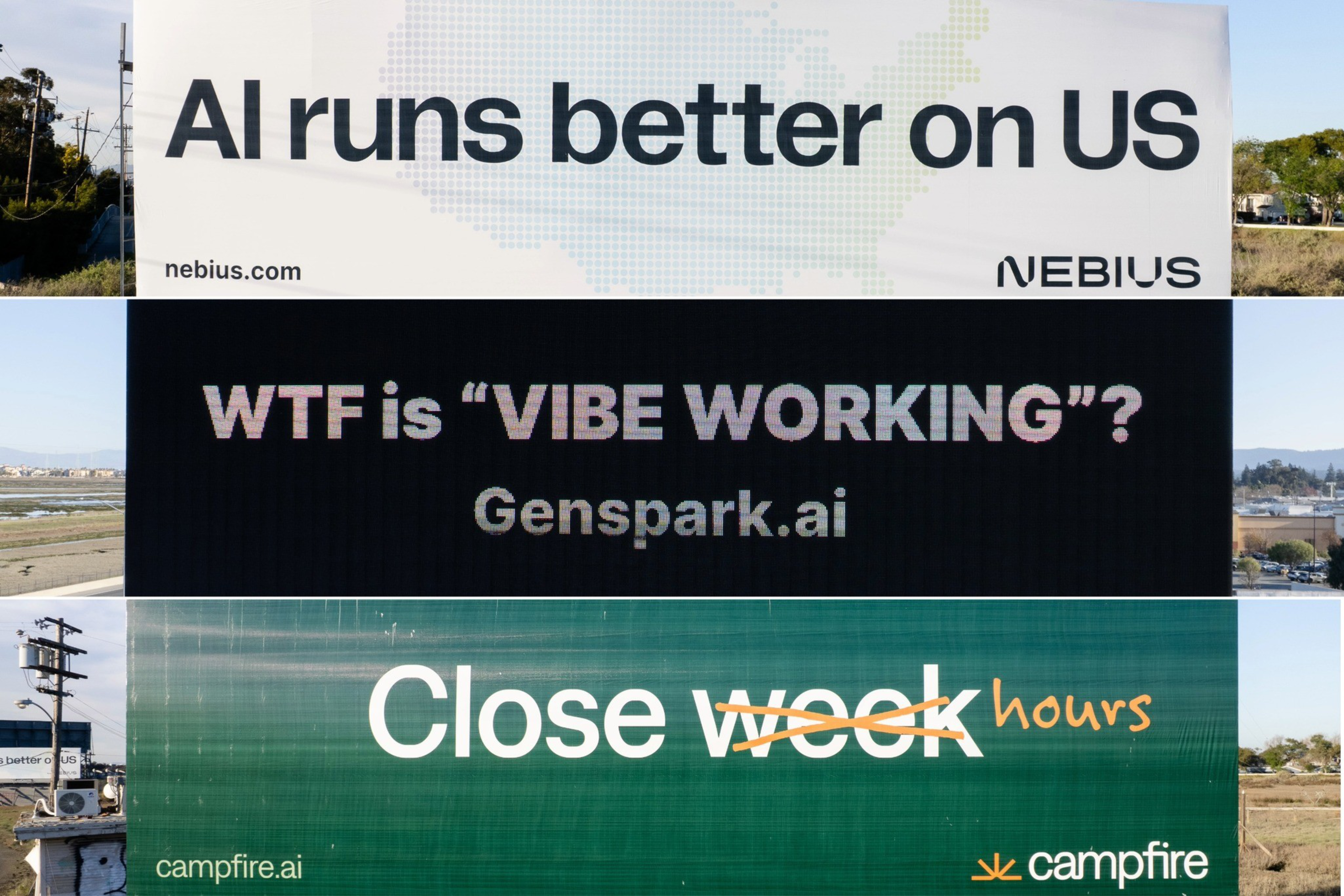
Tech billboards along Highway 101 South\.\|Source:Jungho Kim for The StandardFor the past few years, these lame, inane cryptograms have become a favorite target of jokes\. Ha ha, the articles and social media posts go, I have no idea what the words in San Francisco mean\! Isn’t that funny?
Guys, no\. It’s not funny\. I have come to the conclusion that they are doing some real psychological damage to us as a community\. And they are becoming part of our city’s identity in a way that makes me sad\.
San Francisco has always been a place that called to people: Come here, and you can be yourself\! This can be your home\! But now our city is blanketed in words that send the opposite message: There is a conversation happening here, and you are not a part of it\.
These ads say so little and yet so much\. They are inscrutable, but the message is clear: The city we built and live in is not for us anymore; it’s for someone more valuable, someone who’s in on a joke the majority can’t understand\. And more than that, they force us to accept a level of meaninglessness in our lives that further isolates us from one another and from our city itself\.
Ads in a city, for better or worse, tell us about the constructed and shared identity of the place\. When I lived in Hartford, Connecticut, for a few years around 2003, the billboards along the highway read, “Hartford\. It’s not that bad\!” — a nod to the fact that it suffered from a reputation as an underdog city with no real economic or cultural impact but in reality was a nice place to live\. The billboards in San Francisco aren’t rallying any kind of communal, or even commercial, pride — they’re essentially nihilistic, broadcasting a loss of meaning and identity in our city in general\.
Over the past year, I’ve had this gnawing sense that these ads are hurting us in ways we have a hard time seeing, because we are too close to it\. This was driven home clearly when the AI pendant Friend began advertising in New York last year, and the ads very quickly[were defaced by New Yorkers\(opens in new tab\)](https://www.nytimes.com/2025/10/07/style/friend-ai-subway-ads-new-york.html)who felt insulted by them, who felt they were an anti\-human imposition on the surfaces of their city\. Meanwhile, in SF, those ads had been on bus stops and elsewhere for months with little more than an eyeroll in response\.
The more I’ve stewed on this, the more I’ve decided that the billboards are a symptom of how deeply alienated some in San Francisco have become\. Sociologists define “alienation” as the collective feeling of isolation, normlessness, powerlessness, meaninglessness, and self\-estrangement\. AI ads provoke all of those feelings in me\.
And I know I’m not the only one: Most tech workers I know don’t understand the AI ads in the city\. What’s more, many AI workers don’t even understand the technology they are building because, by its nature, it’s a black box\.
- [https://sfstandard.com/2026/08/06/wiener-built-ai-chatbot-mock-chan-s-politics-pelosi-says-s-sexist-racist/](https://sfstandard.com/2026/08/06/wiener-built-ai-chatbot-mock-chan-s-politics-pelosi-says-s-sexist-racist/)[https://sfstandard.com/2026/08/06/wiener-built-ai-chatbot-mock-chan-s-politics-pelosi-says-s-sexist-racist/](https://sfstandard.com/2026/08/06/wiener-built-ai-chatbot-mock-chan-s-politics-pelosi-says-s-sexist-racist/) ### [Wiener built an AI chatbot to mock Chan’s politics\. Pelosi says it’s ‘sexist’ and ‘racist’](https://sfstandard.com/2026/08/06/wiener-built-ai-chatbot-mock-chan-s-politics-pelosi-says-s-sexist-racist/)
- [https://sfstandard.com/pacific-standard-time/2026/08/05/four-lessons-marina-safeway-housing-battle/](https://sfstandard.com/pacific-standard-time/2026/08/05/four-lessons-marina-safeway-housing-battle/)
- [https://sfstandard.com/2026/08/04/sf-ai-hype-fake-chatbot-billboard/](https://sfstandard.com/2026/08/04/sf-ai-hype-fake-chatbot-billboard/)[https://sfstandard.com/2026/08/04/sf-ai-hype-fake-chatbot-billboard/](https://sfstandard.com/2026/08/04/sf-ai-hype-fake-chatbot-billboard/) ### [The billboard promises a new AI chatbot\. It’s really just one guy typing](https://sfstandard.com/2026/08/04/sf-ai-hype-fake-chatbot-billboard/)
“The more we become alienated from the actual tangible creation and production of things, the more we also become alienated from ourselves, because we become commodities — our labor bought and sold and objectified,” said sociologist Seth Abrutyn of the University of British Columbia\. “The goal of \[AI\] technology is to further alienate people from their productivity\.”
What’s so crazy\-making about these ads is that they are selling a product that alienates us from our own labor and does so in a way we can’t fully understand\. No wonder we don’t know how to feel about them\.
So many people in San Francisco depend on tech for their livelihoods that a kind of paralysis sets in, Abrutyn surmises\. “There is a full\-scale effort to create inevitability,” he says\. This leads to a sense of powerlessness, the idea that AI is coming for us no matter what\. In that way, the billboards are the physical imposition of what looks like a foregone conclusion onto the surfaces of our shared world\. In that sense, the ads aren’t just a dismissal of our identity; they’re a threat: The future will be meaningless, built for and owned by someone else, and there is nothing you can do about it\.
When I drive home along I\-280 and see the “[AI dread?”](https://sfstandard.com/2026/07/24/ai-dread-billboards/)company advertising next to the human\-made “Dream” installation, I feel what Emile Durkheim called “anomie\.” I’m untethered from meaning and place, lost at sea\. Also, just annoyed\. I don’t want to be forced to look at this slop\.
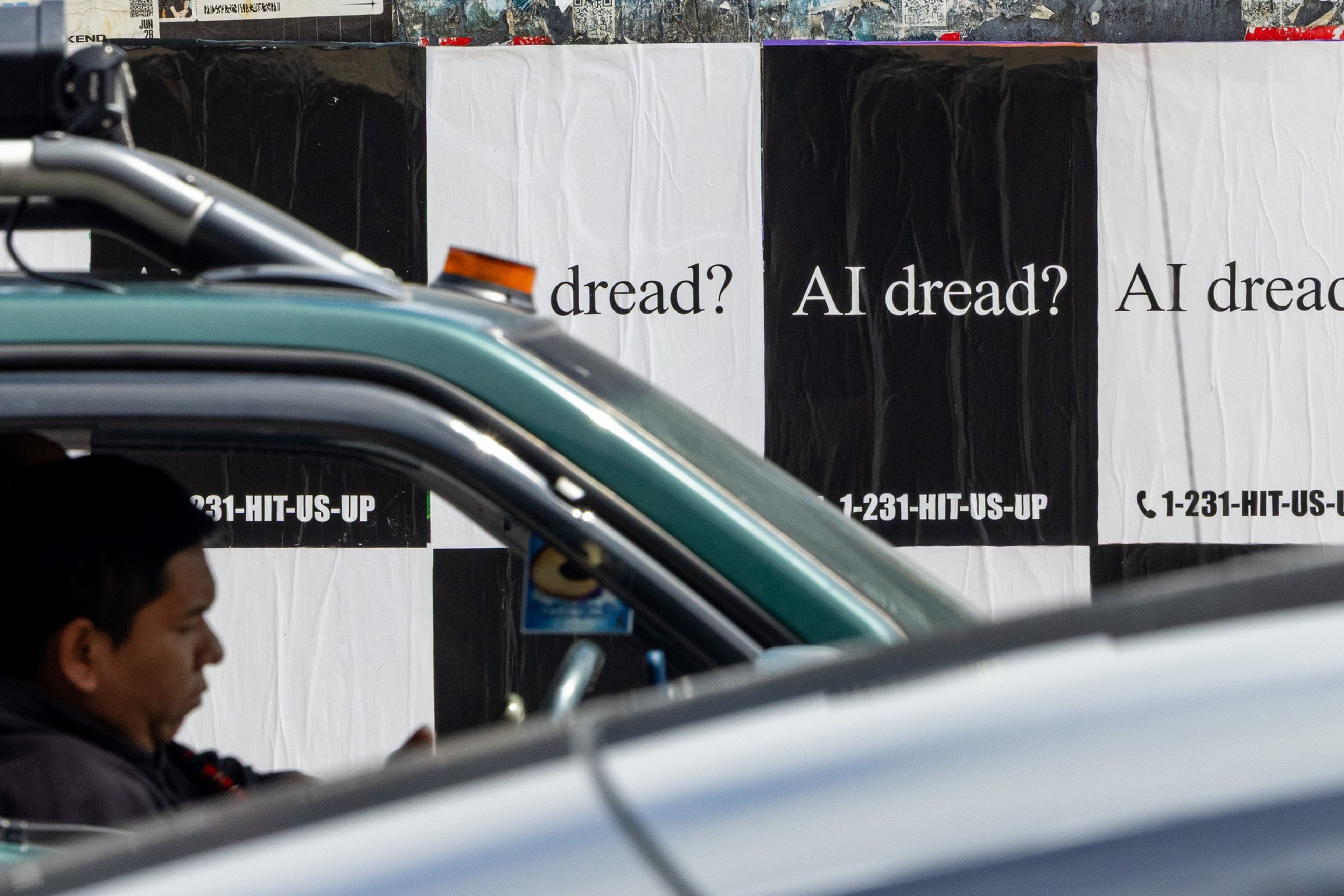
“AI dread” posters put up by Notion are visible in San Francisco’s SoMa neighborhood\.\|Source:Morgan Ellis/The StandardIn my experience, the billboards train us to blur our eyes\. But this, in turn, trains us to stop noticing the world — to stop taking in the landscape, the built environment that is meant to be for us\. And paradoxically, this makes us less able to see — and noticing is everything\. As I’ve learned over many years of making art and writing, noticing the world is what makes you able to bear it and find the beauty in it\. When you stop looking, you stop participating\. When you stop participating, the city is no longer yours\.
This week on “[PST with Emily Dreyfuss](https://sfstandard.com/pacific-standard-time/),” I speak to three people who, unlike me, are refusing to avert their eyes and are taking more direct — and hilarious — action against these ads\. They are sick of feeling left out, crazy, confused, and annoyed\. How are they fighting back? With jokes, one of which costs $6,000 a month\. But boy, is it worth it\.
More about theauthor
- Emily Dreyfuss is the culture editor at The Standard and the co\-host of Pacific Standard Time\.
相似文章
@bitcoinpolicy: 山姆·莱曼为@garryslist撰写了专栏文章:《扼杀美国人工智能的运动始于旧金山》。文中他详述了……
一篇专栏文章和比特币政策研究所的报告称,包括来自上海捐赠者在内的外国资金正在资助美国人工智能数据中心的基层反对运动,导致数十亿美元的投资被推迟。文章详细描述了旧金山湾区及其他地区旨在减缓美国人工智能建设的协调行动。
你的AI使用正在让我大脑崩溃
Jason Koebler 探讨了在充斥着 AI 生成内容的互联网中浏览所付出的心理代价,并创造了“僵尸互联网”一词,用以描述人类、机器人与 AI 智能体在网上互动时那种复杂且令人疲惫的混合状态。
AI、“人性”与曼哈顿博士症候群:一场传播干预
一篇评论文章,批评那些宣称关心抽象‘人性’却忽视真实个体的AI高管,以曼哈顿博士的原型比喻这种脱节。
我受够了“AI 一切”
Hacker News 上的讨论,用户们对 AI 的泛滥表示厌倦,并将其与社交媒体倦怠相提并论。
AI营销反噬:为何'AI优先'品牌开始遇冷
文章探讨了消费者对AI生成营销内容日益增长的反感,以可口可乐情感空洞的AI假日广告和Meta Advantage+平台用怪异AI替代人工广告为例,指出将AI作为噱头的品牌正在丧失真实性。