Cached at:
06/03/26, 12:35 AM
# LLMs are not the Black Box you were promised
Source: [https://www.jay.ai/blog/llms-are-not-a-black-box](https://www.jay.ai/blog/llms-are-not-a-black-box)
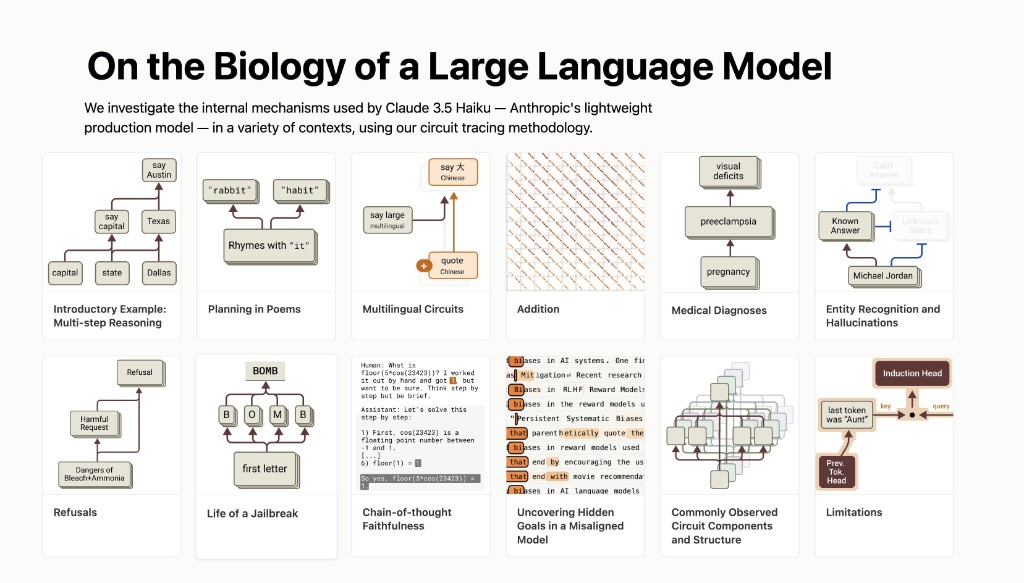
On the Biology of a Large Language Model \(Anthropic, 2025\)LLMs are not the "black box" you were promised\.
Mechanistic interpretability — peering into a neural network to reverse engineer its inner workings — has made major strides\. Anthropic's[*On the Biology of a Large Language Model*](https://transformer-circuits.pub/2025/attribution-graphs/biology.html)\(2025\) is a landmark in that effort\. What follows is a summary of their progress and some related thoughts\.
## What is an LLM actually "thinking"?
How can we understand what an LLM is "thinking"? It's clearly very valuable to do so — it could enable steering model behavior, detecting dangerous intent, and more\.
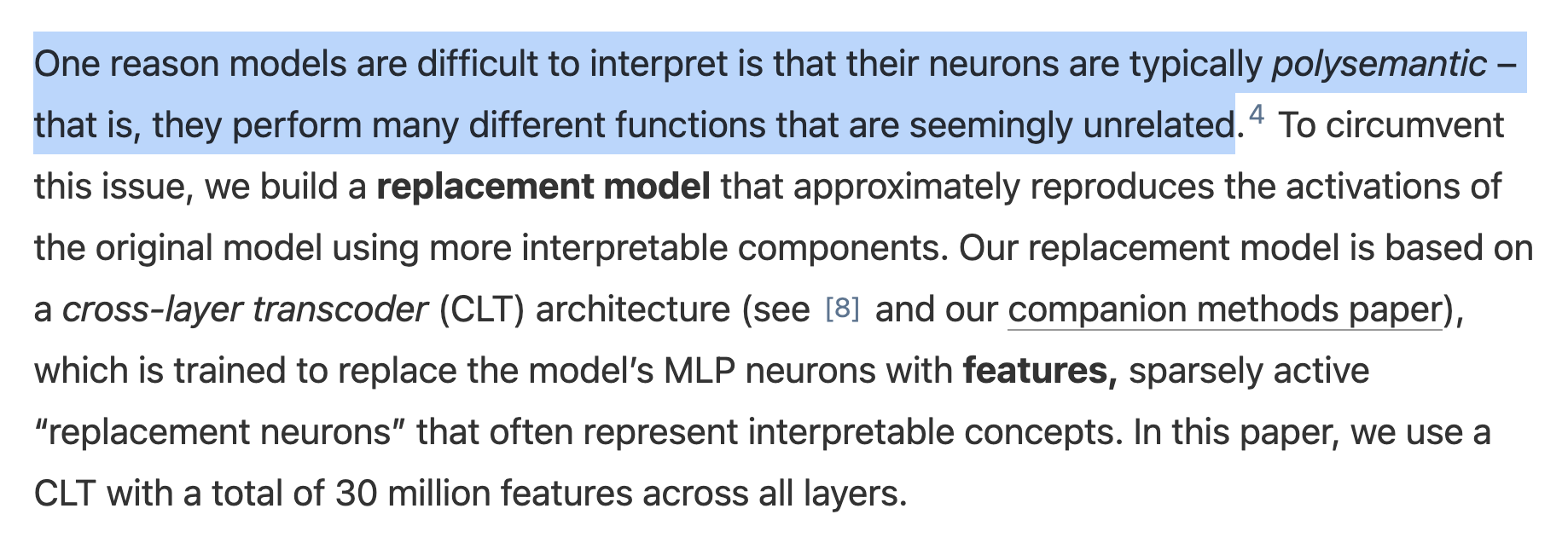
But it's much harder than simply observing individual neuron activations, because of**superposition**: a single neuron participates in many unrelated concepts, and any given concept is smeared across many neurons\. You can't just read meaning off one unit\. You need to get creative\.
## Circuit tracing
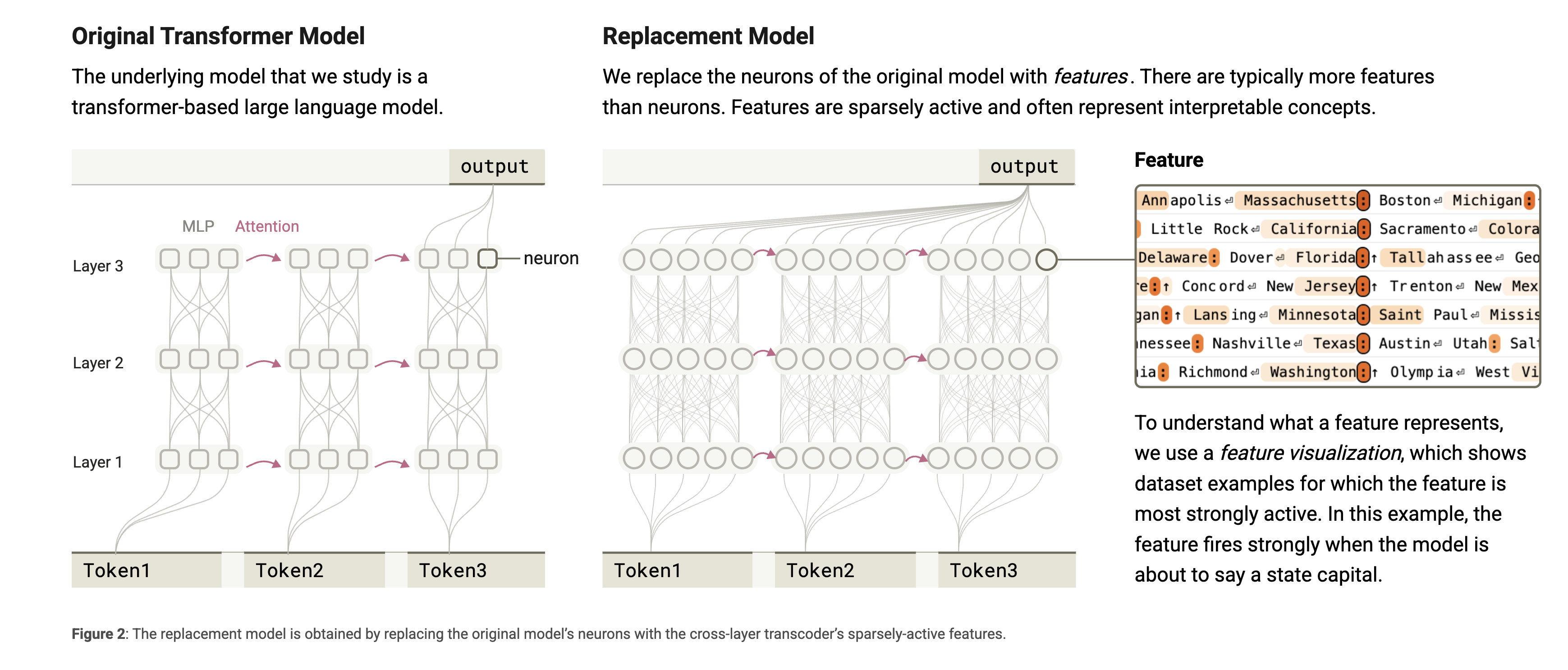
One approach: train a second model to identify discrete concepts, then monitor how those concepts interact over the course of a forward pass\.
Anthropic's**circuit tracing**technique trains a "replacement" model to sparsely recreate the outputs of the base model's MLP layers\. This effectively decomposes the base model's activations into a set of sparse features — and it turns out these features correspond to high\-level concepts that humans can readily identify, like "Texas" or "the Olympics\."
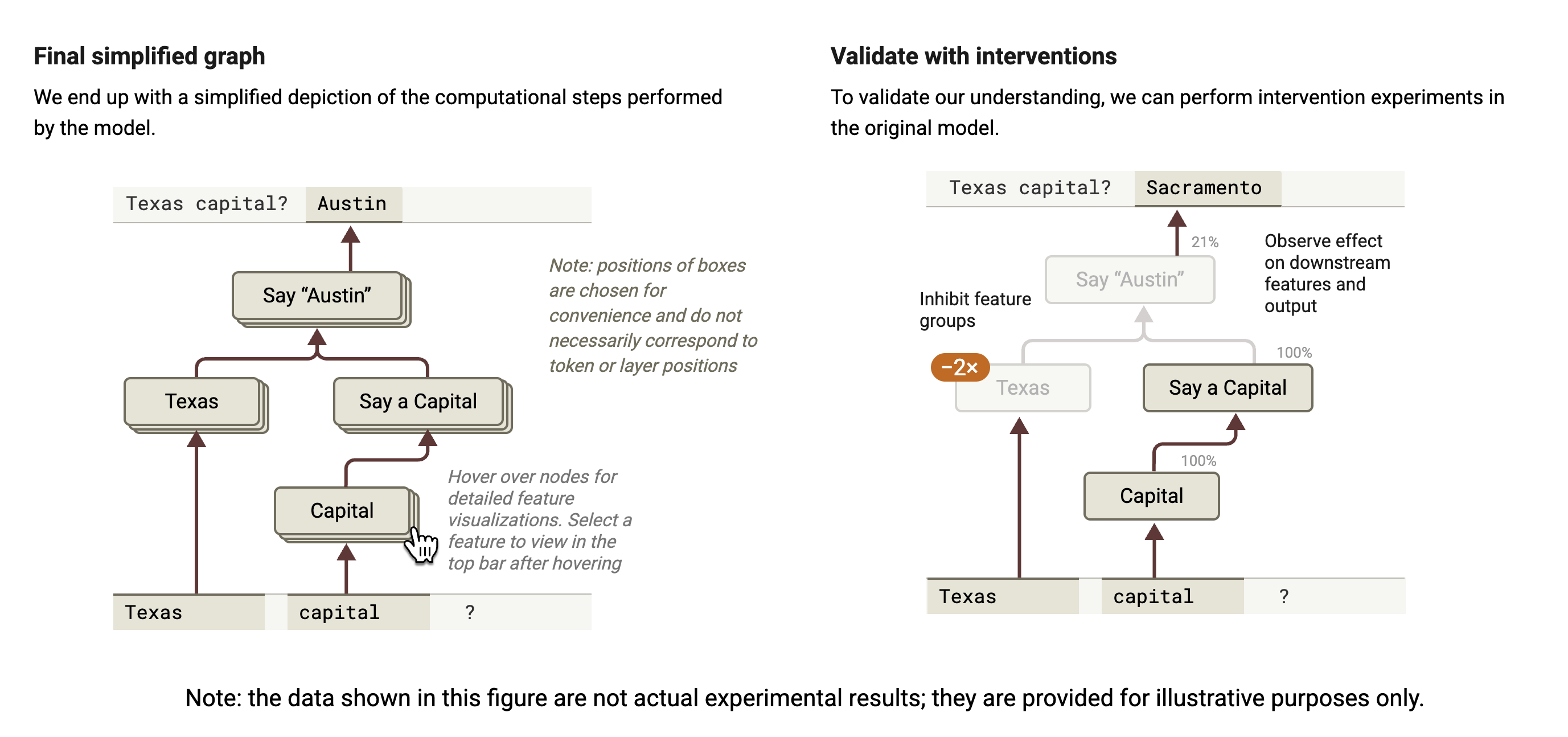
Once you have these human\-interpretable features, you can group them into causally\-linked clusters by tracing how they interact during the forward pass — building up a wiring diagram of the computation\.
## Models really do reason in multiple steps
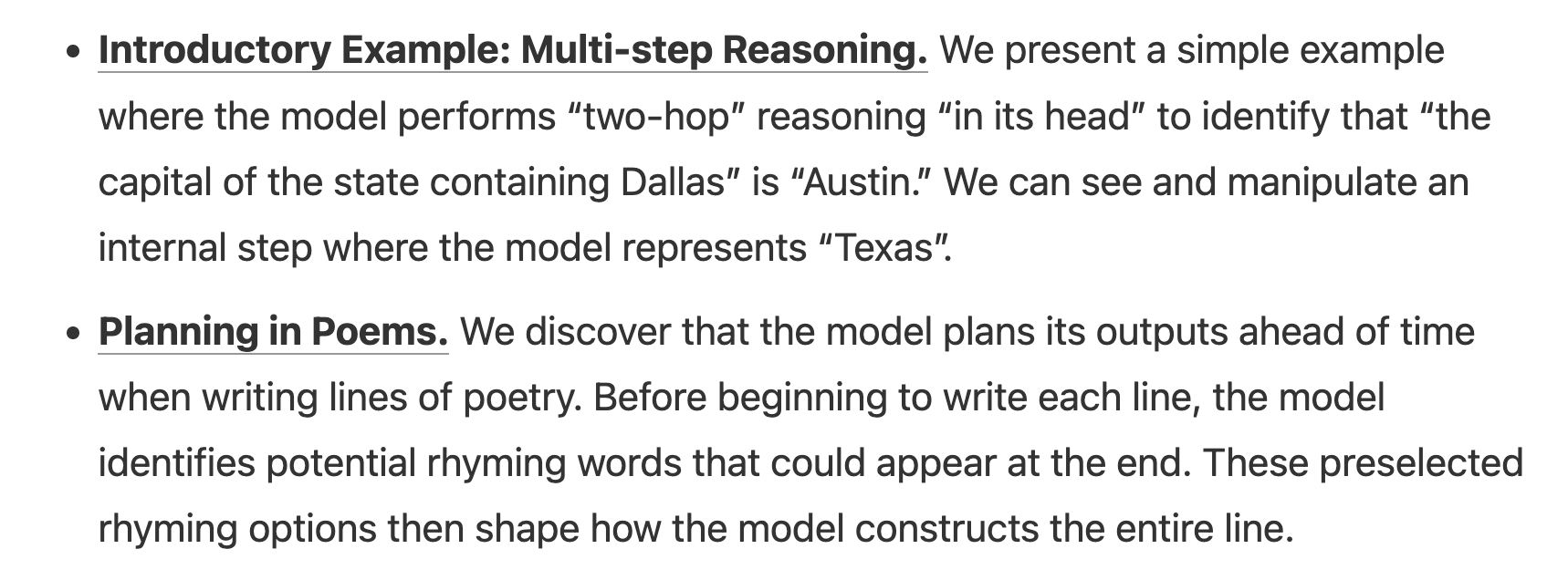
When you run this in practice, you can watch models engage in genuine multi\-step reasoning via intermediary concepts\. The model will even "think ahead" to future rhyme candidates when planning a poem\.
Ask it*"what is the capital of the state containing Dallas"*and you can observe, in order:
- the**Dallas**feature goes active,
- which causes the**Texas**feature to light up,
- which then causes**Austin**to light up\.
It seems fairly clear that this is tracing semantic relationships between high\-level concepts — and in doing so, performing a kind of pseudo\-symbolic inference, similar to what some philosophers would describe as "higher reasoning\."
## This isn't unique to LLMs
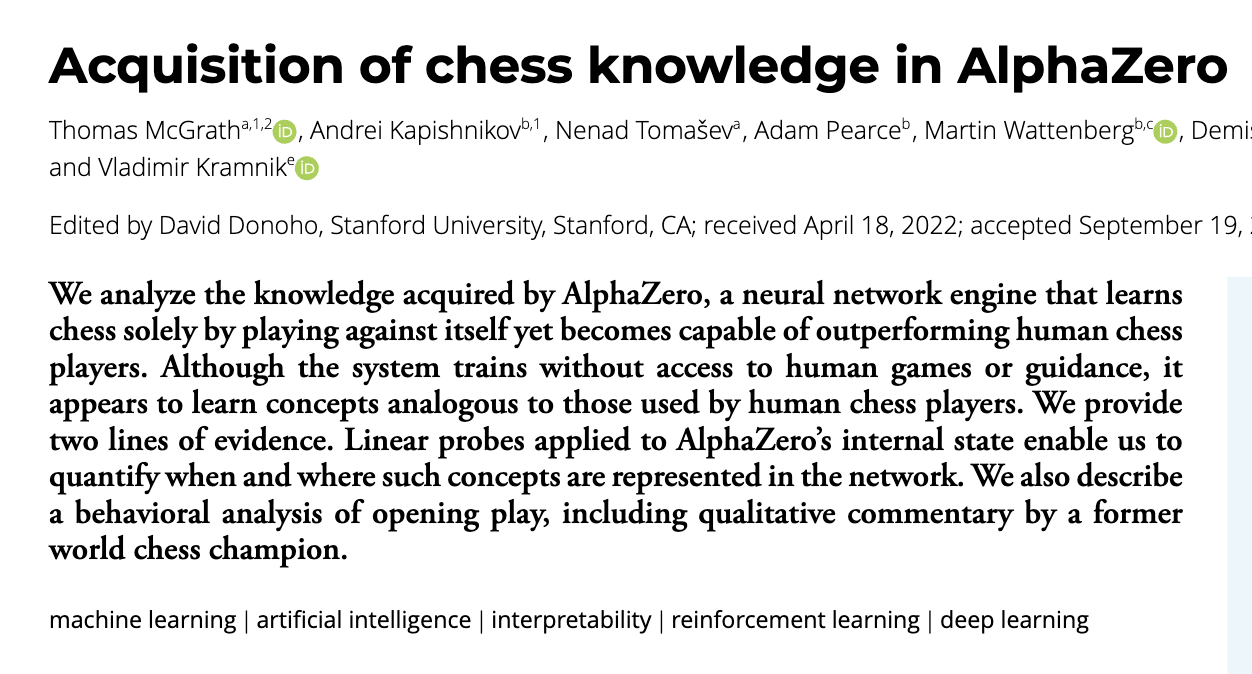
This phenomenon doesn't only apply to language models\. MCTS\-based systems like AlphaZero also converge on concepts that humans recognize\.
DeepMind \(2022\) showed that AlphaZero learned intermediary representations aligning with human chess concepts such as "in check" and "pinning a piece" — entirely on its own, with no human chess knowledge supplied\.
## Better understanding → better algorithms
Breaking down a model's implicit reasoning can help us design better learning algorithms\.
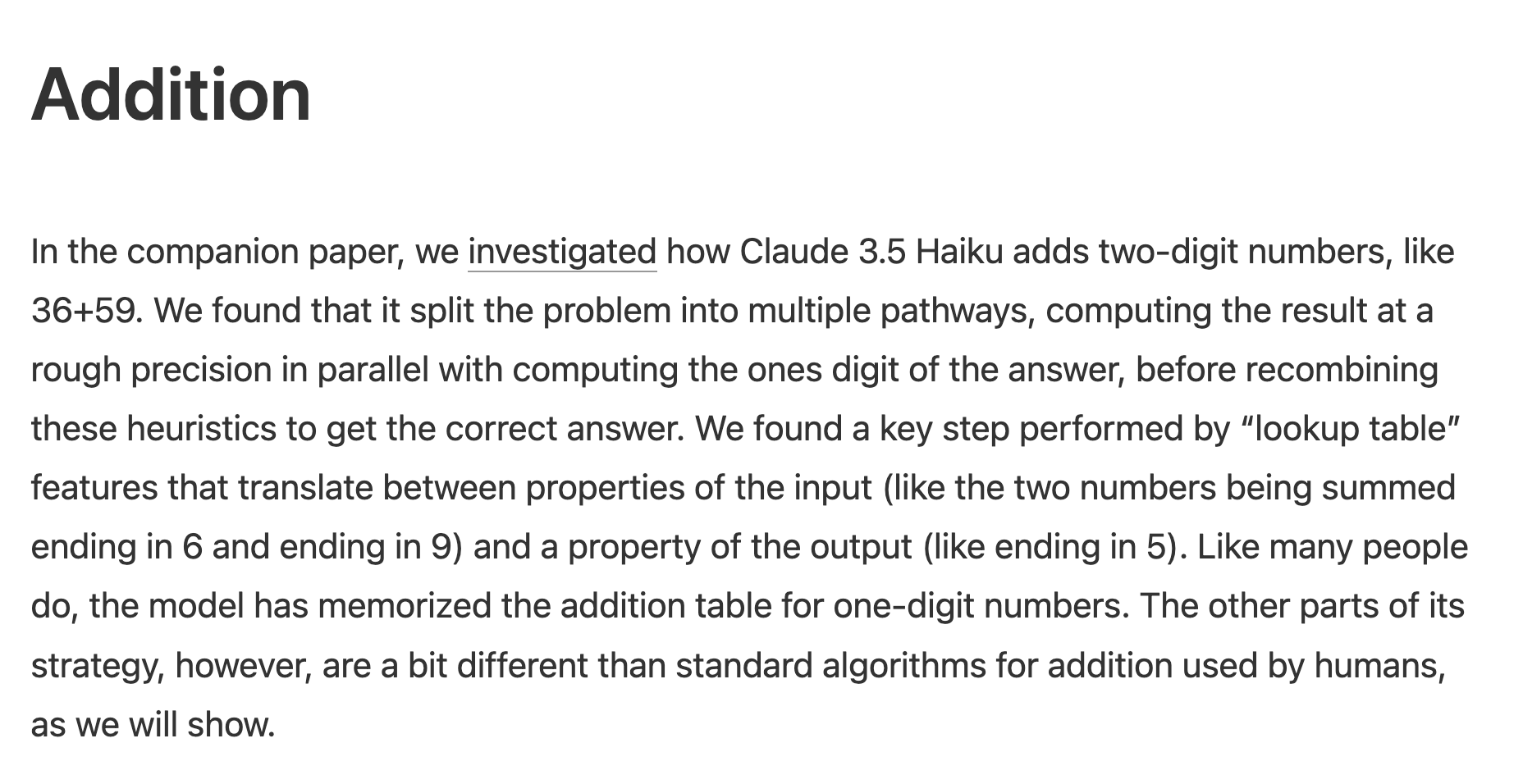
For example: Claude 3\.5 Haiku learned an algorithm for small\-integer addition that does*not*cleanly map to human mental math\. It splits the problem into multiple parallel pathways — computing a rough magnitude alongside the precise ones\-digit — and recombines them, leaning on memorized "lookup table" features\.
The natural question follows: can we identify this, then "guide" the model toward a better algorithm?
## The model has a "subconscious"
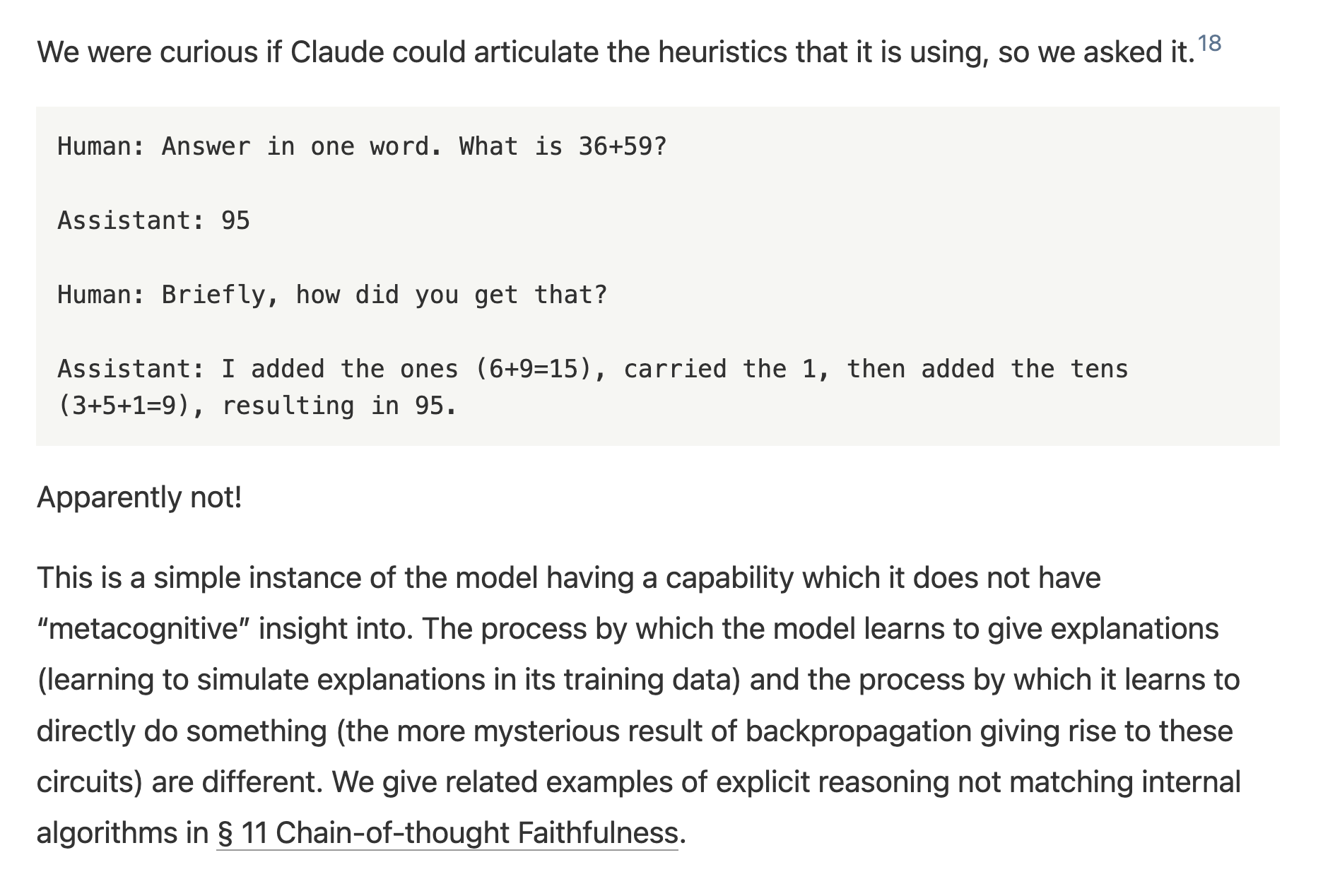
It's worth noting that the model itself does not necessarily have*metacognitive*insight into the underlying thinking process uncovered by circuit tracing\. Ask it to explain how it added two numbers and it will narrate a tidy, human\-style procedure — which is not the algorithm it actually ran\.
For better or worse, the model has some level of subconscious\. And that's precisely what lets us peer in\.
## Why this matters
Mechanistic interpretability is a fascinating, fast\-developing line of work with major Ws on the scoreboard\.
Contrary to what your ML professor may have told you a decade ago, in some ways this is now the*most*insight we've ever extracted from a model\. And the implications are significant — for identifying model misbehavior, for steering, and even for designing better learning algorithms\.
For the original thread, see the[post on X](https://x.com/mathemagic1an/status/2035850046735098065)\. For the full research, read[Anthropic's paper](https://transformer-circuits.pub/2025/attribution-graphs/biology.html)\.
Jay Hack