Google begins reducing Play Store fees as part of its settlement with Epic Games, setting a 5% billing fee for most transactions and expanding the changes globally over time.
<p>Google spent the last few years locked in a legal grudge match with Epic Games, which claimed that Google's stewardship of the Play Store was anticompetitive. Now, the companies are thick as thieves, and Google is beginning to implement app store changes as agreed in its <a href="https://arstechnica.com/gadgets/2026/03/google-and-epic-look-to-bury-the-hatchet-with-new-app-store-settlement/">settlement with Epic</a>. The lower developer fees and new payment options that Google promised are rolling out in select markets this month before expanding.</p>
<p>Until a few years ago, Google followed an Apple-like approach to app store billing, charging most developers a 30 percent commission for transactions in the Play Store. That was the only option, too. Directing users to make purchases outside the store was not allowed, and that's what got Epic in hot water in 2020. Epic added cheaper external billing to the Android and iOS versions of <em>Fortnite</em>, getting the game pulled from both stores and prompting a lawsuit.</p>
<p>Apple managed to (mostly) <a href="https://arstechnica.com/tech-policy/2024/01/supreme-court-denies-epic-v-apple-petitions-opening-up-ios-payment-options/">win its case</a>, but <a href="https://arstechnica.com/gaming/2023/12/googles-android-app-store-monopoly-violates-antitrust-law-jury-finds/">Google tripped up</a> in how it tried to control the Play Store while keeping a more open appearance. The judge in the case was set to impose some <a href="https://arstechnica.com/tech-policy/2024/10/judge-orders-google-to-distribute-third-party-app-stores-on-google-play/">dramatic remedies</a> in 2024, including forcing Google to distribute third-party app stores in Google Play. The settlement, which Google has noted will end its dispute with Epic globally, doesn't go that far. However, developers are about to get the promised fee reductions.</p><p><a href="https://arstechnica.com/google/2026/06/google-starts-lowering-play-store-fees-making-good-on-epic-games-settlement/">Read full article</a></p>
<p><a href="https://arstechnica.com/google/2026/06/google-starts-lowering-play-store-fees-making-good-on-epic-games-settlement/#comments">Comments</a></p>
# Google starts lowering Play Store fees, making good on Epic Games settlement
Source: [https://arstechnica.com/google/2026/06/google-starts-lowering-play-store-fees-making-good-on-epic-games-settlement/](https://arstechnica.com/google/2026/06/google-starts-lowering-play-store-fees-making-good-on-epic-games-settlement/)
[https://cdn.arstechnica.net/wp-content/uploads/2026/06/MM6_Offer-alt-billing.jpg](https://cdn.arstechnica.net/wp-content/uploads/2026/06/MM6_Offer-alt-billing.jpg)[https://cdn.arstechnica.net/wp-content/uploads/2026/06/MM6_Offer-alt-billing.jpg](https://cdn.arstechnica.net/wp-content/uploads/2026/06/MM6_Offer-alt-billing.jpg)[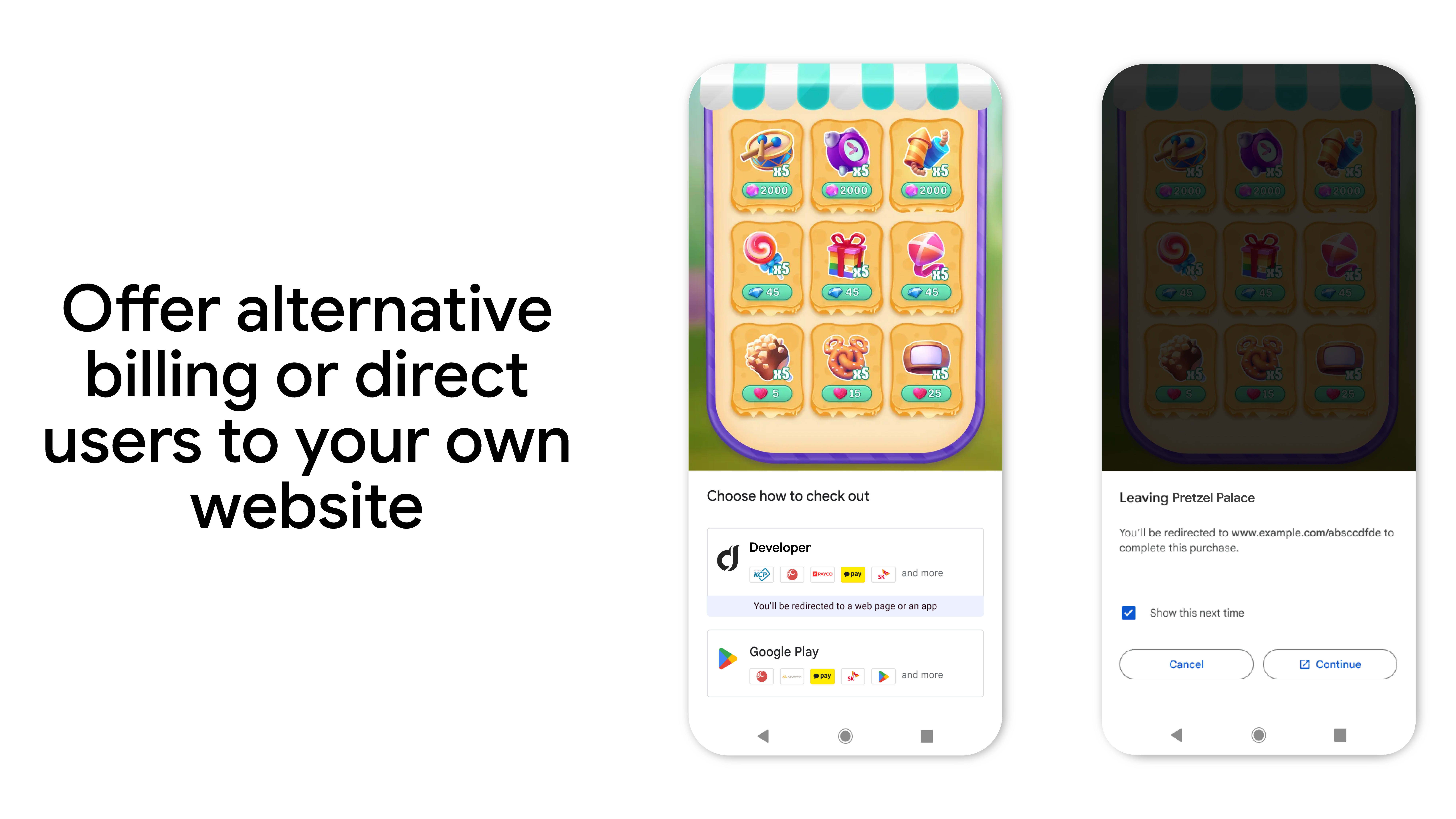](https://cdn.arstechnica.net/wp-content/uploads/2026/06/MM6_Offer-alt-billing.jpg)
Credit: Google
Credit: Google
All transactions that run through Google’s Play Store platform add a 5 percent billing fee—even the base rate for publishers earning less than $1 million\. Google notes that the billing fee is set at 5 percent in the initial markets, but it could be different in other regions\.
## More changes coming
The June 30 start date was stipulated in the settlement for the initial markets, but Google will eventually make these changes global\. Australia will join the new fee structure on September 30, and on December 31, Japan and Korea will be on board\. All other regions will move to the new system on September 30, 2027\.
Google is also working on changes to programs, known as the[Games Level Up](https://play.google.com/console/about/levelup/)and[Apps Experience](https://play.google.com/console/about/programs/appsexperience/), that can offer developers a fee break\. The game program already exists, offering increased Play Store visibility in exchange for implementing more Google Play features\. It will soon include a lower transaction fee, too\.
The Apps Experience program is new and will offer a similar deal for non\-game content in Google Play\. These programs will be available to developers in Europe, the UK, Australia, and the US on September 30 of this year\. They will open to developers in other countries as they are added to the new billing system\.
All in all, these updates will help developers eke out a little more revenue on Google’s platform, but they don’t change the game\. Google is still firmly in control of the Android software ecosystem, and it’s still getting a cut of every sale\. That may change when Google gets around to the next phase of the settlement, which isn’t mentioned in today’s announcement\.
Under the terms of the settlement, Google must also certify third\-party app stores and allow them to operate more like the Play Store on devices\. That may take longer to implement, particularly as Google also begins[enforcing developer verification](https://arstechnica.com/gadgets/2026/06/google-shares-updated-timeline-for-rolling-out-android-developer-verification/)over the coming months\.
Google is rolling out changes to Google Play billing, allowing developers to use alternative payment systems with reduced fees, partially decoupling billing from the app store, in response to antitrust pressures.
Google cuts the price of its AI Plus subscription from $7.99 to $4.99, doubling storage, signaling escalating competition in AI subscription pricing and potential commoditization of AI infrastructure.
Google will pay SpaceX $920 million per month from October 2026 through June 2029 for access to approximately 110,000 NVIDIA GPUs and other components, in a deal similar to SpaceX's recent agreement with Anthropic.
The Hardcore Alliance (Chinese Android phone stores including Huawei, Xiaomi, OPPO, VIVO, etc.) charges game developers up to 50% of in-app purchase revenue, far higher than the 30% standard of Apple and Google, drawing industry attention.
Anthropic is reportedly paying less per GPU than Google for SpaceX compute, with Google paying $920m for 110k GPUs compared to Anthropic's $1.25b for 220k GPUs plus additional capacity, highlighting a significant cost discrepancy.