Cached at:
05/21/26, 06:37 AM
# The third wave of American philanthropy
Source: [https://nanransohoff.substack.com/p/the-third-wave-of-american-philanthropy](https://nanransohoff.substack.com/p/the-third-wave-of-american-philanthropy)
Hundreds of billions of dollars in new philanthropic capital will soon become liquid\. The OpenAI Foundation holds 26% of OpenAI, worth about $220B at today’s valuation\. Anthropic’s seven co\-founders have pledged to give away 80% of their wealth and have instituted the most aggressive donor matching program for employees in tech history\.
How much does this all add up to? And how meaningful is that in the context of philanthropy today?
I was doing some simple napkin math to wrap my head around the scale of what’s coming, and radicalized myself in the process\. I had*dramatically*underappreciated the scale of the philanthropic capital that’s about to become available and the corresponding gap in talent and organizations that will be needed to make the most of it\.
This piece aims to directionally sketch the scale of what’s coming, the gap in operational capacity needed to absorb it, and what we can do to fill it\.
Some directional napkin math suggests that adding up philanthropic pools from just three sources – \(1\) the OpenAI Foundation, \(2\) Anthropic founders, and \(3\) Anthropic employees – translates to an additional ~$37B of intended annual spend:
- ~$370B in total philanthropic assets using today’s OAI and Anthropic valuations: - OpenAI Foundation: Current valuation of $850B \* 26% = ~$220B total\. - Anthropic founders: 7 co\-founders have a combined ~12\-18% of the company, and have pledged 80% of their wealth\. So $900B current valuation \* 13% \* 80% = ~$90B total\. - Anthropic employees: Anthropic has an aggressive philanthropic matching program\.[This source](https://ea-crux-project.vercel.app/knowledge-base/organizations/anthropic-pre-ipo-daf-transfers/?utm_source=chatgpt.com)estimates $20\-$40B in employee DAFs based on a $350B valuation, which has since increased to $900B\. Let’s be conservative and call it ~$60B total\.
- Let’s imagine everyone would like to spend ~10% per year, assuming they can find great things to spend it on\. So, $370B \* 10%= $37B per year\. - Why 10%? Foundations payout on average 5\-9% per year\. DAFs payout on average 20\-25% per year\. So, 10% is pretty conservative by these numbers\.
Of course, this could be lower than expected: OpenAI and Anthropic could stumble \(a la FTX\)\. IPO timelines could slip\. Funders could decide to spend far more conservatively than anticipated\.
But it could also be much higher\. This $37B per year figure is based on*today’s*valuation of OAI/Anthropic and a pretty modest 10% per year spend target\. Let’s say that OpenAI and Anthropic valuations double in a handful of years \(doesn’t seem crazy given their trajectories\), and maybe these donors want to increase their target annual spend from 10% to 15% because they’re especially worried about the AI transition\. This brings us closer to ~$100B per year in target annual spend \(note: I’m using the words*target*annual spend because there are many reasons why*actual*annual spend could be meaningfully lower than this – we’ll discuss those later in the piece\)\.
US charitable giving is around[$600B per year](https://givingusa.org/giving-usa-2025-u-s-charitable-giving-grew-to-592-50-billion-in-2024-lifted-by-stock-market-gains/?utm_source=chatgpt.com)\. Putting this all together:**$37B – $100B of new philanthropic funding,**which would be a 6\-17% increase in annual philanthropic spending relative to today’s $600B/year in the US\.
Practically speaking, a philanthropic ecosystem that can already disburse $600B/year can likely absorb another $50B without much trouble\. The real question is whether there are $50B worth of initiatives that*are compelling to these funders*\. If not, the dollars won’t get spent\.
Just to get a feel for how big $50B/year is, let’s look at a few organizations that are generally well\-respected in these circles \(even if they’re not a perfect match for all funders\)\.
$50B/year could fully fund the annual budgets of the following organizations:
- **6 Gates Foundations**\(~$9B/yr\), or
- **67 Coefficient Givings**\(~$1B/yr\), or
- **100 GiveWells**\(~$500M/yr\), or
- **333 Arc Institutes**\(~$150M/yr\), or
- **5000 Institutes for Progress**\(~$10M/yr\)
Obviously, there are many effective organizations beyond those listed here\. But the takeaway is that**we are*****orders of magnitude off*****from having the great organizations needed to absorb the money that’s coming\.**
So, what types of organizations are needed?
One important input in answering this question is to understand the worldview of this wave of funders, as it informs the types of solutions they’ll be excited to fund\. I’ll do my best to sketch out a few core beliefs of this wave, but it will inevitably be imperfect – both because there’s variation between funders, and because this worldview will evolve alongside AI itself\.
- **Belief 1: AI is fundamentally reshaping civilization and we need to make sure that goes well\.**There are two major questions at hand: \(1\) how do we ensure we make it through the AI transition? And, \(2\) if/once we do, how do we ensure humanity flourishes? The first is more downside\-oriented, concerned with catastrophic or at least major risk \(biosecurity, loss of control, etc\.\)\. The second – human flourishing – is more upside\-oriented\. Flourishing here is broader than the usual short list\. It’s longevity and economic abundance, yes \- but it also extends into aesthetics, civic life, moral imagination, relationships, and the cultural infrastructure that gives life meaning\.
- **Belief 2: Speed matters\. The next X years are critical\.**There’s tremendous concern especially around the group of risks driving question \(1\) described above\. The importance of speed in mitigating these risks is critical if not existential\.
- **Belief 3: Traditional philanthropic orgs and people won’t cut it\. These problems demand tech\-caliber talent and execution\.**Importantly, this new wave of funders grew up in tech and will likely care a lot about the quality of the talent running working on these problems\. I suspect many of them will have an affinity for philanthropic founders who come from tech with excellent track records and by default wary of folks who come from traditional philanthropy\. They’ll also likely expect the organizations they fund to exhibit other startup qualities \(execution speed, creativity, efficiency, etc\.\)\.
To summarize: the reason that $50B/yr is significant is less about the*absolute*amount and more about the fact that it will be aimed at a new type of problem, many of which must be addressed very quickly\.
The talent and institutions needed to solve these problems don’t yet exist anywhere close to the scale required\. This is what we turn to next\.
I want to start by sketching out \- in very broad strokes \- what a philanthropic ecosystem capable of deploying $50B/year might look like\.
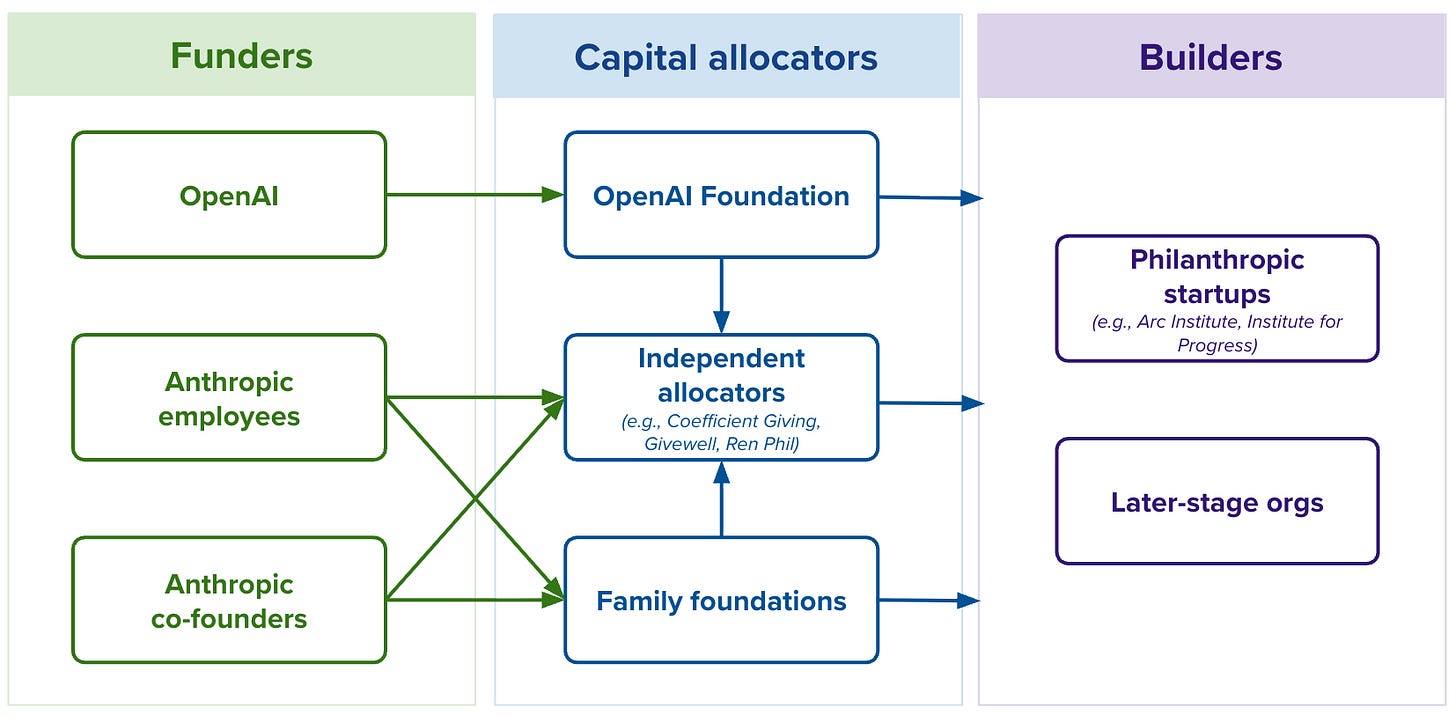
There are three main players in this ecosystem: funders, capital allocators, and builders\. We’ve already discussed funders\. Next, we’ll talk about builders and then capital allocators\.
[](https://substackcdn.com/image/fetch/$s_!twCe!,f_auto,q_auto:good,fl_progressive:steep/https%3A%2F%2Fsubstack-post-media.s3.amazonaws.com%2Fpublic%2Fimages%2F60695681-f621-497c-98f0-ac0374e4b7f7_1654x814.png)
The $50B/year eventually has to make its way to organizations and people who will solve problems in the world\. I’ll call these organizations ‘philanthropic startups’, by which I mean: high\-ambition, talent\-dense organizations designed to solve important public problems with the speed, intensity, and execution of a top technology startup\. I’ll also note that while these organizations*can*be non\-profits, they don’t*have*to be \(on principle, we should try to pick the most capital\-efficient mechanism possible to solve the problem at hand\)\.
We are*really*short on philanthropic startups right now\. And, these startups are created and run by people – meaning we are short those, too\. How short? Let’s look at two different\-shaped organizations as examples:
- **Institute for Progress:**In our $50B/yr scenario, we could fund 5,000 IFPs\. IFP has ~40 employees, so we’d need 200K employees to run these, which is an Alphabet\-worth of employees \(~180K\)\.
- **Arc Institute:**In our $50B/yr scenario, we could fund 333 Arcs\. Arc has ~250 employees, so we’d need ~80K employees, which is a Meta\-worth of employees \(~60K\)\.
Yes, there may be economies of scale as these startups grow, and yes, AI will make things more efficient\.**But the point here is that we don’t need to start ‘just a handful’ of philanthropic startups or recruit ‘just a few’ more people from the private sector\. We are likely short*****hundreds, if not thousands, of philanthropic startups and founders\. And then we’re still short an Alphabet\-worth of employees to power them\.***
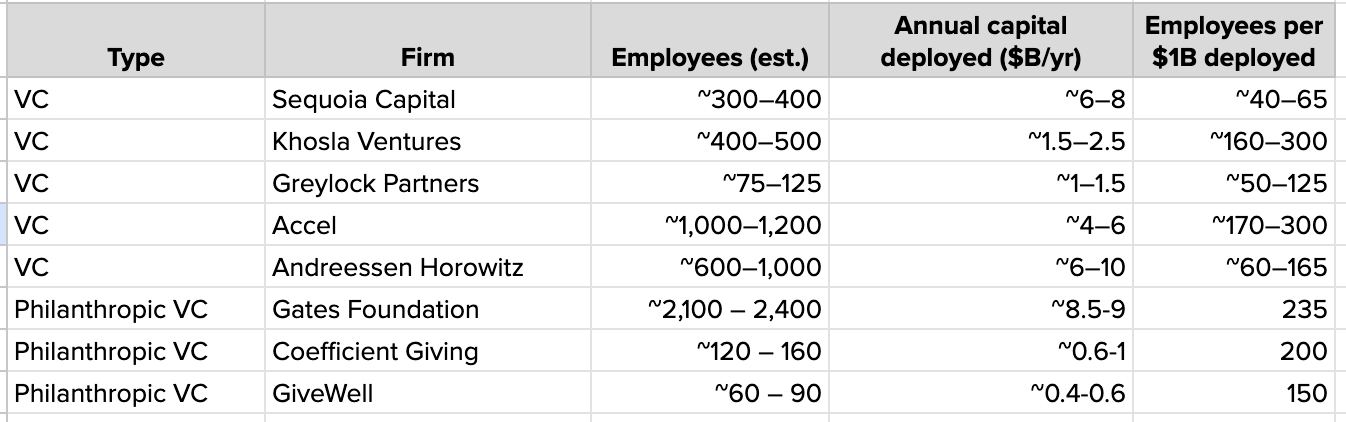
These are the ‘philanthropic VCs\.’ As with premier VCs like Sequoia, these allocators grant money but also bestow credibility and prestige\.
Let’s try to visualize what moving $50B per year might look like, knowing that, at least for a little while, the end recipients will likely skew small\-to\-medium in size\. Again, some napkin math:
- **Number of grants**: Last year, Coefficient Giving deployed $1B via ~1K grants, for an average grant size of $1M\. So, deploying $50B per year, assuming the same average grant size of $1M, means that**collectively****50,000 grants need to get made each year**\. Practically speaking, that’s a*lot*of reading, diligencing, debating, contracting, legal review, and financial operations\. Even if the average grant size goes up over time, the ability to cut big series C checks is premised on the existence of those smaller seed/Series A checks, so the numbers will still be large\.
- **Employees**: We can come at this in a few ways\. To start, we can benchmark the need to premier VCs who, on average, have about 100 employees \(all in\) per $1B deployed \(note that this is more efficient than premier existing philanthropic VCs\)\. This implies that philanthropic VCs might need to collectively hire**another 5,000\+ employees to deploy $50B/yr\. Of course, if average grant size goes up to $10M or $100M on average, employee count would drop to 500 or 50 respectively\.**
[](https://substackcdn.com/image/fetch/$s_!zgGH!,f_auto,q_auto:good,fl_progressive:steep/https%3A%2F%2Fsubstack-post-media.s3.amazonaws.com%2Fpublic%2Fimages%2F4c5a0f96-6eeb-4e55-a338-4003090f8893_1346x422.png)
Now let’s talk more specifically about three types of capital allocators:
**The OpenAI Foundation:**The OpenAI Foundation gets its own category because it’s that significant, representing ~50% of the new philanthropic money we’ve been talking about\. If this becomes liquid soon and they decide they want to target, say 10% per year \(admittedly a lot of ifs\), that would be***$22B per year that a single foundation needs to deploy**\.*This is an enormous operational undertaking\. There are a few strategies they might consider \(and anything in between\):
- **The DIY strategy**\. If they want to deploy directly to philanthropic startups themselves, they’d need to make on the order of ~22K grants per year \(using the $1M/grant benchmark from CG\), and hire ~2,500 employees \(or somehow get really efficient with AI\)\. This is an operationally gigantic task and, as with private\-sector startups, scaling will take time\. They could also decide that they want to write*much*larger checks, but again, that depends on whether enough of those opportunities actually exist\.
- **The regrantor strategy**: Another strategy would be to write much bigger checks to regrantors – essentially other smaller, more specialized capital allocators\. They could, say, give organizations like Coefficient Giving another $1B to double their annual budget\. This means OAIF would need to hire fewer people\. But there simply aren’t a dozen Coefficient Givings out there right now – more would need to be started\.
**Family foundations**: Anthropic founders and early Anthropic employees might decide to start their own family offices\. Alternatively, they might decide they want to give to an independent capital allocator \(e\.g\., Coefficient Giving, Renaissance Philanthropy, GiveWell\)\. It’ll likely be some combination of the two\.
**Independent allocators**: What*does*seem clear is that we will probably need more ‘independent allocators’ if we want capital deployment to scale as fast as we need\. By independent, I mean: they aren’t tied to one capital source \(unlike the OpenAI Foundation or a family foundation\)\. It actually seems quite*important*that more of these exist, in part to reduce the likelihood that deployment becomes single\-threaded on one or a few organizations\. One could imagine this ultimately looking similar to the VC landscape today – there’s a handful of large, elite allocators and a long tail of smaller ones; some are generalists, and others focus on a specific industry or thesis\.
To zoom back out: the shape of what’s needed feels familiar to Silicon Valley decades ago\. Tech built one of the most productive talent\-and\-capital ecosystems in human history\. We now need to do it again, and faster – this time pointed at public goods\.
This can be approached as an ecosystem design question\.
We need to make it easier for great potential founders to know which problems to focus on\. The OpenAI Foundation, Coefficient Giving, Renaissance Philanthropy \(and others\) could publish ‘requests for startups’ in areas they think are important but neglected\. While it’d be great if this comes at least in part from them \(this will reduce the likelihood that founders start organizations that funders don’t actually want to fund\), this can technically come from anyone with insight and vision\. Defining the problems we want solved is no small task, and[vision is in short supply](https://nanransohoff.substack.com/p/what-virtue-is-undersupplied-today)\. We should all take it upon ourselves to think hard about the world we want to live in and what kinds of interventions would increase the likelihood that that world materializes\.
I suspect early on, much of the focus will be on risk mitigation and ensuring the AI transition goes well – AI safety, biosecurity, pandemic preparedness, and so on\. That’s fine\. But, I also hope we don’t lose sight of the more upside\-oriented civilizational endeavors involving civic virtue, public beauty,[moral imagination](https://nanransohoff.substack.com/p/some-thoughts-on-moral-imagination), and the cultural conditions for flourishing\.
**\(a\) Create high\-status on\-ramps for founders\.**Great founders will start great organizations, which in turn will create natural on\-ramps for other great people who want to work at them\. Ultimately, not everyone needs to be a founder\. But the shortage of great philanthropic startup founders is the single bottleneck*today*\. What can we borrow from Silicon Valley? Maybe someone should start a YC for philanthropic startups, informed by the problem areas defined in \(1\) above\. How do we build “PM to[GM](https://nanransohoff.substack.com/p/there-should-be-general-managers)” talent pipelines? Can we systematically help excellent potential founders ramp up in new problem areas by pairing them with subdomain experts? More pointedly: if you work in tech and are thinking about your next thing, consider creating a philanthropic startup\. If you’re on the talent side of startups today – building accelerators, founder communities, talent networks, recruiting pipelines – how can you do that but for public goods?
**\(b\) Figure out how to pay great philanthropic talent well\.**Philanthropy has avoided dealing with this for a long time, but I think we now have to fix this\. If we really believe that the stakes are civilizational, then let’s incentivize the very best people to solve the world’s important problems and then make them rich if they do\. Importantly, the conditions of this wave of philanthropy may make this possible in a way that hasn’t been historically\. A unique property of this wave of is that the sources of philanthropic capital are some of the most highly coveted equity in the world\. Can we figure out a way to pay top philanthropic talent in part with Anthropic or OpenAI equity if they kill it? Imagine funders giving philanthropic startups performance bonuses in the form of Anthropic or OpenAI equity, which founders could distribute to employees via cap tables or some other performance bonus formula\. It feels silly to not chase this down\.
What is the 2x or 10x version of Arc or IFP? They’re at a significant advantage in terms of speed and trust, given they will have a proven track record relative to new philanthropic startups\.
Remember, these capital allocators will have to be able to collectively deploy ~$50B/year\. About*half*of that originates from a single organization – the OpenAI Foundation\. Getting to this scale while maintaining a high bar and doing this at the speed required is not going to happen without a tremendous amount of strategic foresight, operational excellence, and quick adaptation as things on the ground change\. It’s the combination of speed and scale required here is the thing that’s unprecedented\. And if speed really is paramount – which AI funders say it is – this has to be approached differently\. For example, can grant decisions be accelerated 10x with the help of AI? If we approach this the same way we have historically, we will fail\. The risks of trying things quickly here may be high, but the risks of waiting to come up with the perfect plan and having zero tolerance for error are likely higher\.
We’ll need \(potentially many\) more ‘philanthropic VCs’, and we need amazing founders to start those\. The OpenAI Foundation, Coefficient Giving, or even individuals from Anthropic could help seed these organizations today\. Convince your smartest VC\-shaped friend to go start one of these and seed them with a bunch of money\. Then*they*can be the ones making the problems of their subdomains legible and recruiting great founders to start startups\. This is an ecosystem\-expanding move that can be done today\.
About 30% of the total funds come from Anthropic employees\. Some of them might start a family foundation, but many won’t\. These folks need really low\-friction ways to give\. Maybe they’ll just give to Coefficient Giving, but many want to split between multiple managers\. Someone should spend time with these folks to understand what would be helpful to them, and then build that\. There’s possibly an opportunity for a very user\-friendly product/software/platform here\.
Venture capital works in large part because of risk appetite and power laws — we’re willing to tolerate lots of failures for gigantic outcomes\. In philanthropy, risk appetite has historically been much lower and this has also likely limited outcomes\. New funders can change that\.
Speed plays an unusually central role in this wave of philanthropy\. A core belief of these funders is that the next decade will matter enormously for civilization, given the pace of AI progress\. This means that the institutions needed to shape the next decade have to be operational very soon\. But building takes time – it takes time for talented people to leave their jobs, build conviction in a new problem, raise capital, recruit a team, and learn to operate at scale\. The next 12\-18 months will matter disproportionately for whether this ecosystem reaches meaningful size fast enough to matter\. Founders of philanthropic startups and new capital allocators need to start now, not in two years\.
Even under the most optimistic scenarios, the buildout will be lumpy\. Capital allocator capacity will lag at first; then the constraint will shift to a shortage of fundable organizations, then to a shortage of talent, then to whatever bottleneck shows up next\. Ecosystem\-building is lumpy in the best of times, and even lumpier when it has to be done fast\. That’s what we should expect, and we just have to navigate through it\.
This is the third time in roughly 150 years that a transformative technology has produced wealth at this scale and concentrated it in the hands of a relatively small number of people and organizations who want to give most of it away\. Putting this wave in context can give us clues about where we’re building from and what will likely need to evolve\.
The first wave of American philanthropy \(~1880\-1930\) came out of industrial fortunes\.Carnegie and Rockefeller took the unprecedented wealth of the Second Industrial Revolution and built the institutional substrate of modern civic life – the perpetual foundation, the research university, professional medical education, and the public library\. They invented the infrastructure of American philanthropy as we know it\.
The second wave \(~1990\-2020\) came from software and internet wealth\. Gates – amplified by Buffett and others through the Giving Pledge – helped drive one of the largest declines in extreme poverty and child mortality in human history\. The effective altruism movement gave us important frameworks and tools to allocate limited resources across an even more diverse range of domains, and do so in the most cost\-effective ways\. Broadly speaking, this wave gave us the practice of treating philanthropy as a serious operating discipline\.
The third wave of American philanthropy \(2026\-\) is starting now, funded by wealth from AI\. The questions it must grapple with are civilizational in scale and scope\. How do we navigate a minefield of risks associated with navigating the AI transition? And if we do that successfully, how do we ensure all of humanity can benefit from the abundance that AI could create?
We should be conscious that we are entering this wave with an affinity for the measurement\-oriented tools that defined Wave 2\. These will be poor fit for some of the questions that will matter most in Wave 3\. This isn’t an attack on those tools; they’re among the best things philanthropy has ever produced\. But they weren’t designed for questions of civilizational flourishing, meaning, and what makes a life good – all of which Wave 3 will eventually need to grapple with\. We’ll need to get comfortable broadening our decision making tools to include squishier instruments like taste and good judgement to have the best shot at answering these\.
To summarize, the opportunity for good created by this new wave of wealth is enormous\. So is the gap in talent and institutional capacity needed to realize that opportunity\. What we do in the next 12\-18 months will be tremendously consequential in determining what does or does not come from this new wave\.
#### Discussion about this post
### Ready for more?