Cached at:
08/26/26, 06:18 PM
# Access to Urban Woodlands Linked With Lower Use of Antidepressants
Source: [https://e360.yale.edu/digest/scotland-woodlands-antidepressants](https://e360.yale.edu/digest/scotland-woodlands-antidepressants)
[](https://yale-threesixty.transforms.svdcdn.com/production/Dunain_Dunain.jpg?w=1200&h=800&auto=compress%2Cformat&fit=crop&dm=1787745588&s=3b8f04a143eb1295fe4c13a2c1960b73)
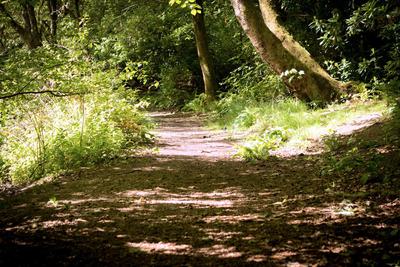
Dunain Community Woodland in Inverness, Scotland\.Dunain Community Woodland
A study from Scotland found that living near an accessible urban woodland significantly lowered the likelihood of being prescribed antidepressants\.
The research focused on Scotland’s Woods In and Around Towns[program](https://www.forestry.gov.scot/woods-and-around-towns), which aims to plant, restore, or protect woodlands in deprived neighborhoods and make them accessible to the public by installing signs, trails, and walking paths\. Launched in 2005, the WIAT program has revitalized nearly 30,000 acres of urban woodlands\.
From the beginning, one of the central aims of the program has been to improve mental health\. To gauge its success, researchers at the Universities of Edinburgh and Glasgow tracked more than 129,000 people across Scotland over five years\. They found that when people moved to within a 10\-minute walk of a WIAT woodland, their odds of being prescribed an antidepressant dropped by 10 percent, while their odds of being prescribed anti\-anxiety medication dropped by 6 percent\.
“Our results tell us that relatively modest investments in local green spaces can make a real difference to people’s mental health,”[said lead author](https://www.ed.ac.uk/news/woodlands-linked-to-reduced-antidepressant-use)Scott Ogletree of the University of Edinburgh\. The findings were[published](https://www.thelancet.com/journals/lanplh/article/PIIS2542-5196(26)00076-8/fulltext)in*The Lancet Planetary Health*\.
A host of prior studies have found that living near green spaces can[reduce stress](https://www.sciencedirect.com/science/article/pii/S1195103625000059),[improve moods](https://www.psychiatricnursing.org/article/S0883-9417(18)30298-X/abstract), and[lower the risk](https://pubmed.ncbi.nlm.nih.gov/37268208/)of developing anxiety or depression\.[Some](https://academic.oup.com/bioscience/article/65/12/1141/223866?login=false)[research](https://www.sciencedirect.com/science/article/abs/pii/S0169204612002502)has even found that exposure to nature can help reduce violent crime\. In light of the well\-documented benefits of living near green spaces, the World Health Organization recommends urban planners establish at least 1 acre of green space within 1,000 feet of every home\.
## **ALSO ON YALE E360**
[***Ecopsychology: How Immersion in Nature Benefits Your Health***](https://e360.yale.edu/features/ecopsychology-how-immersion-in-nature-benefits-your-health)